




The most basic “win condition” in the stock market is pretty straightforward: You buy a stock, it appreciates in price, and you sell it at a higher price than what you paid for it.
But dividend stocks give you a second way to get ahead. Dividend-paying companies typically distribute cash to shareholders on a regular basis (say, quarterly), and they’ll often do so regardless of the direction their stock is moving. In other words, dividends can pad your gains when your shares appreciate, or they can provide a positive offset against share-price declines.
Because dividend stocks are viewed by many as safer than your average company, some investors are perfectly comfortable holding individual names. But dividend stocks aren’t invulnerable; they can fall victim to the same sudden outside forces that upend other stocks. When that happens, not only can their shares decline … but in particularly bad situations, they may even reduce or suspend those cash distributions.
Diversifying your investment across many dividend stocks can greatly water down that risk, and you can do so easily and cost-effectively by owning dividend exchange-traded funds (ETFs).
Today, I’m going to show you some of the best dividend ETFs for 2026. This list highlights a variety of dividend strategies to better ensure that every investor can find something that suits their needs and risk tolerance.
Editor’s Note: Tabular data presented in this article are up-to-date as of Feb. 6, 2026.
Featured Financial Products
Disclaimer: This article does not constitute individualized investment advice. Individual securities, funds, and/or other investments appear for your consideration and not as personalized investment recommendations. Act at your own discretion.
Table of Contents
What Is a Dividend Stock?

I’ll start with the basics. As mentioned before, a dividend is a cash payment from a company to shareholders. Companies that regularly provide these cash payments are referred to as dividend stocks.
Many investors like dividend stocks for more than just the cash payouts. You see, to regularly pay out those dividends, they have to generate consistent and significant profits—a good sign that the company is financially healthy and well-managed. Thus, many investors consider dividends to be a signal of a stock’s quality.
Why Invest in Dividend Stocks via ETFs?
Dividend stocks are pretty common, but they’re not created equally. Some companies only pay nominal dividends that are just a penny or two per share, with no prospect for dividend growth anytime soon. Others may offer generous but unsustainable dividend payouts that might be eliminated altogether in the future.
That’s why exchange-traded funds are a good alternative to individual dividend stocks. Dividend ETFs spread your money around, rather than force you to rely on one company’s specific strengths and weaknesses.
And finding the best stocks capable of consistently paying dividends and enjoying significant future dividend growth can be a daunting task, even for seasoned investors. So instead, why not try to gain exposure to dividend-paying stocks via a single, diversified holding that’s tasked with finding great companies for you?
That’s what the best dividend ETFs have to offer.
Related: The Best Dividend Stocks: 10 Pro-Grade Income Picks for 2026
Dividend Yields, Explained
A term you’re going to want to familiarize yourself with is dividend yield.
A dividend yield tells you how much of your investment you can expect to get back in the form of dividends. A stock’s dividend yield, for instance, is calculated on an annualized basis, and expressed as a percentage of share price. Example: If a stock trades for $200 and pays $1 per quarter, that’s $4.00 in annual payouts—or 2.0% of the share price. So its dividend yield is 2.0%. Pretty easy.
But a fund’s dividend yield is calculated a little differently. It’s much more difficult to estimate future payouts for an ETF or mutual fund because they own groups of many different stocks paying on changing cycles.
The fairest way to measure yield in dividend ETFs and mutual funds is to calculate the distributions over the last calendar year. Dividends might change for these funds going forward, but a trailing 12-month look is the most faithful way to calculate yield.
Related: 7 Best Stock Advisor Websites & Services to Seize Alpha
What Is Yield on Cost?
When you look up an ETF’s information, the dividend yield listed is based on the past year’s worth of dividend payments and the current ETF share price.
That yield is often very different than the one current ETF shareholders enjoy. That yield is called “yield on cost,” which is the payout based on what you said, at the moment you invested.”
Let’s say you buy an ETF at $100, and it pays $1 per share annually. It yields 1.0% when you buy it ($1 / $100 x 100 = 1.0%).
In a year, that ETF has doubled to $200 per share, but the dividends it pays also doubled, to $2 per share. If you look up its information, its dividend is still 1.0% ($2 / $200 x 100 = 1.0%).
That’s not your yield on cost, however. You’re still receiving that higher dividend of $2 per share. But your cost basis is still the original $100 you bought the ETF share at. So now, your yield on cost has doubled, to 2.0% ($2 / $100 * 100 = 2.0%)!
Do you want to get serious about saving and planning for retirement? Sign up for Retire With Riley, Young and the Invested’s free retirement planning newsletter.
Our Favorite Dividend ETFs
Like with any investment, what constitutes the best ETFs for the yield-minded depends on the individual’s personal goals. There are many ways to invest for dividend income; the following list of options should provide something that fits in most portfolios.
Our best dividend ETFs are listed by yield, from smallest to largest.
1. Vanguard Dividend Appreciation ETF

— Assets under management: $102.0 billion*
— Dividend yield: 1.6%
— Expense ratio: 0.04%, or 40¢ per year on every $1,000 invested
The first few dividend ETFs on this list won’t bowl you over with their yields. The income they pay is technically above average, but pales in comparison to funds further down this list. But we want to consider them anyways because of a different, yet still important quality.
Take the Vanguard Dividend Appreciation ETF (VIG), for instance.
VIG is the market’s largest dividend ETF by assets despite paying a sub-2% yield. Its priority? Dividend growth. In other words: While the fund might sport a low headline yield, it invests in the kinds of companies that should improve your “yield on cost” (what you receive based on your initial cost basis) over time as long as you hold on to your shares.
Related: 7 Best Vanguard Dividend Funds [Low-Cost Income]
Also, remember what I said earlier about dividends being a signal of quality. Well, if a company not only pays a dividend, but increases that dividend (and especially if it does so regularly over the years), many investors would consider that an even stronger statement about that company’s financial durability through thick and thin. So dividend growth isn’t just about greater income over time, but identifying high-quality stocks.
In fact, some investors view too-high yields as a potential sign of danger. After all, dividend yield is simply dividend / price, so growth in the distribution can lift a yield … but so can a tanking stock price. This Vanguard index fund agrees. Its benchmark index—the S&P U.S. Dividend Growers Index—not only targets companies that have consistently improved their payouts annually for at least 10 consecutive years, but it excludes the 25% highest-yielding companies that would otherwise be eligible for inclusion.**
Currently, VIG holds nearly 340 top dividend growers, virtually all of which are based in the U.S. Current top holdings include tech giants Broadcom (AVGO) and Microsoft (MSFT), mega-bank JPMorgan Chase (JPM), and Big Pharma name Eli Lilly (LLY). VIG is also weighted by size, which means the bigger the stock, the more influence it has on the portfolio. For instance, this fund’s top five companies command almost a quarter of the portfolio’s assets
Vanguard Dividend Appreciation holds stable, decent-paying stocks, and it provides access to those stocks for one of the lowest annual expense ratios among dividend ETFs—and that fee was just lowered yet again in 2026. VIG simply doesn’t pay a high yield right now; but for a lot of investors, that’s OK.
* Vanguard fund assets are spread across multiple share classes, including mutual funds and ETFs alike. Assets listed for each Vanguard ETF in this story are for the ETF share class only.
** The index also excludes real estate investment trusts (REITs), but that’s likely less to do with quality, and more to do with the fact that REIT dividends are often taxed differently than the “qualified” dividends paid out by other stocks.
Related: The 9 Best Fidelity Index Funds to Buy for 2026
2. Vanguard Small-Cap Value ETF
— Assets under management: $32.2 billion
— Dividend yield: 1.9%
— Expense ratio: 0.05%, or 50¢ per year on every $1,000 invested
The Vanguard Small-Cap Value ETF (VBR) teaches us a couple basic but important lessons about dividend funds: 1.) Dividend ETFs often own larger companies, but they don’t necessarily have to, and 2.) many good sources of dividends come from products that don’t explicitly say “dividends” or “income” in the fund name.
Small caps are commonly defined as being between $500 million to $2 billion in market cap. But many indexes, such as the one VBR tracks (the CRSP US Small Cap Value Index), instead define it as a range of some investable universe by percentage. For instance, the CRSP index represents companies between the bottom 85% to 98% of the CRSP US Total Market Index, which explains why the fund holds many companies worth tens of billions of dollars, as well as some companies that are smaller than $500 million.
Related: The 10 Best Index Funds You Can Buy for 2026
VBR’s index takes that universe of small caps and invests in those that pass muster based on valuation metrics such as future earnings-to-price ratio, historical earnings-to-price ratio, book-to-price ratio, sales-to-price ratio, and dividend-to-price ratio. (“But Kyle,” you ask. “I always learned that it was price-to-earnings [P/E], price-to-sales [P/S], and so on.” I know, reader, I know. But I don’t know what to tell you. CRSP is a rebel without a cause.)
The resulting portfolio of around 850 stocks is currently heaviest in industrial-sector stocks, financial companies, and consumer discretionary firms.
Many people associate dividends with larger, more mature firms that aren’t investing as much in growth anymore, but many smaller companies prioritize dividends, too. That said, every dollar paid out as dividends is a dollar not being reinvested in growth, which is why dividend payers are more frequently also value stocks (growth and value are frequently, but not always, opposite sides of the same coin). As a for-instance? VBR pays almost 2%, which is nearly twice what the blue-chip S&P 500 pays. Its sister fund, Vanguard Small-Cap Growth ETF (VBK), pays just 0.5%.
As for performance? VBR has beaten the average for its category (small-cap value stocks) in every significant trailing time period. Helping the fund is an extremely low expense ratio of 0.05%, which was lowered from 0.07% in early 2026.
Related: 3 Best Preferred Stock ETFs to Buy [High Income From ‘Hybrids’]
3. iShares Core Dividend Growth ETF
— Assets under management: $38.1 billion
— Dividend yield: 2.0%
— Expense ratio: 0.08%, or 80¢ per year on every $1,000 invested
The iShares Core Dividend Growth ETF (DGRO) is another well-established and cost-effective dividend ETF. And like VIG, it is committed to dividend growth rather than dividend yield.
To be included in DGRO, companies must pay a qualified dividend, boast at least five years of uninterrupted annual dividend growth, and have an earnings payout ratio of less than 75%. (This last number means a company can spend no more than 75% of its profits to pay its dividends.) It also has another filter similar to VIG in that, prior to screening its available universe of stocks for dividend growth and payout ratio, it excludes the top 10% of companies by dividend yield..
Related: The 7 Best Gold ETFs You Can Buy
Put more succinctly: DGRO tries to hold dividend growers that aren’t falling apart nor stretching to afford their distributions.
Nearly 400 stocks make the cut, with the typical mega-cap names at the top of the list. That includes tech stocks like Apple (AAPL) that might not have particularly generous yields right now, but that are likely to bolster their payouts in the years to come, but also some more bountiful dividend growers such as Johnson & Johnson (JNJ) and JPMorgan Chase (JPM).
This ETF also doesn’t have a sky-high current dividend yield. However, investors who plan to buy and hold for many years could see the income payments grow significantly over time.
Featured Financial Products
Related: The 9 Best Dividend Stocks for Beginners
4. ProShares S&P 500 Aristocrats ETF

— Assets under management: $11.8 billion
— Dividend yield: 2.0%
— Expense ratio: 0.35%, or $3.50 per year on every $1,000 invested
Of course, there’s dividend growth, and there’s dividend growth. The ProShares S&P 500 Aristocrats ETF (NOBL) clearly falls into the latter.
This dividend ETF invests in the S&P 500 Dividend Aristocrats, which are an elite group of stocks that have upped the ante on their payouts for at least 25 consecutive years. How long is 25 years? That covers not just COVID and the 2020s’ pair of bear markets, but also the Global Financial Crisis of 2008.
More impressive still? NOBL holds stocks that have raised their dividends for even longer periods of time, including a number of Dividend Kings that have hit the half-century mark.
Related: 8 Best-in-Class Bond Funds to Buy
“From an evergreen standpoint, companies that consistently grow their dividends are demonstrating quality,” says Simeon Hyman, global investment strategist at ProShares. “You can’t manufacture a dividend out of thin air. These companies have to be generating consistent earnings, consistent cash flow, have appropriate levels of leverage … and that comes through in spades. If you look at the Aristocrats, you’ll see things like better return on assets (RoA) compared to the S&P 500, and a whole host of other measures.”
In other words … the kinds of companies that have already proven many times that they can survive economic and market tumult.
The Dividend Aristocrats are an exclusive group, so it shouldn’t be surprising that the Dividend Aristocrats ETF is a tight portfolio of about 70 holdings. And similar to other dividend ETFs focused on payout growth, NOBL’s headline yield isn’t much. But if you want to prioritize stability and consistency in your dividend payments with the best track records on Wall Street, this fund is worth a look.
Make Young and the Invested your preferred news source on Google
Simply go to your preferences page and select the ✓ box for Young and the Invested. Once you’ve made this update, you’ll see Young and the Invested show up more often in Google’s “Top Stories” feed, as well as in a dedicated “From Your Sources” section on Google’s search results page.
5. Utilities Select Sector SPDR Fund
— Assets under management: $21.9 billion
— Dividend yield: 2.7%
— Expense ratio: 0.08%, or 80¢ per year on every $1,000 invested
The rest of the dividend ETFs on this list are more geared toward investors who want high current yield.
Utility stocks’ appeal usually comes from their defensive nature. Even in the worst economic environments, Americans will cut down on virtually every other expenditure before they’d let their power go out or have their faucets run dry. That means pretty stable demand for utility companies, who aren’t usually a fount of growth, but are typically allowed to raise rates little by little over the years, and generally pay generous and rising dividends to boot.
However, of late, utilities have been juiced by a new growth driver: data centers and artificial intelligence. “Goldman Sachs Research forecasts global power demand from data centers will increase 50% by 2027 and by as much as 165% by the end of the decade (compared with 2023),” writes James Schneider, a senior equity research analyst covering U.S. telecom, digital infrastructure, and IT services.
Related: 8 Best Stock Picking Services, Subscriptions & Sites
The best way to get this exposure is an oldie but a goodie: the Utilities Select Sector SPDR Fund (XLU). The XLU is an index fund that holds all 31 utility-sector stocks in the S&P 500, including electric, gas, and water utilities; multi-utilities; and independent power and renewable electricity producers. Right now, that list is led by NextEra Energy (NEE), Constellation Energy (CEG), and Southern Co. (SO).
Naturally, if you buy a sector ETF, you run the risk of the entire fund’s portfolio struggling if the sector itself falls on hard times. But in XLU, there’s also some significant single-stock risk—the aforementioned names account for more than a quarter of XLU’s weight, including 14% for NEE alone.
But you’re also receiving a bit of compensation in the form of above-average dividends. Utilities tend to be one of the highest-yielding sectors, and right now, SPDR’s utility ETF doles out more than twice the yield of the S&P 500.
Do you want to get serious about saving and planning for retirement? Sign up for Retire With Riley, Young and the Invested’s free retirement planning newsletter.
6. Schwab U.S. Dividend Equity ETF
— Assets under management: $81.8 billion
— Dividend yield: 3.5%
— Expense ratio: 0.06%, or 60¢ per year on every $1,000 invested
You might not want to put all of your chips into one sector. That’s OK—you can still get an above-average level of yield across several market sectors with high-yield dividend ETFs like the Schwab U.S. Dividend Equity ETF (SCHD).
While SCHD doesn’t explicitly target dividend growth, that doesn’t mean it’s throwing quality out the window. To be included in the fund’s tracking index, the Dow Jones U.S. Dividend 100, a company must have 10 consecutive years of dividend payments, have a float-adjusted market capitalization of at least $500 million, and meet minimum liquidity criteria. The index then selects stocks based on four metrics: cash flow to total debt, return on equity, dividend yield, and five-year growth rate.
Related: Federal Tax Brackets and Rates [2025 + 2026]
SCHD implements a few other controls to prevent excessive single-stock and even single-sector risk, including a modified market-cap weighting, a 4% weighting cap on individual stocks, and a 25% weighting cap on sectors. The index rebalanced quarterly to keep those portfolio caps tight, and its holdings are reviewed once a year.
The result is a basket of more than 100 large-caps with pretty decent yields, including the likes of Lockheed Martin (LMT), Texas Instruments (TXN), and Chevron (CVX). At the moment, the portfolio is heaviest in energy (20%), consumer staples (19%), and health care (16%)—historically dividend-friendly sectors.
Costs are about as low as you could want, too, at just 0.06%, making SCHD one of the cheapest high-dividend ETFs on offer.
Related: 8 Best Schwab Index Funds for Thrifty Investors
7. Vanguard Real Estate ETF

— Assets under management: $34.4 billion
— Dividend yield: 3.9%
— Expense ratio: 0.13%, or $1.30 per year on every $1,000 invested
One of the best income-producing corners of the markets is real estate, and to tap the potential of properties, we’ll want one of the most popular Vanguard ETFs: the Vanguard Real Estate ETF (VNQ).
As the name implies, this dividend ETF is focused solely on real estate investment trusts (REITs) and related investments. So, the companies in this fund own all sorts of real estate—from apartment buildings and strip malls to hotels and hospitals to even driving ranges and casinos. Currently, top holdings include health care real estate giant Welltower (WELL), industrial property and warehouse owner Prologis (PLD), and telecom infrastructure company American Tower (AMT).
Related: 8 Best Real Estate Crowdfunding Sites + Platforms
Interestingly, though, the ETF’s largest allocation is to the Institutional Plus shares of the Vanguard Real Estate II Index Fund, which is itself a basket of REITs that’s extremely similar to VNQ.
REITs are required to pay out at least 90% of their profits to shareholders, which they do in exchange for favorable tax treatment. As a result, real estate tends to be one of the highest-yielding sectors; VNQ’s nearly 4% yield is more than triple that of the S&P 500.
And like with XLU, keep in mind that while this dividend ETF is highly diversified, at more than 150 REITs, these businesses are in many ways interrelated. That means putting your money into this fund exposes you to any volatility from the real estate industry.
Related: 7 Best Banks for Real Estate Investors + Landlords
8. SPDR S&P Emerging Markets Dividend ETF
— Assets under management: $1.1 billion
— Dividend yield: 4.5%
— Expense ratio: 0.49%, or $4.90 per year on every $1,000 invested
International investments are typically split into two categories: 1.) Developed markets (DMs), which are slower-growing but more established economies with highly regulated markets, little if any state ownership of businesses, and other trappings you’d expect from stable nations; and 2.) emerging markets (EMs), which are faster-growing but less established economies that may have less transparent markets, more state-owned companies, geopolitical unrest, and other characteristics you’d expect out of developing but less secure nations.
Investors generally look to developed markets for income and security, and emerging markets for growth. But that doesn’t mean EMs can’t deliver generous dividends.
Related: 7 Low- and Minimum Volatility ETFs for Peace of Mind
The SPDR S&P Emerging Markets Dividend ETF (EDIV) is a collection of the 100 emerging-market stocks with the highest risk-adjusted yields after meeting certain requirements, such as being profitable (by adjusted earnings per share) and paying stable or increasing dividends over a three-year period. Rather than by size, stocks are weighted based on their trailing 12-month dividend yield. But no stock can be weighted at greater than 3%, and no single country nor sector can be weighted at more than 25%.
Financials, which often feature prominently in EM funds, are the top weight at nearly a third of assets. Communication services and consumer staples enjoy double-digit weights, too. Meanwhile, the fund is heaviest in Taiwanese stocks (23%), with the rest scattered among roughly 15 other countries, including Malaysia, Thailand, and South Africa. China is decently represented at just 7% of assets, but that represents both a swift demotion from more than 20% just a few months prior, and a much lighter allocation than many straightforward EM funds.
Top holdings are quite different than your average emerging-market ETF, too. Right now, they include Brazilian brewer Ambev (ABEV), Taiwan’s Sino-American Silicon Products, and Thailand’s PTT Public Company Limited.
These companies fuel a generous 4%-plus dividend. But you should understand how you’re getting that dividend. Most ETFs’ distributions vary from one quarter to the next, but EDIV’s are particularly “lumpy.” Its four most recent dividends were 25.3¢, 65.9¢, 63.7¢, and 28.7¢.
Related: The 12 Best Budgeting Apps We’ve Reviewed
9. iShares International Select Dividend ETF
— Assets under management: $7.6 billion
— Dividend yield: 4.7%
— Expense ratio: 0.50%, or $5.00 per year on every $1,000 invested
EDIV isn’t an outlier. In general, if you want a yield of 4% or more, it’s difficult to find that in dividend ETFs without looking overseas. Indeed, most of the highest-yielding equity ETFs are either international or global (U.S. plus international).
International dividend stocks are a slightly different animal. They often pay less frequently than U.S. dividend stocks—maybe once or twice a year instead of each quarter. Their payouts typically fluctuate more based on seasonal profitability of the companies as well as currency exchange rates. They’re taxed differently, too. But as you can see by the yield of both EDIV and the iShares International Select Dividend ETF (IDV), international stocks tend to be more generous as a group.
Related: 7 High-Quality, High-Yield Dividend Stocks
This 100-stock dividend ETF’s portfolio includes the world’s largest and most established firms. This includes $135 billion French utility giant TotalEnergies (TTE) and $135 billion consumer company British American Tobacco (BTI). The U.K. is the most heavily weighted country at a little more than 20% of assets; IDV also has significant holdings in Italian, French, Spanish, and South Korean companies.
If you yearn for higher yield and want to diversify your portfolio to include international equities, IDV does the trick. In 2025, this was a winning formula, as international developed markets performed far better than U.S. stocks.
Related: The 7 Best Closed-End Funds (CEFs) That Yield Up to 11%
10. Global X SuperDividend ETF

— Assets under management: $1.2 billion
— Dividend yield: 9.0%
— Expense ratio: 0.58%, or $5.80 per year on every $1,000 invested
If you’re looking not just for relatively high yields, but for ludicrously high yields, look no further.
The Global X SuperDividend ETF (SDIV) prioritizes yield above all else, generating a current payout just below 10% that’s about nine times that of the S&P 500, and well more than double the 10-year Treasury yield.
Of course, SDIV definitely doesn’t look like most other dividend ETFs.
Related: 10 Best Alternative Investments
This is a global fund made up of 100 of the world’s highest-yielding securities. But unlike many global funds, which tend to weight the U.S. at 50% or more, America accounts for only about quarter of assets. Other countries fill that vacuum, including Brazil (15%), Hong Kong (12%), and the U.K. (10%). Also, SDIV is extremely tilted toward just a handful of sectors—financials (29%), energy (22%), real estate (13%), and materials (11%) represent three-quarters of the fund’s assets.
I hope it goes without saying that the much higher rewards come with much higher risk. SDIV really is all about high dividend yield—but quality simply isn’t as important. The index’s only real quality check is a periodic review for dividend stability. (Global X gives this example: “no official announcement as of the Selection Day that dividend payments will be canceled or significantly reduced in the future.”)
In other words: SDIV is good for aggressive investors who want high income. But people looking for stability might want to search elsewhere.
Related: Best Vanguard Funds to Hold in an HSA [2026]
Featured Financial Products
Learn More About These and Other Funds With Morningstar Investor

If you’re buying a fund you plan on holding for years (if not forever), you want to know you’re making the right selection. And Morningstar Investor can help you do that.
Morningstar Investor provides a wealth of information and comparable data points about mutual funds and ETFs—fees, risk, portfolio composition, performance, distributions, and more. Morningstar experts also provide detailed explanations and analysis of many of the funds the site covers.
With Morningstar Investor, you’ll enjoy a wealth of features, including Morningstar Portfolio X-Ray®, stock and fund watchlists, news and commentary, screeners, and more. And you can try it before you buy it. Right now, Morningstar Investor is offering a free seven-day trial and a discount on your first year’s subscription when you use our exclusive link.
Do you want to get serious about saving and planning for retirement? Sign up for Retire With Riley, Young and the Invested’s free retirement planning newsletter.
How Do Dividend ETFs Pay Investors?
When you own an ETF, you own parts of shares of various dividend stocks with different payout schedules. However, you don’t get paid when those stocks pay out—you get paid based on the ETF’s payout schedule.
Dividend ETFs pay their investors the same way as dividend stocks do, with deposits appearing on your brokerage statement on a regular cycle. Some funds—like the Global X SuperDividend ETF (SDIV)—pay you on a monthly cycle. But the majority, including the other six dividend ETFs on this list, all pay on a quarterly schedule, which is similar to most U.S. dividend stocks.
Why Does a Fund’s Expense Ratio Matter So Much?
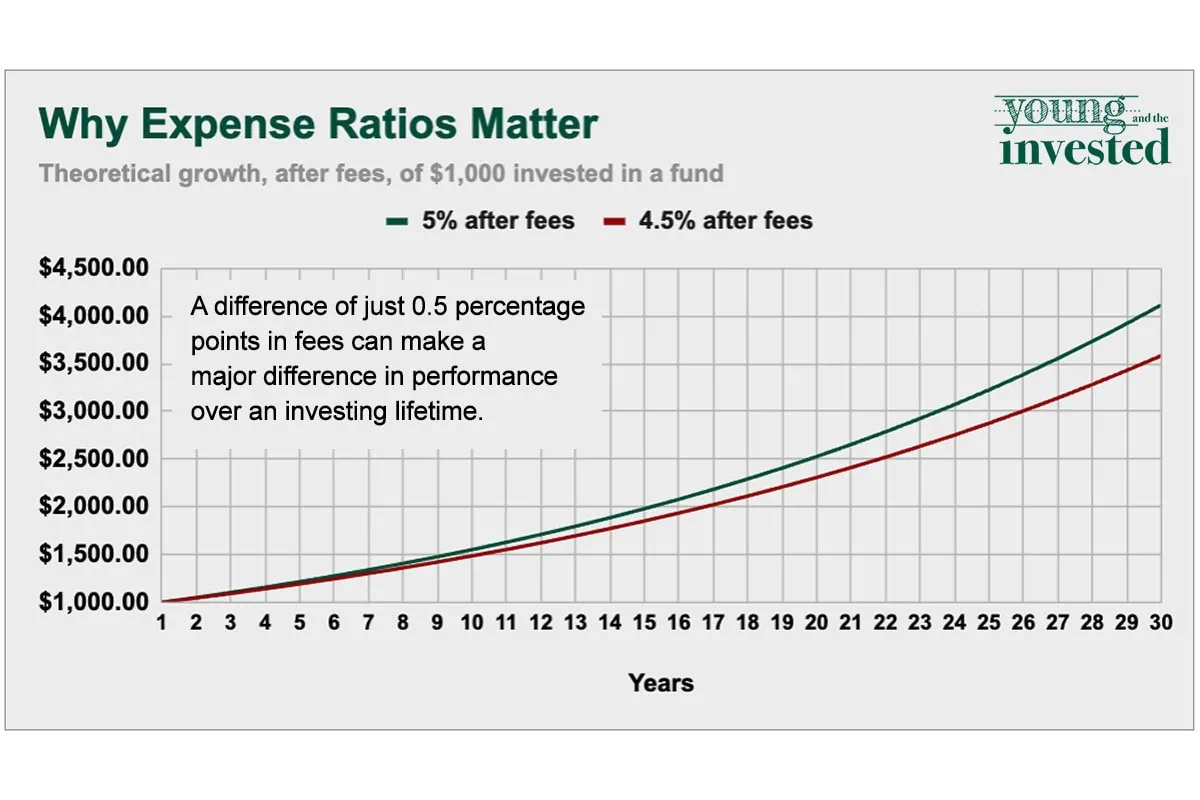
Every dollar you pay in expenses is a dollar that comes directly out of your returns. So, it is absolutely in your best interests to keep your expense ratios to an absolute minimum.
The expense ratio is the percentage of your investment lost each year to management fees, trading expenses and other fund expenses. Because index funds are passively managed and don’t have large staffs of portfolio managers and analysts to pay, they tend to have some of the lowest expense ratios of all mutual funds.
This matters because every dollar not lost to expenses is a dollar that is available to grow and compound. And over an investing lifetime, even a half a percent can have a huge impact. If you invest just $1,000 in a fund generating 5% per year after fees, over a 30-year horizon, it will grow to $4,116. However, if you invested $1,000 in the same fund, but it had an additional 50 basis points in fees (so it only generated 4.5% per year in returns), it would grow to only $3,584 over the same period.
Related: Helpful Teenage Money Management + Financial Planning Apps
Want to talk more about your financial goals or concerns? Our services include comprehensive financial planning, investment management, estate planning, taxes, and more! Schedule a call with Riley to discuss what you need, and what we can do for you.

Related: 15 Best Long-Term Stocks to Buy and Hold Forever
As even novice investors probably know, funds—whether they’re mutual funds or exchange-traded funds (ETFs)—are the simplest and easiest ways to invest in the stock market. But the best long-term stocks also offer many investors a way to stay “invested” intellectually—by following companies they believe in. They also provide investors with the potential for outperformance.
So if you’re looking for a starting point for your own portfolio, look no further. Check out our list of the best long-term stocks for buy-and-hold investors.
Related: 9 Best Fidelity ETFs You Can Buy for 2026
Investors often look to exchange-traded funds (ETFs) for cheap, passive exposure to basic broader market indexes like the S&P 500.
But Fidelity’s ETF suite really shines because in addition to some of those plain-vanilla offerings, Fidelity also provides more tactical ways of tapping into specific corners of Wall Street. See what we mean by checking out our list of the best Fidelity ETFs.
Please Don’t Forget to Like, Follow and Comment
Did you find this article helpful? We’d love to hear your thoughts! Leave a comment with the box on the left-hand side of the screen and share your thoughts.
Also, do you want to stay up-to-date on our latest content?
1. Follow us by clicking the [+ Follow] button above,
2. Subscribe to Retire With Riley, our free weekly retirement planning newsletter, and
3. Give the article a Thumbs Up on the top-left side of the screen.
4. And lastly, if you think this information would benefit your friends and family, don’t hesitate to share it with them!