



Historically, much has been said about Fidelity’s well-run actively managed mutual funds. For good reason! Fidelity has been a fund manager’s haven for decades.
But Fidelity’s index funds, while not as ballyhooed, deserve their flowers, too.
Fidelity index funds deliver the costs we’d demand from rules-based products. Many of Fidelity’s indexed offerings charge paper-thin fees—often at or at least near the bottom of their category—and a handful are actually free.
Better still: Fidelity has another thrifty benefit that many other fund providers don’t: zero investment minimums. You see, even if a fund has a hypercompetitive expense ratio (how much of your returns to go the company in fees), it might still require a minimum initial investment (how much money you must actually fork out to buy your first shares) in the hundreds if not thousands of dollars. Fidelity, however, requires no such thing—you can typically get started for as little as one dollar.
Today, I’m going to look at nine top-rated Fidelity index funds that boast these qualities, and many more. This list covers several strategies across both stocks and bonds, and it includes a handful of products that literally charge nothing in annual expenses.
Editor’s Note: Tabular data presented in this article are up-to-date as of March 31, 2026.
Featured Financial Products
Disclaimer: This article does not constitute individualized investment advice. Individual securities, funds, and/or other investments appear for your consideration and not as personalized investment recommendations. Act at your own discretion.
Table of Contents
Why Fidelity?
Fidelity is a leader in mutual funds (and ETFs, for that matter) and has been a force in the industry since the launch of its Fidelity Puritan Fund (FPURX) back in 1947.
Today, this premier mutual fund company has about $18 trillion in assets under administration thanks in large part to the success of its talented fund managers. Most notable among them? None other than Peter Lynch, the famed, longtime captain of the Fidelity Magellan Fund (FMAGX), which averaged an incredible return of more than 29% annually between 1977 and 1990.
So yes: Fidelity first built its name on actively managed funds. However, over the past three decades, the firm has built out its low-cost and even no-cost index funds as part of the movement to reduce expense ratios and transaction costs for individual investors.
And today, I want to talk to you about those increasingly important index funds.
Why Index Funds?
An index fund is run not by one or more human managers making investment selections, but by a rules-based benchmark called an “index” that measures the performance of a group of assets. It “tracks” the index by actually investing in all (or in some cases, a representative sampling of) the underlying assets.
An index’s strategy can be broad, like the S&P 500, which measures a wide assortment of American companies. Or the focus can be as narrow as, say, forestry and gravel companies. (Of course, I don’t necessarily recommend buying my hypothetical Sticks ‘n’ Stones Index Fund.)
They’re typically cheaper because you’re not paying managers to research and select investments. An index fund technically has a manager overseeing the fund, but they’re not performing stock research and deciding on trades—the index’s rules determine those actions. Thus, fund providers can afford to charge (often much) lower fees on their index funds.
The lack of managers might sound like a handicap, and it can be in certain categories. However, in some categories, indexed products tend to perform extremely well compared to competing actively managed funds. In fact, momentarily, I’ll provide one of the starkest examples of how human managers may struggle to beat a simple index. But in short: An ideal index fund tracks a benchmark that most human managers struggle to beat in the first place, and it gives you an additional performance edge from annual fee savings.
Another note: Turnover—how much the fund tends to buy and sell holdings—is often extremely low in index funds. That’s because index products tend to be buy-and-hold strategies where only a handful of holdings enter or leave each year as the fund checks for qualifying criteria. Why does this matter? Trading within a fund can create capital gains, which the fund must in turn distribute back to investors. These distributions are taxable—at more favorable capital gains tax rates if they’re long-term gains, but at marginal rates if they’re short-term. This tax burden is much more common in actively managed funds than index funds.
The Fidelity funds I’m about to detail all sport minimal turnover, which makes them very tax-efficient investments for taxable brokerage accounts.
How Were the Best Fidelity Index Funds Selected?
While Fidelity offers a few hundred mutual funds, the lion’s share of those are actively managed. Even then, we’re still starting at a group of more than 60 Fidelity index mutual funds, and while diversification is important, no investment basket needs that many eggs.
I started this review like I normally do: by booting up Morningstar Investor and running a quality screen I customize for each article. In this case, I began by including only Fidelity index funds that have earned a Gold Morningstar Medalist rating.
Unlike Morningstar’s Star ratings, which are based upon past performance, Morningstar Medalist ratings are a forward-looking analytical view of a fund. Per Morningstar:
“For actively managed funds, the top three ratings of Gold, Silver, and Bronze all indicate that our analysts expect the rated investment vehicle to produce positive alpha relative to its Morningstar Category index over the long term, meaning a period of at least five years. For passive strategies, the same ratings indicate that we expect the fund to deliver alpha relative to its Morningstar Category index that is above the lesser of the category median or zero over the long term.”
As I’ve written in other Young and the Invested articles, a Medalist rating doesn’t mean Morningstar is necessarily bullish on the underlying asset class or categorization. It’s merely an expression of confidence in the fund compared to its peers.
Fidelity actually has a couple dozen Gold-rated index funds, but several of them are specific share classes that are only available to certain subsets of investors—those enrolled in Fidelity Wealth Services, for instance, or those enrolled in eligible employer-sponsored retirement plans. So I’ve further narrowed the list to only Investor-class index funds, which are available to just about anyone.
From the remaining universe of funds, I’ve selected some core and satellite offerings that exemplify the best Fidelity has to offer.
Make Young and the Invested your preferred news source on Google
Simply go to your preferences page and select the ✓ box for Young and the Invested. Once you’ve made this update, you’ll see Young and the Invested show up more often in Google’s “Top Stories” feed, as well as in a dedicated “From Your Sources” section on Google’s search results page.
The Best Fidelity Index Funds to Buy

Every index fund on this list, in addition to being Gold-rated, is as friendly on the wallet as you could ask for. Specifically, the best Fidelity index funds boast:
- Extremely low fees. Specifically, their fees are in the bottom 20% of all funds in their Morningstar Category.
- No investment minimums. Many mutual fund providers have investment minimums in the hundreds or even thousands of dollars. But these funds allow you to buy with whatever you’ve got—even if that’s just a lonely greenback.
Let’s get started!
Do you want to get serious about saving and planning for retirement? Sign up for Retire With Riley, Young and the Invested’s free retirement planning newsletter.
1. Fidelity 500 Index Fund
- Style: U.S. large-cap stock
- Assets under management: $749.1 billion
- Dividend yield: 1.1%
- Expense ratio: 0.015%, or 15¢ per year for every $1,000 invested
It’s one of the best Fidelity mutual funds you can buy, so naturally, Fidelity 500 Index Fund (FXAIX) also belongs among Fidelity’s best index mutual funds.
The S&P 500 Index is commonly used as a performance benchmark for mutual funds that invest in U.S.-based large-cap stocks. But the majority of fund managers who run these funds typically struggle to beat their benchmark. Indeed, according to S&P Dow Jones Indices, over the trailing 10-year period, just 14% of all active large-cap U.S. equity funds have been able to eclipse the S&P 500, and that number is even less (10%) when looking at the trailing 15 years.
Related: 5 Best Energy ETFs for the Rise of Oil, Natural Gas + More
Thus, if a major mutual fund provider’s lineup includes a cheap S&P 500 index fund, chances are it’ll be one of their best-rated funds. And it doesn’t get much cheaper than Fidelity 500’s 1.5 basis points, which undercuts not only virtually all other S&P 500 mutual funds, but all S&P 500 ETFs, too. (A basis point is one one-hundredth of a percentage point.)
People consider the S&P 500 to be a reflection of the U.S. economy. Perhaps, but it’s hardly perfect, and it’s certainly not evenly split. For instance, the technology sector currently accounts for a third of FXAIX’s assets. However, utilities, real estate, and materials all merit less than 3% apiece. This is in no small part because, like many indexes, the S&P 500 is market capitalization-weighted, which means the greater the size of the company, the more “weight” it’s given in the index. Currently, multitrillion-dollar companies Nvidia (NVDA), Apple (AAPL), and Google parent Alphabet (GOOG/GOOGL) sit atop Fidelity 500 Index Fund’s holdings list.
Note: Once a company becomes an S&P 500 component, it’s not automatically kicked out if it fails to meet all of the criteria. However, the selection committee would take this under consideration and possibly boot the company.
Related: 11 Best Vanguard Funds for the Everyday Investor
People like to consider the S&P 500 a reflection of the U.S. economy. It might be, but it’s hardly perfect. For instance, the technology sector accounts for more than a third of FXAIX’s assets. However, utilities, real estate, energy, and materials all merit less than 3% apiece. This is in no small part because, like many indexes, the S&P 500 is market capitalization-weighted, which means the greater the size of the company, the more “weight” it’s given in the index. Currently, multitrillion-dollar companies Nvidia (NVDA), Apple (AAPL), and Microsoft (MSFT) sit atop Fidelity 500 Index Fund’s holdings list.
Turnover is always low given that index only swaps out a handful of stocks every year, so capital-gains distributions tend to be minimal. This makes FXAIX an extremely tax-efficient option for taxable brokerage accounts.
This combination of traits—the S&P 500’s excellence as an index, bare-bones costs, and tax efficiency—earn FXAIX a Gold Medalist rating from Morningstar. That makes this one of the best Fidelity index funds to buy, especially if you’re building the core of your portfolio.
Related: 14 Best Investing Research & Stock Analysis Websites [2026]
2. Fidelity ZERO Large Cap Index Fund

- Style: U.S. large-cap stock
- Assets under management: $16.5 billion
- Dividend yield: 1.0%
- Expense ratio: None
An S&P 500 fund isn’t the only way to get large-cap* exposure—there are also plenty of actively traded and index large-cap “blend” funds to choose from. Fidelity ZERO Large Cap Index Fund (FNILX), for instance, has a Gold Medalist rating, too, and even a marginal performance edge over FXAIX across its modest lifetime.
That can in large part be chalked up to its most noteworthy trait: It’s free.
Fidelity ZERO Large Cap Index is part of the Fidelity ZERO lineup of funds. They charge no annual expenses and have zero minimum investment requirements. The catch? You can only buy them through an individual Fidelity account, such as a brokerage or individual retirement account (IRA).
Related: The 10 Best Index Funds You Can Buy for 2026
FNILX is also likely to deviate from FXAIX somewhat because it’s not an S&P 500 tracker. Instead, it’s tethered to a proprietary Fidelity large-cap index. That said, this ZERO fund isn’t likely to deviate by much because while it’s not trying to replicate the S&P 500, it does an awfully impressive impersonation. FNILX holds about 510 stocks, virtually entirely domestic. About 80% of assets are allocated to large-cap stocks; the rest sits in larger mid-caps. It’s also chock-full of tech companies, weighting the sector at a third of assets. Nvidia, Apple, and Alphabet are the largest holdings, too, at weights similar to what they command in FXAIX.
Fidelity ZERO Large Cap Index doesn’t have a long track record, given that it launched in 2018. But it has beaten its category average and Morningstar index, on an average annual basis, over the trailing one-, three-, and five-year periods. It has also edged out the S&P 500 on performance over the trailing one- and three-year periods.
* There are different ways to define the different “cap” levels. We’re going by Morningstar’s definition, which says the largest 70% of companies by market capitalization within a fund’s “style” are large-caps, the next 20% by market cap are mid-caps, and the smallest 10% by market cap are small caps.
Related: The 7 Best Vanguard Index Funds for Beginners
3. Fidelity Mid Cap Index Fund
- Style: U.S. mid-cap stock
- Assets under management: $48.9 billion
- Dividend yield: 1.0%
- Expense ratio: 0.025%, or 25¢ per year for every $1,000 invested
Mid-cap stocks are a way to thread the needle between the relative size and stability of large-cap stocks and the high growth potential of small-cap stocks. Indeed, this ideal middle ground has earned mid-caps the nickname “Goldilocks stocks.”
“Since 1978, mid-cap stocks have outperformed small-caps over each of these rolling time periods: five, 10, 20, 30 and 40 years,” says Oregon-based equity manager Jensen Investment Management. “They’ve even bested large-caps over the 30- and 40-year windows. These returns came with lower volatility than small-caps as well, making the evidence even more compelling.
“That means mid-caps haven’t just delivered better performance—they’ve done it more consistently, with fewer drawdowns.”
Related: The 13 Best Mutual Funds You Can Buy for 2026
Fidelity Mid Cap Index Fund (FSMDX) is an exceedingly cost-efficient way to tap this area of the market. FSMDX tracks the Russell MidCap Index, which is made up of the 800 smallest stocks in the Russell 1000 (which is itself an index of the U.S. market’s 1,000 largest stocks). As a result, you’re getting exposure to 800-plus mostly mid-cap stocks—the fund currently is 72% weighted in mids, with another 7% in smaller large caps, and the remaining 21% in larger small caps.
That might seem odd, but it’s common for 20%-30% of a mid-cap fund’s holdings to bleed into small- and/or large-company territory, and some funds invest even more outside of mid-caps. Where FSMDX stands out is that it “selects larger stocks than most,” Morningstar says. “Larger stocks are generally less volatile, so the portfolio could exhibit lower volatility than its peers.”
Sector weights will naturally change over time as certain businesses come into and go out of favor, but right now, industrials are tops at 19%, followed by technology (15%), financials (12%) and consumer discretionary stocks (12%). Also, thanks to both the market cap-weighting of the Russell MidCap Index and the high number of holdings, single-stock risk is minimal—no stock is weighed at more than 1%.
A sound methodology for Wall Street’s mid-sized companies, dirt-cheap fee, and strong historical performance all make FSMDX one of the best Fidelity index funds you can buy.
Related: The Best Mutual Funds for Beginners
Featured Financial Products
4. Fidelity Total Market Index Fund
- Style: U.S. all-cap stock
- Assets under management: $122.8 billion
- Dividend yield: 1.0%
- Expense ratio: 0.015%, or 15¢ per year for every $1,000 invested
Who says you can’t have it all?
Take Fidelity Total Market Index Fund (FSKAX), for instance. This index product, which tries to replicate the Dow Jones U.S. Total Stock Market Index, holds more than 3,700 stocks. That’s not the whole U.S. stock market, but it’s mighty close, and it’s certainly more than enough for the average investor.
Related: The Best Dividend Stocks: 10 Pro-Grade Income Picks for 2026
You usually won’t get equal exposure across all different stock sizes with a total-market fund, as they tend to be market cap-weighted and heavily tilted toward large caps. That’s the case with FSKAX, whose cap weightings align perfectly with the Morningstar’s cap definitions: 70% large caps, 20% mid-caps, 10% small caps.
If you don’t like Fidelity Total Market Index’s ratio of large-, mid-, and small-cap stocks, you’re better off using a blend of market cap-specific funds to get the proportions you prefer.
However, if you want all of your U.S. stock exposure in one fund, products like FSKAX are for you. They ensure that while you do have some access to growthier smalls and mids, you’re still primarily invested in relatively stable large companies; top holdings look just like the S&P 500 right now, in fact. They typically provide this exposure for a song, too—FSKAX is particularly cheap, charging the same 1.5 basis points as the aforementioned FXAIX.
Throw in a Gold Morningstar Medalist rating—awarded for its excellent investment process and razor-thin fees—and FSKAX is one of the best Fidelity index funds to buy for your portfolio core.
Related: 7 Best High-Yield Dividend Stocks: The Pros’ Picks for 2026
5. Fidelity ZERO Total Market Index Fund
- Style: U.S. all-cap stock
- Assets under management: $32.1 billion
- Dividend yield: 1.0%
- Expense ratio: None
Fidelity has not one but two Gold-rated total-market funds.
The second is Fidelity ZERO Total Market Index (FZROX): another example of how having access to Fidelity’s ZERO funds has given investors an edge. FZROX tracks a proprietary Fidelity index that looks an awful lot like its fee-charging cousin’s tracking index. The biggest difference is a smaller portfolio—but at about 2,520 stocks, it’s still an acceptably wide coverage area for someone looking to own “the whole market.”
Related: The 10 Best Dividend ETFs for 2026 [Get Income + Diversify]
Past that, though, the ratio of large-, mid-, and small-cap stocks is almost identical, as are top holdings, as are sector weightings.
Given how little Fidelity Total Market Index charges, you’re not saving much by owning FZROX—just the 1.5 basis points. But that, as well as any slight differences in the portfolio, is enough to translate into a slight historical performance edge of roughly 25 basis points annually, on average, over the past five years.
Related: 9 Best Schwab Funds You Can Buy: Low Fees, Low Minimums
6. Fidelity Total International Index Fund
- Style: International all-cap stock
- Assets under management: $21.8 billion
- Dividend yield: 2.5%
- Expense ratio: 0.06%, or 60¢ per year for every $1,000 invested
America’s stock markets have been among the world’s most productive for decades on end. If you believe in the U.S. economy’s ability to keep going strong, that will likely remain the case. It’s little surprise, then, that most experts would tell you that you should primarily own U.S. stock and bond funds.
Related: 7 Best High-Dividend ETFs for Income-Hungry Investors
But those same experts would point to years like 2025, in which the S&P 500 did well but foreign bourses did even better, and tell you that’s why you should have at least some international exposure.
You can get access to the world’s stock markets cost-efficiently through Fidelity Total International Index Fund (FTIHX), which is tasked with replicating the performance of the MSCI ACWI (All Country World Index) ex USA Investable Market Index. This market-cap weighted index is designed to provide exposure to stocks of all sizes across both developed (mature, slow-growth) and emerging (volatile but higher-growth) markets. And that exposure is extremely broad, at more than 5,000 equities right now.
Like with most index funds, Fidelity Total International Index Fund hardly does any of this equally.
Related: The 7 Best Closed-End Funds (CEFs) That Yield Up to 14.6%
Geographically speaking, this Fidelity mutual fund favors developed markets, including Japan (15%), the U.K. (9%), and Canada (8%). From a company-size perspective, it’s predominantly large-cap in nature: Nearly 80% of the portfolio is invested in big, blue-chip international firms such as Taiwan Semiconductor (TSM), Swiss pharmaceutical giant Novartis (NVS), and British banking firm HSBC Holdings (HSBC). That’s common for international funds, and it tends to result in higher dividend yields than comparable U.S. large-cap funds. Sure enough, FTIHX’s 2%-plus yield is more than double the S&P 500’s.
While Fidelity Total International Index Fund does enjoy a Morningstar Gold medalist rating, that’s largely on the merits of its dirt-cheap investment fee. FTIHX’s historical performance has been more mixed—generally good, though it has wavered at times, and it has certainly not been excellent.
Make sure you sign up for The Weekend Tea, Young and the Invested’s free weekly newsletter that over 10k monthly readers use to level up their money know-how.
7. Fidelity U.S. Bond Index Fund
- Style: U.S. intermediate-term core bond
- Assets under management: $68.2 billion
- SEC yield: 4.0%*
- Expense ratio: 0.025%, or 25¢ per year for every $1,000 invested
Most investors need at least some exposure to bonds, which are debt instruments issued by governments, companies, and other entities. Bonds’ interest payments and relative lack of volatility make them an excellent tool for providing a portfolio with stability and income.
That said: Exactly how much bond exposure you need will vary by age—because these fixed-income securities are better at protecting wealth than growing it, people typically start with little in the way of bond holdings earlier in life, then gradually hold more bonds as they get closer to (and into) retirement.
Related: 7 Best Vanguard Dividend Funds [Low-Cost Income]
Individual bonds can be a hassle, though. Data and research on individual issues is much thinner than it is for publicly traded stocks. And some bonds have minimum investments in the tens of thousands of dollars. But you can blunt these problems by purchasing a bond fund, which allows you to invest in hundreds or even thousands of bonds with a single click—and, in many cases, very low fees.
The Fidelity U.S. Bond Index Fund (FXNAX) tries to replicate the Bloomberg U.S. Aggregate Bond Index. Nicknamed simply “the Agg,” it’s arguably the king of bond indexes; hundreds of billions of dollars are invested in funds that track this benchmark.
FXNAX provides exposure to a few core, investment-grade debt assets across a wide 10,400-plus holdings. U.S. Treasuries are tops at about 45% of assets, followed by corporate bonds and pass-through mortgage-backed securities (MBSes) at roughly 25% apiece. Past that, there are sprinkles of U.S. agency bonds, foreign sovereign debt, commercial MBSes, and other debt. This diversification makes it a prime core bond holding.
Related: The 12 Best Vanguard ETFs for 2026 [Build a Low-Cost Portfolio]
Fidelity U.S. Bond Index Fund’s debt ranges in maturity from just a few months to more than 20 years, but on average, portfolio maturity sits at 7.8 years. Duration—a measure of interest-rate sensitivity—is 5.8 years. That implies that if interest rates rose by 1 percentage point, the fund would experience a short-term decline of 5.8%, and vice versa. (The actual calculation of duration, which involves weighted averaging of the bond’s cash flows, is more complex than that, but it’s a reasonable enough simplification that helps investors understand the greater the duration, the greater the interest-rate risk.)
Of course, part of the reason FXNAX ranks among Fidelity’s best index funds is its costs. The product’s 0.025% expense ratio is a tiny fraction of the average intermediate-term bond fund’s 0.50% annual fee.
* SEC yield reflects the interest earned across the most recent 30-day period. This is a standard measure for funds holding bonds and preferred stocks.
Related: 9 Best Fidelity ETFs for 2026 [Invest Tactically]
8. Fidelity Short-Term Treasury Bond Index Fund

- Style: Short-term government bond
- Assets under management: $3.5 billion
- SEC yield: 3.5%
- Expense ratio: 0.03%, or 30¢ per year for every $1,000 invested
Stocks aren’t the only asset with varying levels of risk and potential reward. Bonds can run the gamut, too.
You can find some of the safest plays in the bond world in Fidelity Short-Term Treasury Bond Index Fund (FUMBX). This Fidelity index fund focuses on bonds that are considered low-risk for a pair of reasons: their short maturities, and their issuer (the U.S. Treasury).
Maturity is a major factor in determining bond risk. As a general rule, the longer the bond, the greater the risk that the bond might not be repaid. Interest rates matter, too. When rates go higher, new bonds pay more, which tempt people to sell their old bonds for the new, higher-paying bonds. But the temptation is much greater when you’re dealing with longer-term bonds with lots of payments remaining—and not so great for short-term bonds with one or just a couple payments left.
Related: 15 Dividend Kings for Royally Resilient Income
And it’s tough to ask for a better issuer. U.S. Treasury bonds are backed by the full faith and credit of the U.S. government, and as a result, they’re among the highest-rated bonds on the planet. While there’s no 100% guarantee they’ll be repaid, there’s a far higher likelihood of repayment than the vast majority of issuers out there.
FUMBX invests in a tight grouping of around 120 Treasury bond issues whose maturities span a few months to five years. That’s a bit longer-term than some other Treasury funds that limit their maturities to three years, but the portfolio’s average maturity is still a low 2.8 years. Duration is just 2.5 years, so FUMBX would fall just 2.5% in response to a 1-percentage-point hike in interest rates. Conversely, it would only rise that much on a similar decline in rates.
But that’s OK, as long as you know what you’re buying. If all you want is portfolio protection that can still generate some yield (at 3.5% currently), FUMBX is one of the best Fidelity index funds you can buy.
Related: 8 Best T. Rowe Price Funds to Buy for 2026
9. Fidelity Freedom Index Funds
- Style: Target-date
- Assets under management (collectively): $204.9 billion
- Expense ratio: 0.12%, or $1.20 per year for every $1,000 invested
Target-date funds (TDFs) are the ultimate buy-and-hold instrument, meant to stay in your portfolio for literally decades.
You can read more about this type of product in our primer on target-date funds, but in short, they’re funds that shift their asset allocation over time to meet investors’ changing needs as they age. A person who turned 25 in 2025 would likely expect to retire in 2065, so they’d buy a fund with a target retirement date of 2065. That fund will probably start out with a very heavy allocation to stocks (to grow the investors’ wealth), but as the years roll on and the fund approaches its target retirement date, it will start putting more of its assets into bonds (to protect the investors’ wealth).
Many fund providers have at least one target-date series, though larger asset managers sometimes offer more. Fidelity is well outside the norm, however, with a whopping four—and the highest-rated among them are the Fidelity Freedom Index Funds.
Related: Beginner’s Guide to Vanguard Target-Date Funds
I’ll start off by pointing out that they’re an exception to the screen. The funds themselves aren’t indexed, but actively managed. Why include them? Well, Fidelity Freedom Index Funds exclusively hold low-cost Fidelity index funds. So while the managers do adjust the portfolios to keep them in line with investors’ changing needs, the underlying holdings are all being selected by indexes.
Few target-date series boast a Gold Medalist rating. That rating is due in no small part to extremely low costs. While target-date funds that own actively managed products tend to charge different fees across the series, all Fidelity Freedom Index Funds collect the same low fee: 0.12%.
Here’s a quick look at the full lineup:
- Fidelity Freedom Index 2010 Fund (FKIFX)
- Fidelity Freedom Index 2015 Fund (FLIFX)
- Fidelity Freedom Index 2020 Fund (FPIFX)
- Fidelity Freedom Index 2025 Fund (FQIFX)
- Fidelity Freedom Index 2030 Fund (FXIFX)
- Fidelity Freedom Index 2035 Fund (FIHFX)
- Fidelity Freedom Index 2040 Fund (FBIFX)
- Fidelity Freedom Index 2045 Fund (FIOFX)
- Fidelity Freedom Index 2050 Fund (FIPFX)
- Fidelity Freedom Index 2055 Fund (FDEWX)
- Fidelity Freedom Index 2060 Fund (FDKLX)
- Fidelity Freedom Index 2065 Fund (FFIJX)
- Fidelity Freedom Index 2070 Fund (FRBVX)
- Fidelity Freedom Index Income Fund (FIKFX)
Fidelity Freedom Index Income Fund (FIKFX), by the way, is designed for people who have reached retirement, and it boasts the most conservative asset blend. When a Fidelity Freedom Index target-date fund expires, it merges with Fidelity Freedom Index Income.
Interestingly, Fidelity actually has two target-date lineups rated Gold. The other is the Fidelity Flex Freedom Blend Fund series, which holds a blend of index and actively managed Fidelity funds. However, the “Flex” designation refers to a share class you can only buy with certain Fidelity accounts; the Fidelity Freedom Index Funds mentioned here are open to everyone.
For a longer explanation of all of Fidelity’s target-date lineups, check out our Beginner’s Guide to Fidelity Target-Date Funds.
Related: Best Fidelity Retirement Funds for a 401(k) Plan
Featured Financial Products
Learn More About These and Other Funds With Morningstar Investor

If you’re buying a fund you plan on holding for years (if not forever), you want to know you’re making the right selection. And Morningstar Investor can help you do that.
Morningstar Investor provides a wealth of information and comparable data points about mutual funds and ETFs—fees, risk, portfolio composition, performance, distributions, and more. Morningstar experts also provide detailed explanations and analysis of many of the funds the site covers.
With Morningstar Investor, you’ll enjoy a wealth of features, including Morningstar Portfolio X-Ray®, stock and fund watchlists, news and commentary, screeners, and more. And you can try it before you buy it. Right now, Morningstar Investor is offering a free seven-day trial and a discount on your first year’s subscription when you use our exclusive link.
- Morningstar Investor offers expert research, investing analysis, and advisor-grade portfolio management tools that are tailor-made for buy-and-hold investors.
- Morningstar is one of the most prized sources of mutual fund and exchange-traded fund (ETF) data in the world.
- How does your portfolio stack up? Put it through Morningstar's Portfolio X-Ray, which will provide insights such as whether you have too many overlapping holdings or whether you're paying too much in fees.
- Special Offer 1: Click our sign-up link to receive $50 off your first year of Morningstar Investor. (Annual plan only.)
- Special Offer 2: Students receive one year of Morningstar Investor access for just $25!
- Special Offer 3: Teachers receive a 60% discount on Morningstar Investor access.
- Top-flight fund research and analysis
- Portfolio management tool
- Powerful screener
- Watchlists
- Tailored news and commentary
- Below-average charting
- High monthly billing rate
Do you want to get serious about saving and planning for retirement? Sign up for Retire With Riley, Young and the Invested’s free retirement planning newsletter.
What Is the Minimum Investment Amount on Fidelity Index Funds?
Fidelity’s index funds make plenty of sense for investors of all shapes and sizes, but they have a particular appeal among people who don’t have much money to work with. That’s because many Fidelity index funds have no investment minimums—you can literally start with as little as $1.
That’s extremely beneficial in self-directed accounts like a brokerage or health savings account (HSA). Many mutual funds from other providers require high minimums in the thousands of dollars, hamstringing investors with little capital to work with.
Why Does a Fund’s Expense Ratio Matter So Much?
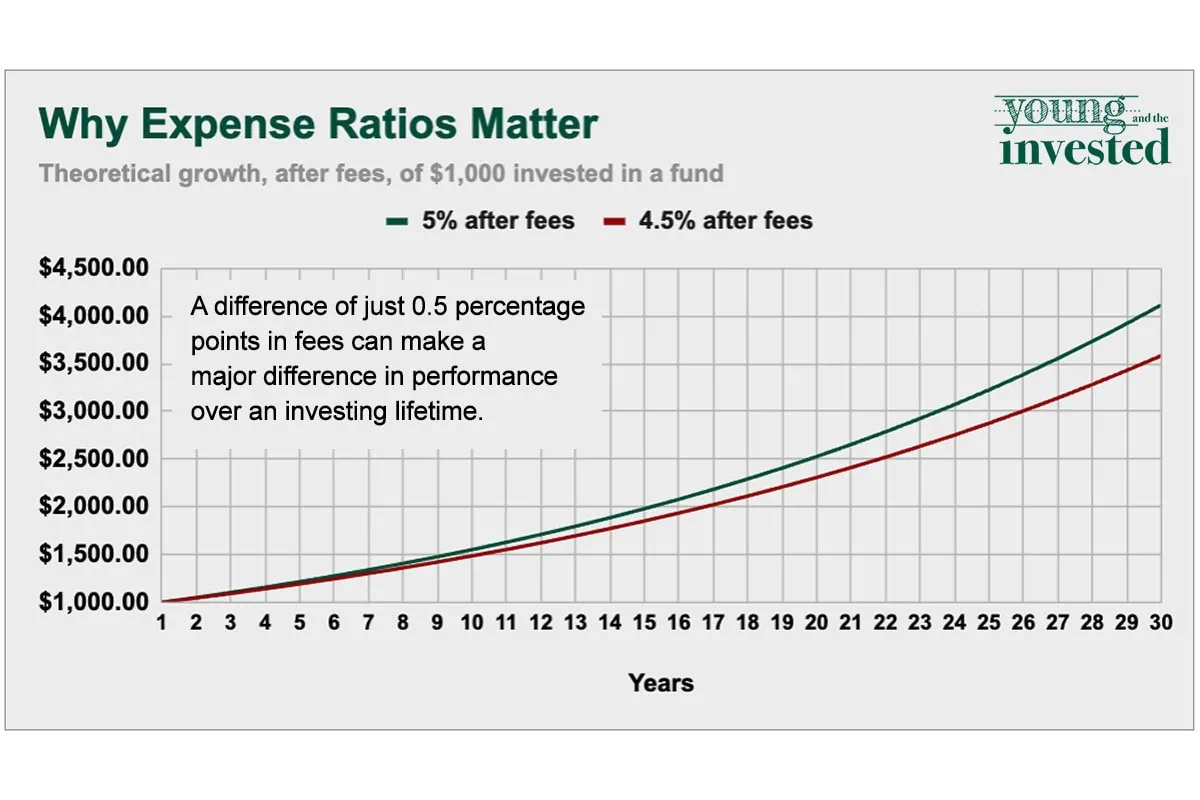
Every dollar you pay in expenses is a dollar that comes directly out of your returns. So, it is absolutely in your best interests to keep your expense ratios to an absolute minimum.
The expense ratio is the percentage of your investment lost each year to management fees, trading expenses and other fund expenses. Because index funds are passively managed and don’t have large staffs of portfolio managers and analysts to pay, they tend to have some of the lowest expense ratios of all mutual funds.
This matters because every dollar not lost to expenses is a dollar that is available to grow and compound. And over an investing lifetime, even a half a percent can have a huge impact. If you invest just $1,000 in a fund generating 5% per year after fees, over a 30-year horizon, it will grow to $4,116. However, if you invested $1,000 in the same fund, but it had an additional 50 basis points in fees (so it only generated 4.5% per year in returns), it would grow to only $3,584 over the same period.
Want to talk more about your financial goals or concerns? Our services include comprehensive financial planning, investment management, estate planning, taxes, and more! Schedule a call with Riley to discuss what you need, and what we can do for you.

Related: 15 Stocks You Can Buy and Hold Forever
As even novice investors probably know, funds—whether they’re mutual funds or exchange-traded funds (ETFs)—are the simplest and easiest ways to invest in the stock market. But the best long-term stocks also offer many investors a way to stay “invested” intellectually—by following companies they believe in. They also provide investors with the potential for outperformance.
So if you’re looking for a starting point for your own portfolio, look no further. Check out our list of the best long-term stocks for buy-and-hold investors.
Related: The 7 Best Value Stocks to Buy Right Now
Some of Wall Street’s best opportunities lie in its most underappreciated stocks. Companies can trade far below their intrinsic value for many reasons, such as being thrown out with the bathwater in a downturn or being ignored for more scintillating shares. Whatever the reason, when other investors catch up to what these stocks have to offer, they can get legs.
Curious about what stocks Wall Street is sleeping on now? Check out our list of the best value stocks to buy right now.
Please Don’t Forget to Like, Follow and Comment
Did you find this article helpful? We’d love to hear your thoughts! Leave a comment with the box on the left-hand side of the screen and share your thoughts.
Also, do you want to stay up-to-date on our latest content?
1. Follow us by clicking the [+ Follow] button above,
2. Subscribe to Retire With Riley, our free weekly retirement planning newsletter, and
3. Give the article a Thumbs Up on the top-left side of the screen.
4. And lastly, if you think this information would benefit your friends and family, don’t hesitate to share it with them!