



You should sock money away in any tax-advantaged retirement account you can get your mitts on. But at least as far as flexibility goes, it’s difficult to top the individual retirement account (IRA).
Most IRAs offer just about everything you could find in a brokerage account from the same provider: Individual stocks, mutual funds, exchange-traded funds (ETFs) and more. Health savings accounts (HSAs) can be that flexible, but numerous providers still offer much more limited plans. And 401(k)s, 403(b)s and other workplace plans are notorious for providing a roster of 10 to 20 mutual funds and calling it a day.
The logic, then, goes that you should stick to mutual funds wherever you’re forced to, then use accounts like IRAs to hold stocks, ETFs, individual bonds and the like. That’s doubly the case given that so many mutual funds have large minimum investment requirements that you can sidestep in workplace accounts.
But there’s no reason not to hold mutual funds in an IRA if those mutual funds happen to boast solid index strategies or seasoned stock pickers, for a low annual fee, and zero minimum initial investment—like many of the products in the Fidelity stable of mutual funds.
Today, I’ll look at some of the best Fidelity retirement funds to buy in an IRA. These funds boast much lower-than-average annual expenses, no investment minimums. Many of them are tax-inefficient, too—a problem for brokerage accounts, but something that IRAs and other tax-advantaged accounts can neutralize.
Editor’s Note: Tabular data presented in this article is up-to-date as of Feb. 5, 2026.
Disclaimer: This article does not constitute individualized investment advice. Individual securities, funds, and/or other investments appear for your consideration and not as personalized investment recommendations. Act at your own discretion.
Table of Contents
What Should You Want in a Retirement Fund?

When you invest your retirement savings in an account like a 401(k) or IRA, you’ll want to keep a few things in mind.
Costs are first and foremost. Let’s say you pay $5 in expenses for every $100 a mutual fund earned you. That’s $5 that wouldn’t grow and compound for you over time. So if all else is equal, the lower the cost, the better. But occasionally, a fund justifies its higher fees. No worries in that department: The best Fidelity retirement funds’ fees typically sit near or at the bottom of their category.
Income matters, too. You probably want your retirement portfolio to produce at least some regular income—in the form of both bond interest and dividend income. Stock prices can suffer during nasty corrections and bear markets, but income-generating funds can help provide for your living expenses without forcing you to sell at an inopportune time. How much income your account should produce depends on your own circumstances. For instance, older investors tend to be more concerned with income while younger investors focus more on growth.
Don’t forget taxes. A taxable account (like a standard brokerage account) is better suited to take advantage of certain tax-advantaged investments, such as municipal bonds. For tax-advantaged accounts, such as HSAs, some of the best investments include bond funds (where the interest income won’t be taxed) and actively managed stock funds (where the capital gains distributions from heavy trading, aka “turnover,” won’t be taxed).
Diversification matters (in more than one way). You’ve probably heard that your portfolio should be “diversified,” which means holding a variety of investments, whether that’s holding multiple assets (stocks, bonds, alternative assets), but that could also mean holding, say, stocks from different countries, or stocks from different sectors. And investment funds, which can own any number of stocks, bonds, or other holdings all at once, can help you achieve that diversification. But every fund has its own level of built-in diversification. Some funds hold dozens of stocks while others hold thousands. Some funds invest heavily in their biggest stocks while others spread their assets out more evenly. So always consider how diversified a fund really is, as well as whether that level of diversification suits your needs.
What Types of Funds Are Available in IRAs?
While the tax rules surrounding IRAs are completely different from brokerage accounts, from a user-experience perspective, they’re often indistinguishable. They’re typically self-directed and extremely flexible, allowing you to own stocks, ETFs, and mutual funds at a bare minimum, and often other investments such as individual bonds, options, and more.
ETFs typically beat both mutual funds and closed-end funds (CEFs) on fees, sometimes by a considerable margin. But there are a few reasons to consider Fidelity mutual funds in an IRA.
They’re cheap, for one. Fidelity mutual funds typically offer very low fees—in many cases lower than even many ETFs with a similar strategy.
Also, many of Fidelity’s mutual funds are actively managed, which as I mentioned above is more efficiently held within an IRA. And you very well might prefer to have a human manager overseeing certain strategies rather than buy a fund that simply follows an index.
The Best Fidelity Retirement Funds for an IRA in 2026
These Fidelity retirement funds are ordered by their Morningstar Portfolio Risk Score for the trailing 10-year period. Here are the risk levels each score range represents:
— 0-23: Conservative
— 24-47: Moderate
— 48-78: Aggressive
— 79-99: Very Aggressive
— 100+: Extreme
Importantly, these scores are a general gauge of risk compared to all other investments. For example, a bond fund with a score of 20 might be considered a conservative strategy overall, but it could simultaneously be riskier than a number of other bond funds.
Lastly, not a single one of these funds has an investment minimum. You can begin with as little as your IRA provider will allow.
With all of that out of the way, let’s explore some of Fidelity’s best mutual funds for IRAs. Most of these funds can be used to build your portfolio core, though a few can be more helpful as satellite positions to drive returns or reduce risk.
Related: 9 Best Fidelity ETFs for 2026 [Invest Tactically]
1. Fidelity Conservative Income Bond Fund
— Style: Ultrashort bond
— Assets under management: $7.0 billion
— SEC yield: 3.9%*
— Expense ratio: 0.25%**, or $2.50 per year for every $1,000 invested
— Morningstar Portfolio Risk Score: 2 (Conservative)
Bonds and bond funds are a core holding of just about any portfolio. But you should be selective about which accounts you’re using to hold them.
That’s because bonds also happen to be among the most tax-inefficient asset classes on earth because the bulk of their returns will generally come from interest paid, and interest income is taxed as ordinary income. For instance: If you’re in the 37% tax bracket, and you hold a bond fund in a taxable account, you’re losing 37% of your bond interest to taxes each year. But you won’t face any tax consequences for collecting that income within a 401(k), IRA, HSA, or other tax-advantaged accounts.
I’ll start with the Fidelity Conservative Income Bond Fund (FCNVX)—a bond fund maximally designed for safety, but a fund that also delivers a competitive amount of income given what it holds.
Like Young and the Invested’s content? Be sure to follow us.
FCNVX’s management team holds roughly 340 bonds across a number of categories. Investment-grade corporate debt is the biggest sleeve at more than half of assets, though the fund also gives double-digit allocations to U.S. Treasuries, asset-backed securities (ABSes), and cash. Credit quality is exceptionally high—most of the bonds it holds are considered investment-grade, though about 10% aren’t rated (which doesn’t indicate anything about their credit quality; it just means they haven’t been scored by the major credit ratings agencies).
A vital metric to consider when considering bonds is duration, which is a measure of how sensitive the fund is to changes in interest rates. The actual calculation is complex; a simple way to think about it is a bond with a duration of two years would see its price rise by 2% if market interest rates fell by 1 percentage point, or fall by 2% if market rates rose by 1 point. The most important takeaway is that all else equal, the longer a bond’s time to maturity, the higher its duration, and thus the higher its interest-rate risk.
FCNVX has a low weighted average maturity of just 0.6 years, reflected in a microscopic duration of just 0.3 years. This means interest-rate fluctuations will have very little impact on the fund’s performance.
* SEC yield reflects the interest earned across the most recent 30-day period. This is a standard measure for funds holding bonds and preferred stocks.
Make Young and the Invested your preferred news source on Google
Simply go to your preferences page and select the ✓ box for Young and the Invested. Once you’ve made this update, you’ll see Young and the Invested show up more often in Google’s “Top Stories” feed, as well as in a dedicated “From Your Sources” section on Google’s search results page.
2. Fidelity Total Bond Fund
— Style: Intermediate-term core bond
— Assets under management: $42.2 billion
— SEC yield: 4.4%
— Expense ratio: 0.45%, or $4.50 per year for every $1,000 invested
— Morningstar Portfolio Risk Score: 15 (Conservative)
For a more diversified option that covers a wider swath of the bond market, consider the Fidelity Total Bond Fund (FTBFX).
FTBFX’s management team allocates its assets across 6,700 holdings representing a wide variety of bonds and other income-producing debt. Currently, it invests the largest percentage of its assets (about 40%) into U.S. government bonds, another 27% into corporates, and about 16% into pass-through mortgage-backed securities (MBSes). The rest is sprinkled across ABSes, commercial MBSes (CMBSes), collateralized mortgage obligations (CMOs), foreign sovereign debt, and more.
Related: 8 Best-in-Class Bond Funds to Buy
While FTBFX tends to gravitate toward investment-grade debt, the fund is allowed to invest up to 20% of assets in bonds rated below investment-grade, which potentially offer higher returns in exchange for accepting slightly higher risk. (Sub-investment-grade bonds are also referred to as high-yield debt securities or junk bonds.) Right now, only 10% of the portfolio is in high-yield investments, so half of its allowable allotment.
Credit quality, while high, isn’t quite as lofty as FCNVX, and the bonds are much longer-term in nature, at a weighted average maturity of 8.1 years. That shows up in a much higher duration of 5.9 years, which means a 1-percentage-point increase in market interest rates would result in a 5.9% short-term drop in FTBFX shares, and vice versa.
In other words: Fidelity Total Bond Fund is still a conservative fund overall, but it’s more aggressive than an ultrashort bond fund like Fidelity Conservative Income Bond.
Related: The 16 Best ETFs to Buy for a Prosperous 2026
3. Fidelity Real Estate Income Fund
— Style: Sector (Real estate)
— Assets under management: $5.7 billion
— SEC yield: 5.0%
— Expense ratio: 0.66%, or $6.60 per year for every $1,000 invested
— Morningstar Portfolio Risk Score: 34 (Moderate)
Real estate has been a preferred asset class since the dawn of human civilization. And today, real estate investment trusts (REITs) offer the potential for both high yield and respectable capital gains.
REITs enjoy a special tax status that allows them to avoid corporate taxation so long as they distribute at least 90% of their net profits as dividends. Because of this tax incentive, REITs tend to be one of the highest-yielding sectors and a perennial favorite among income investors.
Related: 15 Dividend Kings for Royally Resilient Income
Unfortunately, this also makes REITs very tax-inefficient, as a large percentage of the total return comes from taxable dividends. What’s more, REIT dividends are generally not classified as “qualified dividends.” Qualified dividends are taxed at the long-term capital gains rate (0%, 15% or 20% depending on your tax bracket). Non-qualified dividends are taxed as ordinary income, like bond interest, and can face rates as high as 37%, depending on your bracket. Thus, it makes more sense to hold REITs and REIT funds in a tax-advantaged plan like an IRA rather than a taxable brokerage account.
If you’re looking for a good contender, the Fidelity Real Estate Income Fund (FRIFX) is a solid option. The fund holds a collection of common stock of U.S. REITs such as datacenter specialist Equinix (EQIX), logistics real estate leader Prologis (PLD), and health care and senior housing REIT Welltower (WELL).
There’s nothing odd about that. What really sets FRIFX apart from most of its competitors is that equities are only part of the story. Traditional “common” stocks make up only about a third of the fund’s assets. The majority of holdings are fixed-income assets including bonds, preferred stocks, and even mortgage-backed securities. Thus, while I would normally show a trailing-12-month yield for a REIT fund, FRIFX’s debt-heavy portfolio mix makes an SEC yield more appropriate.
FRIFX currently yields 5%, too, making it a very competitive income option—even in a high-yield environment like today.
Do you want to get serious about saving and planning for retirement? Sign up for Retire With Riley, Young and the Invested’s free retirement planning newsletter.
4. Fidelity Puritan Fund

— Style: Allocation (moderate)
— Assets under management: $31.9 billion
— Dividend yield: 1.6%
— Expense ratio: 0.47%, or $4.70 per year for every $1,000 invested
— Morningstar Portfolio Risk Score: 52 (Aggressive)
If Fidelity Puritan Fund (FPURX) evokes thoughts of pilgrims in buckle hats, toss that thought out of your head. One, it has nothing to do with the fund, and two, American pilgrims didn’t actually wear buckle hats, despite what you’ve seen in paintings.
Fidelity Puritan is an “allocation” fund, which means that it invests in both stocks and bonds. You can think of this kind of strategy as a “portfolio in a can”—a single product that tackles most of your core investing needs.
Related: 9 Best Vanguard Retirement Funds [Save More in 2026]
Allocation funds typically range from conservative to aggressive. Puritan’s 65/35 blend of equities and debt, spread across a massive 5,250 holdings, is considered a “moderate” allocation. On the equity side, manager Daniel Kelley favors large-cap stocks with a value tilt. His bond selections are heaviest in U.S. Treasuries, though he’ll also own investment-grade corporates, junk, MBSes, ABSes, foreign sovereign debt, and other securities.
The traditional 60/40 portfolio is arguably too conservative for many investors, especially younger retirement savers. Even 65/35, while a little better, might be a little tame. But if you did want to own an actively managed blend of stocks and bonds, it’s hard to do much better than Puritan. This Fidelity mutual fund is better than at least 90% of its peers over the trailing three-, five-, 10-, and 15-year periods, and it has returned nearly 11% annually since its inception in 1947.
Related: The 7 Best Gold ETFs You Can Buy
Also, while FPURX is the definition of a buy-and-hold investment, Kelley does a fair bit of trading. Why does that matter? When a fund trades its positions, it can generate capital gains. If a fund has net capital gains (after backing out capital losses), it must distribute those at least once a year to shareholders. And if you hold a fund in a taxable account and you receive capital gains distributions, you’ll owe taxes on those distributions for the tax year in which they are paid, at differing rates depending on whether those distributions are long- or short-term in nature.
However, if you hold the fund in an IRA or another tax-advantaged account, you won’t face any tax consequences.
There is no precise, universally accepted threshold for what constitutes “a lot” of active trading, but I would consider any fund with portfolio turnover (how much of the portfolio’s holdings are turned over, or replaced, in a given year) over 30% or so to be fairly tax-inefficient. The higher that number goes, the more inefficient the fund. Fidelity Puritan’s turnover sits near 60%. Thus, holding this Fidelity retirement fund (and any other high-turnover funds) in an IRA might be a tax-smart move.
Related: 11 Best Vanguard Funds for the Everyday Investor
5. Fidelity Equity-Income Fund

— Style: U.S. large-cap growth
— Assets under management: $10.4 billion
— Dividend yield: 1.6%
— Expense ratio: 0.53%, or $5.30 per year for every $1,000 invested
— Morningstar Portfolio Risk Score: 61 (Aggressive)
One of the simplest ways to dip your toe into pure-play equity without taking on immense risk is to target dividend mutual funds. Specifically, you’ll want to focus on dividend funds that prioritize above-average yields, as the stocks tend to be more defensive and value-oriented in nature than dividend funds that prioritize dividend growth.
Fidelity Equity-Income Fund (FEQIX) is in the former camp.
While dividend index funds are governed by a few specific rules and parameters dictating what they can hold, FEQIX is a little looser. Manager Romana Persaud seeks out companies that can deliver above-average yields, downside protection, and capital appreciation. Her roughly 120-stock portfolio is brimming with blue-chip dividend payers like JPMorgan Chase (JPM), Exxon Mobil (XOM), and Walmart (WMT). It drives a yield of 1.6% that, while not particularly generous, is at least meaningfully higher than the S&P 500.
Related: Retirement Plan Contribution Limits and Deadlines for 2025 + 2026
Persaud came on board in 2012; the fund’s 15-year trailing return isn’t much to crow about, and in fact it actually sits in the bottom half of the category (U.S. large-cap growth). But FEQIX has been improving, with Persaud posting Category-beating results over all medium- and short-term periods.
“This strategy posted stellar results in 2025,” Morningstar’s Todd Trubey says. “The retail share class gained 19.0%, thumping the Russell 1000 Value category index’s 15.9% return, and landed just outside the large-value Morningstar Category’s top decile.
“While the fund’s low-turnover approach might suggest it simply benefited from favorable market trends, portfolio manager Ramona Persaud explains the year differently. In late 2024 and early 2025, Persaud saw elevated market risks with heightened market concentration in tech stocks, momentous election outcomes in the US and France, and interest rate uncertainty. In response, she leaned on idiosyncratic ideas such as inexpensive turnarounds and special situations that she perceived diversified and lowered the market risk of the portfolio. For example, she added to positions such as Samsung, Rolls-Royce, and Wells Fargo in the first half of 2025. Those positions posted some of the portfolio’s most significant gains.”
Despite the active management, there’s not a ton of trading here; turnover is just less than 20%. Still, you’ll absorb at least some capital-gains distributions, so this is still a good Fidelity fund to hold in an IRA.
Related: Buy ‘The Future’: 5 Tech Stock ETFs You Should Own in 2026
6. Fidelity Worldwide Fund
— Style: Global large-cap growth
— Assets under management: $3.5 billion
— Dividend yield: 0.5%
— Expense ratio: 0.77%, or $7.70 per year for every $1,000 invested
— Morningstar Portfolio Risk Score: 78 (Aggressive)
If you’re a retirement investor who wants exposure to international stocks, you generally have two broad options: 1.) Buy an “international” stock fund, which will hold companies headquartered outside of the U.S. 2.) Buy a “global” stock fund, which will hold both domestic and international companies.
Related: 9 Best Alternative Investments
Fidelity Worldwide Fund (FWWFX), for instance, provides a blend of exposure typical to many global funds: Two-thirds of assets are invested in U.S. equities, while the remainder is allocated to foreign stocks. Most of that international presence comes from developed-market countries such as the U.K., Canada, and Japan, but FWWFX does provide a little exposure to emerging markets, including Taiwan and China.
Co-Managers Andrew Sergeant and Stephen DuFour have “a holistic and long-term view,” prioritizing “above-average growth prospects … stable and high returns on capital, durable competitive positions, consistent profitability,” and other qualities.
Related: The 10 Best-Rated Dividend Aristocrats Right Now
Their strategy has been plenty successful. FWWFX has a stellar long-term record—it has beat its Morningstar category and index over the trailing three-, five-, 10-, and 15-year periods.
Despite their long view, Sergeant and DuFour do quite a bit of trading. Annual turnover is more than 140%, which effectively means that within a year, the entire portfolio has flipped … and another 40% of those new positions have flipped, too! That means capital gains distributions are a given; historically, some of those capital gains have been short-term in nature and thus taxed at less favorable ordinary income rates.
That’s a problem you can easily snuff out by holding Fidelity Worldwide in an IRA or another tax-advantaged account.
Related: 7 Best High-Dividend ETFs for Income-Hungry Investors
7. Fidelity Trend Fund
— Style: U.S. large-cap growth stock
— Assets under management: $4.5 billion
— Dividend yield: 0.2%
— Expense ratio: 0.59%, or $5.90 per year for every $1,000 invested
— Morningstar Portfolio Risk Score: 93 (Very Aggressive)
An old Wall Street maxim says “you never go broke taking a profit.” There is a lot of wisdom in that quote. As a general rule, buying and holding good stocks or good funds and allowing them to compound over years or even decades is the way to go. But having at least part of your portfolio in actively traded strategies can also make sense, particularly in bear markets. Actively traded strategies have their stretches when they outperform passive index strategies, and they can potentially help you to avoid major declines.
Unfortunately, active trading strategies are also woefully tax-inefficient, particularly if your holding period is less than a year. Short-term capital gains are taxed as ordinary income, meaning you could be sharing up to 37% of your gains with Uncle Sam.
Related: The 12 Best Vanguard ETFs for 2026 [Build a Low-Cost Portfolio]
So, it makes sense to hold funds that do a lot of active trading in a tax-deferred retirement account. There is no precise, universally accepted threshold for what constitutes “a lot” of active trading, but I would consider any fund with portfolio turnover (how much of the portfolio’s holdings are turned over, or replaced, in a given year) over 30% or so to be fairly tax-inefficient. The higher that number goes, the more inefficient the fund.
As an example, let’s look at the Fidelity Trend Fund (FTRNX). This is a fairly aggressive fund that focuses on companies the manager believes have above-average growth potential. Unsurprisingly, FTRNX is heavy in tech names such as NVDA, as well as tech-adjacent companies such as Google parent Alphabet (GOOGL). It has has beaten its Morningstar category average over every meaningful time period, and it’s in the top 20% (or better) of its peers by performance across those time frames, too.
But this high performance comes at the cost of a lot of active trading; the annual portfolio turnover is almost 65%. In a taxable account, that’s a large potential tax liability. Thus, FTRNX is exactly the kind of actively managed fund best held in a tax-advantaged account like an HSA.
Related: 7 Low- and Minimum-Volatility ETFs for Peace of Mind
Learn More About These and Other Funds With Morningstar Investor

If you’re buying a fund you plan on holding for years (if not forever), you want to know you’re making the right selection. And Morningstar Investor can help you do that.
Morningstar Investor provides a wealth of information and comparable data points about mutual funds and ETFs—fees, risk, portfolio composition, performance, distributions, and more. Morningstar experts also provide detailed explanations and analysis of many of the funds the site covers.
With Morningstar Investor, you’ll enjoy a wealth of features, including Morningstar Portfolio X-Ray®, stock and fund watchlists, news and commentary, screeners, and more. And you can try it before you buy it. Right now, Morningstar Investor is offering a free seven-day trial and a discount on your first year’s subscription when you use our exclusive link.
Related: 7 Best Fidelity Retirement Funds [Low-Cost + Long-Term]
Why Fidelity?
Fidelity is a leader in mutual funds (and ETFs, for that matter) and has been a force in the industry since the launch of its Fidelity Puritan Fund (FPURX) back in 1947.
Today, this premier mutual fund company has more than $17 trillion in assets under administration thanks to many successes over the intervening years. That includes star money managers such as Peter Lynch, the long-time manager of the Fidelity Magellan Fund (FMAGX) who averaged an incredible 29.2% per year between 1977 and 1990.
However, while Fidelity first built its name on actively managed funds, over the past three decades, the firm has built out its low-cost and even no-cost index funds as part of the movement to reduce expense ratios and transaction costs for individual investors.
The end result is a fund lineup that can serve just about every need, and that’s typically competitive on price.
Do you want to get serious about saving and planning for retirement? Sign up for Retire With Riley, Young and the Invested’s free retirement planning newsletter.
What Is the Minimum Investment Amount on Fidelity Mutual Funds?
Fidelity’s mutual funds (and ETFs, for that matter) make plenty of sense for investors of all shapes and sizes, but they have a particular appeal among people who don’t have much money to work with. That’s because many Fidelity mutual funds have no investment minimums—you can literally start with as little as $1.
That’s extremely beneficial in self-directed accounts like an IRA. Many mutual funds from other providers require high minimums in the thousands of dollars, hamstringing investors with little capital to work with.
What Is a Mutual Fund?
A mutual fund is an investment company that pools money from many investors to buy stocks, bonds or other securities. The investors get the benefits of professional management and certain economies of scale. A pool of potentially millions or even billions of dollars is large enough to diversify and might have access to investments that would be impractical for an individual investor to own.
Here’s an example: An investor wanting to mimic the S&P 500 Index (an index made up of 500 large, U.S.-listed companies) would generally have a hard time buying and managing a portfolio of 500 individual stocks, especially in the exact proportions of the S&P 500 Index. Another example: An investor wanting a diversified bond portfolio might have a hard time building one when individual bond issues can have minimum purchase sizes of thousands (or tens of thousands!) of dollars.
Equity funds or bond funds will generally be a far more practical solution.
To invest in a mutual fund, you’ll need to open an account with the fund sponsor or open a brokerage account with a broker that has a selling agreement in place with the fund sponsor. As a general rule, most large, popular mutual funds will be available at most brokers, so if you open a traditional investment account (like an IRA or brokerage), you’ll have access to most of the mutual funds you’d ever want to invest in.
Related: The Best Fidelity Retirement Funds for a 401(k) Plan
What Are Index Funds?

There are two kinds of funds: actively managed funds and index funds.
With an actively managed fund, one or more managers are in charge of selecting all of the fund’s holdings. They’ll likely have a specific strategy to adhere to, and they’ll be tasked with beating a benchmark index, but they’ll be given a lot of discretion about how to achieve that. These managers will identify opportunities, conduct research, and ultimately buy and sell a fund’s stocks, bonds, commodities, and so on.
Related: The 9 Best ETFs for Beginners
An index fund, on the other hand, is effectively run by algorithm. The fund will attempt to track an index, which is just a group of assets that are selected by a series of rules. The S&P 500 and Dow Jones Industrial Average? Those are indexes with their own selection rules. Index funds that track these indexes will generally hold the same stocks, in the same proportions, giving you equal exposure and performance (minus fees) to those indexes.
If you guessed that it’s more expensive to pay a conference room full of fund managers than it is a computer that tracks an index, you’d be right. That’s why actively managed funds tend to cost much more in fees than index funds.
And that’s why ETFs are generally cheaper. Most (but not all) mutual funds are actively managed, while most (but not all) ETFs are index funds.
Related: 9 Best Schwab Funds You Can Buy: Low Fees, Low Minimums
What Is an Exchange-Traded Fund?
Exchange-traded funds are actually very similar to mutual funds but feature a handful of significant differences that may make them superior in certain situations.
Like traditional index mutual funds, an ETF will hold a basket of stocks, bonds and other securities. These can be broad and benchmarked to a major index like the S&P 500, or they can be exceptionally narrow and focus on a specific sector or even a specific trading strategy. For the most part, anything that can be held in an exchange-traded fund can also be held in a mutual fund.
However, unlike mutual funds, ETFs trade on major exchanges—such as the New York Stock Exchange or Nasdaq—like a stock. If you want to buy shares, you don’t send the manager money; you just buy shares from another investor on the open market.
The need to buy shares can be problematic when dollar-cost averaging. As an example, let’s say you have exactly $100 to invest, but the shares of the ETF trade for $65. You can only buy one share, and you’re stuck with $35 in cash uninvested.
But ETFs have their own advantages. For one, they have intraday liquidity—that is, if you want to buy or sell in the middle of the trading day (or multiple times throughout the trading day), you can.
Related: 9 Best Schwab ETFs to Buy [Build Your Core for Cheap]
The second advantage is tax efficiency. In a traditional mutual fund, redemptions by investors can generate selling by the manager that creates taxable capital gains for the remaining investors who didn’t sell. This doesn’t happen with ETFs, as the manager isn’t forced to buy or sell anything when an investor sells their shares.
Like we said, many investors use “ETF” and “index fund” interchangeably. That’s because most exchange-traded funds are index funds—but not all. Some are actively managed.
As is the case with Schwab mutual index funds, Schwab ETFs—most of which are indexed—tend to have some of the lowest costs in the business in terms of fees and expenses.
Why Does a Fund’s Expense Ratio Matter So Much?
Every dollar you pay in expenses is a dollar that comes directly out of your returns. So, it is absolutely in your best interests to keep your expense ratios to an absolute minimum.
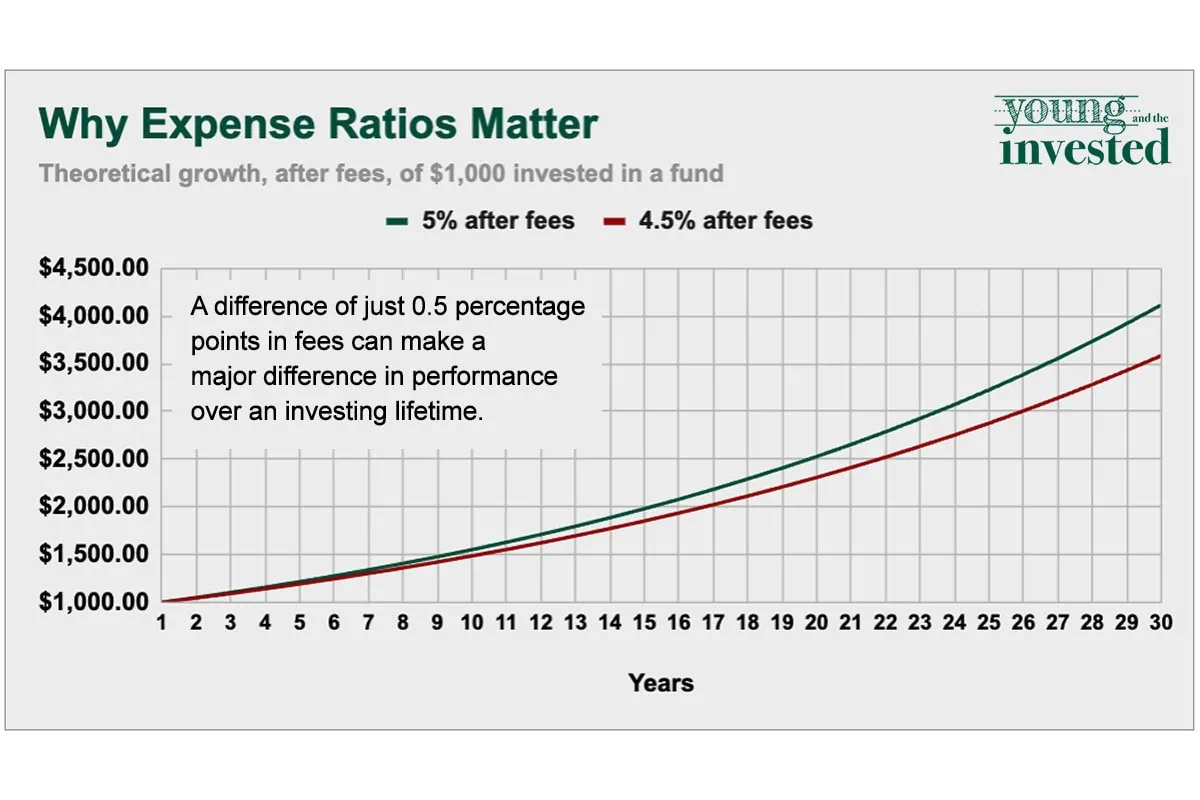
The expense ratio is the percentage of your investment lost each year to management fees, trading expenses and other fund expenses. Because index funds are passively managed and don’t have large staffs of portfolio managers and analysts to pay, they tend to have some of the lowest expense ratios of all mutual funds.
This matters because every dollar not lost to expenses is a dollar that is available to grow and compound. And over an investing lifetime, even a half a percent can have a huge impact. If you invest just $1,000 in a fund generating 5% per year after fees, over a 30-year horizon, it will grow to $4,116. However, if you invested $1,000 in the same fund, but it had an additional 50 basis points in fees (so it only generated 4.5% per year in returns), it would grow to only $3,584 over the same period.
Want to talk more about your financial goals or concerns? Our services include comprehensive financial planning, investment management, estate planning, taxes, and more! Schedule a call with Riley to discuss what you need, and what we can do for you.

Related: 15 Best Long-Term Stocks to Buy and Hold Forever
As even novice investors probably know, funds—whether they’re mutual funds or exchange-traded funds (ETFs)—are the simplest and easiest ways to invest in the stock market. But the best long-term stocks also offer many investors a way to stay “invested” intellectually—by following companies they believe in. They also provide investors with the potential for outperformance.
So if you’re looking for a starting point for your own portfolio, look no further. Check out our list of the best long-term stocks for buy-and-hold investors.
Related: 10 Best Monthly Dividend Stocks for Frequent, Regular Income
The vast majority of American dividend stocks pay regular, reliable payouts—and they do so at a more frequent clip (quarterly) than dividend stocks in most other countries (typically every six months or year).
Still, if you’ve ever thought to yourself, “it’d sure be nice to collect these dividends more often,” you don’t have to look far. While they’re not terribly common, American exchanges boast dozens of monthly dividend stocks.
Please Don’t Forget to Like, Follow and Comment
Did you find this article helpful? We’d love to hear your thoughts! Leave a comment with the box on the left-hand side of the screen and share your thoughts.
Also, do you want to stay up-to-date on our latest content?
1. Follow us by clicking the [+ Follow] button above,
2. Subscribe to Retire With Riley, our free weekly retirement planning newsletter, and
3. Give the article a Thumbs Up on the top-left side of the screen.
4. And lastly, if you think this information would benefit your friends and family, don’t hesitate to share it with them!