




If you invest in a 401(k), chances are that even within your limited universe of mutual fund options, several mutual fund providers will be represented. And if you save for retirement through an individual retirement account (IRA) or other much more flexible accounts, you’ll have a whole world of options at your disposal.
And while there’s certainly nothing wrong with buying funds from different providers based solely on who offers the most attractive option, some investors find that they can own just about every strategy they want within the same fund family.
Fidelity is among the fund families that tend to garner a little loyalty. No wonder: Its massive scale allows it to offer a wide variety of funds spanning numerous investment goals for far-below-average fees and, in most cases, absolutely no required minimum investment.
If you’re starting to invest for retirement in 2026 or simply looking to make a few changes, read on as I look at some of Fidelity’s best retirement funds. I’ll also provide answers to several FAQs about retirement investing broadly.
Editor’s Note: The tabular data presented in this article is up-to-date as of Jan. 26, 2026.
Featured Financial Products
Disclaimer: This article does not constitute individualized investment advice. Individual securities, funds, and/or other investments appear for your consideration and not as personalized investment recommendations. Act at your own discretion.
Table of Contents
What Should You Want in a Retirement Fund?

Here are some of the most critical factors to consider when you start investing your retirement savings in tax-advantaged retirement accounts such as 401(k)s and IRAs:
— Costs: Let’s say you paid $5 in expenses for every $100 a mutual fund earned you; that’s $5 that wouldn’t grow and compound for you over time. So if all else is equal, the lower the cost, the better. However, occasionally, a fund justifies its higher fees. No worries in that department: The best Fidelity retirement funds’ fees typically sit near or at the bottom of their category.
— Income: You ideally want your retirement portfolio to produce at least some regular income—in the form of both bond interest and dividend income. Stock prices can suffer during nasty corrections and bear markets, but income-generating funds can help provide for your living expenses without forcing you to sell at an inopportune time. How much income your account should produce depends on your own circumstances. For instance, older investors tend to be more concerned with income while younger investors focus more on growth.
— Taxes: A taxable account (like a standard brokerage account) is better suited to take advantage of certain tax-advantaged investments, such as municipal bonds. For tax-advantaged accounts, such as HSAs, some of the best investments include bond funds (where the interest income won’t be taxed) and actively managed stock funds (where the capital gains distributions from heavy trading, aka “turnover,” won’t be taxed).
— Diversification: You’ve likely always been told that you should hold a diversified portfolio, which means that you hold a variety of investments, not just one or two. That could mean holding multiple assets (stocks, bonds, commodities), but that could also mean holding, say, stocks from different countries, or stocks from different sectors. And investment funds, which can own any number of stocks, bonds, or other holdings all at once, can help you achieve that diversification. But every fund has its own level of built-in diversification. Some funds hold dozens of stocks while others hold thousands. Some funds invest heavily in their biggest stocks while others spread their assets out more evenly. So always consider how diversified a fund really is, as well as whether that level of diversification suits your needs.
Why Should You Invest in Fidelity Mutual Funds?
Fidelity is a leader in mutual funds (and ETFs, for that matter) and has been a force in the industry since the launch of its Fidelity Puritan Fund (FPURX) back in 1947.
Today, this premier mutual fund company boasts trillions in assets thanks to many successes over the intervening years. That includes star money managers such as Peter Lynch, the long-time manager of the Fidelity Magellan Fund (FMAGX) who averaged an incredible 29.2% per year between 1977 and 1990.
However, while Fidelity first built its name on actively managed funds, over the past three decades, the firm has built out its low-cost and even no-cost index funds as part of the movement to reduce expense ratios and transaction costs for individual investors.
Fidelity’s Best Retirement Funds for 2026

With all of that as an introduction, let’s choose some of the very best Fidelity retirement funds to round out a portfolio.
Any or all of these mutual funds are ideal holdings for a tax-deferred retirement plan like an IRA or 401(k) plan given their tax consequences, but some are perfectly at home in a good old-fashioned brokerage account.
1. Fidelity 500 Index Fund
— Style: U.S. large-cap stock
— Management: Index
— Assets under management: $738.6 billion
— Dividend yield: 1.1%
— Expense ratio: 0.015%, or 15¢ per year for every $1,000 invested
— Minimum initial investment: None
The S&P 500 Index is made up of hundreds of America’s biggest and most recognized companies. And it’s not just one of the most renowned stock-market indexes in the world—it’s one of the most productive. Even professional money managers struggle to beat it; according to S&P Dow Jones Indices data, just 14% of actively managed large-cap mutual funds have outperformed the S&P 500 over the trailing 10-year period, and that number ticks down to 12% when looking at the past 15 years.
Related: The 11 Best Fidelity Funds You Can Own
“I know guys that rate active managers in all these categories, and even they’re like, ‘I’m not buying actively managed large blend; I’m just indexing,'” says Daniel Sotiroff, Senior Analyst for ETF and Passive Strategies at Morningstar. “Because it’s so brutally tough to beat a dirt-cheap index fund in the large blend category.”
Even Warren Buffett, the Oracle of Omaha himself—considered by many to be the greatest investor in history—has said on multiple occasions that most investors, most of the time, should simply buy and hold an S&P 500 index fund and let it run.
So if you’re assembling a long-term retirement portfolio, investing in a simple S&P 500 index fund like the Fidelity 500 Index Fund (FXAIX) is one of the smartest moves you can make. And FXAIX in particular is one of the most cost-effective ways to buy the S&P 500. The Fidelity 500 Index Fund has an almost nonexistent expense ratio of just 0.015%, which is just about impossible to beat. That has helped it draw an incredible $740 billion or so in assets under management, and it’s why I rank FXAIX among the best mutual funds you can buy.
Related: 9 Best Fidelity ETFs for 2026 [Invest Tactically]
As I mentioned above, when evaluating a retirement fund, you’ll always want to consider “turnover” (the percentage of a fund’s holdings that are cycled out of the fund in a given year). High turnover means a lot of trading costs, which are passed on to investors in the form of capital gains distributions, which are taxable … but you can avoid that tax hit by holding high-turnover funds in tax-advantaged retirement accounts like 401(k)s and IRAs.
Fidelity 500 and other S&P 500 index funds tend to have extremely low turnover, at just a couple percent annually, meaning it pays little to no capital gains distributions. Thus, Fidelity 500 will do just fine in a regular ol’ taxable brokerage account. However, given that many people only invest through tax-advantaged retirement accounts, and given that S&P 500 funds will typically make up the core of your portfolio no matter your account type, FXAIX remains a great holding for any retirement account.
Do you want to get serious about saving and planning for retirement? Sign up for Retire With Riley, Young and the Invested’s free retirement planning newsletter.
2. Fidelity Zero Total Market Index Fund

— Style: U.S. large-cap stock
— Management: Index
— Assets under management: $32.4 billion
— Dividend yield: 1.0%
— Expense ratio: N/A
— Minimum initial investment: None
Fidelity’s FXAIX might be one of the least expensive S&P 500 funds you can buy, but Fidelity’s ZERO line of mutual funds manage to go even lower. That’s because they charge nothing—zip, nada, nolla—in annual fees.
Until a mutual fund company starts paying you to own its products, that’s as cheap as it gets.
Fidelity Zero Total Market Index Fund (FZROX) isn’t quite the same as the Fidelity 500. On their faces, you’d think they’re significantly different. The S&P 500 is considered a “large-cap” fund, but FZROX—which tracks the Fidelity U.S. Total Investable Market Index—is a “total market” fund, which means it holds stocks of all sizes. In practice, FZROX leans smaller, but the funds aren’t terribly dissimilar: FXAIX holds an 81/18/1 blend of large-, mid-, and small-cap stocks, while FZROX’s portfolio is a 72/20/8 blend.
You’re technically not getting the total market, though. To keep costs down, the mutual fund uses statistical sampling techniques to replicate the returns of the index without having to own every underlying stock. Still, this Fidelity fund currently holds roughly 2,530 stocks, making it exceptionally well diversified.
Related: 9 Best Fidelity Index Funds to Buy
Practically speaking, there is not much difference between an expense ratio of 0.015% and zero. That extra 15¢ per year per $1,000 invested isn’t going to make a material difference over an investing lifespan. But it’s also not nothing. So if paying the absolute minimum in fees is philosophically important to you, these ZERO products—which cover a few core portfolio needs—could absolutely be treated as Fidelity retirement funds.
However, to invest in FZROX, or any other Fidelity ZERO fund, you have to have a Fidelity brokerage account. If you don’t have a Fidelity brokerage account but want comparable exposure, the Fidelity Total Market Index Fund (FSKAX) charges a barely noticeable 0.015% in annual expenses and requires zero minimum initial investment.
Related: The 7 Best Fidelity Index Funds for Beginners
Featured Financial Products
3. Fidelity Trend Fund

— Style: U.S. large-cap growth stock
— Management: Active
— Assets under management: $4.5 billion
— Dividend yield: 0.2%
— Expense ratio: 0.59%, or $5.90 per year for every $1,000 invested
— Minimum initial investment: None
An old Wall Street maxim says “you never go broke taking a profit.” There is a lot of wisdom in that quote. As a general rule, buying and holding good stocks or good funds and allowing them to compound over years or even decades is the way to go. But having at least part of your portfolio in actively traded strategies can also make sense, particularly in bear markets. Actively traded strategies have their stretches when they outperform passive index strategies, and they can potentially help you to avoid major declines.
Unfortunately, active trading strategies are also woefully tax-inefficient, particularly if your holding period is less than a year. Short-term capital gains are taxed as ordinary income, meaning you could be sharing up to 37% of your gains with Uncle Sam.
Related: The 16 Best ETFs to Buy for a Prosperous 2026
So, it makes sense to hold funds that do a lot of active trading in a tax-deferred retirement account. There is no precise, universally accepted threshold for what constitutes “a lot” of active trading, but I would consider any fund with portfolio turnover (how much of the portfolio’s holdings are turned over, or replaced, in a given year) over 30% or so to be fairly tax-inefficient. The higher that number goes, the more inefficient the fund.
As an example, let’s look at the Fidelity Trend Fund (FTRNX). This is a fairly aggressive fund that focuses on companies the manager believes have above-average growth potential. Unsurprisingly, FTRNX is heavy in tech names such as NVDA and MSFT. It has has beaten its Morningstar category average over every meaningful time period, and it’s in the top 20% (or better) of its peers by performance across those time frames, too.
But this high performance comes at the cost of a lot of active trading; the annual portfolio turnover is almost 65%. In a taxable account, the resulting capital-gains distributions represent a large potential tax liability. Thus, FTRNX is exactly the kind of actively managed fund best held in a tax-advantaged retirement account.
Want to learn more about FTRNX? Check out the Fidelity provider site.
Make Young and the Invested your preferred news source on Google
Simply go to your preferences page and select the ✓ box for Young and the Invested. Once you’ve made this update, you’ll see Young and the Invested show up more often in Google’s “Top Stories” feed, as well as in a dedicated “From Your Sources” section on Google’s search results page.
Related: The 7 Best REITs to Buy for 2026
4. Fidelity Nasdaq Composite Index Fund
— Style: U.S. large-cap growth stock
— Management: Index
— Assets under management: $23.1 billion
— Dividend yield: 0.5%
— Expense ratio: 0.29%*, or $2.90 per year for every $1,000 invested
— Minimum initial investment: None
When you visit a financial website or look at a business channel chyron, you’ll typically see data for the S&P 500 and Dow Jones Industrial Average prominently displayed. That’s because when the average person asks “how did the stock market do today?” they’re typically asking about one of these two American stock-market benchmarks.
They’re probably not asking about the Nasdaq Composite Index.
The market cap-weighted Nasdaq Composite Index is made up of all the roughly 3,300 stocks that are listed on the Nasdaq Composite, which serves alongside the New York Stock Exchange as the world’s two largest stock exchanges by market capitalization. And while it holds a place of prominence right alongside the S&P 500 and DJIA, it’s less as a broad-market index, and more as a proxy of the tech sector.
Related: 8 Best Schwab Retirement Funds [High Quality, Low Costs]
That makes the Fidelity Nasdaq Composite Index Fund (FNCMX) particularly interesting as a Fidelity retirement fund for anyone who wants to be more aggressive with the equity portion of their portfolio.
FNCMX holds a little more than 2,900 Nasdaq Composite stocks—not the index’s full roster, but a representative amount accounting for the vast majority of the index’s market cap. As I write this, about half of the fund’s assets are invested in the technology sector, and another 30% or so is split between the tech-esque communications services sector and the consumer discretionary sector, which includes tech-adjacent mega-caps like Amazon (AMZN) and Tesla (TSLA). Large-cap growth funds normally favor tech and tech-esque companies, but Fidelity Nasdaq Composite Index is even more concentrated in those holdings than competitor funds.
That said, while FNCMX is an aggressive product, it’s not a trading hive. Turnover is actually minimal, at just 2%. That makes this Fidelity fund fairly tax-efficient, and thus perfectly appropriate for taxable accounts and tax-advantaged accounts alike.
* 0.30% gross expense ratio is reduced with a 1-basis-point fee waiver until at least March 31, 2027.
Related: The 7 Best Mutual Funds for Beginners
5. Fidelity International Index Fund

— Style: International large-cap stock
— Management: Index
— Assets under management: $74.1 billion
— Dividend yield: 3.2%
— Expense ratio: 0.035%, or 35¢ per year for every $1,000 invested
— Minimum initial investment: None
The United States is the world’s leading innovation hub as well as its largest economy. And if you are an American and your expenses are in dollars, it only makes sense to keep the bulk of your wealth in U.S. stock and bond funds.
Still, there are thousands of quality companies in developed markets like Europe, Canada, Australia, or wealthier Asian markets like Japan or South Korea, and in emerging markets (less stable but faster-growing) like China and India. And while U.S. stocks have led the world over the past decade, there are long stretches when international stocks outperform, such as 2000-08, and in 2025.
Related: 11 Best Vanguard Funds for the Everyday Investor
Fidelity International Index Fund (FSPSX) is one of the best options for gaining access to a wide selection of international companies. This Fidelity mutual fund’s portfolio is more than 700 stocks wide, featuring foreign blue chips such as Dutch semiconductor equipment company ASML Holding (ASML), British pharmaceutical mainstay AstraZeneca (AZN), and Swiss consumer giant Nestlé (NSRGY).
Morningstar Associate Analyst Brendan McCann notes that FSPSX’s index doesn’t include emerging markets (less established but more “growthy” countries), nor does it own small-cap stocks, so it would miss out on any success in either of those slices of the market.
“However, the impact on category-relative performance should not be huge,” says McCann, in explaining the fund’s Silver Morningstar Medalist rating. “Taken together, they usually constitute less than 10% of competitor portfolios in the foreign large-blend category. Middling performance in those segments gave these funds a small leg up on competitors in recent years.”
Related: 5 Best Stock Recommendation Services [Stock Tips + Picks]
Also worth noting is that international blue chips tend to pay larger dividends than their American brethren; that’s plain to see in FSPSX, whose 3.2% dividend yield is more than double what investors are getting out of the S&P 500.
Fidelity International Index is a one-stop shop for exposure to international stocks, and with an expense ratio of just 0.035%, it’s virtually free to own.
6. Fidelity Investment Grade Bond Fund

— Style: U.S. intermediate-term core bond
— Management: Active
— Assets under management: $11.8 billion
— SEC yield: 4.1%*
— Expense ratio: 0.45%, or $4.50 per year for every $1,000 invested
— Minimum initial investment: None
Most investors need some exposure to bonds, which is debt that’s issued by governments, companies, and other entities. Their interest payments and relative lack of volatility make them an excellent tool for providing a portfolio with stability and income.
Related: Best Fidelity Retirement Funds to Hold in an IRA
Individual bonds can be a hassle, however. Data and research on individual issues is much thinner than it is for publicly traded stocks. And some bonds have minimum investments in the tens of thousands of dollars. But you can blunt these problems by purchasing a bond fund, which allows you to invest in hundreds or even thousands of bonds with a single click—and, in many cases, very low fees.
That makes core bond funds such as the Fidelity Investment Grade Bond Fund (FBNDX) attractive buy-and-hold products for retirement planners who, when it comes to their debt exposure, want to hand the reins over to skilled managers. And now that the yield curve has normalized, investors looking for fixed income are once again being rewarded for buying bonds a little longer in maturity.
Related: Best Fidelity Retirement Funds to Hold in a 401(k) Plan
FBNDX’s five co-managers have built a portfolio of more than 4,600 investment-grade securities spanning numerous debt types, including U.S. Treasuries, corporate bonds, pass-through mortgage-backed securities (MBSes), commercial MBSes, asset-backed securities (ABSes), and other debt. The portfolio’s bond maturities range between just a few months and 20 years, though the biggest allocation is to intermediate-term bonds of five to 10 years until maturity.
Duration—a measure of interest-rate sensitivity—is 6.0 years. In theory, this means if interest rates were to rise by 1 percentage point, the portfolio should experience a short-term capital loss of about 6.0%. Likewise, a 1-percentage-point decline in interest rates would result in a 6.0% increase in short-term capital gains.
Long story short: Fund shareholders are instantly plugged into a widely diversified and well-selected set of fixed-income assets, which generate a decent stream of income, and at a very reasonable cost. This makes FBNDX one of the best Fidelity retirement funds to buy.
* SEC yield reflects the interest earned across the most recent 30-day period. This is a standard measure for funds holding bonds and preferred stocks.
Related: The 9 Best Fidelity ETFs for 2026 [Invest Tactically]
Featured Financial Products
7. Fidelity Short-Term Bond Fund

— Style: U.S. short-term bond
— Management: Index
— Assets under management: $2.5 billion
— SEC yield: 3.8%
— Expense ratio: 0.30%, or $3.00 per year for every $1,000 invested
— Minimum initial investment: None
Short-term bonds are a great source of safety. However, how much yield they’ll give you depends on the interest-rate environment. For instance, bonds with short maturities currently offer relatively high income for relatively low risk. And that makes products such as Fidelity Short-Term Bond Fund (FSHBX) particularly attractive.
Related: 6 Best Money Market Funds [Protect Your Savings]
FSHBX’s managers are tasked with assembling a high-quality portfolio of bonds with an average weighted maturity of three years or less. The fund’s roughly 475 holdings are currently split among a number of categories: Corporate bonds and Treasuries make up the biggest “sleeves” at more than 35% apiece, but you’ll also get modest exposure to ABSes, CMBSes, collateralized mortgage obligations (CMOs), agency bonds, and other debt. Credit quality is high, too, with the fund allocating only a fractional sliver of its assets to “junk”-rated bonds.
These are high-quality bonds with little in the way of credit risk. And because the bonds are short-term in nature, they have very little sensitivity to changes in market interest rates. Fidelity Short-Term Bond’s portfolio has a weighted average maturity of just 2.0 years and a duration of only 1.8 years.
Related: The 10 Best Dividend ETFs [Get Income + Diversify]
There might come a day when short-term bond funds are no longer particularly attractive. But for now, a nearly 4% yield is attractive and comes with very little risk. Thus, FSHBX remains one of the very best Fidelity retirement funds you can buy.
Do you want to get serious about saving and planning for retirement? Sign up for Retire With Riley, Young and the Invested’s free retirement planning newsletter.
8. Fidelity Real Estate Income Fund

— Style: Sector (Real estate)
— Management: Active
— Assets under management: $5.7 billion
— SEC yield: 5.0%
— Expense ratio: 0.66%, or $6.60 per year for every $1,000 invested
— Minimum initial investment: None
Real estate has been a preferred asset class since the dawn of human civilization. And today, real estate investment trusts (REITs) offer the potential for both high yield and respectable capital gains.
REITs enjoy a special tax status that allows them to avoid corporate taxation so long as they distribute at least 90% of their net profits as dividends. Because of this tax incentive, REITs tend to be one of the highest-yielding sectors and a perennial favorite among income investors.
Related: 7 Low- and Minimum-Volatility ETFs for Peace of Mind
Unfortunately, this also makes REITs very tax-inefficient, as a large percentage of the total return comes from taxable dividends. What’s more, REIT dividends are generally not classified as “qualified dividends.” Qualified dividends are taxed at the long-term capital gains rate (0%, 15% or 20% depending on your tax bracket). Non-qualified dividends are taxed as ordinary income, like bond interest, and can face rates as high as 37%, depending on your bracket. Thus, it makes more sense to hold REITs and REIT funds in a tax-advantaged plan like a 401(k) rather than a taxable brokerage account.
If you’re looking for a good contender, the Fidelity Real Estate Income Fund (FRIFX) is a solid option. The fund holds a collection of common stock of U.S. REITs such as datacenter specialist Equinix (EQIX), logistics real estate leader Prologis (PLD), and telecommunications REIT American Tower (AMT).
However, what really sets FRIFX apart from most of its competitors is that equities are only part of the story. Common stock makes up only about a third of the fund’s assets. The majority of holdings are fixed-income assets including bonds, preferred stocks, and even mortgage-backed securities. Thus, while we would normally show a trailing-12-month yield for a REIT fund, FRIFX’s debt-heavy portfolio mix makes an SEC yield more appropriate.
That SEC yield is 5% right now, making it a very competitive income option—even in a high-yield environment like today.
Like Young and the Invested’s Content? Be sure to follow us.
9. Fidelity Freedom Funds

— Style: Target-date
— Management: Active or index, depending on Freedom series
— Expense ratio: Fidelity Freedom Funds: 0.46%-0.68%, or $4.60-$6.80 per year for every $1,000 invested; Fidelity Freedom Index Funds: 0.12%, or $1.20 per year for every $1,000 invested; Fidelity Freedom Blend Funds: 0.41%-0.47%, or $4.10-$4.70 per year for every $1,000 invested; Fidelity Freedom Sustainable Target Date Funds: 0.41%-0.49%, or $4.10-$4.90 per year for every $1,000 invested
— Minimum initial investment: None
One of the issues in building an appropriate allocation allocation is that your ideal mix of stock and bond funds will evolve over time based on your age and stage of life. An ideal portfolio for a 20-year-old is likely going to be very different from that of a 40-year-old, and both those portfolios will be different from what’s ideal for a 60-year-old.
This is where a target date fund can really be a lifesaver. A target-date fund—also called a life-cycle fund—is a type of mutual fund that is designed to change its asset allocation over time.
Related: Beginner’s Guide to Vanguard Target-Date Funds
The typical target-date fund is an actively managed fund—one that will start out with a heavy allocation to stocks and then slowly transition to a heavier allocation to bonds as it approaches its target retirement date, following a glide path.
The target retirement date is intended to be a rough estimate and doesn’t need to be precise. You’re generally not going to know the precise year you plan to retire decades in advance. Fidelity, like most mutual fund families, creates its target-date funds in five-year increments of target retirement date (say, 2025, 2030, 2035, etc.).
Related: Beginner’s Guide to Schwab Target-Date Funds
Fidelity mutual funds have excellent reputations for their low costs and breadth of offerings, and Fidelity’s target-date fund families continue that legacy. They include the Fidelity Freedom Funds, as well as a sustainable target-date lineup:
- Fidelity Freedom
- Fidelity Freedom Index
- Fidelity Freedom Blend
- Fidelity Target Date Sustainable
These Fidelity target-date funds hold portfolios of mostly Fidelity stock and bond mutual funds, they’re cheap, and they have no required minimum investment. They’re among the best suites of life-cycle funds you can buy, and you can read more about them in our primer on Fidelity target-date funds.
Learn More About These and Other Funds With Morningstar Investor
 Morningstar
If you’re buying a fund you plan on holding for years (if not forever), you want to know you’re making the right selection. And Morningstar Investor can help you do that.
Morningstar Investor provides a wealth of information and comparable data points about mutual funds and ETFs—fees, risk, portfolio composition, performance, distributions, and more. Morningstar experts also provide detailed explanations and analysis of many of the funds the site covers.
With Morningstar Investor, you’ll enjoy a wealth of features, including Morningstar Portfolio X-Ray®, stock and fund watchlists, news and commentary, screeners, and more. And you can try it before you buy it. Right now, Morningstar Investor is offering a free seven-day trial and a discount on your first year’s subscription when you use our exclusive link.
What Are Fidelity ZERO Funds?

Fidelity ZERO Funds are a line of zero-minimum, zero-expense index funds launched by Fidelity in 2018. Currently, there are four Fidelity ZERO funds:
— Fidelity Zero International Index Fund (FZILX)
— Fidelity Zero Total Market Index Fund (FZROX)
— Fidelity Zero Extended Market Index (FZIPX)
— Fidelity Zero Large Cap Index Fund (FNILX)
The ZERO funds are true to their name: Investors literally pay nothing in management fees. But there are conditions. The Fidelity ZERO funds are only available in Fidelity brokerage accounts. That might not be a problem, as Fidelity brokerage accounts are generally well regarded and competitive with the other major online brokers. But if you do not already have a Fidelity account, you’d need to open one.
Fidelity ZERO Funds are, strictly speaking, index funds. But they are based on customized indexes that Fidelity has created in-house. The typical large-cap index fund tracks the S&P 500 or another recognized index, but they have to pay licensing fees to the index creator. Fidelity avoids the licensing fees by creating their own indexes, which allows them to pay the savings on in the form of zero fees.
The Fidelity indexes tend to be very similar to popular indexes such as the S&P 500, but they are not the same. So, if tracking a specific index is a priority for you, you should take that under advisement.
What Is the Minimum Investment Amount on a Fidelity Fund?

Every Fidelity fund has its own minimum investment amount specific to that fund. But Fidelity has been a trailblazer in making its funds available to beginning investors with ultra-low minimums, and many Fidelity funds have no minimum investment at all.
Part of our criteria in selecting the best Fidelity index funds was accessibility, and every fund selected here has a minimum investment of zero, meaning you can literally start your investment with any dollar amount.
Why Does a Fund’s Expense Ratio Matter So Much?
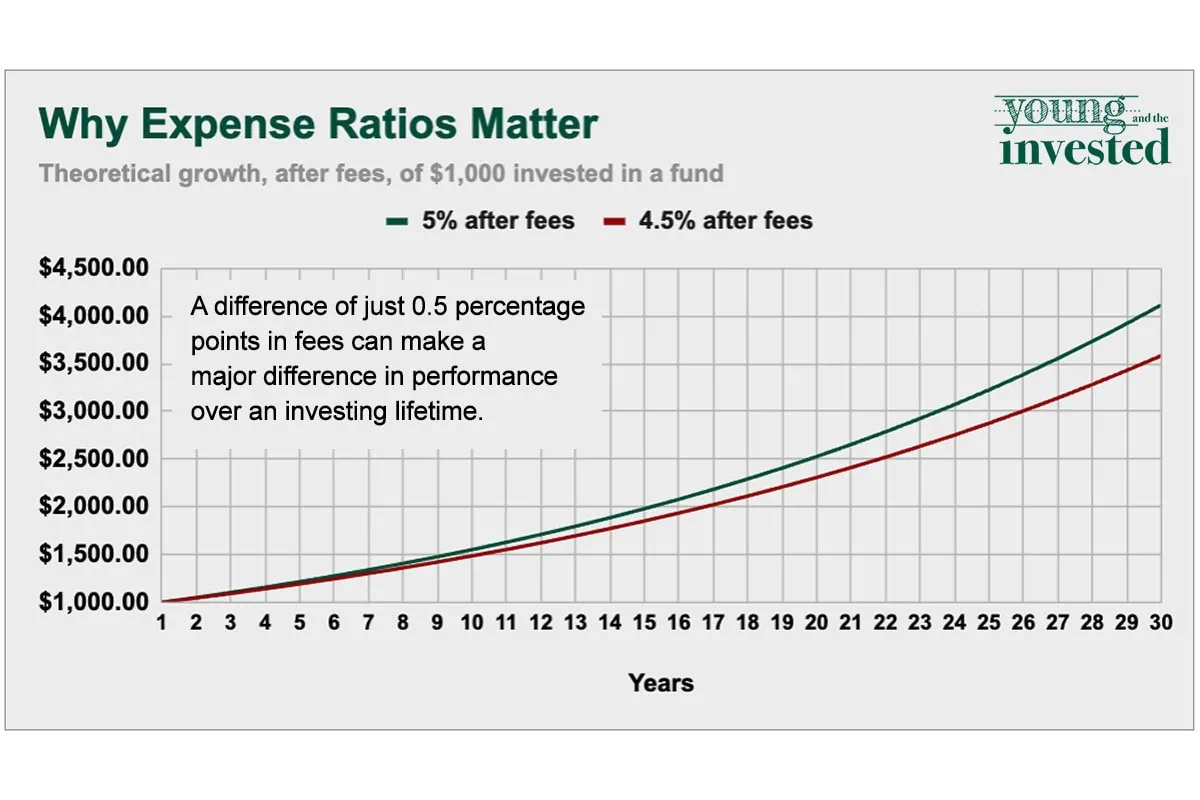
Every dollar you pay in expenses is a dollar that comes directly out of your returns. So, it is absolutely in your best interests to keep your expense ratios to an absolute minimum.
The expense ratio is the percentage of your investment lost each year to management fees, trading expenses and other fund expenses. Because index funds are passively managed and don’t have large staffs of portfolio managers and analysts to pay, they tend to have some of the lowest expense ratios of all mutual funds.
This matters because every dollar not lost to expenses is a dollar that is available to grow and compound. And over an investing lifetime, even a half a percent can have a huge impact. If you invest just $1,000 in a fund generating 5% per year after fees, over a 30-year horizon, it will grow to $4,116. However, if you invested $1,000 in the same fund, but it had an additional 50 basis points in fees (so it only generated 4.5% per year in returns), it would grow to only $3,584 over the same period.
Want to talk more about your financial goals or concerns? Our services include comprehensive financial planning, investment management, estate planning, taxes, and more! Schedule a call with Riley to discuss what you need, and what we can do for you.

Related: 15 Best Long-Term Stocks to Buy and Hold Forever

As even novice investors probably know, funds—whether they’re mutual funds or exchange-traded funds (ETFs)—are the simplest and easiest ways to invest in the stock market. But the best long-term stocks also offer many investors a way to stay “invested” intellectually—by following companies they believe in. They also provide investors with the potential for outperformance.
So if you’re looking for a starting point for your own portfolio, look no further. Check out our list of the best long-term stocks for buy-and-hold investors.
Related: 7 Best Vanguard Dividend Funds to Buy [Low-Cost Income]
What’s better than a smart, sound dividend income strategy? How about a smart, sound dividend income strategy with very little money coming out of your pocket?
If that sounds good to you, you need look no farther than low-cost pioneer Vanguard, which offers up a number of payout-oriented products. Find out what you need to know in our list of seven top-notch Vanguard dividend funds.
Please Don’t Forget to Like, Follow and Comment
Did you find this article helpful? We’d love to hear your thoughts! Leave a comment with the box on the left-hand side of the screen and share your thoughts.
Also, do you want to stay up-to-date on our latest content?
1. Follow us by clicking the [+ Follow] button above,
2. Subscribe to Retire With Riley, our free weekly retirement planning newsletter, and
3. Give the article a Thumbs Up on the top-left side of the screen.
4. And lastly, if you think this information would benefit your friends and family, don’t hesitate to share it with them!