


Financial stress ranked #1 on the American Psychological Association’s annual Stress in America™ survey this year. It has held this position every year since 2007 when the survey began.
It’s natural for parents to want to shield their children from some of this stress by investing money towards their future. However, the best strategies for investing in your child’s future might seem unclear.
- When should you get started?
- What are the best investment accounts?
- What are the best investment vehicles?
- How much should you save?
Undoubtedly, these questions pose serious concerns for parents looking to help their children overcome financial stress. Learn the answers to these questions and more below.
Before You Start Investing for Your Child’s Future

When it comes to investing, the rule is usually that the sooner you invest, the better. But that doesn’t necessarily mean you should start investing for your child the day they are born. Before pursuing investing for kids, you should have emergency savings set aside and you have confidence in your retirement funds.
In retirement, you absolutely need to have affordable housing, food and other necessities. If you can’t, it will be a burden to you as well as your child. It’s similar to how you need to put on your own oxygen mask before you assist another. Help yourself first and then you’ll find yourself in a better position to aid others.
Paying for your child’s college or retirement is ideal, but not as high of a priority. Get yourself to a place where you can “max out” your 401k, especially if you work for a company that matches part of your contributions. Financial advisors commonly say once you’re able to contribute 15% of your income towards retirement, that’s when you should start investing for your child.
This percentage might vary depending on your investment history. If you’ve worked towards your retirement since a teenager and have already saved a significant amount, this percentage might be lower. People who got a late start saving for retirement and want to catch up may need a higher percentage.
Invest for Your Child’s School Savings Account (529 Plan)

When you start to invest for your child’s future, begin with a tax-advantaged savings account. A 529 college savings account acts as one of your best options. These plans can cover expenses related to K-12 tuition if you plan to send your child to a private school or can go toward covering college tuition costs.
These tax-advantaged accounts accumulate on a tax-deferred basis and distributions remain untaxed if used for qualified higher education expenses. You don’t need to use the money at any one specific college, but can use it at any of the nationwide qualified colleges.
Usually, the college doesn’t have to be in the state where you created your 529 account. There are even hundreds of foreign universities that qualify. Make sure to compare the benefits of various state plans before choosing one.
A 529 college savings plan works similarly to a Roth 401(k) or Roth IRA in that you invest your post-tax contributions in mutual funds, target date funds or other investments.
Another category of 529 plans is prepaid tuition plans. These plans let you prepay for costs of in-state public colleges and you can convert the funds for use in other states or at private colleges. If you have confidence your child will attend a private school, you can open a Private College 529 Plan, which over 250 private colleges sponsor.
Once your child begins college, money from the account can go toward eligible expenses, typically including tuition, computers, books, supplies, and housing (if the student enrolls at least half-time). Room and board can’t exceed the “cost of attendance” figures colleges provide. Distributions can also go toward repaying federal and private student loans.
If you withdraw money for non-qualified expenses, the earnings portion becomes subject to ordinary income taxes as well as a 10% tax penalty. You can waive this penalty if the beneficiary attends a U.S. Military Academy, earns a tax-free scholarship, dies, or becomes disabled. The earnings would still fall subject to tax, however.
Suppose your child doesn’t attend college. In that situation, you can switch the beneficiary to another qualifying family member, have yourself become the beneficiary and further your own education, use it for K-12 tuition (up to $10,000), or use the money to repay student loans (up to $10,000).
Funds can also roll over to a 529 ABLE account, which acts as a savings account for people with disabilities. If you have a willingness to pay the penalty and taxes, you can always withdraw your money for any reason. Plans usually have minimum initial contribution requirements. After that, you can make automatic money deposits, contribute lump sums, or both.
Finally, under the SECURE 2.0 Act, which went into effect in 2025, unused 529 funds can be rolled into the beneficiary’s Roth IRA without a tax penalty. There is a lifetime limit of $35,000 for this.
How to Open a 529 Account
If you have interest in opening a 529 account for your child to save money toward educational expenses now or in the future, you should consider opening an account sooner than later. This will allow you to make the most of compounding returns as your child ages and nears his or her financial need.
One company worth knowing in this space is Backer.
Backer

The company aims to make saving for college so easy that every American child will have a college fund, no matter their family’s means, where they come from, or what they look like.
Backer users have lauded its service for three primary reasons:
- Simplicity – Backer allows families to start a college fund or enhance their existing one in under 3 minutes
- Smart Design – The company leverages robo-advice to help families maximize their college savings with tax-free investing in line with the details discussed above
- Social – Backer allows friends and family to support the child’s college fund through gifts and cashback rewards through brand-name partners
- Backer allows you to invest your educational savings tax-free in a 529 plan and also allows for family and friends to help you to save more.
- Use low-cost index funds to invest in different asset classes, including stocks and bonds.

Related: Best Kid-Friendly Debit Cards
Invest for Your Child’s Future Retirement

Helping your child start to save for retirement can put them at a significant advantage later in life.
If your teenager has a job like a freelance writer, lifeguard, fast food worker or something else, you can open a custodial IRA in their name and invest in assets that appreciate in value or other income-generating assets.
A custodial account is a financial account maintained by an adult for another person, such as your child. You would manage your teenager’s account until they reach the age of majority, which is either 18 or 21, depending on your state. These accounts transfer ownership and you can set them up with the best investing apps for college students to manage their own investments.
With the custodial IRA, you can open a traditional or Roth IRA. In either account type, select the best investments for young adults and watch the returns compound over time. Opening and contributing to a child’s custodial IRA requires them to earn taxable income. Sadly, allowances don’t count and you can’t contribute more than what they make each year.
Keep in mind that, even if contributions don’t seem large, contributing regularly over long enough periods can result in a significant impact to their bottom line. These contributions add up and grow through returns earned over time.
A more straightforward, kid-friendly way to save for your child’s retirement is by opening an Acorns account. An Acorns account can be opened in under five minutes and you can start investing without much thought.
The “round up” feature is the most well-known part of Acorns. It rounds up your purchases to the nearest dollar and invests the money into your chosen portfolio. You can also contribute lump sums. This account is an easy way to save for your child’s retirement incrementally.
Invest for Your Child’s Future Expenses

You can also save for your child’s future expenses without a specific plan for how those funds should be used. Uniform Transfer to Minors Act (UTMA) accounts and Uniform Gifts to Minors Act (UGMA) accounts are two beneficial types of custodial accounts that let teenagers invest.
UTMA and UGMA accounts come controlled by the custodian until the minor reaches the age of majority for your state.
Money in these accounts has the tax advantage of only facing taxes at the child’s rate. For example, a child under age 19 wouldn’t pay taxes on the first $1,350 and only 10% for the next $1,350. After that, money falls under the guardian’s marginal tax rate.
With these accounts, you don’t have to limit your contributions to the amount of money your child makes. No contribution limits exist, though anything over $19,000 each year (or $38,000 for a married couple) requires paying the federal gift tax.
Make Young and the Invested your preferred news source on Google
Simply go to your preferences page and select the ✓ box for Young and the Invested. Once you’ve made this update, you’ll see Young and the Invested show up more often in Google’s “Top Stories” feed, as well as in a dedicated “From Your Sources” section on Google’s search results page.
Start Saving for Your Child’s Future Now
You have multiple options to consider when deciding how you’d like to start saving for your child’s future. Of the many I’ve reviewed, I find the two below to provide a simple, easy to use interface and the investments geared toward building long-term wealth.
→ Acorns Early
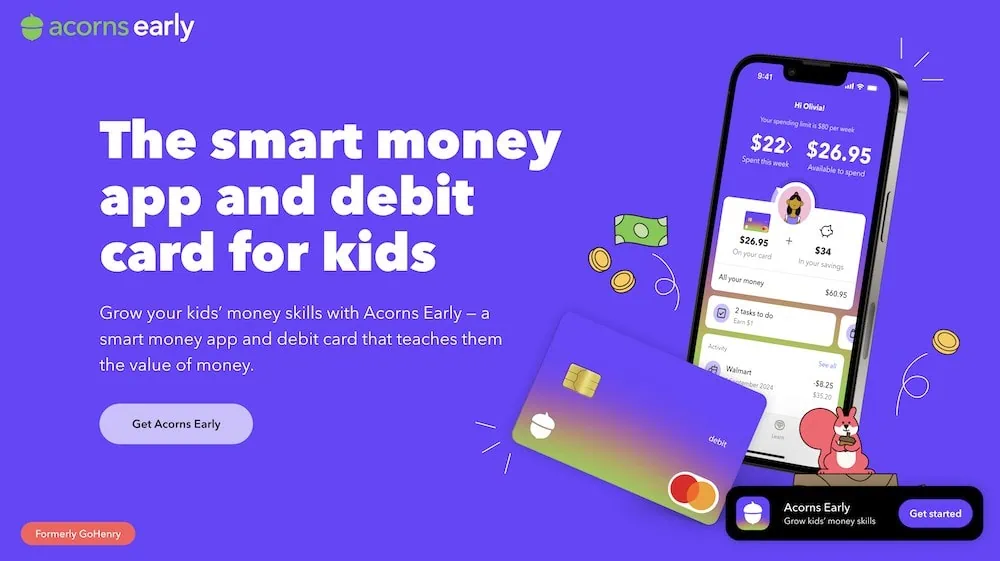
- Available: Acorns Early Lite | Acorns Gold
- Price: Acorns Early Lite: Free 30-day trial, then $8/mo. Acorns Early: $12/mo.