


Anyone looking to make a significant change to their portfolio in 2026’s early innings could do a lot worse than simply reviewing their current allocations and determining where new money might be better spent on superior and/or more cost-efficient replacements.
And on both counts, Schwab’s lineup of index funds is a great place to start.
Index funds were one of the biggest game-changers for retail investors like you and me. These simple, rules-based products have brought down costs across the board for decades, making it cheaper to grow our money and save for retirement. Even to this day, there’s an enormous gulf between the average actively managed mutual fund’s costs and the fees that index funds charge. Consider that according to Investment Company Institute data for 2024 (the most recent data available), equity mutual funds as a whole—including both active and index products—charged an asset-weighted average 0.40% annually. Index funds alone? They averaged just 0.05%.
But Schwab’s index funds have an extra leg up on the competition. That’s because in addition to generally low fees across its products, most Schwab funds also have a skinflint investment minimum of just one dollar. That’s a heckuva lot better than the hundreds or even thousands of dollars it takes to start investing in other mutual fund families’ products.
Today, I’m going to highlight some of the best Schwab index funds for buy-and-hold investors in 2026. Every fund featured here boasts both low fees compared to their category, as well as $1 minimums; and they do so while still delivering high-quality exposure to a variety of market strategies.
Editor’s Note: Tabular data presented in this article are up-to-date as of Jan. 14, 2026.
Disclaimer: This article does not constitute individualized investment advice. Individual securities, funds, and/or other investments appear for your consideration and not as personalized investment recommendations. Act at your own discretion.
Table of Contents
But First, Why Schwab?
Charles Schwab is a U.S.-based brokerage and banking company founded in 1971 as a traditional brokerage company and then as a discount brokerage service in 1974. It’s the largest publicly traded investment services firm with nearly $12 trillion in client assets. And it offers a wide range of financial services, such as investment advice and management, trading services, financial planning, banking services, workplace and individual retirement plans, annuities, and more.
It also offers very low-cost and extremely low-minimum mutual funds. Annual expenses on its mutual funds are well below the industry average. And Schwab really stands out from a nominal-expense perspective. Many providers’ mutual funds require minimum initial investments in the thousands of dollars. But again: Most Schwab mutual funds require a mere $1. That’s an ideal situation for anyone, but especially investors who don’t have much capital to put to work.
In short: Schwab offers a nice variety of mutual funds, some of which are among the best on the market, and they won’t leave your wallet in tatters.
And Second, Why Index Funds?
For most of their history, investment funds (like mutual funds) were entirely run by human managers, who would research, select, buy, and sell securities on the fund’s behalf.
That changed in the mid-1970s with the advent of the index fund.
An index measures the performance of a group of assets, and those assets are determined by the index’s rules. An index fund “tracks” the index by actually investing in all (or in some cases, a representative sampling of) the underlying assets. An index’s strategy can be broad, like the S&P 500, which measures a wide assortment of American companies. Or the focus can be as narrow as, say, holding only tobacco and alcohol companies domiciled in Japan.
But while I don’t recommend buying my hypothetical Tokyo Vice Index Fund, I do recommend buying index funds in general, for a few reasons.
They’re typically cheaper. An actively managed index fund has one or more managers, all of whom need to be paid. An index fund technically has a manager overseeing the fund, but they’re not performing stock research and deciding on trades—the index’s rules determine those actions. Thus, fund providers can afford to charge (often much) lower expenses on index funds.
Index funds tend to perform well, too, compared to comparable actively managed funds. I’ll provide a pretty stark example later, but just know that human managers often struggle to beat the benchmark indexes. So, if you have a fund that cheaply tracks a benchmark index, and many human managers can’t even beat that benchmark index … that index fund starts to look awfully good.
How the Best Schwab Index Funds Were Selected
Unlike other mutual fund giants, Schwab’s assets are concentrated in a tight roster of just a few dozen mutual funds. So, investors sorting through Schwab’s index mutual funds won’t have nearly as bad a case of analysis paralysis.
Still, a little filtering is necessary to get us down to a more manageable list. So as I often do when reviewing funds, I’ve started by booting up Morningstar Investor and running a quality screen. Here, I began my search by seeking out only Schwab index funds that have earned a Morningstar Medalist rating. Unlike Morningstar’s Star ratings, which are based upon past performance, Morningstar Medalist ratings are a forward-looking analytical view of a fund. Per Morningstar:
“For actively managed funds, the top three ratings of Gold, Silver, and Bronze all indicate that our analysts expect the rated investment vehicle to produce positive alpha relative to its Morningstar Category index over the long term, meaning a period of at least five years. For passive strategies, the same ratings indicate that we expect the fund to deliver alpha relative to its Morningstar Category index that is above the lesser of the category median or zero over the long term.”
As I’ve written in other Young and the Invested articles, a Medalist rating doesn’t mean Morningstar is necessarily bullish on the underlying asset class or categorization. It’s merely an expression of confidence in the fund compared to its peers.
From the remaining universe of funds, I selected a range of products that invest in various core and satellite strategies, with a distinct focus on the absolute lowest annual expenses. To be fair, the overall best Schwab funds to buy are pretty cheap in their own right, and include a couple funds from this list. But here, the most expensive fund charges 0.25%, or $2.50 annually on a $1,000 investment—and all of the other index funds here charge far less than that.
The Best Schwab Index Funds to Buy
Below are some great Schwab index mutual funds—most of which one would consider core holdings, though a couple are better used as satellite positions to help you either generate a little more alpha or get more defensive.
And good news: Indexing is where Schwab excels. Its highest-rated funds are all indexed products, so you’re getting an ideal combination of high quality and very, very low costs.
And every Schwab fund on this list has a minimum initial investment of just $1. Typically, when I’m writing about mutual funds, I try to also list ETF share classes or equivalent ETFs for investors who might have less capital to put to work. But in this case, there’s no need—even if your liquidity is limited to a single greenback, you’ve got enough to get started.
Do you want to get serious about saving and planning for retirement? Sign up for Retire With Riley, Young and the Invested’s free retirement planning newsletter.
1. Schwab S&P 500 Index Fund
— Style: U.S. large-cap stock
— Assets under management: $133.6 billion
— Dividend yield: 1.1%
— Expense ratio: 0.02%, or 20¢ per year for every $1,000 invested
— Morningstar Medalist rating: Gold
You might tire of seeing an S&P 500 at the top of any “best funds” list. But there’s a darn good reason why I’m starting with one.
Fund managers who run large-cap funds* (funds that invest in larger companies) are typically tasked with beating the S&P 500 Index. Unfortunately, the majority of these stock pickers are unable to do so, particularly after accounting for fees. According to S&P Dow Jones Indices, the vast majority (86%) of active large-cap U.S. equity funds failed to beat the S&P 500 over the trailing 10-year period, and that number is 88% when looking at the past 15 years.
So, as I typically say when confronted with an S&P 500 fund: If you can’t beat it, join it.
Related: The 10 Best Vanguard Index Funds You Can Buy
The Schwab S&P 500 Index Fund (SWPPX) isn’t just a cheap way to get access to the S&P 500—it’s one of the cheapest ways across both mutual funds and ETFs alike, charging a razor-thin expense ratio of just 0.02%. That’s not free, but it’s mighty close.
A reminder: The S&P 500 is a collection of 500 large American businesses. To join the index, a company must have a market capitalization of at least $22.7 billion, its shares must be highly liquid (shares are frequently bought and sold), and at least 50% of its outstanding shares must be available for public trading. It also must have positive earnings in the most recent quarter, and the sum of its previous four quarters must be positive: two criteria that weed out a few of even Wall Street’s biggest firms. (By the way: If a company that’s already in the S&P 500 suddenly fails to meet a criterion, it’s not automatically kicked out, but a selection committee might consider replacing that company with a different one.)
Related: 9 Best Schwab ETFs to Buy [Build Your Core for Cheap]
The S&P 500 may reflect the U.S. economy, but the U.S. economy isn’t balanced, so not all industries are represented equally. The technology sector accounts for 35% of SWPPX’s assets; energy, utilities, real estate, and materials merit less than 3% apiece. This is also because the S&P 500 is market capitalization-weighted, which means the greater the size of the company, the more “weight” it’s given in the index. For instance: Trillion-dollar-plus companies Nvidia (NVDA), Apple (AAPL), and Microsoft (MSFT) are Schwab S&P 500 Index Fund’s top three holdings, combining to represent almost 20% of assets alone. That means these stocks have an outsized impact on SWPPX’s performance.
Turnover (how much the fund tends to buy and sell holdings) tends to be low, as only a handful of stocks enter or leave the index in any given year. That’s good for you and me because it minimizes (and in some years, eliminates) capital gains generated by trading throughout the year, which in turn reduces or eliminates the unfavorably taxed capital-gains distributions SWPPX must make to us at the end of each year. This makes Schwab S&P 500 Index Fund an extremely tax-efficient option for taxable brokerage accounts.
A combination of the S&P 500’s excellence as an index, as well as SWPPX’s bare-bones costs and tax-efficiency, merit a Gold Medalist rating from Morningstar. It’s just one of four Schwab products to earn that coveted ranking, making it easily one of the best Schwab index funds you can buy.
* There are different ways to define “cap” levels. We’re adhering to Morningstar’s definition, which says the largest 70% of companies by market capitalization within a fund’s “style” are large caps, the next 20% by market cap are mid-caps, and the smallest 10% by market cap are small caps.
Make Young and the Invested your preferred news source on Google
Simply go to your preferences page and select the ✓ box for Young and the Invested. Once you’ve made this update, you’ll see Young and the Invested show up more often in Google’s “Top Stories” feed, as well as in a dedicated “From Your Sources” section on Google’s search results page.
2. Schwab U.S. Large-Cap Growth Index Fund
— Style: U.S. large-cap growth stock
— Assets under management: $4.6 billion
— Dividend yield: 0.5%
— Expense ratio: 0.035%, or 35¢ per year for every $1,000 invested
— Morningstar Medalist rating: Silver
The most common way to split up the stock market is by dividing it up into growth stocks and value stocks.
Growth stocks are generally expected to produce higher-than-average improvement in metrics like revenues and profits, which should theoretically lead to better-than-average stock performance. Meanwhile, value stocks are considered to be underappreciated by investors based on metrics such as price-to-earnings (P/E) or price-to-sales (P/S), among others. The idea is that once the market gets wise, they’ll buy up shares, driving the stock’s price higher as it reaches a fairer value.
Related: 9 Best Fidelity Index Funds to Buy
It’s not a perfect dichotomy—some stocks can both have growth characteristics and be undervalued, and some stocks can be neither “growthy” nor underpriced. But growth and value are nonetheless two primary “stock types” that investors tend to gravitate toward.
Investors who would like to stuff their portfolio with growth stocks can do so through the Schwab U.S. Large-Cap Growth Index Fund (SWLGX).
SWLGX tracks the Russell 1000 Growth Index, which consists of any Russell 1000 companies that sport higher I/B/E/S forecast two-year earnings growth, higher five-year historical growth in sales per share, and relatively higher price-to-book (P/B) ratios. (The high P/B is interesting because that’s not a growth metric, but a valuation metric—one that indicates a stock is potentially expensive, no less. However, it illustrates the commonly held idea that growth exists opposite of value, even though you can absolutely find companies that simultaneously exhibit growth characteristics and are undervalued. But I digress.)
Related: 7 Low- and Minimum-Volatility ETFs for Peace of Mind
The index is float-adjusted market cap-weighted. Traditional market cap-weighting accounts for all of a company’s shares—even those that might be privately held and non-transferable. (Owners, directors, and insiders sometimes hold these kinds of shares.) But float-adjusted market cap weighting accounts only for market capitalization based on the “float,” which is shares available for public trading.
Like many growth funds, the roughly 390-stock SWLGX is all-in on tech, which accounts for more than half of the fund’s assets. Consumer discretionary is another 13%, largely because of big holdings in tech-esque Amazon (AMZN) and Tesla (TSLA). And the tech-adjacent communication services sector accounts for another 13%. Also like many growth-oriented funds, a richly valued portfolio is table stakes. SWLGX’s P/E, price-to-cash flow (P/CF), and other valuation ratios are all higher than the broader market.
However, since inception in 2017, Schwab U.S. Large-Cap Growth Index has provided the outperformance investors seek from growth stocks, leading the S&P 500 in all meaningful time periods since then. Tack on a Silver Medalist rating, and SWLGX is firmly fixed among the best Schwab index funds you can buy.
Related: The 10 Best Dividend ETFs [Get Income + Diversify]
3. Schwab U.S. Large-Cap Value Index Fund
— Style: U.S. large-cap value stock
— Assets under management: $974.1 million
— Dividend yield: 1.8%
— Expense ratio: 0.035%, or 35¢ per year for every $1,000 invested
— Morningstar Medalist rating: Silver
On the other side of the coin, we have the Schwab U.S. Large-Cap Value Index Fund (SWLVX).
Schwab’s value index fund addresses value stocks in a strange way, effectively seeking out the inverse of the SWLGX. It tracks the Russell 1000 Value Index, which is made up of Russell 1000 companies with “relatively lower price-to-book ratios, lower I/B/E/S forecast medium term (2-year) [earnings] growth and lower sales per share historical growth (5 years).”
Put differently: While SWLGX does use P/B, it otherwise avoids valuation metrics and instead tries to define value through relatively low growth. The use of price-to-book is also odd in and of itself—it’s very helpful when trying to value capital-intensive businesses (manufacturers, energy companies, banks), but not very useful when trying to value companies with a lot of intangible assets like patents and intellectual property (tech firms). Even more curious? Despite effectively being the inverse of Russell 1000 Growth, which includes less than 400 of the Russell 1000’s stocks, Russell 1000 Value is made up of some 860 of the Russell 1000’s stocks. Odd, I know.
Related: Best Target-Date Funds: Vanguard vs. Schwab vs. Fidelity
Regardless, Schwab U.S. Large-Cap Value Index Fund’s resulting portfolio is value-priced across a range of metrics—not just P/B, but also P/E and P/CF as well. And as you’d expect, the portfolio also sports a much lower average return on equity.
SWLVX is much more balanced from a sector perspective than its growth-stock cousin, though it still has some high concentrations—currently financials (21%), industrials (13%), and health care (13%). There’s far less single-stock risk, too. Berkshire Hathaway (BRK.B) garners about 3% of assets, and only three other stocks—JPMorgan Chase (JPM), Google parent Alphabet (GOOGL), and Amazon (AMZN)—are weighted at more than 2%.
Lastly, this concentration in value stocks also results in a higher-than-average yield, as value-priced companies also are more likely to be dividend payers. SWLVX currently yields 1.8%, compared to just 1% for the S&P 500.
Performance comparisons aren’t really that helpful, though. Both SWLGX and SWLVX started in December 2017. The large-growth fund has delivered an average annual return of roughly double its value brother since then, but it’s through no fault of SWLVX’s construction—you can credit a prolonged outperformance from growth stocks in general for that.
Related: 8 Best Schwab Retirement Funds [High Quality, Low Costs]
4. Schwab Fundamental U.S. Small Company Index Fund

— Style: U.S. small-cap stock
— Assets under management: $1.9 billion
— Dividend yield: 1.4%
— Expense ratio: 0.25%, or $2.50 per year for every $1,000 invested
— Morningstar Medalist rating: Silver
Investors who are willing to accept more risk for the potential of more explosive returns can find that kind of action in small-cap stocks. Smaller companies are generally thought to have higher upside than larger firms. For one, as they say, it’s much easier to double your revenues from $1 million than $1 billion. And as these stocks become noticed by institutional investors and fund managers, or begin qualifying for certain indexes, they can begin to enjoy large-scale investments that drive their prices even higher.
Just be careful. A smaller company’s revenues might be dependent on just one or two products or services—meaning a single disruption could have massive financial consequences. They also have less access to capital than their larger peers, so they’re less likely to get a lifeline should they suffer from broader economic headwinds.
Related: Best Schwab Retirement Funds for an IRA
It’s the definition of “high risk, high reward.” A small company could feasibly double in short order, or it could get cut in half overnight.
However, you can harness some of the energy from these firms while tamping down risk by investing in a small-stock fund like Schwab Fundamental U.S. Small Company Index Fund (SFSNX).
This Schwab product differs from your traditional small-cap index fund in that, rather than weighting its components by size, SFSNX effectively weights its roughly 970 holdings by quality. It tracks the RAFI Fundamental High Liquidity US Small Index, which both selects and weights stocks by fundamental metrics including adjusted sales, retained operating cash flow, and dividends plus buybacks. In short: The better the fundamental quality, the more assets a stock will command.
For what it’s worth, most broad small-cap funds have very little single-stock risk to begin with. Even SFSNX’s greatest holdings command weights of roughly half a percent or less, and that’s par for the course. But how the fund assigns those weights makes a huge difference—SFSNX has solidly outperformed its basic-index counterpart, the Schwab Small Cap Index Fund (SWSSX), over every meaningful medium- and long-term trailing time period. That helps justify SFSNX’s 0.25% expense ratio, which is the most expensive annual fee on this list, but still within the cheapest quintile in its Morningstar category.
Related: How to Get Free Stocks for Signing Up: 9 Apps With Free Shares
5. Schwab Total Stock Market Index Fund
— Style: U.S. all-cap stock
— Assets under management: $33.3 billion
— Dividend yield: 1.1%
— Expense ratio: 0.03%, or 30¢ per year for every $1,000 invested
— Morningstar Medalist rating: Gold
Who says you can’t have it all?
That’s the idea behind total-market funds like the Schwab Total Stock Market Index (SWTSX), which is designed to “track the total return of the entire U.S. stock market.” OK, OK. If we’re splitting hairs, SWTSX’s 3,010-stock portfolio doesn’t technically equate to the “entire U.S. stock market.” But it’s about as close as you’d ever reasonably need to get.
Related: The 7 Best Closed-End Funds (CEFs) for 2026
A total-market fund typically won’t give you equal exposure to all the different stock sizes—they’re usually market cap-weighted, which means they’re heavily tilted toward large caps. And so it is with SWTSX, which currently has roughly 70% of its assets wrapped up in large caps (like with the S&P 500 fund, Nvidia, Apple, and Microsoft are top weights here), nearly 20% in mid-caps, and the remaining 10% in smalls.
The point of a total-market fund like SWTSX is simplicity. One fund gets you exposure to most of the U.S. stock market—and it overloads you in the largest, most stable firms while providing only modest exposure to smaller, more volatile firms. Better still? You can get all this for just 0.03% in annual expenses. It’s a one-two punch of coverage and price that has been recognized with a Morningstar Gold Medalist rating, and inclusion on my list of Schwab’s top index funds.
How (or whether) you use it is a matter of preference.
If you like the exact breakdown of SWTSX’s large-, mid-, and small-cap exposure, you could make it the core of your portfolio and not have to bother with any other broad U.S. stock funds. Or, if you like the idea of owning all these different-sized stocks (but would want to do so in different ratios), you could either hold SWTSX and augment with the funds above, or buy your ideal mixture of large-, mid-, and small-cap funds.
Related: 15 Dividend Kings for Royally Resilient Income
6. Schwab Fundamental Global Real Estate Index Fund
— Style: Sector (Real estate)
— Assets under management: $73.9 million
— Dividend yield: 3.5%
— Expense ratio: 0.39%, or $3.90 per year for every $1,000 invested
— Morningstar Medalist rating: Gold
Joining the ranks of Schwab’s Gold-rated funds is the Schwab Fundamental Global Real Estate Index Fund (SFREX): a global portfolio of real estate investment trusts (REITs) and other real estate stocks. (Global, in investment-fund parlance, means “international + U.S.”)
REITs are a specially structured type of company that owns and sometimes operates real estate. They enjoy a special tax status that allows them to avoid corporate taxation so long as they distribute at least 90% of their net profits as dividends—and as a result, REITs tend to be among the highest-yielding sectors and a perennial favorite among income investors.
Related: 7 Best Vanguard Dividend Funds [Low-Cost Income]
This Schwab fund tracks a “RAFI” (Research Affiliates Fundamental Index) series index that prioritizes fundamental metrics—adjusted sales, retained operating cash flow, and dividends plus buybacks—when both selecting and weighting its components. The resulting 353-stock portfolio is split about 50/50 between U.S. and international REITs and other real estate equities. The overseas portion of the portfolio is most weighted in Japanese, Chinese, and Hong Kong property owners. It’s a fair blend of large-, medium-, and small-sized firms, too, at a 30/45/25 split.
Real estate can cover a wide range of industries, too. For instance, SFREX’s top holdings include Prologis (PLD), which owns warehouses and other logistics real estate; American Tower (AMT), a specialist in telecommunications infrastructure such as wireless and broadcast towers, data centers, and literally even rooftops; and diversified Japanese real estate developer Mitsui Fudosan (MTSFY).
These real estate plays combine to help Schwab Fundamental Global Real Estate Index Fund pay an attractive yield north of 3%. But understand that REITs are very tax-inefficient. They tend to pay nonqualified dividends, which are taxed as ordinary income (thus as high as 37%, depending on your tax bracket). So if at all possible, you’ll want to hold REITs and REIT funds like SFREX in a tax-advantaged plan like a 401(k) or IRA to negate those tax consequences.
Related: How to Rebalance Your Portfolio: A Quick Guide
7. Schwab International Index Fund

— Style: International large-cap stock
— Assets under management: $13.3 billion
— Dividend yield: 3.6%
— Expense ratio: 0.06%, or 60¢ per year for every $1,000 invested
— Morningstar Medalist rating: Silver
You’ve probably noticed by now that this list of funds, like many, is loaded with U.S.-centric options. That’s for good reason. U.S. markets have long been among the most productive in the world, and if you believe in the American economy’s ability to keep growing, that should remain the case. Thus, most financial experts here will direct you to gobble up U.S. stock funds.
But those same experts would tell you that it’s worth having at least some international exposure. And you can do that for a song through the Schwab International Index Fund (SWISX).
Related: The 16 Best ETFs to Buy for a Prosperous 2026
For a measly 0.06%, SWISX invests you in 710 stocks across primarily developed markets in Europe and Asia. Japan is tops at 22% of assets, though you also get double-digit exposure to the U.K., France, and Germany.
Almost 90% of Schwab International Index’s holdings are large-cap stocks, while most of the rest are mid-caps. Top holdings are full of blue-chip multinationals such as Dutch semiconductor firm ASML Holding (ASML), British pharmaceutical company AstraZeneca (AZN), German software firm SAP (SAP), and Swiss foods giant Nestlé (NSRGY). And like with most international funds with a heavy bent toward large firms, SWISX has an outsized dividend yield that currently sits at 3.6%.
Related: The 9 Best Dividend Stocks for Beginners
This is another instance in which Schwab has an inexpensive basic index fund, as well as a more expensive but more productive “fundamental” alternative. The Schwab Fundamental International Large Company Index Fund (SFNNX) isn’t a perfect one-for-one—even though SFNNX has an explicit goal of holding large caps, it ends up actually holding a larger percentage of mid-caps than SWISX. However, it it’s a better-performing fund with similar enough exposure that it’s worth considering.
But if your goal is to invest as cheaply as possible, Schwab International Index is no slouch. It provides some of the most inexpensive international coverage you’ll find, and it has historically produced better-than-average returns.
Do you want to get serious about saving and planning for retirement? Sign up for Retire With Riley, Young and the Invested’s free retirement planning newsletter.
8. Schwab U.S. Aggregate Bond Index
— Style: U.S. intermediate-term bond
— Assets under management: $5.8 billion
— SEC yield: 4.1%*
— Expense ratio: 0.04%, or 40¢ per year for every $1,000 invested
— Morningstar Medalist rating: Bronze
Most investors need some exposure to bonds, which is debt that’s issued by governments, companies, and other entities. Their interest payments and relative lack of volatility make them an excellent tool for providing a portfolio with stability and income.
But how much bond exposure you need will vary by age. They’re not great for generating wealth, which is your prime concern when you’re younger, but they’re outstanding for protecting wealth, which becomes increasingly pivotal as you age. So generally speaking, when you’re younger, you’ll want to be primarily invested in stocks … and as you get older, you’ll want to go lighter on stocks and start buying more bonds.
Related: 10 Best Alternative Investments [Options to Consider]
You might not want to buy individual bonds, however. Data and research on individual issues is much thinner than it is for publicly traded stocks. And some bonds have minimum investments in the tens of thousands of dollars. So, your best (and most economical) bet is to buy a bond fund, which allows you to invest in hundreds or even thousands of bonds with a single click.
One of the best Schwab mutual funds you can buy for this access is the Schwab U.S. Aggregate Bond Index Fund (SWAGX), which holds a whopping 11,150 debt issues. At the moment, 45% of assets are invested in U.S. government and agency bonds, while mortgage-backed securities (MBSes) and corporate bonds each account for another 25% or so. The slim remainder is peppered around foreign government-related bonds, municipal bonds, and other debt.
Related: 11 Best Investment Opportunities for Accredited Investors
SWAGX’s maturities range from less than a year to more than 20 years. Meanwhile duration—a measure of interest-rate sensitivity—is 5.9 years, implying that a 1-percentage-point hike in interest rates would result in a short-term decline of 5.9% in the fund, and vice versa. Put differently: This is moderate interest-rate risk, which is perfectly acceptable for a basic core bond holding like this.
* SEC yield reflects the interest earned across the most recent 30-day period. This is a standard measure for funds holding bonds and preferred stocks.
Learn More About These and Other Funds With Morningstar Investor

If you’re buying a fund you plan on holding for years (if not forever), you want to know you’re making the right selection. And Morningstar Investor can help you do that.
Morningstar Investor provides a wealth of information and comparable data points about mutual funds and ETFs—fees, risk, portfolio composition, performance, distributions, and more. Morningstar experts also provide detailed explanations and analysis of many of the funds the site covers.
With Morningstar Investor, you’ll enjoy a wealth of features, including Morningstar Portfolio X-Ray®, stock and fund watchlists, news and commentary, screeners, and more. And you can try it before you buy it. Right now, Morningstar Investor is offering a free seven-day trial and a discount on your first year’s subscription when you use our exclusive link.
What Is the Minimum Investment Amount on Schwab Mutual Funds?
Schwab is one of the most friendly fund companies for beginners. That’s not just because both its mutual funds and ETFs sport below-industry-average expense ratios, but because you don’t need much money to invest in them in the first place. Most Schwab mutual funds have a negligible investment minimum—you can literally start with as little as $1.
That’s extremely beneficial in self-directed accounts like an IRA. Many mutual funds from other providers require high minimums in the thousands of dollars, hamstringing investors with little capital to work with.
Why Does a Fund’s Expense Ratio Matter So Much?
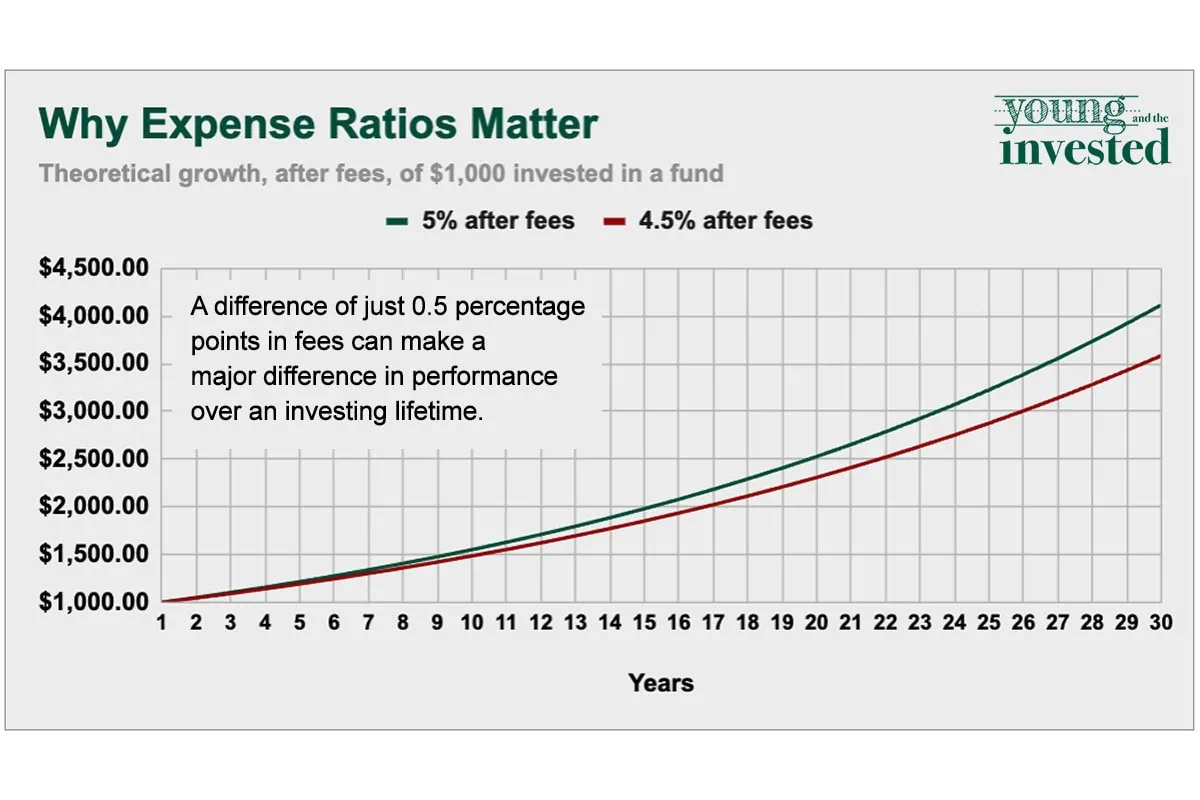
Every dollar you pay in expenses is a dollar that comes directly out of your returns. So, it is absolutely in your best interests to keep your expense ratios to an absolute minimum.
The expense ratio is the percentage of your investment lost each year to management fees, trading expenses and other fund expenses. Because index funds are passively managed and don’t have large staffs of portfolio managers and analysts to pay, they tend to have some of the lowest expense ratios of all mutual funds.
This matters because every dollar not lost to expenses is a dollar that is available to grow and compound. And over an investing lifetime, even a half a percent can have a huge impact. If you invest just $1,000 in a fund generating 5% per year after fees, over a 30-year horizon, it will grow to $4,116. However, if you invested $1,000 in the same fund, but it had an additional 50 basis points in fees (so it only generated 4.5% per year in returns), it would grow to only $3,584 over the same period.
Want to talk more about your financial goals or concerns? Our services include comprehensive financial planning, investment management, estate planning, taxes, and more! Schedule a call with Riley to discuss what you need, and what we can do for you.

7 Best Vanguard Dividend Funds to Buy [Low-Cost Income]
What’s better than a smart, sound dividend income strategy? How about a smart, sound dividend income strategy with very little money coming out of your pocket?
If that sounds good to you, you need look no farther than low-cost pioneer Vanguard, which offers up a number of payout-oriented products. Find out what you need to know in our list of seven top-notch Vanguard dividend funds.
10 Best Monthly Dividend Stocks for Frequent, Regular Income
The vast majority of American dividend stocks pay regular, reliable payouts—and they do so at a more frequent clip (quarterly) than dividend stocks in most other countries (typically every six months or year).
Still, if you’ve ever thought to yourself, “it’d sure be nice to collect these dividends more often,” you don’t have to look far. While they’re not terribly common, American exchanges boast dozens of monthly dividend stocks.
Please Don’t Forget to Like, Follow and Comment
Did you find this article helpful? We’d love to hear your thoughts! Leave a comment with the box on the left-hand side of the screen and share your thoughts.
Also, do you want to stay up-to-date on our latest content?
1. Follow us by clicking the [+ Follow] button above,
2. Subscribe to Retire With Riley, our free weekly retirement planning newsletter, and
3. Give the article a Thumbs Up on the top-left side of the screen.
4. And lastly, if you think this information would benefit your friends and family, don’t hesitate to share it with them!