




The best Vanguard dividend funds, in my opinion, combine three great tastes: Dividend income, the relative stability of dividend-paying stocks, and the low fees that investors have come to expect from this leading asset manager and fund provider.
We can’t take for granted the idea that dividend mutual funds will invest with an eye toward both yield and quality. Some products pay above-average dividends today but risk volatility or even future cutbacks in their payouts because of the companies they choose to hold. So if you’re in the market for a dividend-paying mutual fund, you need to select one based on more than just its “headline” yield.
Let me help you with your search by narrowing down the field. The following is a select group of the best Vanguard dividend funds to buy, based not only on their current yield, but other factors including dividend growth rate, expense ratio, and strategy.
The result is a list of dividend mutual funds that should serve you well regardless of any stock market ups and downs.
Editor’s Note: The tabular data shown in this article is up-to-date as of Dec. 30, 2025.
Featured Financial Products
Disclaimer: This article does not constitute individualized investment advice. Securities, funds, and/or other investments appear for your consideration and not as personalized investment recommendations. Act at your own discretion.
Table of Contents
Why Invest in Dividend Stocks via Mutual Funds?

The best dividend mutual funds offer investors a way to invest in a group of high-quality stocks that pay above-average dividends with just one purchase.
As a group, dividend stocks are pretty common, but they’re not created equally. Sure, you can find some stocks with a good, sustainable yield and growing payouts. But some only pay nominal dividends that are just a penny or two per share, with no prospect for dividend growth anytime soon. Others might offer generous but unsustainable dividend payouts that might be eliminated altogether in the future.
That’s why mutual funds are a good alternative to individual dividend stocks. These vehicles spread your money around, rather than force you to rely on one company’s specific strengths and weaknesses. And finding the best stocks capable of consistently paying dividends and enjoying significant future dividend growth can be a daunting task, even for seasoned investors. So instead, why not try to gain exposure to dividend-paying stocks via a single, diversified holding that’s tasked with finding great companies for you?
That’s what you’ll get from many of Vanguard’s dividend-focused funds.
Why Invest in Vanguard Funds?
Vanguard Group’s arguably biggest claim to fame is the pioneering of index funds, which are simply funds that track a rules-based index, like the S&P 500. In 1976, Vanguard founder Jack Bogle launched the first Vanguard index fund for U.S. retail investors—the Vanguard First Index Investment Trust, which is now the Vanguard 500 Index Fund Admiral Shares (VFIAX).
In the five decades that have followed, Vanguard Funds has grown to become the dominant force in index investing. This financial behemoth now has nearly $12 trillion in assets under management thanks in large part to its simple funds … but not entirely.
Vanguard also grew into the powerhouse mutual fund company it is today by taking care of its clients and genuinely looking after their interests. In addition to its indexed products, Vanguard has a variety of actively managed funds that, despite boasting skilled stock and bond pickers, don’t charge an arm and a leg, either.
Vanguard funds really started (and continue to accelerate) the trend of fee compression. We all collectively pay less in fees and expenses and enjoy better returns because of the index revolution started and led by Vanguard’s founder Jack Bogle. Today, the company’s funds have an average expense ratio of just 0.07%, or a mere 70¢ for every $1,000 invested. As recently as last year, Vanguard announced its largest fee cut in history—a drop in price on 168 share classes across 87 funds that the firm predicted would save its investors $350 million in the first year alone.
Today, I’m going to take a look at the very best Vanguard dividend funds. But you can also find a host of other index funds and investing options for strategies of all shapes and sizes. Whatever your tactics, however, you can have confidence that Vanguard will offer significant scale and rock-bottom fees via its investment options.
Our Favorite Vanguard Dividend Funds
Vanguard’s best dividend mutual funds include a variety of strategies and flavors—in other words, no single reader is going to need each fund on this list, but there should be something for virtually everyone.
Importantly, all of these funds are established dividend investments with low cost structures. So not only can you invest with confidence in one or more of these options if they align with your personal investing needs, but you can be assured that they’ll collect very little of your money by way of fees.
Related: The 7 Best Mutual Funds for Beginners in 2026
Please note that every one of the best Vanguard mutual funds on this list requires an investment of at least $3,000 to get started. However, the majority of these picks have an exchange-traded version that you can purchase for the price of one share (or less, if you have a brokerage account that allows fractional shares). Where appropriate, I’ve mentioned the Vanguard ETF alternatives to these dividend funds to provide flexibility for those who might need it.
1. Vanguard Dividend Appreciation Index Fund Admiral Shares

— Style: U.S. dividend-growth stock
— Management: Index
— Assets under management: $120.4 billion*
— Dividend yield: 1.6%
— Expense ratio: 0.07%, or 70¢ per year for every $1,000 invested
— Minimum initial investment: $3,000
Many of the funds on this list will be charged with generating an above-average amount of current income. But I want to start with the Vanguard Dividend Appreciation Index Fund Admiral Shares (VDADX) because it’s a great way to demonstrate that there’s more than one kind of dividend fund.
The Vanguard Dividend Appreciation Index Fund tracks the S&P U.S. Dividend Growers Index, which comprises high-quality companies that have ample headroom in their profits to raise dividends, as well as a track record of recent increases (hence “dividend appreciation”). In fact, VDADX doesn’t just view high yield as a lesser priority—the fund’s underlying index excludes the 25% highest-yielding companies, implying that massive dividends can be a liability.
Bear with me for a minute.
Related: The 10 Best Dividend ETFs [Get Income + Diversify]
Dividend yield is just the dividend divided by the share price. That means a dividend increase can improve the yield … but so can a stock-price decline. So a high dividend, then, is sometimes just the result of spiraling shares, reflecting a troubled company who might not be able to sustain its cash distributions for much longer.
This Vanguard dividend fund also excludes real estate investment trusts (REITs)—a group of stocks we’ll get into later. This likely has less to do with their typically high yields, and more to do with the fact that their dividends aren’t “qualified” and thus taxed as ordinary income at your marginal tax rate.
So, what are you getting?
VDADX is a portfolio of 340 predominantly large-cap stocks**. It’s considered a “blend” fund, too, which means it holds both value and growth stocks. The fund is market cap-weighted, so the larger the company, the more assets the fund allocates to holding its shares; VDADX’s biggest positions right now are in dividend growers such as Broadcom (AVGO), Apple (AAPL), and JPMorgan Chase (JPM).
Related: The 9 Best Dividend Stocks for Beginners
The current yield on dividend-growth funds tends to be modest; indeed, Vanguard Dividend Appreciation pays just half a percentage point more than the broader market right now. Why bother? Well, your future “yield on cost” (the yield on the price you originally paid) might grow significantly as you hold the fund through the years. But also, dividend growth is generally a sign of financial quality, and thus holding this Vanguard index fund is a way to own high-quality companies.
And that’s why VDADX is one of Vanguard’s best dividend funds.
VDADX has an exchange-traded version, the Vanguard Dividend Appreciation ETF (VIG, 0.05% expense ratio), that you can buy for around $220 per share currently. VIG ranks as one of the 20 largest U.S. ETFs of any flavor as measured by assets. That reinforces the popularity of this strategy, even if the current yield doesn’t blow your hair back.
* Many Vanguard funds have multiple share classes, including ETFs. Listed net assets for Vanguard funds in this story refer to assets under management across all of a given fund’s share classes.
** There are different ways to define “cap” levels. We’re adhering to Morningstar’s definition, which says the largest 70% of companies by market capitalization within a fund’s “style” are large-caps, the next 20% by market cap are mid-caps, and the smallest 10% by market cap are small caps.
Do you want to get serious about saving and planning for retirement? Sign up for Retire With Riley, Young and the Invested’s free retirement planning newsletter.
2. Vanguard Dividend Growth Fund
— Style: U.S. dividend-growth stock
— Management: Active
— Assets under management: $43.9 billion
— Dividend yield: 1.5%
— Expense ratio: 0.22%, or $2.20 per year for every $1,000 invested
— Minimum initial investment: $3,000
The Vanguard Dividend Growth Fund (VDIGX), as the name suggests, is another way to put dividend-growth stocks in your portfolio. But it’s built somewhat differently than VDADX.
Unlike VDADX, Vanguard Dividend Growth is actively run, currently helmed by Wellington Management Company’s Peter Fisher. And rather than having to strictly follow rules like VDADX does by tracking an index, Fisher has full discretion to build a portfolio of “high-quality companies that have both the ability and the commitment to grow their dividends over time.” His portfolio is much smaller, at a tight 44 stocks currently.
Related: The 16 Best ETFs to Buy for a Prosperous 2026
But like VDADX, Vanguard Dividend Growth Fund isn’t too concerned with current yield—it’s focused on future payouts.
As an example, let’s look at credit-card processing giant Visa (V), which is currently in VDGIX’s top 10 holdings. The company’s most recent quarterly distribution of 67¢ is 13% better than it was paying last year; about 80% better than it was paying in 2022; and almost quadruple the 14¢ it was paying near the end of 2015. Sure, Visa’s yield if you bought it right now is below 1%, but Fisher is much more interested in earning Visa’s higher yield on cost over time.
Related: 7 Best High-Yield Dividend Stocks: The Pros’ Picks for 2026
Indeed, many of VDIGX’s holdings are Dividend Aristocrats with 25 or more years of uninterrupted dividend growth. And a few—including Coca-Cola (KO) and Procter & Gamble (PG)—are Dividend Kings, which boast at least 50 years of annual dividend hikes.
Just understand that actively managed funds can sometimes generate much greater turnover (the percentage of the portfolio that is churned in a given year) than index funds. Why does this matter? Trading can generate capital gains that funds must redistribute to their shareholders, and depending on the nature of the distributions, they’re taxed at either short- or long-term capital gains rates. So funds like these are often best held in tax-advantaged accounts such as 401(k)s, individual retirement accounts (IRAs), and health savings accounts (HSAs).
Featured Financial Products
3. Vanguard High Dividend Yield Index Fund Admiral Shares
— Style: U.S. high-yield dividend stock
— Management: Index
— Assets under management: $84.5 billion
— Dividend yield: 2.4%
— Expense ratio: 0.08%, or 80¢ per year for every $1,000 invested
— Minimum initial investment: $3,000
Investors who are more concerned with getting a higher yield now will be more interested in the likes of the Vanguard High Dividend Yield Index Fund Admiral Shares (VHYAX).
VHYAX tracks an index made up of companies with larger-than-average dividends. Its 570 total components have been picked based on their current income potential—not hopes of bigger future paydays (though some holdings do grow their dividends, too). So it excludes companies like Apple that pay dividends but offer only modest yield. Instead, it has a bias toward longtime holdings such as Exxon Mobil (XOM) and Johnson & Johnson (JNJ) that pay significantly more than the average large-cap stock.
Related: 7 Best Schwab Index Funds for Thrifty Investors
In the process, VHYAX provides decent sector diversification. Yes, financials make up more than 20% of assets, but after that, four other sectors enjoy double-digit (or near-double-digit) weights. That includes a 17% weighting in tech dividend stocks —a respectable allocation given the technology sector’s reluctance to pay big dividends, but certainly less exposure than you would get in a typical large-cap stock fund. So be aware of these and other sector weightings as you consider how to layer this Vanguard dividend fund into your big-picture strategy.
Vanguard High Dividend Yield Index, like the aforementioned VDADX, explicitly excludes real estate investment trusts.
This fund is also offered in ETF form: The Vanguard High Dividend Yield ETF (VYM, 0.06% expense ratio) currently trades around $145 per share.
Make Young and the Invested your preferred news source on Google
Simply go to your preferences page and select the ✓ box for Young and the Invested. Once you’ve made this update, you’ll see Young and the Invested show up more often in Google’s “Top Stories” feed, as well as in a dedicated “From Your Sources” section on Google’s search results page.
Related: 10 Best Dividend Stocks to Buy [Steady Eddies]
4. Vanguard Equity-Income Fund Investor Shares
— Style: U.S. high-yield dividend stock
— Management: Active
— Assets under management: $63.0 billion
— Dividend yield: 2.1%
— Expense ratio: 0.27%, or $2.70 per year for every $1,000 invested
— Minimum initial investment: $3,000
Vanguard Equity Income Fund Investor Shares (VEIPX) is an actively managed way to get higher-than-average yield.
VEIPX isn’t operated by a strict methodology like VHYAX is. Co-managers Matthew Hand and Sharon Hill split stock-picking duties, and do so in contrasting ways. Hand uses traditional qualitative analysis to pick about 60 to 70 dividend stocks, while Hill applies a more quantitative approach for the remaining holdings. Top picks in the roughly 200-stock portfolio include Broadcom, Bank of America (BAC), and Big Pharma name Merck (MRK).
Related: Best Vanguard Retirement Funds for a 401(k) Plan
You face certain risks when you put your money behind an actively managed fund instead of an index fund, particularly given the long history of active managers underperforming their passive benchmarks. However, some investors prefer the peace of mind that comes with knowing someone is hand-picking components—particularly in the area of dividend stocks, where there’s a delicate balance between current yield and future payout potential.
If you have a lot of money to invest, you can get Vanguard Equity Income at a lower cost. Specifically, the Admiral Shares (VEIRX) charge just 0.18% in annual expenses, though you need $50,000 to get started, versus just $3,000 for the VEIPX Investor Shares. Most smaller-money investors might prefer to shoulder the high fees rather than put all their eggs in a cheaper basket.
Related: 10 Best ETFs to Beat Back a Bear Market
5. Vanguard Real Estate Index Fund Admiral Shares
— Style: U.S. sector (real estate)
— Management: Index
— Assets under management: $65.4 billion
— Dividend yield: 3.9%
— Expense ratio: 0.13%, or $1.30 per year for every $1,000 invested
— Minimum initial investment: $3,000
Remember how I said a couple of the aforementioned funds excluded real estate? Well, if you want exposure to that sector, you can do so through the Vanguard Real Estate Index Fund Admiral Shares (VGSLX).
Real estate investment trusts, or REITs, are a special class of company created by Congress in 1960 to help make real estate investing more accessible to the average Joe. REITs own and often operate real estate of all kinds—apartment buildings, office complexes, hotels, you name it. And you can buy and sell publicly traded REITs just like any other stock.
Related: 12 Best Investment Opportunities for Accredited Investors
But REITs have a few rules that set them apart from traditional companies. Most importantly to income investors: REITs generally enjoy an exemption from federal income taxes in exchange for distributing 90% of their taxable income as dividends to their shareholders. REIT dividends tend to be mighty generous as a result.
Vanguard Real Estate Index Fund, and similar products, allow you to invest in dozens if not hundreds of REITs easily and efficiently. VGSLX itself holds roughly 155 real estate stocks that deal in a variety of property types, including industrial, retail, telecom tower, self-storage, office, residential, and more. Right now, top holdings include health care property owner Welltower (WELL), logistics and warehousing REIT Prologis (PLD) and telecommunications infrastructure play American Tower (AMT).
Related: The 10 Best Index Funds You Can Buy
True to its nature, VGSLX currently offers a healthy yield of almost 4%—more than three times what you’d get from an S&P 500 fund, and even better than you’d receive from most high-yield dividend funds.
You can get VGSLX in ETF form via the Vanguard Real Estate ETF (VNQ, 0.13% expense ratio), which trades around $90 per share.
Featured Financial Products
6. Vanguard International Dividend Appreciation Index Fund Admiral Shares
— Style: International dividend-growth stock
— Management: Index
— Assets under management: $9.4 billion
— Dividend yield: 1.8%
— Expense ratio: 0.16%, or $1.60 per year for every $1,000 invested
— Minimum initial investment: $3,000
You might have noticed that all of the above funds have had a specifically U.S.-centric bent. That’s good—U.S. markets have long been among the most productive in the world, and if you believe in the American economy’s ability to keep growing, that should remain the case.
But most experts would tell you that it’s worth having at least some international exposure for whenever the U.S. catches a cold. Every now and then, like in 2025, the world’s markets beat ours. And the Vanguard International Dividend Appreciation Index Fund Admiral Shares (VIAAX) is one of the best Vanguard index funds you can own when the rest of the globe perks up.
Related: 7 Best Fidelity Retirement Funds [Low-Cost + Long-Term]
Vanguard International Dividend Appreciation Index has a similar thrust to Vanguard Dividend Growth in that it’s interested in owning high-quality companies, which it does by identifying and holding companies with a history of increasing their dividends. VIAAX tracks the S&P Global Ex-U.S. Dividend Growers Index, which consists of international firms that have improved their payouts on an annual basis for at least seven consecutive years. As an additional quality screen, the index excludes the 25% highest-yielding eligible companies; REITs are excluded, too.
VIAAX is most heavily invested in developed European and Asian markets such as Japan, Switzerland, and the U.K., though it also has a high concentration in Canadian stocks, as well as some exposure to emerging markets such as India and China. But many of its 330 holdings will be plenty familiar to Americans; it’s loaded with blue-chip multinational firms like Swiss food giant Nestlé (NSRGY), German software firm SAP (SAP), and Royal Bank of Canada (RY).
While international blue chips typically yield more than their American counterparts, the focus on dividend growth keeps VIAAX’s yield grounded. But at 1.8%, you’re still getting a little more income than you do from its U.S. sister fund, VDADX.
You can get this Vanguard fund as an ETF, too: the Vanguard International Dividend Appreciation ETF (VIGI, 0.10% expense ratio), which trades around $90 per share.
Related: 7 Low and Minimum-Volatility ETFs for Peace of Mind
7. Vanguard International High Dividend Yield Index Fund Admiral Shares

— Style: International high-yield dividend stock
— Management: Index
— Assets under management: $14.6 billion
— Dividend yield: 3.8%
— Expense ratio: 0.17%, or $1.70 per year for every $1,000 invested
— Minimum initial investment: $3,000
Among Vanguard dividend funds, it’s difficult to find a higher yield than what’s offered by the Vanguard International High Dividend Yield Index Fund Admiral Shares (VIHAX).
VIHAX’s tracking index is designed to own international stocks with higher-than-average 12-month forward-looking yields. While it will hold large- and mid-cap stocks, a current 85/15 split leans heavily toward the former.
Related: 8 Best Stock Portfolio Tracking Apps [Stock Portfolio Trackers]
It also has a significant preference for developed international markets (more established but slower-growing economies) over emerging markets (less established but “growthier” economies). European nations including the U.K. and Switzerland are tops at around 45% of assets, followed by Pacific-region developed countries (26%), all emerging markets (21%), and North America developed markets (8%, all wrapped up in Canadian assets).
Vanguard International High Dividend Yield Index is rich with blue chips such as Nestlé, British bank HSBC Holdings (HSBC), and Japanese automaker Toyota (TM). These holdings produce a comparatively massive dividend yield of almost 4% that puts its high-yield U.S. counterparts to shame.
As a general rule, this income and stability makes VIHAX a fruitful holding during downturns across international equities, but it sometimes lags Vanguard International Dividend Appreciation when the market heads higher.
VIHAX’s exchange-traded version is the Vanguard International High Dividend Yield ETF (VYMI, 0.17% expense ratio), which goes for roughly $90 per share right now.
Related: 8 Best-in-Class Bond Funds to Buy
Learn More About These and Other Funds With Morningstar Investor

If you’re buying a fund you plan on holding for years (if not forever), you want to know you’re making the right selection. And Morningstar Investor can help you do that.
Morningstar Investor provides a wealth of information and comparable data points about mutual funds and ETFs—fees, risk, portfolio composition, performance, distributions, and more. Morningstar experts also provide detailed explanations and analysis of many of the funds the site covers.
With Morningstar Investor, you’ll enjoy a wealth of features, including Morningstar Portfolio X-Ray®, stock and fund watchlists, news and commentary, screeners, and more. And you can try it before you buy it. Right now, Morningstar Investor is offering a free seven-day trial and a discount on your first year’s subscription when you use our exclusive link.
How Are the Top Dividend-Focused Funds From Vanguard Different From “Income” Funds?
Many investors have seen funds branded as “income” funds, and it’s easy to get confused. That’s because dividends from stocks are just one way of producing income from your portfolio.
The other major way is to own bonds, which are pooled debt instruments where the company is the borrower who pays interest on that debt to the investor on a regular basis. Beyond that there are also other instruments including preferred stock, or even real estate and private equity investments.
For the purpose of this list, we focused purely on dividends, which are profit-sharing distributions to shareholders of common stock. Those other asset classes all come with their own unique risks, and shouldn’t be seen as interchangeable with the potential risks and rewards delivered by dividend stocks or the mutual funds that hold them.
Do you want to get serious about saving and planning for retirement? Sign up for Retire With Riley, Young and the Invested’s free retirement planning newsletter.
What Is the Minimum Investment Amount on Vanguard Mutual Funds?
Vanguard funds are known for being shareholder-friendly. The Vanguard mutual fund company blazed new trails with the index fund, and Vanguard has done more than any other investment firm to keep costs to a minimum for investors.
But there is one hitch. Many of Vanguard’s cheapest funds in terms of fees have initial investment minimums of around $3,000.
If that is a problem for you, don’t sweat it. Most popular Vanguard index funds are also available as ETFs. Most brokers will allow you to buy as little as one share, and some even allow for fractional shares. And if you use a commission-free brokerage, you can buy those ETFs without incurring additional fees. ETF prices vary, of course, but many cost less than $100, and they rarely exceed $400 per share.
Why Does a Fund’s Expense Ratio Matter So Much?
Every dollar you pay in expenses is a dollar that comes directly out of your returns. So, it is absolutely in your best interests to keep your expense ratios to an absolute minimum.
The expense ratio is the percentage of your investment lost each year to management fees, trading expenses and other fund expenses. Because index funds are passively managed and don’t have large staffs of portfolio managers and analysts to pay, they tend to have some of the lowest expense ratios of all mutual funds.
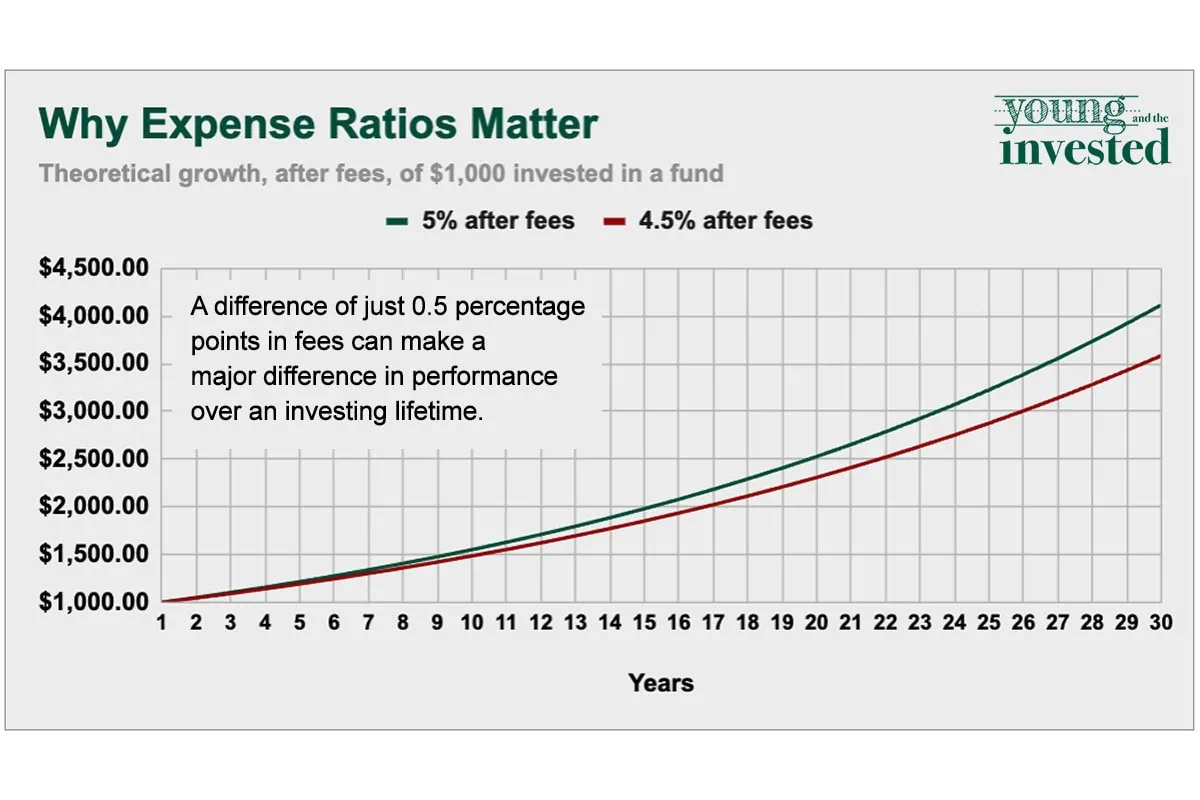
This matters because every dollar not lost to expenses is a dollar that is available to grow and compound. And over an investing lifetime, even a half a percent can have a huge impact. If you invest just $1,000 in a fund generating 5% per year after fees, over a 30-year horizon, it will grow to $4,116. However, if you invested $1,000 in the same fund, but it had an additional 50 basis points in fees (so it only generated 4.5% per year in returns), it would grow to only $3,584 over the same period.
Like Young and the Invested’s Content? Be sure to follow us.
What Is Dividend Yield?
Dividend yield is a simple financial ratio that tells you the percentage of a company’s share price that is paid out across a year’s worth of dividend distributions. Expressed as a mathematical equation, it’s simply:
Dividend yield = annual dividend / price x 100
Yield helps dividend investors normalize dividend payments regardless of stock price, different quarterly payments, even different payment frequencies (like monthly or annually). For instance, each of the following fictional stocks all have a dividend yield of 2.5%:
— Alpha Corp. currently trades for $40 a share. It pays a 25-cent quarterly dividend, for $1.00 per year in full. ($1 / $40 x 100 = 2.5%)
— Beta Inc. pays $1 in the first quarter, $2 in Q2, $3 in Q3 and $4 in Q4. That’s $10 in dividends for the full year. It trades for $400 a share. ($10 / $400 x 100 = 2.5%)
— Gamma Ltd. pays $2.50 just once per year. It trades for $100 a share. ($2.50 / $100 x 100 = 2.5%)
The idea is to focus on the percent of your initial investment you get back, and help you compare apples to apples.
Taking this math a step further, you learn that a company can suddenly feature a very high dividend yield through one of two very different ways: the share price falling very quickly, or the dividend growing very rapidly.
Alpha Corp., which trades for $40 per share, pays a 25-cent quarterly dividend that yields 2.5%. In a month, it yields 5.0%. Here are two ways that could have happened.
— Alpha Corp. doubled its dividend to 50 cents per share, for a full $2 per share across the year. The share price stays the same. ($2 / $40 x 100 = 5.0%)
— Alpha Corp. kept its dividend the same, but its share price plunged in half to $20 per share. ($1 / $20 x 100 = 5.0%)
Clearly, that 5% yield appears to be much safer and reliable in one scenario than the other.
What Is a Payout Ratio?
As with dividend yield, it’s important to normalize the dividend payout ratio for a stock. This is simply the percentage of a company’s earnings per share that is being distributed via dividends. It’s calculated as:
Payout ratio = dividends per share / earnings per share x 100
As an example, a stock that makes $100 million in profits and has 10 million shares of public stock has $10 in earnings per share. And if that company pays $5 annually in dividends, it has a payout ratio of 50% ($5 / $10 x 100 = 50%).
There’s a lot of “gray” when it comes to payout ratios. In general, though, the lower the payout ratio, the more sustainable the dividend, and the more room for future hikes.
Note: Payout ratio is calculated using different metrics depending on the type of business you’re looking at. For typical companies, you look at earnings. But, for example, when working with REITs, you typically calculate payout ratio using funds from operations (FFO), which is an important measure of REIT profitability.
What Is ‘Yield on Cost’?
When you look up a stock’s information, the dividend yield listed is based on the most recent dividend and the current stock price.
That yield is often actually different than the one current shareholders enjoy. That yield is called “yield on cost,” which is the payout based on what you paid, at the moment you invested.
Let’s say you buy a stock at $100, and it pays $1 per share. It yields 1.0% when you buy it ($1 / $100 x 100 = 1.0%).
In a year, that stock has doubled to $200 per share, and it also doubled its dividend to $2 per share. If you look up its information, its dividend is still 1.0% ($2 / $200 x 100 = 1.0%).
That’s not your yield on cost, however. You’re still receiving that higher dividend of $2 per share. But your cost basis is still the original $100 you bought the share at. So now, your yield on cost has doubled, to 2.0% ($2 / $100 * 100 = 2.0%)!
Related: 15 Best Investment Apps and Platforms [Free + Paid]
Want to talk more about your financial goals or concerns? Our services include comprehensive financial planning, investment management, estate planning, taxes, and more! Schedule a call with Riley to discuss what you need, and what we can do for you.

9 Best Fidelity ETFs You Can Buy [Invest Tactically]
Investors often look to exchange-traded funds (ETFs) for cheap, passive exposure to basic broader market indexes like the S&P 500.
But Fidelity’s ETF suite really shines because in addition to some of those plain-vanilla offerings, Fidelity also provides more tactical ways of tapping into specific corners of Wall Street. See what we mean by checking out our list of the best Fidelity ETFs.
Related: 10 Best Monthly Dividend Stocks for Frequent, Regular Income
The vast majority of American dividend stocks pay regular, reliable payouts—and they do so at a more frequent clip (quarterly) than dividend stocks in most other countries (typically every six months or year).
Still, if you’ve ever thought to yourself, “it’d sure be nice to collect these dividends more often,” you don’t have to look far. While they’re not terribly common, American exchanges boast dozens of monthly dividend stocks.
Please Don’t Forget to Like, Follow and Comment
Did you find this article helpful? We’d love to hear your thoughts! Leave a comment with the box on the left-hand side of the screen and share your thoughts.
Also, do you want to stay up-to-date on our latest content?
1. Follow us by clicking the [+ Follow] button above,
2. Subscribe to Retire With Riley, our free weekly retirement planning newsletter, and
3. Give the article a Thumbs Up on the top-left side of the screen.
4. And lastly, if you think this information would benefit your friends and family, don’t hesitate to share it with them!