




If you’re investing in an individual retirement account (IRA), and you’re trying to strip your expenses to the bone, it’s difficult to do much better than owning Vanguard funds, which are among the most cost-efficient funds on the planet.
Indeed, if you’re currently or planning on investing toward your retirement, you can thank Vanguard for how inexpensive doing so has become … even if you don’t invest in a Vanguard account or own any Vanguard funds. After all, it was Vanguard that created the index fund—a product that didn’t just bring down expenses in-house, but triggered more than three decades’ worth of lower fees from fund providers here and around the globe.
And Vanguard remains one of the investing world’s low-cost leaders today. It offers a bevy of the most popular retirement-focused mutual funds—of both the indexed and actively managed variety—and you can get most of them for a relative song. Better still, an IRA’s tax rules help to snuff out any adverse consequences of holding some of the less tax-efficient funds in their lineup.
Let me introduce you to a handful of these IRA-ready funds—each of which is inexpensive, effective, and sport long-term investing objectives. These funds also will be right at home in other tax-advantaged plans, so if you don’t have an IRA, you still might be able to own these products in health savings accounts (HSAs), 401(k)s, and more.
Editor’s Note: Tabular data presented in this article is up-to-date as of April 1, 2026.
Featured Financial Products
Disclaimer: This article does not constitute individualized investment advice. Individual securities, funds, and/or other investments appear for your consideration and not as personalized investment recommendations. Act at your own discretion.
Table of Contents
What Do You Want in a Retirement Fund?

When you invest your retirement savings in an account like an IRA, you’ll want to keep a few things in mind.
- Costs are first and foremost. If you own a mutual fund that charges you $5 annually for every $100 invested, that’s $5 (or $10, or $15, etc., depending on how many shares you own) that can’t grow and compound for you over time. Thus, if all else is equal, the lower the cost, the better. Just note that some funds can justify their higher fees. Vanguard rarely has to justify its fees, however, as the best Vanguard retirement funds’ fees typically sit near or at the bottom of their category.
- Income matters, too. You probably want your retirement portfolio to produce at least some regular income—in the form of both bond interest and dividend income. Stock prices can suffer during nasty corrections and bear markets, but income-generating funds can help provide for your living expenses without forcing you to sell at an inopportune time. How much income your account should produce depends on your own circumstances. For instance, older investors tend to be more concerned with income while younger investors focus more on growth.
- Don’t forget taxes. Standard taxable brokerage accounts are better suited to take advantage of certain tax-advantaged investments, such as municipal bonds, which are exempt from federal taxes, as well as state and local levies if you live where the bond was issued. However, because investments grow free of tax consequences within IRAs, these and other tax-advantaged accounts are much better suited to hold traditional bond funds (which throw off fully taxable interest income) and actively managed stock funds (which distribute capital gains generated by trading within the fund, aka “turnover”).
- Diversification matters (in more than one way). You’ve probably heard that your portfolio should be “diversified,” which means holding a variety of investments, whether that’s holding multiple assets (stocks, bonds, alternative investments), but that could also mean holding, say, stocks from different countries, or stocks from different sectors. And investment funds, which can own any number of stocks, bonds, or other holdings all at once, can help you achieve that diversification. But every fund has its own level of built-in diversification. Some funds hold dozens of stocks while others hold thousands. Some funds invest heavily in their biggest stocks while others spread their assets out more evenly. So always consider how diversified a fund really is, as well as whether that level of diversification suits your needs.
What Kinds of Funds Are Available in IRAs?
Once you back out the different tax treatment, an IRA will look, feel, and act very similar to a tax-advantaged brokerage account. They’re typically self-directed and extremely flexible. Most IRAs will let you own any type of fund—mutual funds, exchange-traded funds (ETFs), and even closed-end funds (CEFs).
If given the choice, many investors will own ETFs because they usually beat both mutual funds and CEFs on fees. However, I can think of a few reasons to consider owning Vanguard mutual funds in an IRA.
They’re cheap, for one. Vanguard mutual funds typically offer very low fees—in many cases lower than even many ETFs with a similar strategy. Many of the company’s products are highly rated by independent fund analysts, too.
You also might well prefer to have a human manager overseeing certain strategies rather than buy a fund that simply follows an index. Mutual funds boast a richer array of these products (that’s certainly the case at Vanguard). If so, again, mutual funds are more tax-efficiently held within an IRA.
Why Should I Own Vanguard Funds?
Vanguard Group is a massive firm that, as it points out itself, “is owned by its funds, which in turn are owned by Vanguard’s fund shareholders.” Its sheer scale—it’s responsible for approximately $12 trillion in assets—and alignment with shareholders’ interests allow it to charge a laughably low 0.06% expense ratio (a mere 60¢ for every $1,000 invested) on average across its 400-plus Vanguard mutual funds and Vanguard ETFs. The average asset-weighted expense ratio for U.S. mutual funds and ETFs is more than six times that, at 0.44%.
Very shortly put: Even when a Vanguard fund isn’t the absolute cheapest in its category, it’s still going to be one of your most cost-efficient options.
If anything, Vanguard has only gotten more aggressive about its low-cost leadership. It was 0.08% in 2024, but declined to 0.07% in 2025 after Vanguard cut expenses on 168 share classes across 87 funds. Its drop to 0.06% occurred in early 2026 when the company announced it would slash fees on another 84 share classes across 53 funds. All told, Vanguard estimates that’s $600 million in savings for investors, which the firm claims is its “largest-ever two-year combined cost reduction.”
By the way, Vanguard’s price vigilance doesn’t just benefit people who own Vanguard retirement funds. We all collectively pay less in fees and expenses and enjoy better returns thanks to Vanguard founder Jack Bogle’s index revolution, which has put downward price pressure on the rest of the industry.
Just remember: There’s more to Vanguard than low fees. This firm grew into the powerhouse mutual fund company it is today by taking care of its clients and genuinely looking after their interests.
Related: The 13 Best Mutual Funds You Can Buy for 2026
The Best Vanguard Funds for an IRA

These Vanguard retirement funds are ordered by their Morningstar Portfolio Risk Score for the trailing 10-year period. Here are the risk levels each score range represents:
- 0-23: Conservative
- 24-47: Moderate
- 48-78: Aggressive
- 79-99: Very Aggressive
- 100+: Extreme
Importantly, these scores are a general gauge of risk compared to all other investments. For example, a bond fund with a score of 20 might be considered a conservative strategy overall, but it could simultaneously be riskier than a number of other bond funds.
Lastly, these funds have a required minimum initial investment of $3,000 unless otherwise indicated. In other words, if you want to invest in these funds via an IRA, you’ll need to be able to purchase at least $3,000 worth of shares up front. Once invested, you can spend as much or as little as your IRA provider allows on subsequent purchases.
With that out of the way, let’s dig into some of the best Vanguard retirement funds for IRAs in 2026.
Do you want to get serious about saving and planning for retirement? Sign up for Retire With Riley, Young and the Invested’s free retirement planning newsletter.
1. Vanguard Short-Term Treasury Index Fund Admiral Shares
- Style: Short-term U.S. Treasury bond
- Management: Index
- Assets under management: $32.7 billion*
- SEC yield: 3.7%**
- Expense ratio: 0.06%, or 60¢ per year for every $1,000 invested
- Morningstar Portfolio Risk Score: 6 (Conservative)
No retirement asset allocation is complete without bond funds. As an asset class, bond funds play an important role in lowering volatility and providing regular income. However, bond interest is taxable at your federal income tax rate—if you’re in the 37% tax bracket, then you’re losing 37% of your bond interest to taxes—and because interest is the predominant source of returns on bonds, bond funds are best held in tax-advantaged accounts such as IRAs.
Between 2022 and 2024, the yield curve was inverted (inversion is when short-term rates are higher than long-term rates). That’s no longer the case, but short-term bonds still offer relatively high yields for relatively low risk. Thus, it makes sense to keep a decent chunk of your overall bond exposure in short-term bond funds, such as the Vanguard Short-Term Treasury Index Fund Admiral Shares (VSBSX).
Related: 9 Best Vanguard Retirement Funds [Save More in 2026]
VSBSX tracks the Bloomberg US Treasury 1-3 Year Bond Index—a collection of roughly 100 federal bond issues with maturities of between one and three years. U.S. Treasuries are among the best-rated bonds on the planet, meaning that the major credit-rating agencies believe bonds issued by our federal government are likelier than most to repay you fully with interest. These bonds are considered all the more secure given their short maturities—at most, these bonds will mature in just three years, which is a relatively small time for the security of those bonds to change.
One of the most critical metrics to consider when considering bond funds is duration, which is a measure of interest-rate sensitivity. As an example, a bond with a duration of two years would see its price rise by 2% if interest rates fell by 1 percentage point (or conversely, would see its price fall by 2% if interest rates rose by 1 percentage point). The actual calculation of duration is fairly complex; it’s the weighted average of the bond’s cash flows. But the key takeaway is that, all else equal, the longer a bond’s time to maturity, the higher its duration—and thus the higher the interest-rate risk.
VSBSX has a duration of just 1.9 years, which is very low. And in return, you currently receive a yield that’s closer to 4% than it is to 3%. That combination of low risk and competitive income makes Vanguard Short-Term Treasury Index Fund one of the very best Vanguard IRA funds you can own in an IRA.
This mutual fund, like many Vanguard index funds, is also available as an ETF: the Vanguard Short-Term Treasury ETF (VGSH, 0.03% expense ratio), which trades around $60 per share currently.
* Many Vanguard funds have multiple share classes, including ETFs. Listed net assets for Vanguard funds in this story refer to assets under management across all of a given fund’s share classes.
** SEC yield reflects the interest earned across the most recent 30-day period. This is a standard measure for funds holding bonds and preferred stocks.
Make Young and the Invested your preferred news source on Google
Simply click here and select the ✓ box for Young and the Invested. Once you’ve made this update, you’ll see Young and the Invested show up more often in Google’s “Top Stories” feed, as well as in a dedicated “From Your Sources” section on Google’s search results page.
Related: 10 Best Dividend Mutual Funds to Boost Your Income
2. Vanguard Total Bond Market Index Fund Admiral Shares

- Style: Intermediate-term core bond
- Management: Index
- Assets under management: $395.3 billion
- SEC yield: 4.3%
- Expense ratio: 0.04%, or 40¢ per year for every $1,000 invested
- Morningstar Portfolio Risk Score: 15 (Conservative)
Bond funds play an important role in lowering volatility and providing regular income. However, they don’t need to be as conservative as the aforementioned VSBSX.
Related: The 16 Best ETFs to Buy for a Prosperous 2026
The Vanguard Total Bond Market Index Fund Admiral Shares (VBTLX), for instance, covers many more debt categories with holdings that boast longer maturities. But despite the higher risk, it still stands out as one of the very best Vanguard retirement funds for its combination of high-quality holdings, competitive yield, and rock-bottom fees.
VBTLX holds nearly 11,500 debt issues, providing extremely broad exposure to the investment-grade bond universe. A little less than half of its portfolio is made up of Treasury or agency debt backed by the U.S. government, 25% is corporate debt, another 20% is invested in government mortgage-backed securities (MBSes), and the rest is spread across foreign bonds, commercial mortgage-backed securities (CMBSes), and other debt.
Related: 15 Best Long-Term Stocks to Buy and Hold Forever
Risk is higher than Vanguard’s short-term government-bond fund for a number of reasons. For one, roughly a third of VBTLX’s bonds aren’t government- or agency-related—they’re corporates and other issues with ratings that, while high, are lower than U.S. Treasury debt. Time remaining on these bonds is longer, too, with an average effective maturity of more than eight years. As a result, duration is higher—at 5.8 years, a percentage-point increase in market interest rates would theoretically send the fund 5.8% lower in the short term.
On the flip side, you’re rewarded with a higher yield and more potential upside should rates go lower. And with an expense ratio of just 0.04%, Vanguard Total Bond Market Index Funds is all but free to own.
VBTLX is also available as an ETF: the Vanguard Total Bond Market ETF (BND, 0.03% expense ratio), which trades around $75 per share currently.
Related: 15 Dividend Kings for Royally Resilient Income
Featured Financial Products
3. Vanguard Wellesley Income Fund Investor Shares
- Style: Moderately conservative allocation
- Management: Active
- Assets under management: $49.4 billion
- SEC yield: 3.5%*
- Expense ratio: 0.22%, or $2.20 per year for every $1,000 invested
- Morningstar Portfolio Risk Score: 29 (Moderate)
If you want both stocks and bonds in your portfolio, you have three choices: 1. buy individual stocks and/or bonds, 2. buy stock funds and bond funds, or 3. buy an “allocation” fund.
I affectionately refer to allocation (also “balanced”) funds as “portfolios in a can.” That’s because, if you so desired, you could literally invest in that single fund and have an entire portfolio of stocks and bonds. That’s not to say investors necessarily should do this, but they certainly can. Still, if you find one of these funds that has an excellent track record and savvy management, they can be useful for allocating certain portions of your nest egg—like, say, the money in your IRA.
Related: The 7 Best Gold ETFs You Can Buy
Enter Vanguard Wellesley Income Fund Investor Shares (VWINX), a “moderately conservative” allocation fund that’s much more defensively positioned. Here, bonds make up a little more than 60% of the portfolio. VWINX holds about 1,350 bonds—primarily corporate debt, but also Treasury and agency bonds, and even sprinklings of foreign bonds and MBSes. The remaining equity portion is spread across roughly 75 stocks or so, with a distinct value tilt and with a little exposure to developed international markets.
“Vanguard Wellesley Income’s disciplined approach, experienced leadership, and attractive fees make this fund an appealing choice for investors seeking steady income and a defensive profile,” Morningstar analyst Stephen Margaria says.
From a tax perspective, Wellesley generates a lot of interest income and has a high turnover rate above 60%, which means, on average, more than 60% of the portfolio changes every year. As a result, VWINX can generate sizable capital-gains distributions, so it’s best held in a tax-advantaged retirement account.
* SEC yield is used instead of dividend yield here because of the fund’s bond-heavy allocation.
Make sure you sign up for The Weekend Tea, Young and the Invested’s free weekly newsletter that over 10k monthly readers use to level up their money know-how.
4. Vanguard Wellington Fund Investor Shares

- Style: Moderate allocation
- Management: Active
- Assets under management: $119.8 billion
- Dividend yield: 2.1%
- Expense ratio: 0.24%, or $2.40 per year for every $1,000 invested
- Morningstar Portfolio Risk Score: 46 (Moderate)
Vanguard’s oldest mutual fund, Vanguard Wellington Fund Investor Shares (VWELX), is another “portfolio in a can,” this one much more aggressive than the aforementioned VWINX.
Vanguard Wellington, which came to life in 1929, is a moderate allocation fund that invests roughly two-thirds of its assets in stocks, and the other third in bonds. The stock portion of the portfolio currently holds about 80 predominantly large-cap stocks—a “who’s who” of mega-cap blue-chip firms such as Nvidia (NVDA) and Apple (AAPL)—with a median market cap of around $330 billion. Most holdings are U.S.-domiciled, but you do get a little exposure to international companies including UBS Group (UBS) and British American Tobacco (BTI).
Related: 7 High-Quality, High-Yield Dividend Stocks
The bond portfolio is much more broadly diversified, at more than 1,500 investment-grade issues. Two-thirds of that is invested in corporate bonds, with another 20% in Treasuries and agency bonds, and the rest peppered across MBSes, foreign sovereign bonds, and other debt.
Turnover (how much the fund tends to buy and sell holdings) is on the elevated side, with about 60% of the portfolio turning over every year, so VWELX generates some capital gains distributions. It also produces a decent chunk of interest income from its bond portfolio. An IRA can help you avoid both sets of tax consequences.
Vanguard Wellington, as the name suggests, is managed by Wellington Management, an investment management company with nearly a century of operational experience. And this one-stop shop for your large-cap stock and bond needs charges just 0.24% in annual fees—very inexpensive for the skilled management and strong performance track record you’re getting in return.
Just make sure you’re considering your own investment needs. If you don’t want a third of your portfolio to be in bonds, you’ll want to put additional money into individual stocks, equity funds, and/or alternative investments.
5. Vanguard Target Retirement Funds
- Style: Target-date
- Management: Active
- Expense ratio: 0.08%, or 80¢ per year for every $1,000 invested
- Morningstar Portfolio Risk Score: 20-61 (Conservative to Aggressive)
One of the challenges in retirement planning is getting the asset allocation right, or having an asset class mix that is appropriate for an investor at your age and stage of life. An ideal portfolio for a 20-year-old is likely going to be very different from that of a 40-year-old, and both those portfolios will be different from what’s ideal for a 60-year-old.
This is where Vanguard Target Retirement Funds can really add value.
Target-date funds—also called life-cycle funds—are a type of mutual fund that are designed to change their asset allocation over time. Target-date funds start out invested heavily in stocks, then slowly reduce their stock exposure and replace it with bond exposure as they approach their target retirement date, following a glide path.
Related: 5 Best Energy ETFs for the Rise of Oil, Natural Gas + More
The target retirement dates are intended to be estimates; they don’t have to be super precise. Generally, most mutual fund families will create target-date funds in five-year increments (say, 2025, 2030, 2035, etc.).
Given the hyper-specific focus on retirement, target-date funds tend to be most commonly found in 401(k) plans, but there’s nothing keeping you from holding them in an IRA or other tax-advantaged account as well.
Vanguard Target Retirement Funds hold varying blends of both U.S. and international stocks of various sizes, as well as U.S. and international bonds. They’re unsurprisingly dirt-cheap, at just 0.08% annually, and the entire series earns a respectable Silver Medalist rating from Morningstar. And even better: Unlike most Vanguard funds, which have a $3,000 minimum initial investment, Vanguard’s target-date series has a lower bar to clear: $1,000.
Related: Best Vanguard Retirement Funds for a 401(k) Plan
6. Vanguard Dividend Growth Investor Shares

- Style: U.S. dividend-growth stock
- Management: Active
- Assets under management: $40.0 billion
- Dividend yield: 1.5%
- Expense ratio: 0.22%, or $2.20 per year for every $1,000 invested
- Morningstar Portfolio Risk Score: 64 (Aggressive)
Vanguard Dividend Growth Investor Shares (VDIGX) is an excellent Vanguard retirement fund for virtually any account. Just understand what you’re buying before you purchase.
Vanguard says the actively managed VDIGX “focuses on high-quality companies that have both the ability and the commitment to grow their dividends over time.” In other words, the fund might not have a great yield now, but owners of this fund should enjoy a higher “yield on cost” (the yield you’re actually earning based on the price you bought the stock) as the years roll on. Also, dividend growers tend to be high-quality companies; only firms with strong financials and excellent cash flows can afford to keep paying shareholders more every year.
Said differently: Dividend growth acts like a quality screen that ensures you’re owning a higher grade of stock.
Related: The 7 Best REITs to Buy for 2026
Portfolio Manager Peter Fisher has a tight holding set of more than 45 predominantly mega-cap equities with bulletproof balance sheets. All of them have raised their payouts for at least a few years, but some have long histories of uninterrupted dividend growth. Procter & Gamble (PG) and Colgate-Palmolive (CL), for instance, are Dividend Aristocrats, which are companies that have raised their dividends annually for at least 25 consecutive years.
It’s worth noting that Fisher has only had sole control over the fund since Jan. 1, 2024. That’s when longtime manager Donald Kilbride stepped down, leaving the reins of VDIGX to his comanager. But Kilbride will continue to provide ideas for the portfolio.
“The strategy rests on the core tenet that compounding capital via companies that grow their dividends will produce strong long-term returns,” Morningstar Senior Analyst Todd Trubey says about the fund’s Gold Medalist rating. “Fisher, like Kilbride, holds that growing cash dividends also serves as the most dependable measurement of continuous sound operation. They prefer to buy firms at reasonable prices, so they often add companies with temporary troubles.”
The tax situation here doesn’t look so dire on its face, with turnover sitting around 15% annually. Regardless, this fund has a history of occasionally making very large capital-gains distributions (including a whopper in 2025), so VDIGX still belongs in tax-advantaged accounts.
Do you want to get serious about saving and planning for retirement? Sign up for Retire With Riley, Young and the Invested’s free retirement planning newsletter.
7. Vanguard International Core Stock Fund Investor Shares
- Style: International large-cap stock
- Management: Active
- Assets under management: $6.7 billion
- Dividend yield: 1.3%
- Expense ratio: 0.48%, or $4.80 per year for every $1,000 invested
- Morningstar Portfolio Risk Score: 70 (Aggressive)
U.S. markets have long been among the most productive in the world, and if you believe in the American economy’s ability to keep growing, that should remain the case. Still, America’s stock markets do catch the occasional cold, and that’s why most experts will tell you it’s worth having at least some exposure to international stocks.
Related: 7 Best Vanguard Dividend Funds [Low-Cost Income]
You can do that via funds such as the Vanguard International Core Stock Fund Investor Shares (VWICX).
VWICX, which is run by Wellington Management’s F. Halsey Morris and Anna Lunden, currently own 95 companies that have been selected from a universe of 350 to 400 equities from around the globe (excluding the U.S.). Morris and Lunden favor firms from more established nations—companies from developed markets such as Japan and the U.K. make up 75% of assets—but they also hold stocks from emerging markets such as China, India, and Taiwan.
Related: The 7 Best Vanguard Index Funds for Beginners
The managers blend growth and value styles, but they generally lean heavily on large-cap stocks; VWICX’s median market cap is close to $75 billion. In other words, this is a predominantly blue-chip portfolio, one that includes multinationals such as Taiwan Semiconductor (TSM), China internet giant Alibaba (BABA), and British oil-and-gas giant Shell (SHEL).
Also, as is common with developed-country funds, VWICX’s yield is higher than comparable U.S. funds.
Vanguard International Core Stock Fund also does more trading than any other fund on this list, with turnover sitting around almost 90% right now—which means most of the portfolio turns over each year. As that can result in capital gains distributions, VWICX is a great Vanguard retirement fund for an IRA, but a little less so for taxable accounts.
Related: The 10 Best Dividend ETFs [Get Income + Diversify]
8. Vanguard 500 Index Fund Admiral Shares
- Style: U.S. large-cap stock
- Management: Index
- Assets under management: $1.5 trillion
- Dividend yield: 1.1%
- Expense ratio: 0.04%, or 40¢ per year for every $1,000 invested
- Morningstar Portfolio Risk Score: 74 (Aggressive)
The S&P 500 Index is tough to top. Just ask professional mutual fund managers of large-cap products, the majority of whom fail to consistently beat the S&P 500 Index, especially once fees are factored in.
Related: The 10 Best Index Funds You Can Buy for 2026
According to S&P Dow Jones Indices, in 2025, “79% of all active large-cap U.S. equity funds underperformed the S&P 500, worse than the 65% rate observed in 2024 and the fourth-worst year for active large-cap managers over the 25-year history of our SPIVA Scorecards.” With that data now folded in, SPIVA reports that just 14% of large-cap funds have outperformed the S&P 500 over the trailing 10-year period, and just 10% across the trailing 15 years.
The pros can’t beat it, so let’s own it instead.
The Vanguard 500 Index Fund Admiral Shares (VFIAX) is Vanguard’s oldest index strategy, and it remains one of the very best Vanguard retirement funds—for IRAs or wherever else you can stash it.
Related: The 7 Best Fidelity Index Funds for Beginners
VFIAX, by virtue of tracking the S&P 500, holds shares of 500 large U.S. companies. But it doesn’t hold them equally. The S&P 500 is “market-cap weighted,” which means the larger the company, the more weight the stock has in the index (and thus the more impact it has on returns). Thus, right now, VFIAX dedicates the largest portions of its assets to companies like Nvidia, Apple, and Google parent Alphabet (GOOG/GOOGL), whose market caps are measured in trillions of dollars.
It’s also considered to be a “blend” fund, which means it has relatively even exposure to value stocks and growth stocks.
Turnover is traditionally low, as only a handful of stocks enter or leave the index in any given year, so VFIAX typically makes little to no capital gains distributions. That makes this Vanguard index fund an extremely tax-efficient option for taxable accounts. But again, if you primarily invest through your IRA, and your goal is simply to maximize performance, it still makes sense to own the S&P 500 in your IRA.
Also, VFIAX has an ETF share class, Vanguard S&P 500 ETF (VOO, 0.03% expense ratio), which costs 1 basis point less in fees and goes for about $580 per share currently.
Related: The 12 Best Vanguard ETFs for 2026 [Build a Low-Cost Portfolio]
9. Vanguard Strategic Equity Fund Investor Shares
- Style: U.S. mid-cap stock
- Management: Active
- Assets under management: $10.5 billion
- Dividend yield: 1.1%
- Expense ratio: 0.17%, or $1.70 per year for every $1,000 invested
- Morningstar Portfolio Risk Score: 85 (Very Aggressive)
Large-cap companies, like those in the S&P 500, have the potential for outsized growth. But smaller companies tend to be more explosive—for better or worse. They benefit from investing’s rule of large numbers (effectively, doubling your revenues from $1 million to $2 million is a lot easier than doing so from $1 billion to $2 billion). And when institutional investors become interested in these stocks, large influxes of new investment money can send their stocks skyward.
Related: 10 Best ETFs to Beat Back a Bear Market
But they’re riskier. Smaller firms have fewer and narrow revenue streams, meaning if a core product line struggles, it can more easily lead to stock turbulence and losses. They also have less access to capital than larger companies, so if times get tight, it’s harder for them to survive.
Products like Vanguard Strategic Equity Fund Investor Shares (VSEQX) help defray that risk by allowing you to buy many smaller companies at once, so one stock’s failure doesn’t torpedo your portfolio’s worth.
Fund manager Cesar Orosco is tasked with buying mid- and small-cap stocks with above-average growth potential. He takes a quantitative approach, attempting to identify the most attractive stocks within an MSCI index of small- and midsized companies based on variables such as improving fundamentals and attractive valuation. He currently holds about 570 positions, split roughly 60/40 between small caps and mid-caps.
Related: The Best Dividend Stocks: 10 Pro-Grade Income Picks for 2026
“Clearly, portfolio manager Orosco has been the driving force since his arrival nearly five years ago.,” Morningstar analyst Todd Trubey says. “Long-term, it’s a great choice for smaller-cap U.S. equities.”
VSEQX does a fair bit of trading, with turnover of more than 60%. You can snuff out the tax liability of the resulting capital gains by stuffing this Vanguard fund into an IRA.
Like Young and the Invested’s content? Be sure to follow us.
Featured Financial Products
What Is the Minimum Investment Amount on Vanguard Mutual Funds?
Vanguard funds are known for being shareholder-friendly. The Vanguard mutual fund company blazed new trails with the index fund, and Vanguard has done more than any other investment firm to keep costs to a minimum for investors.
But there is one hitch. Many of Vanguard’s cheapest funds in terms of fees have initial investment minimums of around $3,000.
If that is a problem for you, don’t sweat it. Most popular Vanguard index funds are also available as ETFs. Most brokers will allow you to buy as little as one share, and some even allow for fractional shares. And if you use a commission-free brokerage, you can buy those ETFs without incurring additional fees. ETF prices vary, of course, but many cost less than $100, and they rarely exceed $400 per share.
Also worth noting? If you invest in a 401(k) and any of these Vanguard funds are available to you there, consider investing in them that way. There is no minimum investment through a 401(k) plan—you just pick an allocation percentage, and when money is taken from your paycheck to contribute to your plan, whatever dollar amount that translates into will be invested into the fund.
Related: Best Vanguard Funds for an HSA
Why Does a Fund’s Expense Ratio Matter So Much?
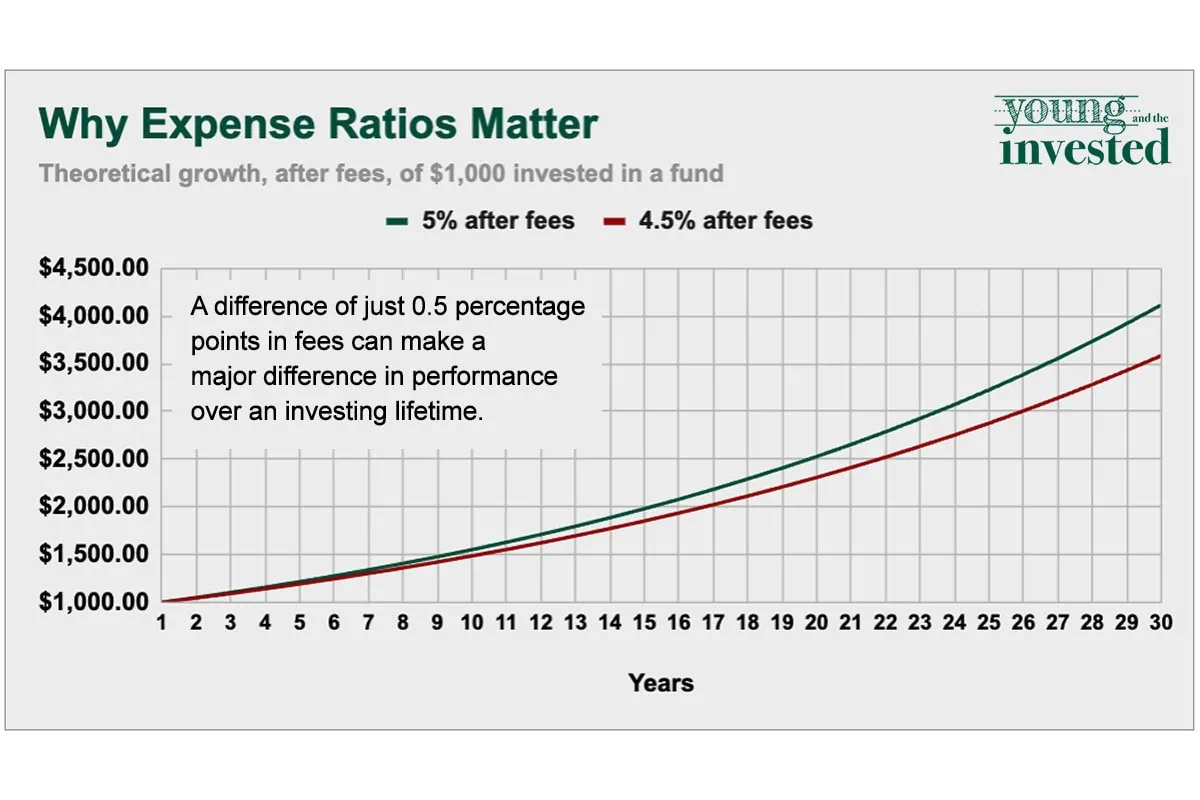
Every dollar you pay in expenses is a dollar that comes directly out of your returns. So, it is absolutely in your best interests to keep your expense ratios to an absolute minimum.
The expense ratio is the percentage of your investment lost each year to management fees, trading expenses and other fund expenses. Because index funds are passively managed and don’t have large staffs of portfolio managers and analysts to pay, they tend to have some of the lowest expense ratios of all mutual funds.
This matters because every dollar not lost to expenses is a dollar that is available to grow and compound. And over an investing lifetime, even a half a percent can have a huge impact. If you invest just $1,000 in a fund generating 5% per year after fees, over a 30-year horizon, it will grow to $4,116. However, if you invested $1,000 in the same fund, but it had an additional 50 basis points in fees (so it only generated 4.5% per year in returns), it would grow to only $3,584 over the same period.
Like Young and the Invested’s content? Be sure to follow us.
Want to talk more about your financial goals or concerns? Our services include comprehensive financial planning, investment management, estate planning, taxes, and more! Schedule a call with Riley to discuss what you need, and what we can do for you.

Related: The 10 Best Dividend ETFs for 2026
We love exchange-traded funds (ETFs) because they can provide one-click access to hundreds, even thousands of stocks, while charging often minuscule fees.
One way to put that low-cost diversification to work? Collecting dividends. But trying to choose from literally hundreds of income-producing funds could take up a lot more time than you have. So let us help you narrow the field—check out our list of 10 top dividend ETFs.
Related: 9 Best Fidelity ETFs You Can Buy Right Now
Investors often look to exchange-traded funds (ETFs) for cheap, passive exposure to basic broader market indexes like the S&P 500.
But Fidelity’s ETF suite really shines because in addition to some of those plain-vanilla offerings, Fidelity also provides more tactical ways of tapping into specific corners of Wall Street. See what we mean by checking out our list of the best Fidelity ETFs.
Please Don’t Forget to Like, Follow and Comment
Did you find this article helpful? We’d love to hear your thoughts! Leave a comment with the box on the left-hand side of the screen and share your thoughts.
Also, do you want to stay up-to-date on our latest content?
1. Follow us by clicking the [+ Follow] button above,
2. Subscribe to Retire With Riley, our free weekly retirement planning newsletter, and
3. Give the article a Thumbs Up on the top-left side of the screen.
4. And lastly, if you think this information would benefit your friends and family, don’t hesitate to share it with them!