




Saving money can be difficult, especially when you’re a teenager. But with a little bit of effort and some creative thinking, it is possible to save money even if you don’t have a job.
Today, we’ll outline several of the best ways to save money as a teenager.
Featured Financial Products
Why Do Teenagers Need to Save Money?

Teens need to save money for a variety of reasons. Maybe they need to make the down payment on a car. Maybe they want to save up for college. Or maybe they just want to travel.
The needs could be more immediate. Maybe they need to pay for things like a cell phone bill or car insurance, or their parents might ask them to pay for some entertainment costs such as dates or after-school snacks.
And hey: Some teens might be saving up money in case of an emergency. That’s just good teenage money management.
When Can Teenagers Start Saving Money?
Many teenagers begin thinking about saving money in the bank when they get their first jobs. However, saving money as a teenager is typically a good idea even if the teen doesn’t have a job.
Here are some of the best times for teenagers to start saving money:
- When they get their first paycheck
- Before they get their driver’s license and need to buy a car
- Before they go away to college and need to pay for room and board
- Whenever they come across extra money that isn’t needed right away
How to Save Money for a Teenager
No one is born with money management knowhow. It takes teaching, practice, trial, and error.
We can help you with the first part by providing you with a few tips about saving money as a teenager. And we’ll file these tips away into three categories:
- Establishing an account to save money
- Earning money (can’t save what you don’t have, after all)
- Habits and mindsets that will help you save money
Do you want to get serious about saving and planning for retirement? Sign up for Retire With Riley, Young and the Invested’s free retirement planning newsletter.
Accounts That Help You Save Money

It’s possible that the most disciplined teens could stack their cash in a desk drawer and not touch it until they needed it. But opening an account of some time helps fight off temptation, offers more safety, and offers other benefits, such as helping you grow your money too.
So, let’s look at several accounts you might consider:
1. Savings Account
One of the best ways to start saving money as a teenager is to open up a savings account. When you put your money in a savings account, the bank holds and protects your money, and allows you to withdraw it from branches.
Many banks also offer incentives such as special interest rates (so, your money earns more money just by sitting there) or bonus gifts when you sign up for a savings account.
2. Checking Account/Debit Card
You and your parents might decide that a checking account (which typically is linked to a debit card) might be a better option for you.
A teen checking account typically won’t offer you as high an interest rate as a savings account. On the other hand, checking accounts are a more convenient way of spending the money you do save; you can withdraw cash at ATMs and branches, write checks to pay for things, or use your debit card to pay.
One of the best checking accounts with a debit card for teens is the Greenlight card. The account comes with useful financial literacy resources and parental controls to monitor their child’s account activity.
- Greenlight is a financial solution for kids that allows them to spend with a debit card, earn money on savings, and even invest their money.
- Greenlight offers flexible parental controls for each child and real-time notifications of each transaction. And it's the only debit card that lets you choose the exact stores where kids can spend on the card.
- Parents can use this app to teach kids how to invest with a brokerage account through Greenlight Max, Infinity, and Family Shield plans.
- Families can earn 2% (Core), 3% (Max), 5% (Infinity), or 6% (Family Shield) per annum on their average daily savings balance of up to $5,000 per family. Also, Max and Infinity families can earn 1% cash back on their monthly expenditures.
- Unlike many apps that simply provide features and controls, Greenlight is also designed to spark discussions with children about spending, investing, and more, fostering a better educational experience.
- Best-in-class parental controls (can prohibit specific stores)
- Can add brokerage account to invest in stocks
- Intuitive Parent + Kid apps
- Competitive cash back & interest rates
- Parent-Paid Interest
- High price points
- No cash reload options
- No parent / child lending

Related: The Best Debit Cards for Teens
3. Prepaid Debit Card
A prepaid debit card is a great way to save and spend if most of their money is going to come directly from their parents. Prepaid debit cards, rather than going through a bank or credit union, are instead run through stores and online apps. A parent loads the card with however much money they want, and the teenager can only spend that much; they can’t overdraft or otherwise spend more than they have.
Related: The Best Free Debit Cards for Kids + Teens
4. Investment Account
Teens who are interested in not just saving their money, but potentially growing some or all of it more aggressively than they can in a bank account, might consider an investment account. Teens don’t have many options, as most investment accounts require a person to be 18 to sign up, but they can participate in a few accounts, such as a joint brokerage account with their parent.
5. Custodial Account
A custodial account is another way for teens to save, invest, earn compound interest on their accounts, and simply learn more about how the stock market works.
That said, they work a little differently. Unlike a joint account, where you can make investment decisions, parents open a custodial account for you in your name, and they make the investments within the account. But all funds must go toward you and your needs.
Typically, you receive full ownership of a custodial account when you reach age 18 or 21, depending on the state. You can use it to go to school, buy a house, supplement your income, or reach a big savings goal.
Open a Free Custodial Account with E*Trade

- Platforms: Web, mobile app (Apple iOS, Android)
- Price: No monthly fees or trading commissions on stocks and ETFs through E*Trade’s Custodial Account
Most people know E*Trade as one of the leading providers of individual brokerage accounts, but you can also put the powerful platform to work saving for your child’s future, though a custodial account (and even a custodial IRA).
E*Trade’s custodial account for teens (and generally any minor) allows you to open up a custodial account that offers the chance to build a personalized portfolio through thousands of stocks, bonds, ETFs, and mutual funds, or you can have E*Trade select your holdings for you through its Core Portfolio robo-advisory service (minimum account size of $500 is needed to use this product). Further, you can choose to open a traditional custodial IRA or a custodial Roth IRA for children under age 18 who have earned income.
Just like with its individual brokerage accounts for adults, E*Trade custodial accounts offer zero-commission stock, ETF, and options trading. It also has a leg up on some platforms by offering $0-commission mutual fund, Treasury, and new-issue bond trading.
And if you want to learn more about investing—or want your young one to learn alongside you—E*Trade also boasts educational resources, including articles, videos, classes, monthly webinars, and even live events.
For a limited time, E*Trade offers a new account funding bonus (when you use reward code “OFFER26”) in the following amounts:
- $1,000-$4,999 earns $50.
- $5,000-$19,999 earns $150.
- $20,000-$49,999 earns $200.
- $50,000-$99,999 earns $300.
- $100,000-$199,999 earns $600.
- $200,000-$499,999 earns $800.
- $500,000-$999,999 earns $1,000.
- $1,000,000-$1,499,999 earns $3,000.
- $1,500,000-$1,999,999 earns $5,000.
- $2,000,000 or more earns $6,000.
To open a free E*Trade custodial account, click “Open Account” below.
Related: How Old Do You Have to Be to Buy Stocks?
6. Educational Fund (529)
A 529 college savings plan, casually known as an educational fund, is a very specific type of savings account. These accounts, which vary from state to state, allow parents and children to save together and grow their money so it can be withdrawn (tax-free!) for college tuition and other education-related expenses.
529 plans with Backer

Backer, a hassle-free 529 Savings Plan where your family and friends can play a role, has helped families save over $20 million towards college in just minutes. 529 plans help teens afford college and other educational expenses by allowing parents and children alike to save and grow their money over time. That could keep your teen from having to take on costly student loans.
Backer allows you to invest in a portfolio of low-cost index funds, which include exposure to large-company stocks, small-cap stocks, international companies and U.S. government bonds.
- Backer allows you to invest your educational savings tax-free in a 529 plan and also allows for family and friends to help you to save more.
- Use low-cost index funds to invest in different asset classes, including stocks and bonds.

7. Money App
Even your phone can help you save money.
App stores are ripe with money apps for teenagers that can teach lessons about personal finance, keep teens’ money organized, and help control spending.
These apps typically allow teens to track expenses, set financial goals, and even find ways to save money on the things they buy most often.
Related: The 13 Best Money Apps for Kids
How to Earn Money

Of course, you can’t save what you don’t have. So here are some of the most common (and a few unconventional) ways for teens to make money that they can then put away.
8. Perform Chores and Earn an Allowance
Ask your family if they’d be open to giving you an allowance every week or month for chores you complete.
If they agree, take advantage by saving as much as possible toward specific goals you have. The more chores you complete, the more savings you’ll pile up.
Related: Best Kid-Friendly Debit Cards
Acorns Early
- Available: Acorns Early Lite | Acorns Gold
- Price: Acorns Early Lite: Free 30-day trial, then $8/mo. Acorns Early: $12/mo.
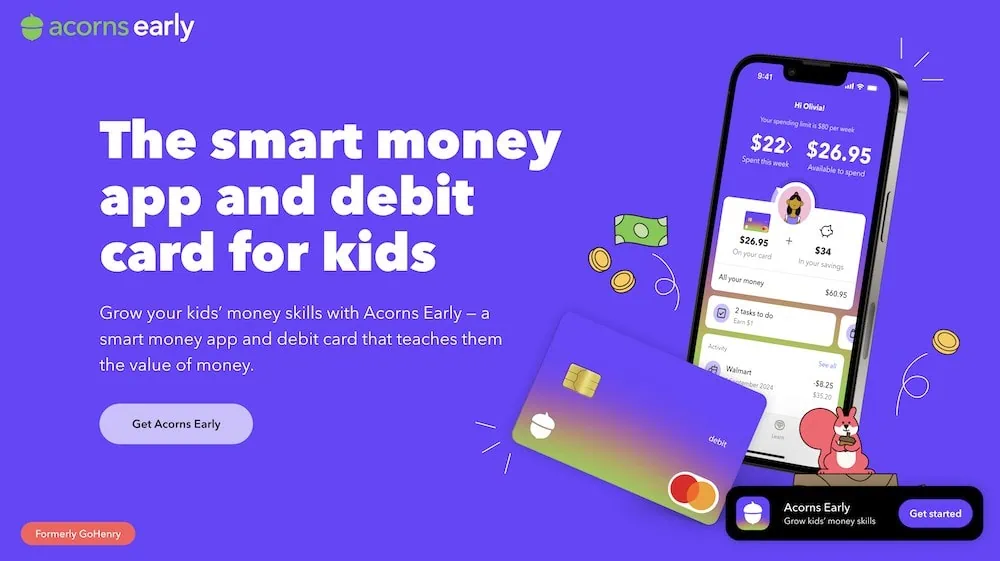
Many reviewers have long painted Acorns Early (formerly GoHenry) as just a way to spend. However, I see it as a real financial solution for minors—a debit card, yes, but also an app-based ecosphere that provides education and experience for the child, as well as ways for parents to keep their kids safe and teach them responsibility.
An Acorns Early account includes a smart money app, as well as Visa debit cards for up to four children. These debit cards can be used to spend anywhere Visa is accepted (so, millions of vendors online and in stores), as well as withdraw cash from ATMs. An Acorns Early account also allows kids to set savings goals, which they can fund manually or via autosave. And the app also hosts educational materials to help children and teens alike develop good money habits.
This FDIC-insured account also enjoys a variety of safety features, including chip and PIN protection, secure PIN recovery, and fraud protection. Acorns Early also offers parents additional peace of mind by providing a number of controls, including:
- Real-time spending notifications
- Card lock/unlock
- Savings goal lock/unlock
- Adjustable spending limits on a per-transaction and per-week basis
- Card category block/unblock for in-store purchases, online purchases, and ATM withdrawals
- Adjustable spending block/unblock at stores that sell age-restricted goods such as firearms and alcohol
Also, kids can only spend whatever money is available on the card because it’s a prepaid debit card. That means parents don’t have to worry about costly overdraft fees or their kids running up a debt.
Acorns Early also stands out to us as one of the best prepaid debit cards for kids because of its outstanding customer service, which it inherited from GoHenry. Acorns Early users enjoy seven-day-a-week phone service (9 a.m. to 8 p.m. ET Monday-Friday, 9 a.m. to 5 p.m. ET Saturday-Sunday), as well as 24/7 live chat support.
Acorns Early has no minimum age requirements but recommends starting at age 6 or older. Parents have two ways of signing up for Acorns Early:
- Sign up for Acorns Early Lite. This subscription level provides you with everything mentioned above.
- Sign up for Acorns Gold. Acorns Gold is the top Acorns subscription tier for adults, and it provides a wealth of banking, investing, and other features. However, it also includes a subscription to Acorns Early (again, good for up to four children), and it unlocks Acorns Early Invest: a UGMA/UTMA custodial account you can use to invest for your kids’ future.
Acorns frequently offers small bonuses for anyone who signs up with our links. You can check out current offers in the box below, or read more about this app in our Acorns Early review.
- Acorns allows you to sign up for investment, retirement, and checking accounts for you and your family, learn how to earn more money, and grow your investing knowledge.
- Famous for investing spare change automatically through Round-Ups, this all-in-one financial app helps younger generations start investing earlier.
- Invest in expert-built portfolios made up of diversified ETFs.
- Silver tier includes perks such as a 25% match on Acorns Earn rewards (up to $200/mo.), generous APYs on Checking and Emergency Fund, and live Q&As with investing experts.
- Gold tier includes perks such as a 50% match on Acorns Earn rewards (up to $200/mo.), $10,000 in life insurance, and picking individual stocks for your portfolio.
- Gold also comes with a free Acorns Early account for up to four children. It's also the only tier to offer Acorns Early Invest: a UGMA/UTMA custodial account where you can save toward your kids' future and get a 1% match on up to $7,000 in contributions annually.
- Earn even more with Later Match: Acorns will match up to 1% (Silver) or 3% (Gold) of all new IRA contributions in your first year.*
- Special offer: Get a free $20 bonus investment when you sign up with our link and start making recurring investments.**
- Robo-advisor with affordable fees (on larger portfolios)
- Fixed fee model
- Round-ups
- FDIC/SIPC insurance
- IRA match (Personal Plus and Premium)
- High fixed fees for small balances
- Limited investment selections
- Must subscribe to Premium for any self-directed investing options

Related: Best Acorns Early (Formerly GoHenry) Alternatives
9. Get a Part-Time Job
Working a part-time job, whether it’s after school or just during the summer, can help you save money fast because you’ll have a substantial income to put toward your goals. Plus, it gives you some experience in the workforce.
If you’re considering an after-school job, make sure you can balance the responsibility along with your studies. It’s nice to earn money as a teen, but you don’t want to sacrifice your grades to do it.
A summer job is an ideal situation for most teens. They usually provide enough hours to make some decent money, but not enough that you can’t enjoy your summer vacation.
Related: Online Jobs for Teens to Make Extra Money
10. Start a Small Business
Do you love washing cars or baking cupcakes for your friends and family? Do you spend hours playing a video game and live streaming to all your fans? If so, you might have what you need to start a small business, make your own money, and begin accumulating monthly savings.
You’ll need to consider a few things, such as whether you’ll have upfront costs (like buying equipment or software), how much you’ll charge, and how you’ll receive payments (cash, check, Stripe). You’ll also need to research business accounts and the best savings account for you.
This all might sound overwhelming, but if you succeed, you could get a massive head start on your financial future that will literally change how you live the rest of your life.
Related: How to Invest in Small Business Opportunities
11. Have a Garage Sale
A garage sale can be both fun, and a profitable one-time influx of cash, if you do it right.
First, make sure that you organize everything into categories so buyers know exactly where they are looking at when browsing. Keep things neatly arranged alphabetically or by price range.
Next, set up signs all over your neighborhood and advertise your sale on sites like Facebook and Nextdoor.
Lastly, be willing to negotiate. You’ll be surprised at how much even a few dollars here and there adds up!
Featured Financial Products
12. Save Gift Money in a Bank Account
When you receive money as a gift from family members or friends, don’t rush to go spend it. Put it in a savings account (or in whatever account you’re using to save money). This will help you stay focused on saving goals instead of spending the money.
Make Young and the Invested your preferred news source on Google
Simply go to your preferences page and select the ✓ box for Young and the Invested. Once you’ve made this update, you’ll see Young and the Invested show up more often in Google’s “Top Stories” feed, as well as in a dedicated “From Your Sources” section on Google’s search results page.
Developing Good Money Habits + A Healthy Mindset

The last thing you’ll need to do involves how you think and act. That is, you’ll need to start adopting a few good habits that generally help people save and spend wisely. You’ll also need to think about your money in a new way that prioritizes your savings goals over shorter-term impulses.
Do you want to get serious about saving and planning for retirement? Sign up for Retire With Riley, Young and the Invested’s free retirement planning newsletter.
13. Set Financial Goals for Yourself
Whether it’s for college, buying a phone, or buying your first car, setting clear financial goals can help focus your saving efforts.
When you know what you’re saving up for, you know how much you need to save. From there, you can break down your large saving goals into smaller savings goals. Let’s say you want to save up $1,000 for a down payment for a car. Well, it’s hard to save $1,000 all at once. So set a goal of saving up $50 per week, and you’ll reach your goal in 20 weeks.
14. Make a Budget
Next, you need to make a budget—and stick to it.
Figure out how much money you bring in via jobs, allowance, etc. Then calculate how much you need to spend each month. Whatever’s left over is what you can allocate toward your savings goals.
After that, monitor how much money is actually coming in and how much you’re spending, and compare it to your budget. That will help you understand how long it will take you to reach your goal—and what you can change to reach that goal more quickly.
15. Don’t Let the Little Spends Add Up
A soda here and a pack of Pokemon cards here might not cost all that much each time you buy one. But little spends add up over time and can slow you down as you try to reach your savings goals. Do your best not to withdraw money for impulse buys; instead, remind yourself of what you’re saving toward.
16. Don’t Overspend on Expensive Items
If you do want to buy the occasional expensive item while still saving for another goal, be savvy about it. Many expensive items, such as phones and computers, go on sale occasionally, allowing you to spend less money and put more toward your goals. Track the price of the thing you want, and if it comes down significantly in price, consider buying it then. This takes patience, but it can keep your savings plan on track.
17. Buy Used Instead of New When Possible
One great thing about being a teenager is having access to student discounts and all sorts of secondhand goods at more affordable prices than brand-new ones.
So, whether you shop online or visit thrift stores, remember: Buying used can save you a lot of money in the long run.
18. Talk to Your Parents About What You’re Saving For
One great way to get motivated about saving money as a teenager is by letting others know what your goals are. We know you might not want to talk to your parents about it, but you should tell them what you’re trying to save for and why it’s important to you. Not only can they keep you accountable, but they can provide support along the way.
For example, many parents will offer to match the money you save for big goals. So, if you save $3,000 for a car, they might match it with $3,000, so you can buy a $6,000 car. That’s a lot better than raising $6,00 on your own!
19. Start Small
Don’t worry if you can’t do all of these things at once. That’s OK! Just start with a few of them and see how far they’ll take you.
Eventually, some of these habits will become easy for you, allowing you to focus on adding even more good habits. And the more you pick up, the better you’ll be at saving.
Featured Financial Products
Related FAQs on Saving Money for Teenagers

How can a teenager save money without a job?
If you don’t have a job, there are still plenty of ways to save money. For example, you can collect change, ask for an allowance, and sell old possessions you don’t use anymore.
How much money should I save each month?
If you’re just trying to develop a savings habit, there’s no wrong answer; you can save as much money each month as you’d like.
If you’re saving with a specific financial goal in mind, you might want to use a savings calculator to figure out how much money to save each month.
What are some good savings goals for teenagers?
Some good goals for teenagers include buying a new phone or computer, saving up for college tuition, and putting away money for a car down payment.
Talk to your parents about what might be realistic and how you can contribute.
How can a 13-year-old save money?
If you’re 13 years old, some good ways to save money include collecting spare change, or doing odd jobs in your neighborhood, and putting that cash away in an extra savings account or an investment account with your parents.
How can a teenager save money fast?
There are many ways for a teenager to start saving money fast.
For example, some teenagers are better about saving when they open up a savings account at their local bank.
Earning more money means you can save more money, so some teenagers earn extra cash by doing chores around the house or running errands for family friends. Some teenagers get really creative, like starting a small yard work business or offering dog walking services.
And some teenagers also sell items they no longer need, such as old clothes, furniture, or electronics.
What should I do with my first paycheck as a teen?
You should open a savings or checking account when you get your first paycheck. It’s not easy to manage money, and when people simply cash their first paycheck, that money often gets spent really quickly.
Savings accounts are better for people who just want to save, while checking accounts are better for people who need to frequently spend the money they earn.
Related: