



Investing competently isn’t necessarily difficult—but it can take some time, attention, and effort.
The problem is, many people who want to save for retirement don’t necessarily have one or more of those things. You’re busy. You have responsibilities, families, hobbies, and other things that take up your bandwidth. But that’s OK, because we’ve got target-date funds (TDFs).
Think about your average mutual fund. It might change over time, but it does so to meet a particular investment goal that pretty much always stays the same. So you might want more exposure to that fund early on in life, but less as time goes on, and the only way to ensure that is to actively manage your portfolio, selling shares as market conditions and time dictate.
TDFs are more than that. These are living, breathing portfolios you can purchase just as easily as a mutual fund. And as you age, they change to ensure you’re holding the proper balance of assets you should be for wherever you are in life.
Today, we’re going to talk about some of the most well-known and accessible target-date funds from a quartet of fund providers: Vanguard, Fidelity, Schwab, and T. Rowe Price. If you’re looking for a one-stop shop for your retirement savings, read on.
Editor’s Note: Data in this article is up-to-date as of March 24, 2026.
Disclaimer: This article does not constitute individualized investment advice. Individual securities, funds, and/or other investments appear for your consideration and not as personalized investment recommendations. Act at your own discretion.
Table of Contents
What Are Target-Date Funds?

Let’s start with some definitions.
Target-date funds invest in assets that match the recommended risk preferences of investors with their intended retirement date. These products typically own stocks and bonds, and the mix of assets changes over time. While exact allocations will vary from one fund (and series, and fund provider) to the next, most follow a similar strategy:
- Pick the fund closest to your intended retirement date.
- Invest money across time.
- Have a fund manager adjust the mix of stock, debt, and cash to become more conservative over time.
However, despite these simple steps, these funds can differ dramatically. This includes the investments held in each fund, various levels of fees associated with the fund and underlying investments, and even what happens with the investments from present to target date and beyond (“to” vs. “through”).
In fact, some funds cease the transition to more conservative investments at the target date while others transition slower and continue shifting toward more fixed-income/cash allocations. The advantage of the latter would be more potential for growth into your retirement years.
Continued portfolio growth in our later years is important, so I’d say for target-date funds to qualify as one of the best investments for young adults, I’d only consider the latter (“through” retirement). Why? Well, Social Security and Medicare are both suffering from solvency issues that could result in smaller benefits down the road, so we might not have as many retirement resources as our parents and grandparents did.
And let’s face it: Despite reaching your goal, you might still need more capital appreciation going forward. If you consider the amount of time you’re likely to spend in retirement, which could be 30 years or more, it becomes clear a need still exists for capital growth from stocks and also some combination of income-generating assets.
How Do Target-Date Funds Work?
Target-date funds offer the simplicity of investing in one product and having the asset allocation change over time as you age. This allows for a transition from more stocks to more fixed-income and cash-equivalent investments to match your recommended risk levels by age.
This transition, referred to as the “glide path,” can help investors who do not pay close attention to their retirement holdings across time. An investor need only select the fund best-matched to their intended retirement date and hold the investment. This results in better tax consequences (discussed below) and eases concern by not needing to worry about rebalancing, asset selection, or any other investing due diligence.
Are Target-Date Funds a Good Investment?

Here’s an anecdote I often think about. A 2018 CNBC article discussed a man who was just laid off. He held four employer-sponsored retirement accounts from four previous employers, and he had another from the employer that just let him go. The man suffered steep losses in the four accounts, which were heavily invested in stock portfolios; his fifth portfolio was invested in a target-date fund, and it lost far less.
Put succinctly: Had all of his money been in target-date funds that were appropriate for him, it’s likely he would’ve held a higher percentage of bonds, and it’s likely he would’ve lost far less ground in the recession.
Looking at Morningstar’s data included in the article, we can see accounts held in funds closer to retirement performed less-poorly than those intended for later dates. This is because those later-dated target funds held higher allocations in equities and thus experienced more adverse returns during the recession.
For investors who wish to automate their retirement savings in diversified, low-cost passive investments, target-date funds can be valuable financial instruments. The products automatically transition from heavier stock allocations to bond allocations as the employee ages, thereby reducing risk in the retirement portfolio over time.
If these types of investments interest you, consider opening an account with the likes of Interactive Brokers (IBKR), TradeStation, or SoFi Invest.
Related: Best Investment Apps for Beginners to Start Investing
Are Target-Date Funds Held ‘To’ or ‘Through’ Retirement?
Target-date funds continue to hold equities in a person’s portfolio when entering retirement. However, the allocation will depend on whether the investor has access to target-date funds which transition “through” retirement or “to” retirement. “Through” offers a greater allocation in equities because these funds understand the holder continues to seek capital appreciation through a higher stock allocation than fixed-income investments. “To” holds a more conservative allocation.
More specifically, TDFs inherently manage an investor’s assets in relation to an intended retirement date.
With target-date funds employing the “to” approach, this results in funds adopting higher allocations to fixed-income investments near or at the retirement date. The investor’s portfolio allocation will remain static thereafter. But with “through” retirement target-date funds, the shifts don’t end at the retirement date. Funds using this approach typically have higher stock allocations than “to” funds by the target date, but then continue to decrease their allocation for 10 to 30 years following retirement.
These fund approaches differ dramatically in terms of risk/return potential. Make sure you understand the risk/reward trade-off made through these funds and how they invest in stocks and bonds over time.
The charts below illustrate the differences in allocations to stocks and bonds in both a “to” and “through” approach. As you can see, both graphs show changes in allocations over a 50-year-plus period. The “to” approach emphasizes the static glide path (consistent slope of the change in allocation over time) while the “through” approach emphasizes a steepening decline in its glide path beyond retirement.
Target-Date Fund Held Through Retirement

Target-Date Fund Held to Retirement
Do you want to get serious about saving and planning for retirement? Sign up for Retire With Riley, Young and the Invested’s free retirement planning newsletter.
What Are the Best Target-Date Funds?
Low-cost target-date funds can be great for holding an entire retirement account’s portfolio. That’s because the underlying assets will typically be low-cost actively managed or index funds that provide both diversification, as well as risk management (through the glide path feature).
But I’ll emphasize low cost. If the fees for a target-date fund exceed 1%, and you could DIY your own portfolio with much lower fund fees in either your workplace account or your own retirement account, it might make sense to take management into your own hands. Just know that doing so requires manually adjusting your allocation to individual stocks and bonds, as well as stock and bond mutual funds and ETFs, across time. (Not to mention, you add your own element of, ahem, operator error.)
Or, of course, you could just find a lower-cost target-date fund from one of the families below.
→ Vanguard Target-Date Funds
I’ll start with Vanguard’s target-date fund series. Vanguard Target Retirement Funds are a dirt-cheap option, charging just 0.08% annually (or 80¢ on every $1,000 invested) across the entire lineup as of March 2026. For comparison’s sake, the industry average expense ratio for comparable target-date funds is 0.41%, according to Vanguard research.
The series currently is composed of 12 funds—11 dated funds (2020, 2025, and so on), as well as the Vanguard Target Retirement Income Fund (VTINX), designed for people already in retirement who want to generate income with a little potential for capital appreciation.
Vanguard offers a number of target-date index funds, but the ones of most interest to this site’s readers (young adults) are likely the Vanguard Target Retirement 2060, 2065, and 2070 Funds (VTTSX, VLXVX and VSVNX, respectively).
These funds keep their expense ratios low by investing in a handful of passive Vanguard index funds. The only active management here is happening at the fund-allocation level; that is, how much of each bond or stock fund that each target-date fund decides to hold.
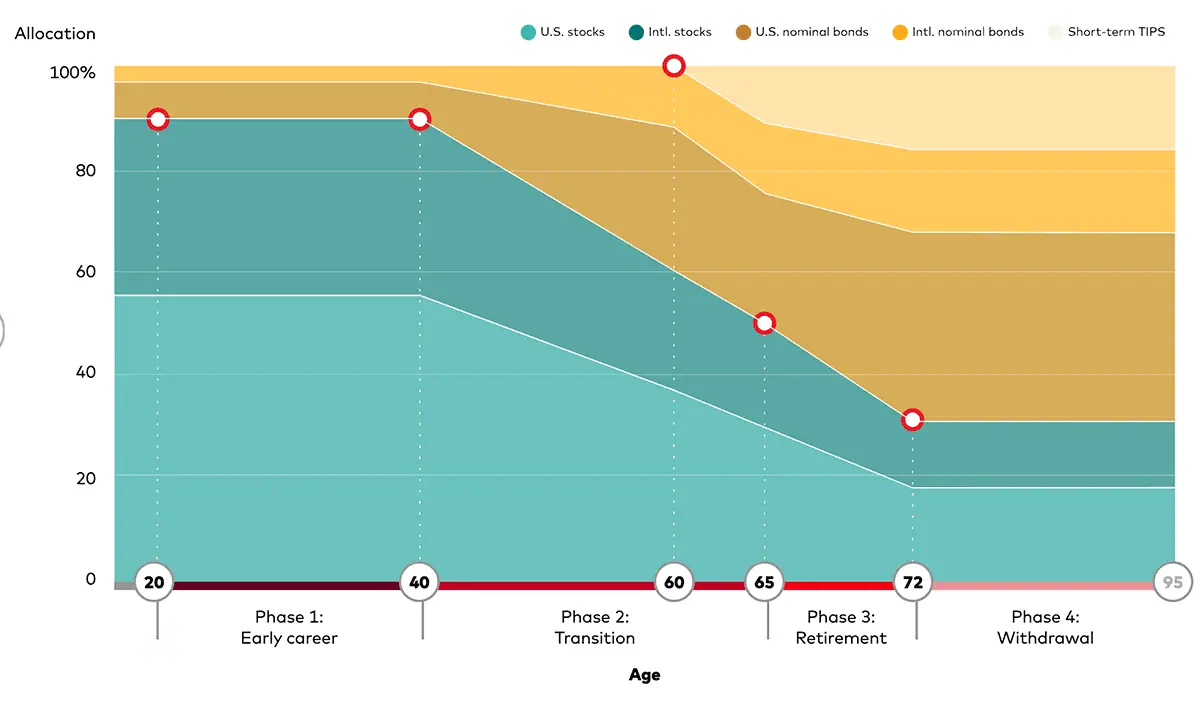
Here’s a look at the glide path for Vanguard Target Retirement Funds:
You can learn more in our primer on Vanguard target-date funds.
→ Fidelity Target-Date Funds
You actually have four lineups to choose from if you want a Fidelity target-date fund: Three “Freedom” sets and a “Sustainable” series:
Fidelity Freedom Funds are a family of 14 target-date funds whose dates run from 2010 to 2027, plus the income-focused Fidelity Freedom Retirement Fund (FFFAX). These target-date funds predominantly (but not entirely) hold actively managed funds. That elevates costs a bit; they currently run between 0.46% and 0.68% annually.
Fidelity Freedom Index Funds, which run at just 0.12% annually, is another 14-product TDF lineup, this one built exclusively from Fidelity’s lineup of low-cost index funds.
Fidelity Freedom Blend Funds earn their name from holding a “blend” of actively managed and indexed funds. The result? Expenses that fall between the two prior lineups, ranging from 0.41% to 0.47%. Again, there are 14 funds here: 13 dated funds, plus Fidelity Freedom Blend Retirement Fund (FHBZK).
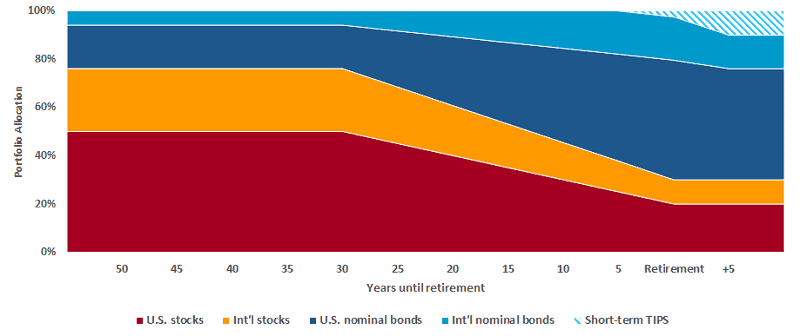
This is what the glide path for Fidelity Freedom funds looks like:

Fidelity Sustainable Target Date Funds are Fidelity’s youngest target-date lineup. These 14 funds, which range from 0.41% to 0.49% in annual expenses, invest in either actively managed funds that select securities based on ESG characteristics, index funds that track an ESG index, or funds that don’t necessarily have a principal ESG strategy, but that have at least 80% of assets in debt securities that the adviser believes have positive ESG characteristics.
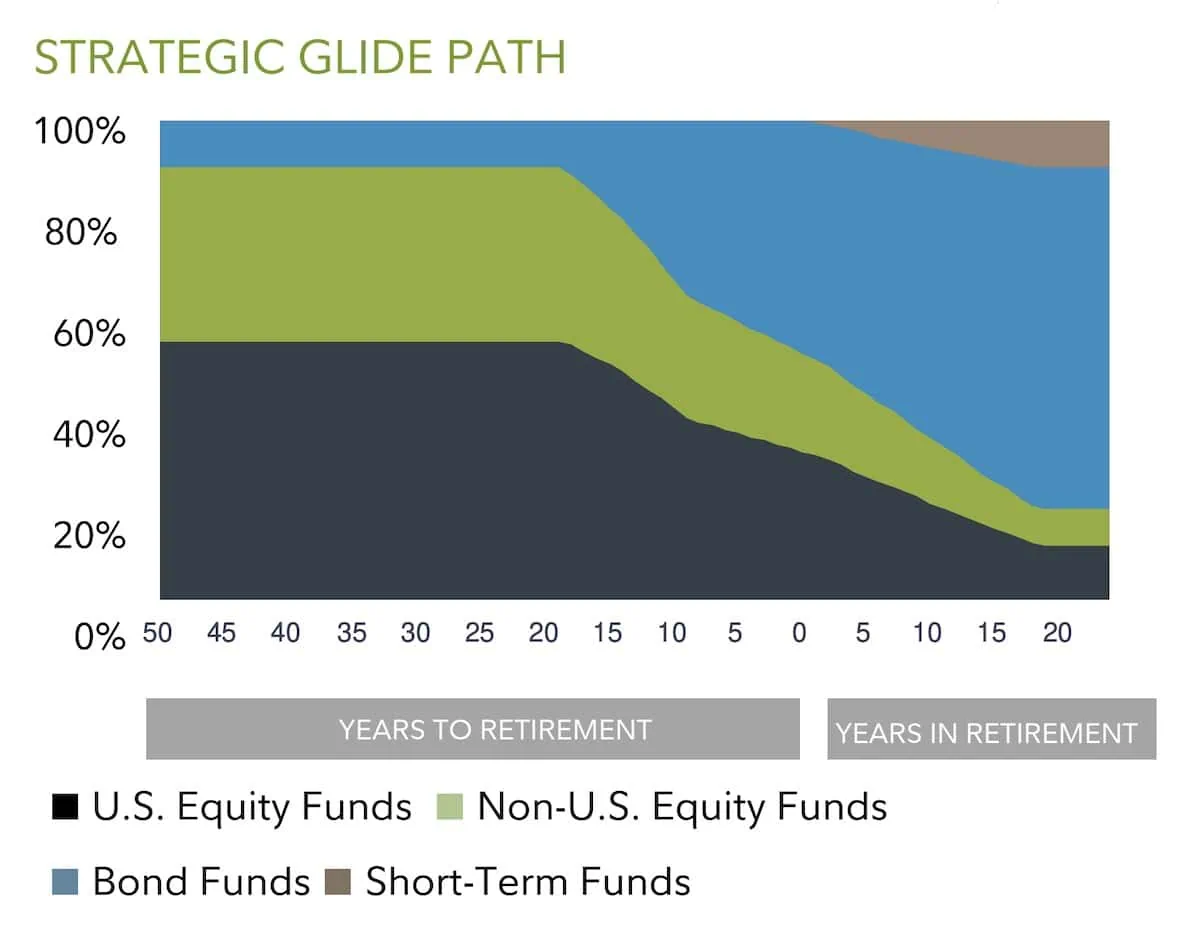
And here we have the Fidelity Sustainable lineup’s glide path:
You can learn more in our primer on Fidelity target-date funds.
Make sure you sign up for The Weekend Tea, Young and the Invested’s free weekly newsletter that over 10k monthly readers use to level up their money know-how.
→ T. Rowe Price Target-Date Funds
T. Rowe Price also has dozens of target-date funds, spread across three families:
T. Rowe Price Retirement Funds include 14 dated funds, as well as an additional two income funds (so, 16 total). These funds are run by a management team that averages 19 years of experience, and hold various actively managed T. Rowe mutual funds to achieve their goals. Net annual expenses range from 0.49% to 0.64%.
T. Rowe Price Retirement Blend Funds, like with Fidelity’s blended lineup, strike a balance between indexed and actively managed holdings that helps cut down on cost. This 14-fund line’s average expenses range from 0.34% to 0.44%.
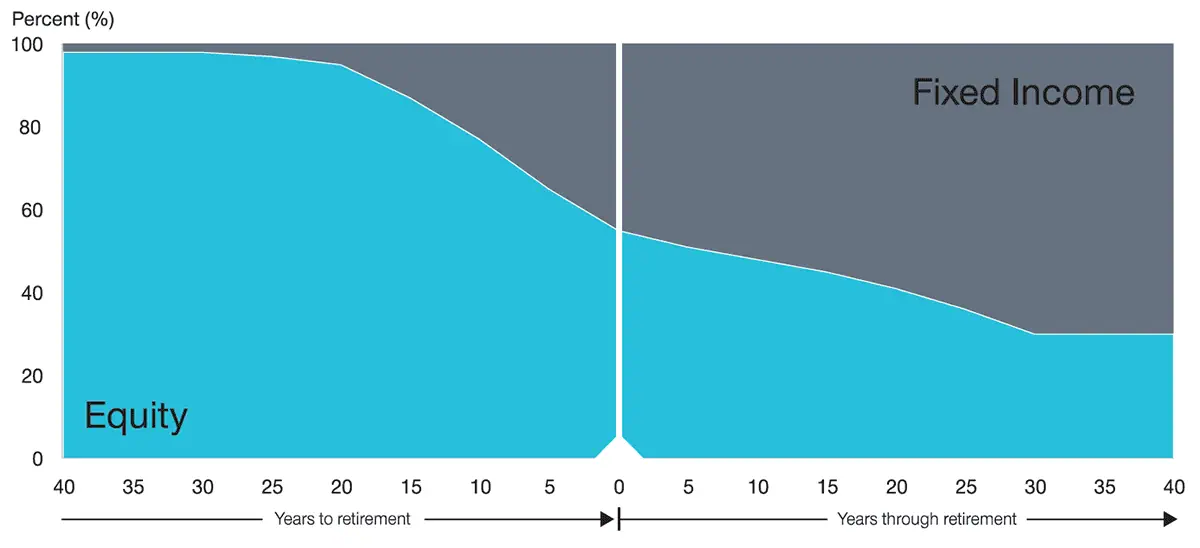
Here’s a look at the glide path for the T. Rowe Price Retirement line:
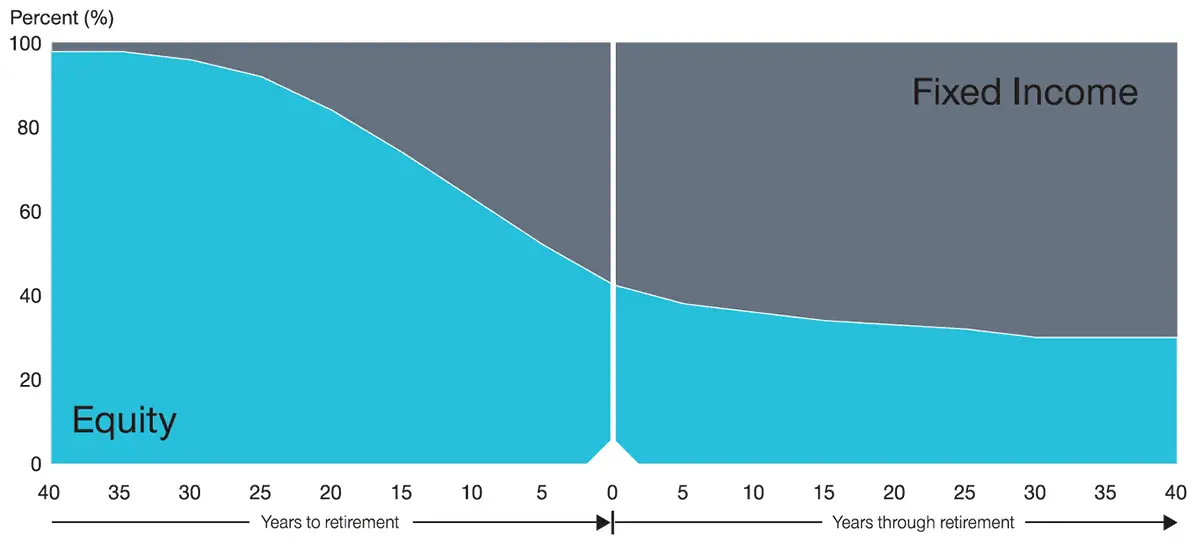
T. Rowe Price Target Funds, made up of 14 dated funds, are among the more interesting varieties across all the major fund providers. T. Rowe’s Target Funds provide higher exposure to bonds across the glide path. While it’s not a drastic difference, it provides more stability for less risk-averse investors. And as you can see from the graphic below, that greater emphasis on fixed income starts pretty early. Expenses here range from 0.45% to 0.64%.
T. Rowe Price Target Funds have a somewhat different glide path:
My previous employer partnered with T. Rowe Price for our 401(k) plan and would default new employees into these target-date funds when retirement benefits began accruing. Many employees likely remained in these funds with their retirement contributions.
Make Young and the Invested your preferred news source on Google
Simply go to your preferences page and select the ✓ box for Young and the Invested. Once you’ve made this update, you’ll see Young and the Invested show up more often in Google’s “Top Stories” feed, as well as in a dedicated “From Your Sources” section on Google’s search results page.
→ Schwab Target-Date Funds
Schwab has a pair of target-date funds, one of which competes directly with Vanguard on price:
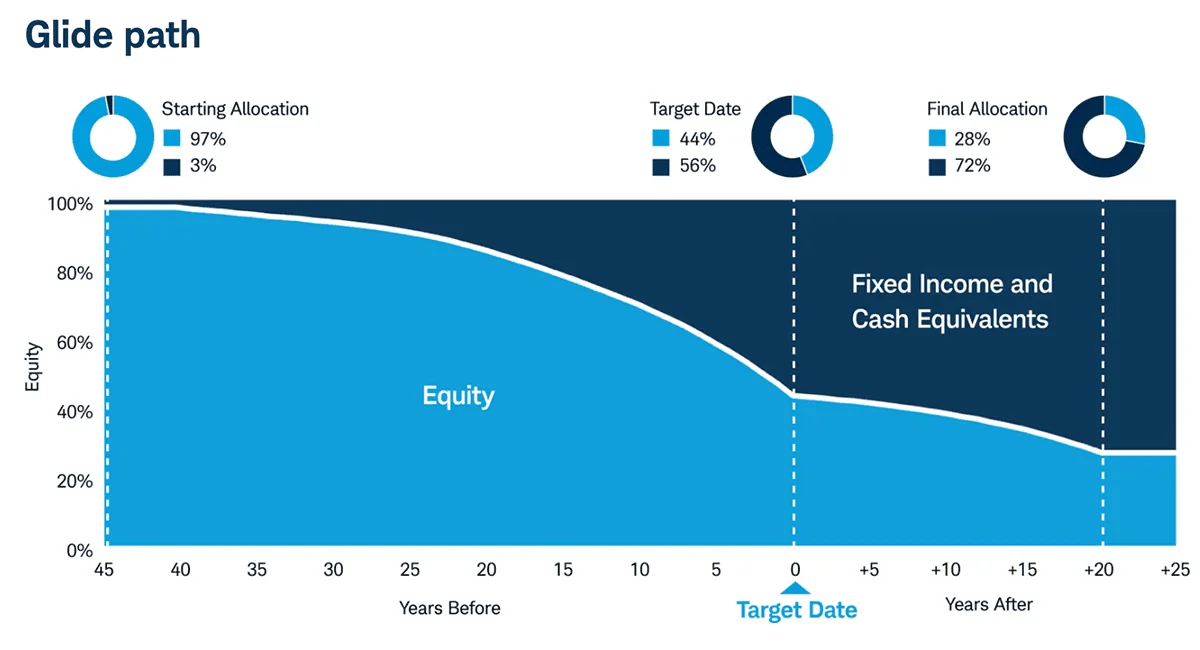
Schwab Target Funds range in five-year increments from 2010 to 2070, with new iterations added over time. Each of these 13 target-date funds holds a mixture of stock mutual funds and fixed income mutual funds, with the percentage allocated to stocks gradually getting higher the further out the targeted retirement date is. Schwab Target Funds also are OK with holding both actively managed and index funds. Expenses range from 0.25% on the low end to 0.58% on the high end.
Here’s what the glide path looks like for this series:
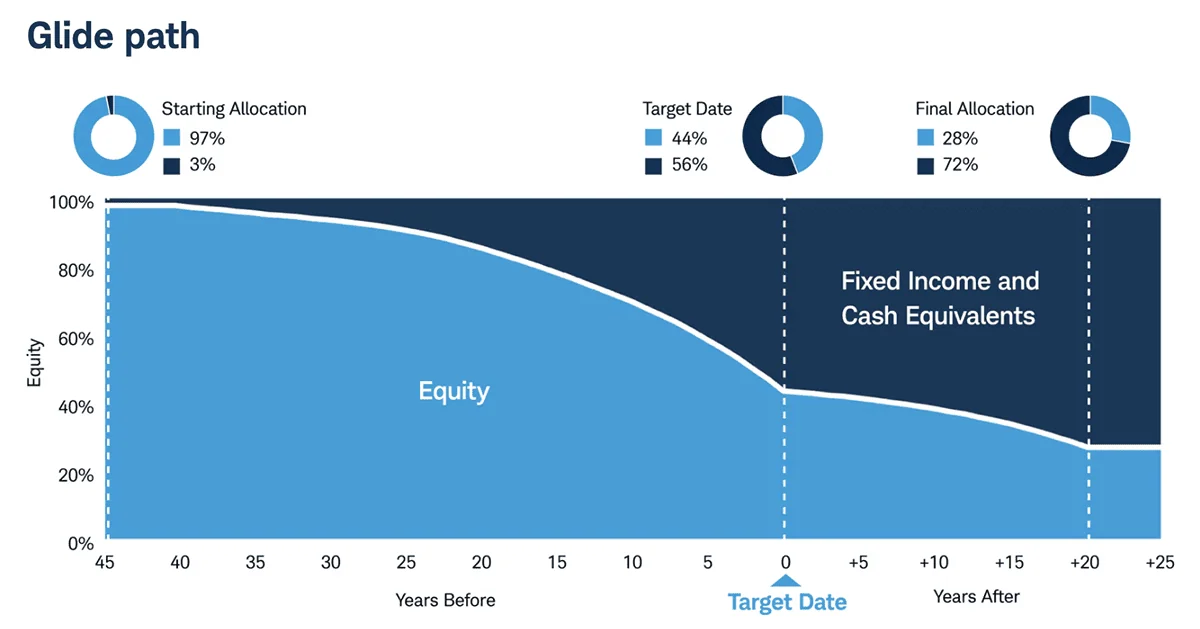
Schwab Target Index Funds, as the name would suggest, invests exclusively in index funds. However, unlike many other target-date fund families, this 13-fund Schwab lineup gets its exposure from exchange-traded funds. For instance, Schwab Target 2025 Index Fund (SWYDX) has holdings in Schwab ETFs such as the Schwab US Aggregate Bond ETF (SCHX) and the Schwab US Large Cap ETF (SCHX). The result is a low 0.08% annual expense ratio across the board, on par with Vanguard Target Retirement Funds.
And here’s the glide path for the Target Index series:
Want to learn more? Check out our primer on Schwab target-date funds.
Schwab vs. T. Rowe Price vs. Fidelity vs. Vanguard Target-Date Funds
→ Expense Ratios
Over the long term, expenses matter a great deal. And given that annual expense ratios affect your long-term performance, you should consider them strongly when selecting a target-date fund.
To give you a flavor for how these companies’ expense ratios compare, have a look at the following tables. The first table focuses on traditional (actively managed) target-date funds, while the second focuses on indexed TDFs.
Expense Ratios - Schwab vs. T.Rowe Price vs. Fidelity vs. Vanguard Target Date Funds (NON-INDEX)
| Target Date | Schwab Target Series (non-Index) | T. Rowe Price Retirement Series (non-Index) | Fidelity Freedom Series (non-Index) | Vanguard (Only offers index TDFs) |
|---|---|---|---|---|
| 2030 | 0.40% | 0.55% | 0.61% | N/A |
| 2045 | 0.52% | 0.60% | 0.68% | N/A |
| 2060 | 0.58% | 0.64% | 0.68% | N/A |
| Data as of Jan. 29, 2026 | ||||
Expense Ratios - Schwab vs. T.Rowe Price vs. Fidelity vs. Vanguard Target Date Funds (INDEX)
| Target Date | Schwab Target Index Fund | T. Rowe Price Retirement Blend Fund Series (Doesn't offer true index TDFs) | Fidelity Freedom Index Series | Vanguard Target Retirement Fund Series |
|---|---|---|---|---|
| 2030 | 0.08% | 0.38% | 0.12% | 0.08% |
| 2045 | 0.08% | 0.41% | 0.12% | 0.08% |
| 2060 | 0.08% | 0.44% | 0.12% | 0.08% |
| Data as of Jan. 29, 2026 | ||||
→ Equity Percentage at Age 65 (Retirement)
Further adding diversity in these companies’ target-date funds lineups is the percentage of underlying assets held in equities at retirement age (65).
Given your investment objectives, you might wish to hold more or less equity in your portfolio at retirement, adding further complexity to your investment decision. Looking at these four companies, the following table shows the respective equity percentage held in the target-date fund families at retirement age:
| Target Date Family | Percentage of Equities @ 65 |
|---|---|
| Schwab | 43% |
| T. Rowe Price | 55% |
| Fidelity | 55% |
| Vanguard | 50% |
| Based on 2025 funds SWHRX (Schwab), TRRHX (T. Rowe), FFTWX (Fidelity), and VTTVX (Vanguard) data as of Jan. 29, 2026 | |
→ Asset Classes Represented
Another important consideration for choosing between these target-date funds is the underlying asset classes represented in each of the fund families.
Have a look at the following table to see the asset classes held in each target-date fund family.
| Asset Class | Schwab | T. Rowe Price | Fidelity | Vanguard |
|---|---|---|---|---|
| U.S. Large Cap | X | X | X | X |
| U.S. Mid Cap | X | X | X | X |
| U.S. Small Cap | X | X | X | X |
| International Equity | X | X | X | X |
| Emerging Markets Equity | X | X | X | X |
| U.S. Fixed Income | X | X | X | X |
| U.S. TIPS | X | X | X | X |
| High Yield Bonds | X | X | X | X |
| International Bonds | X | X | X | X |
| Emerging Markets Debt | X | X | X | X |
| REITs | X | X | X | |
| Commodities | X | |||
| Source: Morningstar; data is as of Jan. 29, 2026 | ||||
Are Target-Date Funds Tax Efficient?

When investing in mutual funds and target-date funds, you purchase a security comprised of underlying assets (mutual funds or ETFs). When these underlying funds realize capital gains and/or dividends, these pass through annually to the shareholder, who pays the applicable tax.
For net capital gains (capital gains less capital losses), they come grouped into two buckets: long-term (securities held longer than one year) or short-term (held <1 year). The IRS taxes both at the appropriate rates for the shareholder, and depending, could result in paying no tax.
For dividends, fund managers accumulate and distribute these to shareholders throughout the year. Dividends receive ordinary income tax treatment unless they meet the requirements for qualified dividends. These distributions represent one form of taxation on target-date funds.
Investors can also transact by buying and selling the funds themselves, triggering another taxable event. Commonly, target-date funds are tax efficient in nature because they often require no transacting on your part to arrive at your asset allocation. As a result, the target-date investor faces fewer taxable events than an actively-managed portfolio.
However, because capital gains and dividends pass through to the investor regularly, if an investor holds these investments outside of a tax-advantaged account, this can trigger regular tax consequences. In other words, if the investor transacts less often with target-date funds (no worries about receiving a margin call from shorting stocks) than with active management, it can represent a more tax efficient investment.
Are Target-Date Funds Actively Managed?
Target-date funds provide a simplified way to save for retirement. They offer exposure to a variety of asset classes, markets, and active and passive management (discussed below).
Regarding the active vs. passive management component, investors need to remain aware of the assets held in the target-date funds. Said differently, despite the simplicity of these investments, investors must should be conscious of the underlying asset allocation, fees, and portfolio risk of their target-date investments. In fact, some fund companies offer two type of target-date investments: target-date funds and target-date index funds.
Target-Date Funds vs. Index Funds
An index fund is almost always a single portfolio made up of stocks and/or bonds, with holdings determined by an index governed by a set of rules.
Target-date funds differ in a couple of ways. For one, their holdings are almost always multiple mutual funds or ETFs instead of individual securities. Also, TDFs are almost always managed by humans—even if the TDFs exclusively own index funds.
If I’m being practical, they’re two terms that are never really contrasted against one another. A target-date fund provides something (changing allocations over time) that most other portfolios don’t—regardless of whether those other portfolios are actively or passively managed.
Target-Date Funds Pros and Cons

The pros?
- Get a complete portfolio in a single fund. By electing one target-date fund, you have a straightforward approach to a sophisticated problem: how to invest successfully for retirement, whether in an individual retirement account (IRA), 401k, or other eligible retirement account. No matter the account type, be sure to take advantage of retirement plan limits.
- Less risk through broader diversification. Each target-date fund available through Vanguard, Fidelity, T. Rowe Price, Schwab or other companies invests in index funds which track the broader market. Available options give you access to thousands of U.S. and international stocks and bonds, including exposure to the major market sectors and segments.
- Professionally-managed asset mix. Each target-date fund has a manager who gradually shifts each fund’s asset allocation to a lower stock mix and more fixed income investments over time. This happens to make the investment portfolio more conservative the closer you get to retirement.
- Automatic rebalancing. Because managers oversee these funds, they make sure to maintain the current target asset mix. This frees you from the hassle of worrying about ongoing rebalancing on a quarterly, semi-annual or annual basis. Essentially, the funds operate on a schedule laid out in the prospectus.
- Low costs. Depending on your target-date fund company, your costs can fall on the lower side than managing the assets yourself. For example, Vanguard offers expense ratios 81% below the industry average. When you pay less for your target-date funds, this keeps more money for you and shows you just how to save money toward your retirement goals.
And now for the cons:
- Tax-inefficient. Depending on your investing strategy, target-date funds can represent tax inefficient investments. Capital gains and dividends pass through to the investor and can result in tax consequences if held outside of a tax-advantaged account. For this reason, target-date funds most commonly reside in tax-advantaged retirement plans.
- Glide path variability. Depending on fund type, you might not hold the preferred allocation of stock, bonds, and cash. Some funds transition quicker or slower than your desired asset allocation. This can expose the investor to undue risk. Before purchasing a target-date fund, take a closer look at the allocation, glide path, and whether the fund employs a ‘to’ or ‘through’ retirement methodology.
- Higher fees. Make no mistake about it, these higher-touch products come at a higher cost. Quite often, target-date funds can charge higher fees than mutual funds because they pass through not only the underlying mutual funds’ fees, but also their own management fees. Some target-date funds come with over 0.80% of annual fees based on the numbers shown above. These fees can compound and make it harder to learn how to build wealth.
Target-Date Funds Alternative
As an alternative, you can use a service like Betterment with a robo-advisory function.
Betterment recently loosened the reins to empower users to buy individual stocks and ETFs, but the investing platform was built around pre-built portfolios with different themes and goals. The company’s automated investing solution helps you build an ETF portfolio to suit your goals, then handles all the trading, rebalancing, reinvesting, even tax management for you.
You also have a wealth of account options, including traditional taxable brokerage accounts, IRAs, Roth IRAs, and SEP IRAs, among others.
Sign up with Betterment today.
Do you want to get serious about saving and planning for retirement? Sign up for Retire With Riley, Young and the Invested’s free retirement planning newsletter.
Mega-Yielding Funds You’ve Never Heard Of
You’ve assuredly heard of mutual funds and exchange-traded funds (ETFs). But how much do you know about closed-end funds (CEFs)?
If the answer is “not much,” don’t worry—they get a fraction of the attention of those other investment funds. But you should also learn more about them. That’s because CEFs have a host of enticing characteristics, including that they frequently pay mammoth yields. Check out our list of the best CEFs, many of which pay in the high-single and even double digits.
The 10 Best Dividend ETFs [Get Income + Diversify]
We love exchange-traded funds (ETFs) because they can provide one-click access to hundreds, even thousands of stocks, while charging often minuscule fees.
One way to put that low-cost diversification to work? Collecting dividends. But trying to choose from literally hundreds of income-producing funds could take up a lot more time than you have. So let us help you narrow the field—check out our list of ten top dividend ETFs.
Please Don’t Forget to Like, Follow and Comment
Did you find this article helpful? We’d love to hear your thoughts! Leave a comment with the box on the left-hand side of the screen and share your thoughts.
Also, do you want to stay up-to-date on our latest content?
1. Follow us by clicking the [+ Follow] button above,
2. Subscribe to Retire With Riley, our free weekly retirement planning newsletter, and
3. Give the article a Thumbs Up on the top-left side of the screen.
4. And lastly, if you think this information would benefit your friends and family, don’t hesitate to share it with them!