


A custodial account represents a way for a parent or legal adult to transfer financial assets for the benefit of the minor account owner.
These financial accounts come in two types: UGMA and UTMA accounts. Uniform Gifts for Minors Act Accounts and Uniform Transfers to Minors Act accounts both protect assets from a child’s full control until reaching the age of majority in their state of residence.
Learn more about how these accounts work, how they differ and where to open one. As it turns out, you may only have one as a option.
Table of Contents
What is a Custodial Account?

A custodial account is a financial account held in the name of a minor by one or more custodians.
Custodian is defined as “the person who manages assets for another” and typically refers to an adult who holds legal responsibility for the account on behalf of the child—usually their parent. A custodian can be the child’s parent, guardian, spouse of their parent, grandparent or another relative.
Custodial accounts are typically used to save and invest for a minor in the hopes that they will use their funds in a productive way when they reach adulthood. Once you have opened a custodial account, you can use it for various financial goals, including college savings, retirement or general investment purposes.
Many use the account to teach some basic financial lessons about investing to their children. You can use the opportunity to discuss investment choices and outcomes, review account statements and give them a vote on significant decisions.
The custodian is responsible for managing and investing funds accordingly with the trust that they act in their best interest at all times.
How Do Custodial Accounts Work?
A custodial account works by having a parent, guardian, or other custodian establish an account with a bank or broker offering these accounts. The custodian makes or accepts contributions into the account and manages the underlying assets the funds invest in for the beneficiary.
Custodial accounts allow custodians to invest money into a variety of assets. Most commonly, parents establish these accounts for children to build assets they will eventually own. Due to this longer-term time horizon, stocks often make suitable investment vehicles for these investment accounts.
Further, these investments can be carefully planned to provide the best chances for compounding returns by purchasing assets like index funds, individual stocks or mutual funds. You can try a portfolio mixed with many different assets to teach your child how markets work and also with little money at risk to start.
Consider picking stocks in some of your child’s favorite companies like Netflix, McDonald’s or others. Several stock newsletters can also point you toward stocks with significant long-term upside potential.
If you pick suitable investments and hold them for a long time, this can maximize your child’s future financial prospects as well as your own if this makes your child financially independent.
After setting up an account, making contributions and choosing the investments to hold, you’ll need to be careful when managing the money in the account. This is especially true for any withdrawals that get made, as you will want to remain mindful of the rules involved.
Custodial accounts require careful management because funds must remain untouched until the child reaches 18 or 21, depending on state law, to ensure maximum benefits from compound interest over time.
Custodial accounts come in two flavors, a UGMA and a UTMA account, though the former is no longer available to be opened as a new account.
Related: 11 Best Ways to Protect Yourself From Financial Fraud
What is a Uniform Gifts to Minors Act Account (UGMA)?
UGMA (Uniform Gifts to Minors Act) accounts are custodial accounts typically set up by parents, guardians, grandparents or other relatives, who then serve as custodians for the child’s account until reaching the age of termination or majority in their particular state. In most places, this occurs when a child reaches 18, but other places require the minor to be 21 or older.
When friends and family contribute money to a UGMA account opened through a bank or stockbroker, they are subject to annual contribution limits ($19,000 per person per year in 2026), but they can exceed this amount and file a Form 709, United States Gift (and Generation-Skipping Transfer) Tax Return with their tax return to declare the gift.
One other element to be aware of: When making these financial gifts, they become irrevocable, meaning they can’t be taken back from the minor once transferred. For this reason, it may be essential to consult a lawyer or other qualified professional before setting up an account.
UGMA accounts can hold purely financial assets like cash, stocks, bonds, mutual funds, life insurance policies, and other financial instruments.
What is a Uniform Transfers to Minors Act Account (UTMA)?
UTMA accounts (Uniform Transfers to Minors Act) are also custodial accounts and are not limited to a specific dollar amount each year.
UTMA accounts can hold any type of property, meaning they can have the above financial instruments, real estate, and real property. For example, you can place the deed to a home, car, fine art or other property into the UTMA account and transfer ownership to the minor.
What is the Difference Between an UGMA and UTMA Account?

Both UGMA and UTMA accounts are similar in that they are custodial accounts with assets held within them for the benefit of the minor.
They differ in two ways:
1. Types of Assets Held Within the Account
UTMA accounts can hold any type of property, meaning they can hold the above financial instruments and real estate and real property. For example, you can place the deed to a home, car or other property into the UTMA account and transfer ownership to the minor.
UGMA accounts can only hold traditional financial assets like cash, stocks, bonds and life insurance policies.
2. State Adoption Policies
Another critical difference between a UGMA and UTMA account relates to state adoption policies. All states have adopted UGMA accounts, but until recently, not all states have adopted the UTMA account. Once the final states chose those new rules, you are only able to open new UTMA accounts in all 50 states. New UGMA accounts aren’t available to open anymore, though existing UGMA accounts can remain open.
Do you want to get serious about saving and planning for retirement? Sign up for Retire With Riley, Young and the Invested’s free retirement planning newsletter.
Do UTMA or UGMA Accounts Affect Financial Aid?
If you have concerns about the impact of your child’s assets on their eligibility for federal financial aid, then UGMA and UTMA accounts might not be suitable for your needs.
Students have a higher expected contribution of their savings versus what their parents might be able to, usually 20% vs. a maximum of 5.6% of savings for the parents. Because of the higher expected contribution amount used to figure federal student aid, using money from a custodial account for qualified educational expenses doesn’t make the most sense when considering the potential tax consequences and financial aid impact.
Instead, you’d likely look to a 529 plan if you’d want to save after-tax dollars in a tax-smart way for college costs that realize tax savings when used for educational expenses. These college savings plans allow you to save money toward qualified educational expenses without tapping into the child’s money from a custodial account to pay for schooling.
Further, these accounts have a lower impact in limiting eligibility for financial aid purposes, enabling children to be eligible for more scholarship funds.
Related: Coverdell ESA vs. 529 vs. UTMA/UGMA [College Savings + More]
What Can You Invest in through UGMA and UTMA Accounts?
1. Stocks

Stocks represent one of the best investments for kids because they have a long-term orientation and will provide years of profitable returns for your kids.
All of the child investment plans covered above allow you to hold stocks in some form or fashion through individual stocks, exchange-traded funds or mutual funds.
Custodial accounts, whether as a taxable account or a custodial IRA, allow you to hold numerous different assets within them in your child’s name. One common purpose for opening a custodial account is to invest in stocks for your kids. If this is your goal, you can open a custodial brokerage account to begin investing on behalf of the child.
Investing in your children’s future is a rewarding and beneficial endeavor. You can use stocks to teach lessons to your children about the value of thrift, the importance of investing and general money management skills.
Getting them connected to investing may require tapping into other areas of their life to begin building interest over time. To get a child interested in the stock market, consider creating an individual portfolio of stocks for kids they’ll likely recognize from their daily lives.
Companies could include Apple, Google, Disney and many more. Children’s investment accounts will grow steadily over time if you invest in a portfolio of well-performing stocks.
Make Young and the Invested your preferred news source on Google
Simply go to your preferences page and select the ✓ box for Young and the Invested. Once you’ve made this update, you’ll see Young and the Invested show up more often in Google’s “Top Stories” feed, as well as in a dedicated “From Your Sources” section on Google’s search results page.
2. Exchange-Traded Funds (ETFs) and Mutual Funds
ETFs have become increasingly popular over the past two decades. These investment vehicles replicate similar types of performance as mutual funds by holding an underlying, diversified portfolio of stocks, bonds, or other investments.
Where they primarily differ, however, is by trading openly on the stock market exchanges. Because of this feature, they often have better liquidity than mutual funds because they trade throughout the day.
ETFs can represent both passive and active investment options. Passive ETFs are index funds that track a broader market and may also be specific to a sector or group of related assets. Investing in index funds provides instant diversification in one investment with low expenses. You do not need to engage in stock picking or participate in risky behavior like investing for quick profits.
Management expenses are negligible for passive ETFs because they invest in publicly traded stocks or funds that attempt to replicate the performance of a section of the market. They don’t actively select stocks nor employ a research team to conduct top stock research services in the hopes of outperforming the benchmark.
Plus, trading commissions only come into play if you don’t invest through a free stock trading app. Active ETFs can charge much higher management fees because they actively trade in and out of securities to achieve some stated investment objective.
ETFs can pay dividends, an excellent passive income idea to consider for building an income portfolio. They can also act as high-return investments over time.
3. Savings Account

Starting to save can seem daunting, but parents can address that head-on by making it an easy task for kids through repetition and understanding.
If you’ve already conquered the ability to save, be that parent who helps your kids learn about the importance of opening a savings account early and developing good money habits as early as possible.
If you want to help your children build a savings account balance or even help them open an account through a kid banking app or teen checking account to handle money from their allowance or a part-time job, you’ve got options to make building savings a habit.
Doing so will provide them with an opportunity to earn some interest in their savings account while also learning how to bank. Many even come with debit cards for teens that allow parents to monitor spending and set guardrails for how they spend.
When choosing a youth savings account, you’ll want to pay attention to the following items:
- interest rate
- any fees or minimum balance requirements
- how the grandchild can access the funds
- how the account can grow with them as they mature.
Related:
- Best Prepaid Debit Cards for Teens & Families [Reloadable]
- Best Free Debit Cards for Kids & Teens [Earn, Save & Spend]
Do Custodial Accounts Have Tax Benefits or Tax Advantages?
As a bit of tax benefit, these accounts carry some tax breaks related to investment income, though you must still pay taxes above certain levels due to the Kiddie Tax rules. This tax requires parents to pay the marginal income tax rate on all unearned income realized in the account. This rule applies to all unearned income for kids under 19 or full-time students under 23.
This doesn’t make the child pay higher taxes than their current wages. The IRS allows the first $1,350 of annual unearned income to be tax-free, the second $1,350 to be taxed at the child’s rate and any balance above that at the parents’ rate in 2026.
This means that if you invest $1,000 each year for your child in a custodial account and they earn under $1,350 toward the child’s unearned income, they come tax-free. However, if it’s $1,600, taxes will be due on $250 of that amount on the child’s federal income tax return. States tax rules may vary.
If the account has $2,800 in dividends, $1,350 will be untaxed, $1,350 will be at the child’s tax rate and $100 at the parents’ rate.
If your child later sells any stocks held in their account, they will be subject to capital gains tax. If kept for longer than a year, they may qualify for slight tax breaks by having the gains fall subject to long-term capital gains tax and not short-term capital gains tax. Long-term capital gains tax rates tend to have more favorable levels, while the short-term capital gains tax rates incur the same rates you pay on ordinary income.
Related: Best Debit Cards for Kids
Open a Custodial Account With Acorns Early
- Available: Acorns Early Lite | Acorns Gold
- Price: Acorns Early Lite: Free 30-day trial, then $8/mo. Acorns Early: $12/mo.
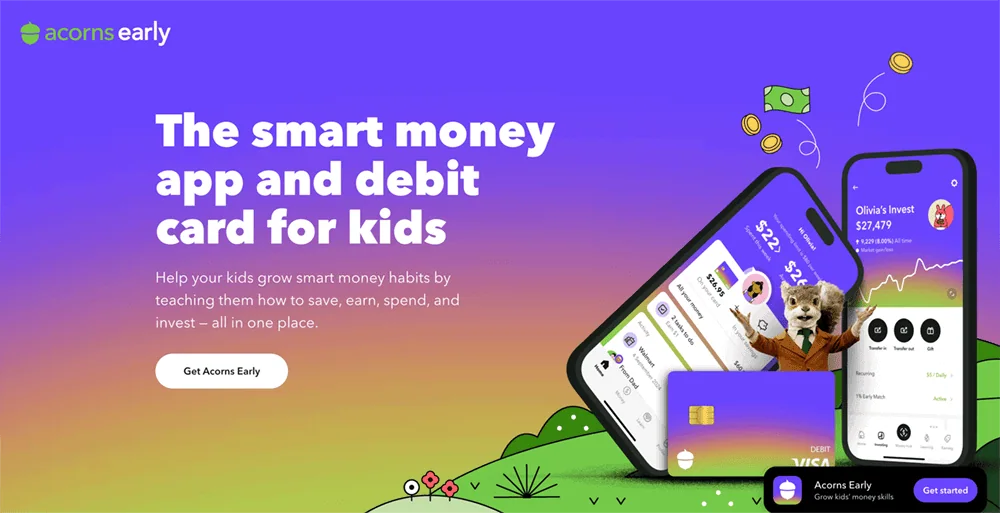
Many reviewers have long painted Acorns Early (formerly GoHenry) as just a way to spend. However, I see it as a real financial solution for minors—a debit card, yes, but also an app-based ecosphere that provides education and experience for the child, as well as ways for parents to keep their kids safe and teach them responsibility.
An Acorns Early account includes a smart money app, as well as Visa debit cards for up to four children. These debit cards can be used to spend anywhere Visa is accepted (so, millions of vendors online and in stores), as well as withdraw cash from ATMs. An Acorns Early account also allows kids to set savings goals, which they can fund manually or via autosave. And the app also hosts educational materials to help children and teens alike develop good money habits.
This FDIC-insured account also enjoys a variety of safety features, including chip and PIN protection, secure PIN recovery, and fraud protection. Acorns Early also offers parents additional peace of mind by providing a number of controls, including:
- Real-time spending notifications
- Card lock/unlock
- Savings goal lock/unlock
- Adjustable spending limits on a per-transaction and per-week basis
- Card category block/unblock for in-store purchases, online purchases, and ATM withdrawals
- Adjustable spending block/unblock at stores that sell age-restricted goods such as firearms and alcohol
Also, kids can only spend whatever money is available on the card because it’s a prepaid debit card. That means parents don’t have to worry about costly overdraft fees or their kids running up a debt.
Acorns Early also stands out to us as one of the best prepaid debit cards for kids because of its outstanding customer service, which it inherited from GoHenry. Acorns Early users enjoy seven-day-a-week phone service (9 a.m. to 8 p.m. ET Monday-Friday, 9 a.m. to 5 p.m. ET Saturday-Sunday), as well as 24/7 live chat support.
Acorns Early has no minimum age requirements but recommends starting at age 6 or older. Parents have two ways of signing up for Acorns Early:
- Sign up for Acorns Early Lite. This subscription level provides you with everything mentioned above.
- Sign up for Acorns Gold. Acorns Gold is the top Acorns subscription tier for adults, and it provides a wealth of banking, investing, and other features. However, it also includes a subscription to Acorns Early (again, good for up to four children), and it unlocks Acorns Early Invest: a UGMA/UTMA custodial account you can use to invest for your kids’ future.
Acorns frequently offers small bonuses for anyone who signs up with our links. You can check out current offers in the box below, or read more about this app in our Acorns Early review.
- Acorns allows you to sign up for investment, retirement, and checking accounts for you and your family, learn how to earn more money, and grow your investing knowledge.
- Famous for investing spare change automatically through Round-Ups, this all-in-one financial app helps younger generations start investing earlier.
- Invest in expert-built portfolios made up of diversified ETFs.
- Silver tier includes perks such as a 25% match on Acorns Earn rewards (up to $200/mo.), generous APYs on Checking and Emergency Fund, and live Q&As with investing experts.
- Gold tier includes perks such as a 50% match on Acorns Earn rewards (up to $200/mo.), $10,000 in life insurance, and picking individual stocks for your portfolio.
- Gold also comes with a free Acorns Early account for up to four children. It's also the only tier to offer Acorns Early Invest: a UGMA/UTMA custodial account where you can save toward your kids' future and get a 1% match on up to $7,000 in contributions annually.
- Earn even more with Later Match: Acorns will match up to 1% (Silver) or 3% (Gold) of all new IRA contributions in your first year.*
- Special offer: Get a free $20 bonus investment when you sign up with our link and start making recurring investments.**
- Robo-advisor with affordable fees (on larger portfolios)
- Fixed fee model
- Round-ups
- FDIC/SIPC insurance
- IRA match (Personal Plus and Premium)
- High fixed fees for small balances
- Limited investment selections
- Must subscribe to Premium for any self-directed investing options

Related: Best Acorns Alternatives: Micro-Investing Apps to Use
Please Heart ❤️, Follow and Subscribe
Did you find this article helpful?
1. Click the Heart Button.
2. Follow WealthUpdate —-> https://flipboard.com/@WealthUpdate
3. Subscribe to Retire With Riley, our free weekly retirement planning newsletter.