


Big banks made a new record profit in 2025, clocking in at almost $300 billion in earnings, up about 10% from the year prior and better than the previous peak in 2021. They did so in large part by earning interest on loans and paying out scant amounts of interest to their depositors. This difference, called net interest income, has become much more substantial in recent years thanks to Federal Reserve rate hikes to fight post-COVID inflation.
If that doesn’t exactly make you comfortable and makes you skeptical of big banks, or if you’re looking to get more money out of your own savings, or if you just want features not offered by traditional banks, you’re in the right place. There are numerous alternatives to conventional banking that provide secure options for your funds.
In this article, we’ll explore the best places to keep your money outside of big banks. I’ll detail the advantages and disadvantages of each option, highlighting that many of these alternatives not only ensure safety but also offer attractive benefits.
Whether you’re considering moving all your funds away from a big bank or simply diversifying where you store your money for strategic reasons, this guide is for you.
Featured Financial Products
Table of Contents
Alternative Places to Save—Our Top Picks
|
Best High-Yield Savings Account for Higher Balances
|
Investment App With a Dividend Match
|
Brokerage Account with Alternative Investments

|
|
Primary Rating:
4.4
|
Primary Rating:
4.6
|
Primary Rating:
4.2
|
|
4.25% APY. No monthly account service fees.
|
Free to access, no commissions on stocks and ETFs.
|
Basic: Commission-free trading. Premium: $8/mo.*, fee waived for account balances over $50,000.
|
Why Wouldn’t You Want to Store Your Money in a Bank?

Some people choose not to keep their money in a traditional bank for a plethora of reasons.
To start, a different financial institution, such as an online-only bank, may offer more financial flexibility and better tools. Often, credit unions and other bank alternatives provide better rates on loans to finance big purchases, such as auto loans and mortgages. And many people also choose not to put all of their money in checking and savings accounts because other types of financial products and accounts can be more fruitful ways to grow their savings.
1. Treasury Bills
Just as many consumers and businesses do, the U.S. government borrows money to make ends meet. It does so through the U.S. Treasury, which issues three primary kinds of debt:
- Treasury bonds (T-bonds): Mature in 20 to 30 years
- Treasury notes (T-notes): Mature in two to 10 years
- Treasury bills (T-bills): Mature in 4 to 52 weeks
Treasury bills—which can have maturities of four, eight, 13, 17, 26, and 52 weeks—are sold in increments of $100 (which is also the minimum purchase amount), up to a maximum of $10 million. You can typically purchase these through the U.S. government’s Treasury Direct website or through a bank or broker.
When you buy a T-bill, you lend money to the U.S. government for a specified period of time. The price for a T-bill will vary, but typically will be below the bond’s face value, or “par value.” (For instance, a $1,000 T-bill might cost $975 to purchase.) When the T-bill matures, you receive the full par value of the bond—so the return on your investment is the difference between the discounted price you paid at auction and the par value of the T-bill.
Treasuries are one of the most secure investments in the world due to their virtually guaranteed repayment—the federal government hasn’t defaulted on a debt payment since moving away from the gold standard in 1971.
When you receive the repayment of your T-bills’ face value, the income generated is exempt from state and local taxes, which can make them a good choice for investors looking for reliable, tax-advantaged income.
Invest With Public.com
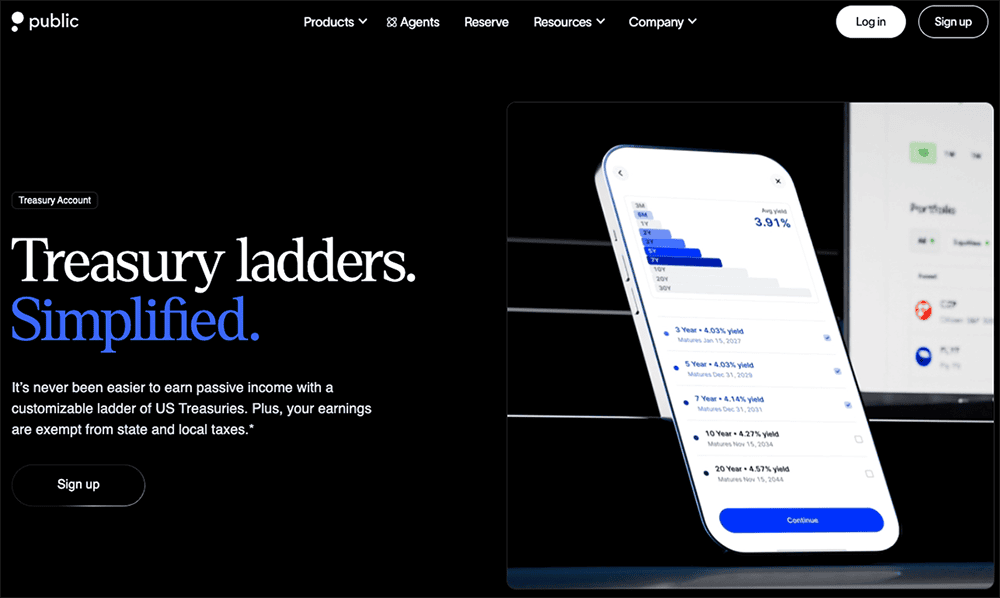
Public.com, an investing platform that allows you to invest in stocks, ETFs, crypto, and alternatives, has launched a product that allows you to invest in Treasury bills.
This investing product allows you to earn a higher yield than even the most competitive rates on high-yield savings accounts—with equal accessibility to your cash. That is, you can tap your balance anytime; you don’t have to wait for your T-bill holdings to mature.
To participate, you’ll need to open an account with Public.com and make a deposit of as little as $100. The Treasury product is offered through Public by Jiko Securities, Inc., a registered broker-dealer, member FINRA and SIPC.
- Public.com offers zero-commission trading on thousands of stocks and ETFs, available as fractional shares. The app also allows you to invest in cryptocurrency, options, and bonds as well, and it's one of the rare brokerages that allows its users to buy alternative assets.
- Lock in a 5.3% yield with Public.com's Bond Account, which allows you to invest in a diversified portfolio of investment-grade and high-yield bonds.
- Use a social feed where members can share why they believe in certain companies (or don't) and can post comments on others' trades.
- Invest in curated lists of stocks and ETFs for people to aggregate investments by interest area or values.
- Subscribe to Public Premium for features such as advanced company-level data, Morningstar insights, and exclusive audio content from Public.com's expert analysts.
- Special offer: Receive an uncapped 1% match on transfers into a Public IRA.
- Fractional shares
- Good selection of investible assets
- Allows you to trade alternative assets
- No payment for order flow (PFOF)
- Creative social investing features
- Doesn't support mutual funds
- Limited investment research and other tools
Related: The 7 Best Mutual Funds for Beginners
2. Credit Unions
Credit unions are member-owned, not-for-profit financial institutions. They are often highly involved in a local community and are known to provide excellent customer service.
These financial institutions are just as safe as banks. Credit unions have their own equivalent to the Federal Deposit Insurance Corporation (FDIC), which is the National Credit Union Administration (NCUA). The NCUA insures the money in each credit union member’s account up to $250,000.
Credit unions offer all the functions you’d expect from a bank, such as direct deposit, mobile pay, loans, and much more. But because credit unions don’t have shareholders to pay, they can offer their members better terms on loans and more competitive rates on savings accounts.
Related: 10 Ways Banks Have Changed That Only Seniors Remember
3. Online Banks
Online banks allow users to conduct all of their banking functions through an internet connection.
Just like traditional brick-and-mortar banks, most internet-based banks offer Federal Deposit Insurance Corporation-insured accounts, so your money is safe, as is your personal information.
Related: 15 Best Long-Term Stocks to Buy and Hold Forever
An online savings account is simple to open, as these banks typically either don’t require a minimum balance to get started, or a very low one. And because they don’t have to spend money on physical buildings and associated costs, they can pass some of those savings on to their depositors—in the form of higher rates on savings and other interest-bearing vehicles. Fees are often lower, too.
CIT Bank Platinum Savings (Earn an Extra 0.5% APY for 6 Months)

- Available: Sign up here
- Platforms: Web, mobile (iOS, Android)
The CIT Bank Platinum Savings account is a free, FDIC-insured account offering a competitive APY that you can boost for six months when you sign up today.
This savings account features no account opening fee nor monthly service fee, and it takes just five minutes to open. You can use the CIT Bank mobile app to manage your account, deposit checks from your mobile device, and make transfers. And you can have peace of mind knowing that all deposits are FDIC-insured up to $250,000 per depositor.
While the account features a low minimum deposit of $100, you receive a significantly higher APY (detailed below) if your balance is $5,000 or more. But no matter how much you have deposited, if you sign up via our link and use the promo code BOOST50, you’ll receive a 0.5% APY bonus for six months from account opening.
- CIT Bank's Platinum Savings Account is a high-yield savings account (HYSA) that currently pays a 4.25% annual percentage yield (APY) if you hold a balance of $5,000 or more.¹ That's roughly 10 times the national average.²
- CIT Bank offers competitive interest rates on numerous other products, including certificates of deposit (CDs) and money market accounts (MMAs).
- Quick, easy signup process and a low $100 minimum deposit.
- Deposits are FDIC-insured up to $250,000 per depositor.
- CIT Bank is an online banking division of First Citizens Bank, which has provided financial services for more than 125 years.
- Special offer: Sign up with our link and use promo code BOOST50 to receive a 0.50% APY bonus for six months from your account opening.
For a complete list of account details and fees, see our Personal Account disclosures. See additional disclosures for Platinum Savings here.
- Competitive interest rates (for balances of $5,000 or more)
- Temporary APY boost
- Low minimum deposit ($100)
- Mobile banking features
Related: 8 Best Instant Sign-Up Bonus Apps [Grab Free Cash Instantly]
4. Cash Management Accounts
A cash management account is similar to an online bank account. However, instead of a bank, the providers are typically broker-dealers or advisory firms that partner with banks to hold your cash. These products usually combine features from investment, checking, and savings accounts, all within one account. If you want fewer accounts to manage, a cash management account may be an excellent fit for you.
Often, cash management accounts have minimal or no fees and offer above-average interest rates. The banks they partner with to hold your cash and earn interest are generally FDIC-insured, meaning your savings are secure, but you should read the fine print associated with the account to make sure you understand any limits or exceptions that apply.
Featured Financial Products
Do you want to get serious about saving and planning for retirement? Sign up for Retire With Riley, our free retirement planning newsletter.
5. Investment Accounts

Investment accounts can grow your money much faster than traditional savings accounts, high-yield savings accounts, or basically any other type of non-investment account. But they also come with far higher risk than those options. Money you put into stocks, bonds or other securities should generally be money you’re prepared to invest for the long term to give you the best chance of growing your funds.
While some investment accounts allow you to invest in alternative assets like cryptocurrencies and options, the safer markets to put your money to work in are the traditional stock and bond markets. Consider the investments below:
Stock market
- Individual stocks
- Stock mutual funds
- Stock exchange-traded funds (ETFs)
Bond market
- Individual bonds
- Bond mutual funds
- Bond ETFs
Earn a Dividend Match With Plynk**
- Available: Sign up here
- Platforms: Web, mobile app (Apple iOS, Android)
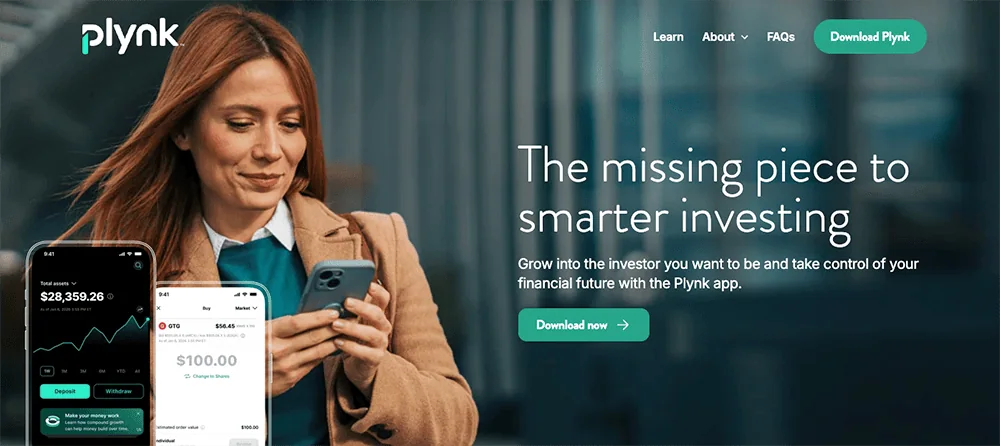
Plynk® is an investing app designed to not only help you start putting your money to work, but teach you about the markets and your money along the way—and now it will help you grow your dividend income.
The Plynk app charges no account opening fees and lets you start investing with as little as $1. It offers commission-free trades on 5,000 stocks and nearly 2,000 ETFs, and also provides access to more than 50 mutual funds and four cryptocurrencies. You can use the app as a traditional brokerage account, but if you’d prefer the potential tax advantages of retirement accounts, the Plynk app also allows you to open traditional IRAs and Roth IRAs.
One of the app’s newest features is a dividend match. Plynk will provide a cash match of 25% on dividends generated within the account, allowing you to earn up to $250 extra annually.
Among Plynk’s other features: expert ratings on stocks and funds, automatic investing, a 52-week investment ramp-up program, simulated trading, virtual portfolios, and more.
Begin today: Sign up with Plynk using our exclusive link to kick-start your investing journey.
- Plynk® is a dividend-friendly app that offers commission-free trades* on 5,000 stocks and more than 3,400 ETFs, and also supports mutual funds and cryptocurrencies.
- Plynk offers a cash match of 25% on dividend income that allows you to earn up to $250 extra each year.**
- Track your dividends and interest with Income Hub.
- Earn a 3.48% APY on uninvested cash.
- Plynk charges no account opening fees, and you can start investing for as little as $1.
- No account fees
- Smart design and smooth user experience
- Fractional shares
- Designed for beginning investors
- Virtual portfolios and simulated trading
- 25% dividend match
- Earn interest on uninvested cash
- One of the best automated investing programs we've seen (Steady Start)
- Elite educational resources and tools
- Lacks features such as options trading and advanced charting that more experienced traders prefer
Related: The 10 Best Dividend Stocks for Beginners in 2026
6. Money Market Accounts
A money market account is an interest-bearing product, similar to a savings account, that may also allow limited debit card transactions or check-writing privileges, with a monthly cap on such transfers.
The interest rates on money market accounts are often higher than those of a standard savings account. Deposits are insured for money market accounts up to $250,000 per depositor, making this a secure place to keep your cash.
As money market accounts typically offer high interest rates and permit a predetermined number of transactions each month, some people keep their emergency fund in these accounts. The money earns a competitive interest rate but is still readily accessible if needed. Just note that money market accounts sometimes have minimum balance requirements, and they sometimes have lower yields than high-yield savings accounts.

7. Money Market Mutual Funds
A money market mutual fund is a fixed-income fund that invests in debt securities. These funds are known for being low-risk and holding securities with very short maturities.
There are three categories of money funds: government, prime, and municipal. The funds are an excellent place to store money as they are secure, stable, and liquid.
While it may not match the returns of other fixed-income funds, a money market mutual fund is generally much safer. They are excellent places to keep your emergency fund or hold cash while you’re waiting for other investment opportunities to become available.
8. Certificates of Deposit
A certificate of deposit (CD) is a savings vehicle that earns interest on a lump sum for a predetermined period of time.
CDs’ main selling point is their high interest rates. They offer a higher annual percentage yield (APY) than traditional savings accounts and usually beat out high-yield savings accounts, too. Also, a CD’s interest rate is locked in until it matures—the yield on a high-yield savings account can move over time.
The downside to the CD is that the money is illiquid for the duration of its term. Terms usually last from a few months to a few years, though some are longer. If you withdraw money before the term is over, an early withdrawal penalty is charged.
Related: Is It a Good Time to Buy CDs?
- CIT Bank's 13-month certificate of deposit (CD) currently offers an extremely competitive 3.25% annual percentage yield (APY). That's more than a percentage point better than the national average.
- CIT Bank offers competitive interest rates on numerous other products, including high-yield savings accounts (HYSAs) and money market accounts (MMAs).
- Quick, easy signup process and a low $1,000 minimum deposit.
- Deposits are FDIC-insured up to $250,000 per depositor.
- CIT Bank is an online banking division of First Citizens Bank, which has provided financial services for more than 125 years.
For a complete list of account details and fees, see our Personal Account disclosures.
- Competitive interest rates
- Low minimum deposit ($1,000)
- Mobile banking features
9. Treasury Notes
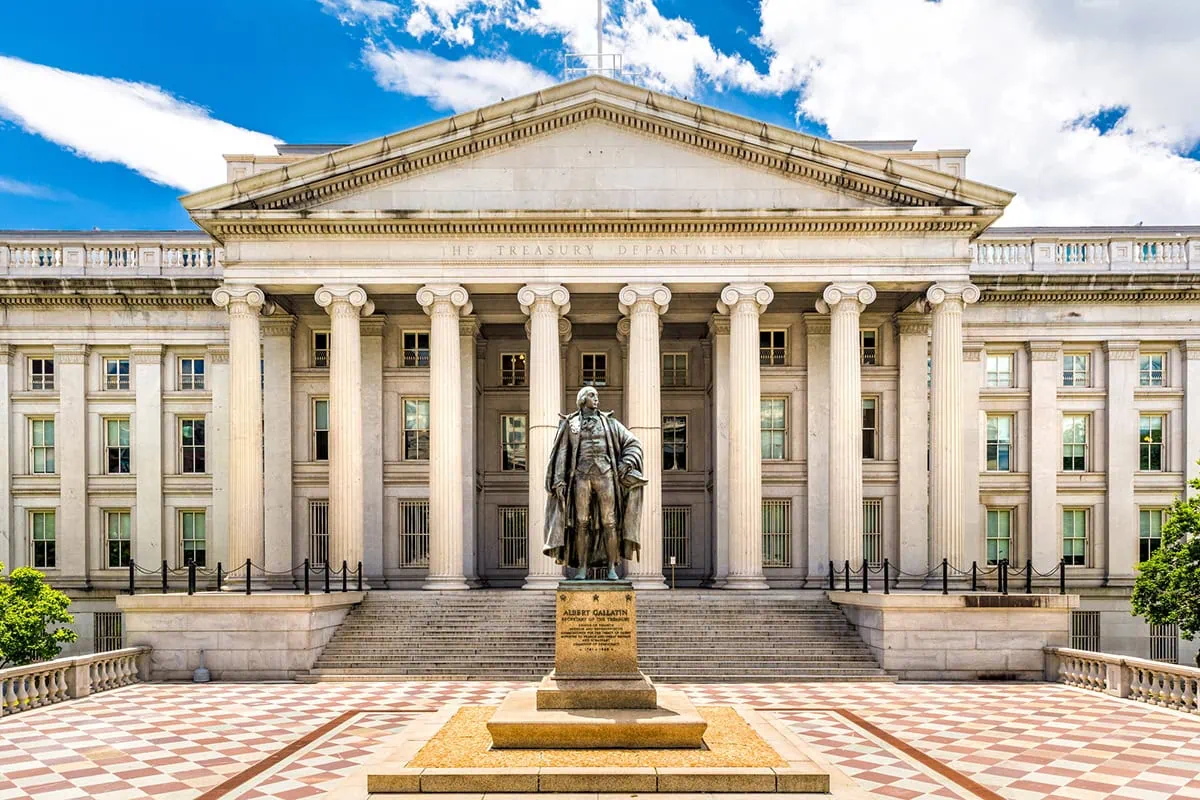
As mentioned before, Treasury notes are considered between short- and medium-term in nature, taking more time to mature (two to 10 years) than T-bills. Like with T-bills, T-notes are backed by the full faith and credit of the U.S. government, making them very low-risk investments. They’re sold at terms of two, three, five, seven, and 10 years.
Related: Is It a Good Time to Buy Treasury Bonds?
Treasury notes pay a fixed interest rate every six months until the note matures. Federal taxes on interest earned are due each year, though the income is exempt from state and local taxes.
With T-notes and other bonds, you can either hold on until it matures, at which point your full principal will be repaid. But you can also sell the bond—which you’ll hopefully do for a gain, but you might have to sell at a loss. Either way, if you want to know how bonds move higher and lower, take a breath and brace yourself—it’s a mouthful:
Bonds’ performance is directly tied to market interest rates. Specifically, bonds have an “inverse relationship” with interest rates—when market interest rates rise, bond prices fall, and when rates fall, bond prices rise. Thus, all bonds have some level of “interest-rate risk,” and T-notes have more of it than T-bills. Why? If market interest rates rise, new bonds with higher rates will make comparable older bonds with lower rates look less enticing to investors. As a result, the market will price those older bonds lower. This effect is amplified on longer-dated bonds because they have more interest payments remaining.
Put differently: If a bond you hold matures in four weeks, you probably won’t sell it early just because a new short-term bond with higher rates is available. But if your bond matures in, say, five years, you might sell your current bond to buy a bond with higher income potential.
The flip side of this risk? T-notes usually offer higher rates than T-bills. They’re also similarly liquid—yes, they take longer to mature, but you can usually buy and sell them with ease.
Featured Financial Products
Related: 11 Best CD Alternatives to Capture Interest With Low Risk
10. Short-Term Corporate Bonds
Just like the U.S. government issues bonds to help fund its operations, corporations frequently issue bonds to fund research, development, expansion, you name it.
Generally speaking, corporate bonds have lower credit quality than U.S. Treasury bonds. Credit quality is generally determined by how likely an entity is to pay back its debts—and the credit-ratings agencies believe that just about any U.S. corporation has at least a little (if not a lot) more risk of going under than the U.S. government. Probably a fair bet.
That lower quality does mean more risk—but it also usually means better compensation in the form of higher yields.
Also, “lower quality than Treasuries” doesn’t always mean “low quality.” Many corporate bonds are considered investment-grade, which means the bond rating companies generally deem them likely to be repaid. If you’re willing to accept more risk, you can invest in junk bonds, which are less likely to be repaid but also offer even sweeter yields as a result.
Like with U.S. Treasury bonds, short-term corporate bonds are fairly liquid—they don’t take long to expire, and if you need cash before that, you can typically sell without trouble. And like with T-notes and T-bills, many investors buy these through ETFs and mutual funds rather than individually.
Related: Best Schwab Retirement Funds for a 401(k) Plan
11. And If You Really Want the Money in Your Possession: Cash

Cash is king, or so the saying goes. Many small businesses only accept cash payments, and some large businesses have a minimum amount you must spend to pay with a card. And during times of crisis, such as a natural disaster, credit card readers can go dark—cash always works.
But cash won’t grow in value. And if you lose it, it’s gone—bank and other accounts offer much more protected. So while it’s wise to have a little cash around, it’s a good idea to have most of your money saved or invested.
Featured Financial Products
Where Is the Safest Place to Keep Your Money?
The safest place to keep your money is in debt issued by the federal government, such as savings bonds or T-bills. However, you can’t keep all of your money in savings bonds and similar assets, as they aren’t completely liquid.
Bank accounts are a wonderful place to keep money, since up to $250,000 per depositor, per institution, is FDIC-insured. Certificates of deposit are another safe, FDIC-insured option, though they are not liquid unless you pay an early-termination fee.
Also on the list of safe places to store your funds are money market accounts at banks with FDIC coverage and credit unions with NCUA coverage.
Is It Safe to Keep Your Money at a Bank?
Yes, it’s safe to save money at a bank. However, many people seek alternatives for various reasons. Many bank alternatives offer a higher annual percentage yield, letting you grow your money faster. Depending on the savings vehicle, there can be many other perks, as well.
So while it’s safe to keep some of your money in a bank, it can be strategic to have some of your funds in other places, as well.
Do you want to get serious about saving and planning for retirement? Sign up for Retire With Riley, our free retirement planning newsletter.
Are There Risks to Keeping My Money Somewhere Other Than a Bank?
Banks are not the only financial institutions that keep your money secure. Government debt, such as T-bills or savings bonds, are backed by the federal government and are therefore extremely safe.
To determine whether your money is safe in another non-bank financial institution, check whether your money is insured through the FDIC or NCUA. If your money is insured, it’s safe.
Related: Are Credit Cards Safer Than Debit Cards?
Cash, prepaid cards, and similar physical funds could be stolen, but that’s preventable with proper precautions. For an online bank or similar account, make sure security measures are in place to protect your personal information, such as your name and Social Security number.
What are the risks to keeping money with a non-bank financial institution?
Some non-bank financial institutions have no physical locations. If something goes wrong, it can be more challenging to get a hold of an employee to fix the problem. You’ll need to call or go online for help.
Make sure any financial institution you work with has security measures in place to protect both your money and your personal information. It’s also important to only work with financial institutions where your money is covered by one of the government-sponsored insurers, like the FDIC.
Want to talk more about your financial goals or concerns? Our services include comprehensive financial planning, investment management, estate planning, taxes, and more! Schedule a call with Riley to discuss what you need, and what we can do for you.

Please Heart ❤️, Follow and Subscribe
Did you find this article helpful?
- Click the Heart Button.
- Follow WealthUpdate —-> https://flipboard.com/@WealthUpdate
- Subscribe to Retire With Riley, our free weekly retirement planning newsletter.
Read More on WealthUpdate
- VanEck’s WBMO ETF: For Investors Who Want to Own It All
- What Is the IRMAA for Medicare Parts B and D?
- Everyone Needs to Learn These Financial Subjects
Disclosures
Public.com Disclaimer
This does not constitute investment advice. Investing involves the risk of loss, including the potential loss of principal. Brokerage services for US-listed, registered securities available on Public are offered by Open to the Public Investing, Inc. (OTTP), a member of FINRA & SIPC, and a wholly-owned subsidiary of Public Holdings, Inc. Brokerage services for alternative investments are offered by the Dalmore Group, LLC, a member of FINRA & SIPC. Alternative investments are over-the-counter equity securities that have been issued pursuant to Regulation A of the Securities Act of 1933. Cryptocurrency trading is provided by Apex Crypto LLC (NMLS ID 1828849). Apex Crypto is licensed to engage in the virtual currency business by the New York State Department of Financial Services. New customers of OTTP receive free stock valued between $3 – $1,000 (0.3% receive the maximum value).
Plynk
All Plynk disclosures can be viewed here.