



The Iran war’s upward pressure on energy costs expectedly continued to seep into the economy last month, as consumer prices for April climbed at their highest rate in three years in what was characterized as “a troubling CPI report.”
The U.S. Bureau of Labor Statistics said Tuesday that April’s consumer price index (CPI), which measures the change in prices on a variety of consumer goods and services, rose by a seasonally adjusted 0.6% month-over-month—a slower rate than March’s 0.9%, which was the fastest such pace since June 2022. However, the headline year-over-year reading was 3.8% higher, which was much quicker than the prior month’s 3.3% and the highest such pace since May 2023.
Meanwhile, “core” CPI—a measure of inflation that excludes food and energy costs (factors that are more volatile than the other prices tracked by the Labor Department)—came in ahead of estimates, too. Core CPI for April was 0.4% higher, which came in ahead of March’s rate of 0.2% and ahead of estimates for 0.3% growth. On a year-over-year basis, the core CPI increased by 2.8%, versus March’s 2.6% and faster than projections for 2.7%.
Related: 5 Best Energy ETFs for the Rise of Oil, Natural Gas + More
“Inflation is getting sticky, and it’s getting structural,” says David Russell, Global Head of Market Strategy at TradeStation. “Today’s report brings an unwelcome increase in services and shelter costs. Combined with the ongoing pressures from energy, this puts Kevin Warsh in a tough spot as he’s joining the Fed. Price pressures are compounding and driving core inflation higher.”
Here’s a quick look at April’s key CPI figures:
- MoM CPI: +0.6% (estimate: +0.6%)
- YoY CPI: +3.8% (estimate: +3.7%)
- MoM Core CPI: +0.4% (estimate: +0.3%)
- YoY Core CPI: +2.8% (estimate: +2.7%)
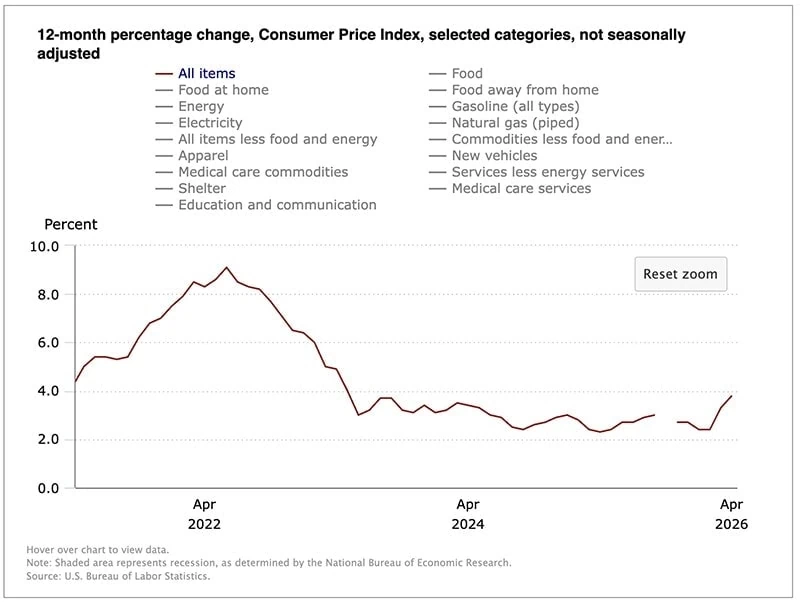
Energy as a whole slowed from April’s 10.9% month-over-month surge, but prices still increased by 3.8% MoM, resulting from Iran’s closure of the Strait of Hormuz—a crucial pathway for 20% of the global oil supply. Gasoline rose by 5.4% MoM, while fuel oil jumped 5.8%. Year-over-year, energy prices are up nearly 18%; gasoline costs have swelled by 28%, and fuel oil prices have rocketed 54% higher.
The impact at the pump could also be felt from airline fares, which were up 2.8% as higher fuel costs began to be passed through into transportation services.
Related: Best Custodial Accounts: How to Start Investing for Kids
“The timing matters,” says Jason Pride, Chief of Investment Strategy and Research at Glenmede. “The ceasefire was announced April 8, meaning the bulk of April’s energy price data still reflected pre-ceasefire conditions. The roughly 14% single-day decline in Brent crude that followed the announcement has not yet worked its way through to prices at the pump, and meaningfully softer energy readings in May and June are a reasonable expectation if the ceasefire holds.”
Food also rose meaningfully last month, up 0.5% as a whole. Prices for food at home were 0.5% higher month-over-month, while food away from home climbed a more modest 0.2%.
Shelter rose 0.6% MoM in April, too, marking the largest single-month gain since January 2024.
“The shelter re-acceleration is notable because it operates independently of energy dynamics and could prove more durable than the energy-driven components of today’s report,” Pride adds.
Other consumer prices remained muted, however. New-vehicle costs actually retreated by 0.2%, while medical care commodities pulled back by 0.4%. Used car and truck prices remained level, as did medical care services.
“Forget about the headline numbers, which came in as expected. The trouble in in the details,” says Larry Hatheway, Head of Research, Franklin Templeton Institute. “Core inflation was boosted by a resurgence of shelter inflation. That will get the Fed’s attention. Shelter, alongside goods prices, were supposed to be the offsets to surging energy prices. Huh, that’s not happening. And even where goods prices are falling—new and used autos, for example—the Fed and the markets should be concerned. The marginal car buyer is pausing to tighten their purse strings.
“Today’s new is all about inflation persistence and the pressures that is placing on average Americans. Meanwhile, stocks and bonds are shrugging their shoulders. That’s a lazy read on what was a troubling April CPI report.”
Do you want to get serious about saving and planning for retirement? Sign up for Retire With Riley, Young and the Invested’s free retirement planning newsletter.
April CPI Unlikely to Sway Fed
Wall Street largely has expected the Federal Reserve to keep its benchmark interest rate level amid the data noise generated by the Iran war, and that didn’t change Friday.
“Inflation is likely to take a backseat over the coming months as investors remain focused on earnings, economic growth, and the AI-driven capex cycle,” says Tim Urbanowicz, Chief Investment Strategist, Innovator ETFs from Goldman Sachs Asset Management. “The Fed has been clear that it is willing to look through any temporary inflation spike tied to the Iran conflict, and that remains the key consideration for investors in the near term. Markets had already priced out rate cuts for 2026 heading into the report, and nothing in the data suggests rate hikes are back on the table.”
The CME FedWatch Tool, which uses trading in federal-funds futures to determine Wall Street’s expectations for future Federal Reserve actions, shows a 98% chance that the target range for the federal funds rate will stay at its current 3.50%-to-3.75% range at the conclusion of the next Federal Open Market Committee (FOMC) meeting, scheduled for June 16-17. That’s virtually unchanged from yesterday.
They also project 90%-plus probabilities of rates either remaining where they are or being raised for every remaining Fed meeting throughout the rest of 2026.
“Fed fund futures markets are now pricing the chance of a rate hike at a better than a coin-flip in March 2027,” says Josh Jamner, Senior Investment Strategy Analyst at ClearBridge Investments. “While rate hikes are possible should inflationary pressures continue to build, the potential for de-escalation of the conflict in the middle east and muted strength in the labor market should keep the Fed on hold for the time being, with cuts still more likely than hikes in 2027 in our view.”
Want to talk more about your financial goals or concerns? Our services include comprehensive financial planning, investment management, estate planning, taxes, and more! Schedule a call with Riley to discuss what you need, and what we can do for you.

What the Experts Think About April’s CPI Report
Here, we outline more thoughts from the experts on what last month’s CPI numbers mean for consumers, markets, the Federal Reserve’s future actions, and more:
Scott Helfstein, Head of Investment Strategy, Global X ETFs
“There seem to be two different in the inflation data. On the surface prices increased at the fastest pace since mid-2023, but much of that driven was energy. Inflation excluding food, energy, and shelter came in very close to the Fed target and was unchanged from last month. Those are two very different spins from the same report.
“The inflation report will likely be overshadowed by the U.S.-China summit at the end of the week. The categories that helped push inflation are based on supply side disruptions, and that likely persists as long as the Strait of Hormuz stays closed. The Fed does not really have great tools to address supply side inflation.”
Related: HSBC, Yardeni Add to Growing Stack of S&P 500 Upgrades