



It’s easy to love what dividend stocks have to offer. In addition to the upside potential that equities in general provide, the cash income from dividend-paying companies is a second source of returns—a vital (and relatively tax-friendly) ballast for when market performance isn’t going our way.
But some dividend stocks take the generosity a step further by occasionally increasing the amount they pay out to their shareholders. Others go the extra mile by doing so every year. And a select few really set themselves apart from the crowd by doing so every year for so many years that someone decided to slap a label on them:
Dividend Aristocrats.
Today, I’m going to tell you a little bit about the Dividend Aristocrats, then highlight the 10 best-rated members of a particular blue-chip subset called the S&P 500 Dividend Aristocrats.
Editor’s Note: Tabular data presented in this article is up-to-date as of June 30, 2026.
Disclaimer: This article does not constitute individualized investment advice. Individual securities, funds, and/or other investments appear for your consideration and not as personalized investment recommendations. Act at your own discretion.
Table of Contents
Why You Should Care About Dividend Growth

When a company starts up a dividend program, that in and of itself is a powerful statement by corporate management about that company’s ability to generate profits. If logically implies that they expect their business to regularly produce a level of earnings so high, they can afford to share some of it with us.
That’s great! If a business wasn’t paying us squat on Monday, then decided on Tuesday to start paying us a dollar per share every year for the rest of my life? Well, you wouldn’t hear a peep of complaint out of me.
But what if a company started paying us a dollar per share one year, then raised it every year after that? I’d argue that would look a lot more attractive, for several reasons:
- A higher dividend over time means a higher “yield on cost” for us. If we bought a share of stock for $100, that $1 per share would equal a 1% yield on our purchase. If the stock price and dividend both doubled, to $200 per share and $2, respectively, new investors would still be buying at a 1% yield. But us? We’d be earning 2% on our original $100 purchase.
- A higher dividend over time fends off inflation. In most years, we experience inflation, which is when the worth of our currency slightly declines. So $1 worth of groceries, gas, etc. this year will generally buy you slightly less groceries, gas, etc. next year. High inflation over the past few years really drives home this point—according to the U.S. Bureau of Labor Statistics, in May 2026 you would need $1.96 to buy what $1 could have bought in January 2020, right before the COVID pandemic hit a fever pitch. So if you receive $1 in dividends every year in perpetuity, your dividend income will lose its value over time. But if that initial $1 dividend is raised enough every year, your income could keep pace with (or even outrun) inflation.
- A higher dividend can be a sign of quality. Just like initiating a dividend says “we have so much money that you can have some,” a track record of raising dividends typically signals a company’s ability to continue growing its bottom line.
Put simply: Regular dividend growth signals a higher caliber of operations (and thus potentially a higher caliber of stock), and it puts more money in our pockets. That’s a lot to love.
The S&P 500 Dividend Aristocrats
The term “Dividend Aristocrats” generally refers to stocks with some sort of track record of dividend growth. There are, in fact, many types of Dividend Aristocrats—European Aristocrats, Canadian Aristocrats, mid-cap Aristocrats, and so on—and each group has a certain set of criteria for inclusion, including a baseline of dividend growth.
But most discussions around Dividend Aristocrats revolve around one particular subset: the S&P 500 Dividend Aristocrats.
The S&P 500 Dividend Aristocrats are the biggest, blue-chip dividend growers that the U.S. equity markets have to offer. And ultimately, they have to meet just two criteria for inclusion:
- Be members of the S&P 500.
- Have increased dividends for at least 25 consecutive years.
That second criterion needs a little explaining, however.
Make sure you sign up for The Weekend Tea, Young and the Invested’s free weekly newsletter that over 10k monthly readers use to level up their money know-how.
There’s More Than One Way to Grow Dividends Every Year

Most companies’ annual dividend increases go exactly the way you’d expect: Every year, they raise the amount they regularly pay across the calendar.
Example: Woodley Inc. (KW) distributed $1 per share every quarter in 2026, then to start 2027, it increased that payout to $1.10 per share across the whole year. 2027 would count as one year toward the 25-year streak.
However, technically speaking, dividend increases are calculated across the entire year. So what really mattered wasn’t the increase from $1 to $1.10 per share, but the fact that Woodley Inc. paid out $4 per share across 2026, then $4.40 per share across 2027. Why does that matter? Well …
Example: Woodley Inc. started 2026 paying 90¢ per share per quarter. In mid-2026, it raised its quarterly payout to $1 per share. It paid $3.80 per share (90¢ + 90¢ + $1 + $1) across all of 2026. The next year, Woodley Inc. didn’t increase its quarterly dividend, so it paid out $1 per share quarterly, and thus $4 per share ($1 + $1 + $1 + $1) across the whole year. 2027 would still count as one year toward the 25-year streak. (However, the company would have to increase the quarterly dividend in 2028 to earn another year of growth.)
In short: A Dividend Aristocrat doesn’t necessarily have to raise its periodic dividend every year to achieve a streak of annual dividend growth. (But they frequently do.)
Lastly, whenever a Dividend Aristocrat announces a dividend increase, we in the media typically give them the benefit of the doubt and add another year to their dividend-growth streak. But on rare occasions, the year doesn’t end up qualifying, usually resulting in a broken streak and exclusion from the Aristocrats.
Example: Woodley Inc. paid $1 per share quarterly in 2026, good for $4 per share across the entire year. In January 2027, the company increased the quarterly dividend to $1.10 per share. In mid-year, sudden cash-flow issues forced the company to reduce its dividend by 50%, to 55¢ per share. Woodley Inc. paid out $3.30 per share ($1.10 + $1.10 + 55¢ + 55¢) across 2027. That would not count as a year of dividend growth, thus Woodley Inc.’s dividend-growth streak would end.
Related: 15 Best Investment Apps and Platforms [Free + Paid]
The Best-Rated Dividend Aristocrats Right Now
Currently, there are 69 S&P 500 Dividend Aristocrats—a group of stocks that most people would generally consider to be stable, dependable companies.
But that doesn’t mean they all make equally worthy investments.
Let’s separate the wheat from the chaff. I’ll show you the 10 best-rated Dividend Aristocrats right now, as determined by their consensus analyst rating, provided by S&P Global Market Intelligence. S&P boils down consensus ratings down to a numerical system where …
- 1 to 1.5: Strong Buy
- 1.5 to 2.5: Buy
- 2.5 to 3.5: Hold
- 3.5 to 4.5: Sell
- 4.5 to 5: Strong Sell
All of the Dividend Aristocrats on this list have a rating of 2 or less, indicating that at worst they enjoy a pretty firm consensus Buy rating, if not an outright Strong Buy rating.
I’ve listed all 10 stocks in reverse order of consensus analyst rating (from worst to best).
Do you want to get serious about saving and planning for retirement? Sign up for Retire With Riley, Young and the Invested’s free retirement planning newsletter.
Best Dividend Aristocrat #10: Amcor

- Sector: Consumer discretionary
- Market cap: $20.2 billion
- Dividend yield: 6.7%
- Consensus analyst rating: 1.75 (Buy)
Amcor (AMCR) produces flexible and rigid packaging products for a wide variety of industries. Its rigid packaging is used on any number of grocery-store items, including soft drinks, water, sports drinks, sauces, spreads, even personal-care items, while its flexible packaging is used in the food-and-beverage, medical, and pharmaceutical industries, among others. (Thus, while Amcor is considered a consumer discretionary name, it’s truly closer to being a consumer-industrial hybrid.)
Amcor grew considerably bigger last year, acquiring rival Berry Global in April 2025 to create a combined entity with more than 400 facilities and 75,000 employees, and boasting a reach of over 40 countries. It has struggled this year, though, on the back of elevated energy and freight costs related to America’s war on Iran.
Related: The 7 Best Gold ETFs You Can Buy
Regardless, analysts remain bullish overall, with AMCR shares boasting eight Buys, four Holds, and no Sells. That puts it among the 10 best-rated Dividend Aristocrats right now.
“We believe the company has multiple avenues at its disposal to drive more pronounced volume growth, EBITDA, and FCF [following the Berry] acquisition, which we view as a transformational transaction,” says Truist Managing Director Michael Roxland, who rates shares at Buy. “Volumes should improve by at least 100bps through a combination of cross-selling, new geographies, and do-it-yourself. Further, EBITDA and FCF growth will be driven by better volumes as well as cost synergies, which we believe have upside.”
This Aristocrat currently has more than four decades of uninterrupted dividend growth. It marked 42 years with the announcement of a 2% raise, to 65¢ per share, in November 2025. (Note: The dividend amount here has been adjusted for a 1-for-5 reverse stock split, also announced in November, that was completed in mid-January 2026. At the time of the announcement, the increase was listed as a 2% raise to 13¢ per share.)
Related: 9 Apps With Free Stocks for Signing Up [Get Free Shares]
Best Dividend Aristocrat #9: AbbVie
- Sector: Healthcare
- Market cap: $446.6 billion
- Dividend yield: 2.7%
- Consensus analyst rating: 1.74 (Buy)
AbbVie (ABBV) is a mega-cap biopharmaceutical company that was spun off from fellow Dividend Aristocrat Abbott Laboratories (ABT) in 2013.
It has a wide and deep lineup. Some of its best-known drugs include Skyrizi (autoimmune diseases) and Rinvoq (inflammatory diseases), and it has several cancer drugs including Imbruvia, Venclexta, and Elahere. Its other medicines treat everything from schizophrenia and bipolar disorder to Parkinson’s and migraines. AbbVie also offers a number of eye-care products including Refresh/Optive, Durysta, and Restasis, and even cosmetic therapies for crow’s feet, forehead lines, and facial volume loss.
ABBV, like much of the healthcare sector, sat in the red for much of the year before its recent rebound. But the Street remains optimistic after a strong first-quarter earnings report released in late April.
Related: 8 Best-in-Class Bond Funds to Buy
“While competition will continue to be something to monitor, management’s strong commentary on Skyrizi growth and market share combined with success of the subcutaneous induction regimen in Crohn’s disease and intriguing combination data with ABBV-382 in Crohn’s disease bolster longer-term competitiveness of the company’s immunology franchise,” say William Blair analysts, who rate the stock at Outperform (equivalent of Buy). “Combined with bullish commentary on Temab-A, the Parkinson’s and migraine portfolio, and earlier-stage assets, we continue to believe there are reasons to be constructive on AbbVie shares.”
In June, they reiterated their bullishness on the company’s proposed acquisition of Apogee Therapeutics (APGE). “While we do consider the nearly $11 billion price tag for an asset that will not be accretive until 2032 to be fairly expensive, the lead asset zumilokibart clearly fits within a therapeutic area where AbbVie has had commercial success for over a decade and offers the potential to further expand the company’s I&I pipeline into respiratory indications,” they say.
William Blair is among 24 research firms that rate ABBV a Buy. Another six say the stock is a Hold, and one calls it a Sell.
AbbVie also belongs to another elite group: the Dividend Kings, which have raised their payouts without interruption for at least half a century. ABBV specifically has increased its distribution for 54 consecutive years, most recently in January 2026, when the company announced a 5.5% improvement to $1.73 per share.
Related: 14 Best Investing Research & Stock Analysis Websites [2026]
Need Help Picking Stocks? Consider These Top-Rated Services
|
Best Introductory Stock Picking Service

|
Best Overall Stock Research Service

|
Best Proprietary Ranking System

|
|
Primary Rating:
4.7
|
Primary Rating:
4.8
|
Primary Rating:
4.2
|
|
$99/yr. ($100 first-year savings)
|
Premium: 7-day free trial, then $269/yr. ($30 discount)* Pro: 1 month for $89, then $2,149/yr.**
|
30-day free trial, then $249/yr.
|
Best Dividend Aristocrat #8: Dover

- Sector: Industrials
- Market cap: $30.3 billion
- Dividend yield: 0.9%
- Consensus analyst rating: 1.72 (Buy)
Established in 1955 and headquartered in Downers Grove, Illinois, Dover (DOV) is a diversified global manufacturer, providing innovative equipment, components, and services across multiple industries, including energy, engineered systems, fluids, and refrigeration and food equipment.
The company’s strategic approach to diversification and its focus on industrial innovation have been central to its enduring financial performance. Dover provides everything from radio frequency and microwave filters for defense and aerospace firms to trash compactors and recycling balers. This wide variety of competencies has helped Dover weather the ups and downs of the competitive, cyclical industrial manufacturing industry.
Related: 10 Best ETFs to Beat Back a Bear Market
“We appreciate Dover’s significant portfolio transformation over the years, shedding non-industrial assets and establishing a more streamlined multi-industry portfolio,” say Oppenheimer analysts, who rate shares at Outperform. “We believe Dover is well positioned for sustainable core growth across platforms with EPS upside driven by volume leverage and continuous operating improvements.”
DOV stock currently enjoys 12 Buy calls against five Holds and a Sell.
Dover has a long and storied history of consistent dividend payments that includes a seven-decade streak of annual payout increases, making it the S&P 500’s longest-paying Aristocrat and King.
DOV’s past few dividend bumps admittedly have been small—increases of roughly 1%, including a half-cent uptick announced in August 2025 to 52¢ per share quarterly. Still, Dover maintains an extremely conservative payout ratio that’s currently just 20% of estimated 2026 earnings, ensuring that rain or shine, the company should be able to afford its dividend while reinvesting most of its profits back into the business.
Best Dividend Aristocrat #7: Abbott Laboratories
- Sector: Healthcare
- Market cap: $159.2 billion
- Dividend yield: 2.7%
- Consensus analyst rating: 1.67 (Buy)
Abbott Laboratories (ABT) is a large healthcare firm that develops, makes, and sells medical devices, diagnostic products, nutritional products, and generic pharmaceuticals. Among other things, it’s responsible for FreeStyle (and FreeStyle Libre) glucose monitors, Pedialyte hydration products, Similac formulas, PediaSure children’s nutritional products, and BinaxNow COVID-19 antigen tests.
It’s also the owner of Cologuard screening tests following the March 2026 closure of its acquisition of Exact Sciences.
Medical devices are Abbott’s biggest breadwinner at nearly half of revenues, and they’ve been a key driver of growth of late. The company has reported 13 consecutive quarters of double-digit top-line growth in medical devices; in the first quarter of 2026, it enjoyed a 14% year-over-year improvement in electrophysiology revenues and 11% growth in heart failure product sales.
Related: Best Vanguard Funds to Hold in an HSA
Abbott has fallen into bear-market territory in 2026, with short-term headwinds including weakness in nutrition that might not wane until this year’s second half. Regardless, ABT enjoys a crowded bull camp of 20 Buys (versus seven Holds and no Sells).
“Abbott’s pivot to a price-cutting strategy in Nutrition raises concerns about increased competition in the market,” says Argus Research analyst David Toung (Buy). “On the other hand, we believe Abbott’s growth drivers (including the FreeStyle Libre, electrophysiology products, leadless pacemakers, and cardiovascular devices) as well as its ability to develop and launch new products could lead to continued growth in sales and earnings. We note that Abbott plans to expand the FreeStyle portfolio beyond the diabetic market to the consumer market.”
“Abbott’s continued growth on the MedTech side, disciplined M&A, and margin leverage over time buoy our constructive stance on the name,” add Oppenheimer analysts, who rate the stock at Outperform. “The relative buffers provided by the different business segments, the cash-on-hand, dividend yield, and potential for margin expansion form the basis of our constructive stance on the name.”
Abbott is another Dividend King, this one boasting 54 years of uninterrupted dividend growth. The most recent increase to the quarterly payout—a 7% hike to 63¢ per share—was announced in December 2025. The distribution itself dates back more than a century, to 1924.
Related: 7 Best Value Stocks to Buy Right Now
Best Dividend Aristocrat #6: Nucor
- Sector: Materials
- Market cap: $50.8 billion
- Dividend yield: 1.0%
- Consensus analyst rating: 1.65 (Buy)
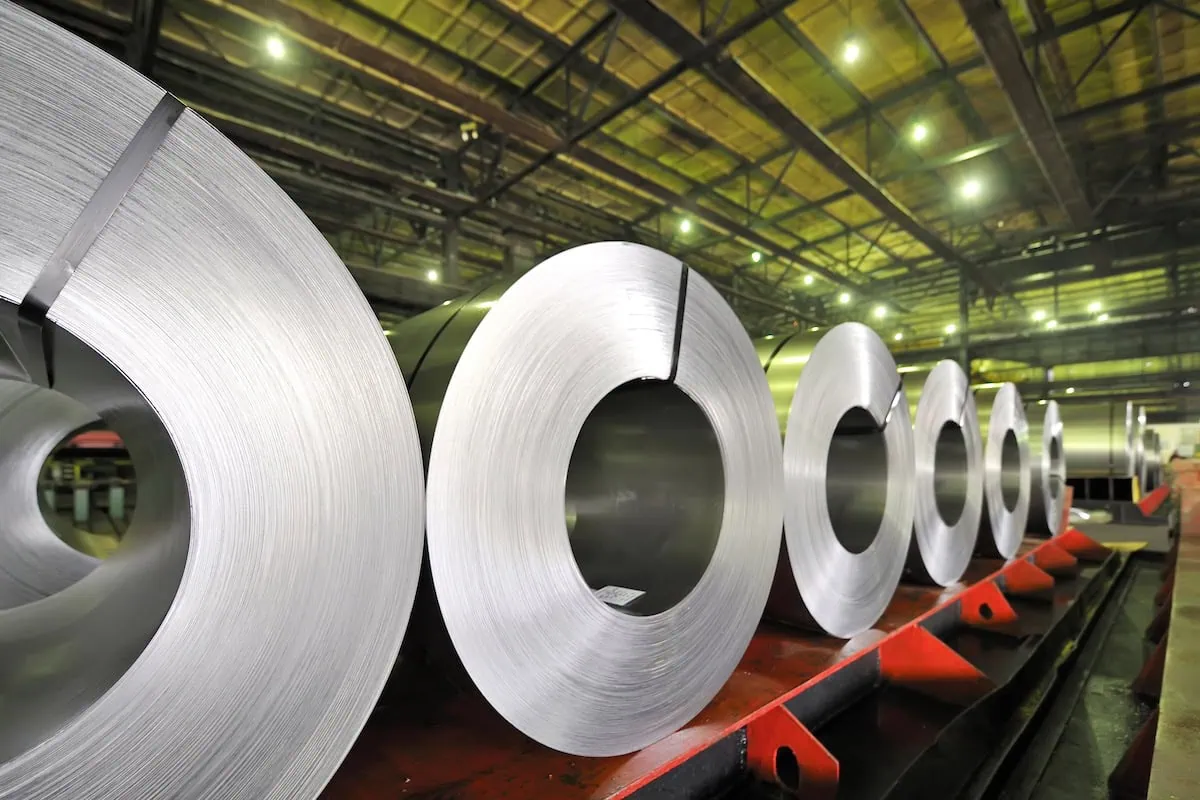
Nucor (NUE) is North America’s largest steel manufacturer and recycler. It produces a wide variety of products, including hot-rolled, cold-rolled, and galvanized sheet steel products; bar steel products; and steel joists and joist girders, among other products. It also has a raw materials segment that produces direct reduced iron, processes scrap metal, and even engages in natural gas production.
It’s among the top-rated materials stocks right now, too, enjoying 14 Buys versus just two Holds and a single Sell.
Related: 8 Low- and Minimum-Volatility ETFs for Peace of Mind
“We view Nucor as a well-run company with a strong record in its industry, and poised to take advantage of megatrends (such as the rebuilding of U.S. infrastructure, the transition to alternative energy sources, and manufacturing onshoring),” says Argus Research’s Alexandra Yates (Buy). “Although NUE’s earnings were hurt recently by reduced demand and inflationary pressures, we see conditions improving. The balance sheet is clean, and management has experience navigating difficult conditions. With Nucor’s diverse portfolio and commitment to investing in higher-margin businesses, we see potential for shareprice gains and continued resilience.”
Nucor is a highly cyclical stock whose fates are closely tethered to economic activity, both here and abroad. That’s typically not going to be fertile breeding ground for dividend stability.
But NUE is an exception to the rule: It has delivered 53 years of dividend growth, good enough for inclusion among the Dividend Kings. No. 53 came in December 2025, when the company raised its payout by 1.8%, to 56¢ per share.
Make Young and the Invested your preferred news source on Google
Simply go to your preferences page and select the ✓ box for Young and the Invested. Once you’ve made this update, you’ll see Young and the Invested show up more often in Google’s “Top Stories” feed, as well as in a dedicated “From Your Sources” section on Google’s search results page.
Related: The 10 Best Fidelity ETFs You Can Buy [Invest Tactically]
Best Dividend Aristocrat #5: Linde
- Sector: Materials
- Market cap: $241.5 billion
- Dividend yield: 1.3%
- Consensus analyst rating: 1.63 (Buy)
Materials companies are often extremely cyclical investments that tend to rise and fall based on broad-based economic trends and industrial demand. That said, a few have passed the test of time and managed to deliver consistent dividends regardless.
Case in point: Ireland-based Linde plc (LIN). Linde is the world’s largest industrial gas producer, offering oxygen, nitrogen, argon, helium, hydrogen, electronic gases, acetylene, and rare gases. It also produces air separation, synthesis, olefin, and other plants for third-party customers. And it does this across every continent.
It’s a cyclical business, but Linde offers some shelter from the economic shocks that many of its businessmates suffer. That’s in part because of its diverse offerings, but also because of the industries it supplies.
Related: How to Pass an IRA to Heirs [Without Leaving a Tax Mess]
“We expect Linde to benefit in 2026 from increased demand for its industrial gases,” says Argus Research’s Yates (Buy). “The company has a strong presence in many defensive end markets, including healthcare, food and beverages, and electronics that should generate consistent revenues even in a soft economic environment. In addition, Linde currently manages a significant $10 billion backlog of projects, mostly under contract with bluechip companies, which provide strong and steady cash flow and maintain a solid balance sheet.”
UBS (Buy) adds that space launch-related growth in oxygen, nitrogen, and helium could add 30 to 70 basis points to Linde’s annual volume growth.
Linde’s business has been so relatively stable that it has—by virtue of its 2018 merger with fellow gas giant Praxair—been able to deliver 33 consecutive years of increased dividends to its shareholders, most recently a 7% hike announced in February 2026, to $1.60 per share.
While long-term buy-and-holders might look away from the materials sector, Linde sticks out as both a Dividend Aristocrat and a surprisingly stable “forever stock.”
Related: Direct Indexing: A (Tax-)Smarter Way to Index Your Investments
Best Dividend Aristocrat #4: Walmart

- Sector: Consumer staples
- Market cap: $904.0 billion
- Dividend yield: 0.9%
- Consensus analyst rating: 1.54 (Buy)
The Dividend Aristocrats are littered with consumer staples stocks: companies that make goods considered to be basic necessities.
It’s pretty easy to understand why. When times get tough, households might spend less on vacations and designer jeans, but they’re not going to stop going to the grocery store. (This is why staples make for some of the best dividend stocks for beginners, too.)
Take Walmart (WMT), for instance. WMT is frequently contrasted with fellow big-box store Target (TGT). The former is considered a lower-priced but lower-quality retailer, while the latter is pricier but perceived to be more upscale. Walmart has been addressing this in numerous ways over the past few years, including improving store standards and widening price gaps. But growth at the retailer is increasingly a digital matter, not a physical one.
Related: 8 Best T. Rowe Price Funds to Buy Now
“eCommerce generates the lion’s share of Operating Income growth,” says a team of Morgan Stanley analysts (Overweight, equivalent of Buy). “To be clear, as Walmart U.S. expands its eCommerce reach, leveraging its Supercenters as fulfillment centers with forward-deployed inventory, it drives an expanding base of Walmart+ membership fees and Walmart Connect advertising income, shifting the contribution to [earnings before interest and taxes] growth toward eCommerce. In turn, the evolving shape of the [profit-and-loss statement] allows Walmart U.S. to increase the depth and breadth of its price rollbacks, shielding consumers from inflationary pressures.”
Indeed, Walmart is sneakily ahead of the curve in using technological adoption to address changing consumer interests. For instance, its AI partnership is expected to benefit from reports that OpenAI is retreating from its idea to introduce direct shopping within ChatGPT, instead directing product checkouts to retailer apps.
“We view this as a net positive for Walmart,” say BofA Global Research analysts Christopher Nardone and Madeline Cech (Buy). “This change would bring about an integrated commerce solution that’s similar to Walmart’s partnership with Google’s Gemini (announced in January). There will likely be fewer retailers (at first) with this integrated app capability and once Sparky is integrated within the platform, Walmart should have an advantage showing up in searches given its low pricing and vast product assortment.”
Walmart is among the best-rated Dividend Aristocrats there are, boasting 37 Buys versus five Holds and one Sell right now. WMT also enjoys King status; its 53rd consecutive dividend improvement came in March 2026, when it juiced its distribution by 5%, to 24.75¢ per share.
Related: 9 Best Vanguard Retirement Funds [Save More in 2026]
Best Dividend Aristocrat #3: Cardinal Health
- Sector: Healthcare
- Market cap: $56.0 billion
- Dividend yield: 0.9%
- Consensus analyst rating: 1.47 (Strong Buy)
Cardinal Health (CAH) is a relatively boring but extremely essential cog in the healthcare machine, providing both products and services to hospitals, healthcare systems, pharmacies, ambulatory surgery centers, physician offices, even home patients.
Just a small sample of its offerings include distributing branded, generic, and specialty pharmaceutical, medical supplies, over-the-counter healthcare products, and consumer products; pharmacy management services; Cardinal Health-manufactured and branded medical, surgical, and laboratory products; and supply chain services. This wide reach provides both revenue diversification across the sector, as well as ample opportunity for growth in several segments.
Related: The 7 Best REITs You Can Buy Right Now
Cardinal shares rocketed higher in 2025, up 76% on a total-return basis (price plus dividends). It’s had more of a roller-coaster year in 2026, though shares are currently climbing the hill again, up more than 15% year-to-date. Among the drivers were its fiscal third-quarter earnings report, released in late April.
“We view the CAH thesis as unchanged with underlying growth trends across the Pharma and ‘Other’ segments remaining strong as management continues to execute and deliver earnings beats and guidance raises,” says Jefferies analyst Brian Tanquilut, who rates the stock at Buy. “We read early FY27 commentary from management positively and believe they should initially guide to at least the +12% to 14% EPS growth [long-range plan].”
The consensus is for more of the same; Tanquilut is one of 14 Buys on the stock, in contrast to three Holds and no Sells.
Cardinal Health also extended its dividend growth streak in May 2026, when it raised its payout by 1% to 51.58¢ per share. That puts the Dividend Aristocrat at 30 years of uninterrupted payout increases.
Do you want to get serious about saving and planning for retirement? Sign up for Retire With Riley, Young and the Invested’s free retirement planning newsletter.
Best Dividend Aristocrat #2: West Pharmaceutical

- Sector: Healthcare
- Market cap: $25.2 billion
- Dividend yield: 0.3%
- Consensus analyst rating: 1.47 (Strong Buy)
When is a pharmaceutical company not a pharmaceutical company? When it’s West Pharmaceutical (WST).
Apologies to those of you who hate riddles, but West Pharmaceuticals doesn’t deal in drugs. Instead, it designs, manufactures, and sells the containment and delivery systems that house drugs. Its products include syringe and cartridge components, stoppers and seals for injectable packaging systems, entire self-injection systems, and drug containment solutions (including a cyclic olefin polymer called Crystal Zenith). It also provides analytical lab services, regulatory expertise, and other integrated solutions.
In short: Whereas buying a pharmaceutical company is a play on the success of that pharmaceutical company’s treatments, buying West Pharmaceutical is effectively a play on the overall growth of the pharmaceutical industry … and, of course, West’s ability to convince other pharmaceutical companies that it’s the ideal packaging partner.
Related: 8 Best Stock Portfolio Tracking Apps [Portfolio Trackers]
Wall Street is certainly convinced—the stock enjoys 13 Buys versus one Hold and one Sell.
“We rate the stock Outperform, and that rating is predicated on West being a high-quality, franchise name that provides quality and dependable earnings and cash flow, a clear leadership competitive position, and access to attractive end-market trends without single-product or technology risk,” William Blair analysts Matt Larew and Jacob Krahenbuhl wrote in January.
More recently, the pair praised the hiring of Michel Lagarde, who most recently served as executive vice president and COO at Thermo Fisher Scientific (TMO), effective at the end of August. “When Green first announced his intention to retire, we expected the role would attract high-quality talent, and Lagarde’s credentials are impressive and in our opinion well-suited for the role. Lagarde will join West as only the company’s seventh-ever CEO in the more than 100-year history of the company, and with now an effectively brand-new senior leadership team at the helm, we would not expect there to be any more major leadership changes in the near to medium term.”
A business built on the broader growth of the healthcare sector has also meant growing income over time, which WST has been happy to increasingly share with investors. In late July 2025, the company announced its 33rd consecutive hike to the cash distribution—a 22¢-per-share dividend it began paying in November.
Want to talk more about your financial goals or concerns? Our services include comprehensive financial planning, investment management, estate planning, taxes, and more! Schedule a call with Riley to discuss what you need, and what we can do for you.

Best Dividend Aristocrat #1: S&P Global
- Sector: Financials
- Market cap: $119.8 billion
- Dividend yield: 1.0%
- Consensus analyst rating: 1.29 (Strong Buy)
I get a little enjoyment out of informing you that S&P Global (SPGI)—parent of S&P Dow Jones Indices, which produces the S&P 500—is also the best-ranked Dividend Aristocrat within the S&P 500.
The S&P 500, of course, is America’s most ubiquitous index—literally trillions of dollars worth of fund assets are either indexed to it or benchmarked against it. (And as I point out every year in my list of the best ETFs, active managers have a really hard time beating it.)
Related: How to Choose a Financial Advisor
But S&P Global is more than just the S&P 500. It’s also responsible for the Dow Jones Industrial Average, the Dow Jones Transportation Index (the oldest index in use), and more than a million other indexes across a number of asset classes. It’s also home to …
- S&P Global Ratings: Credit ratings, research, and analytics
- S&P Global Commodity Insights: Information and benchmark prices for commodities and energy
- S&P Global Market Intelligence: A wide variety of financial markets and asset data and analytics, enterprise technology, and advisory services.
As I write this, SPGI also has a “global mobility” business—solutions for vehicle manufacturers, automotive suppliers, mobility service providers, and other companies in the automotive value chain. However, that business will be spun off into its own publicly traded company, Mobility Global (MBGL), on July 1, 2026.
SPGI is down 20% in 2026, but not because of the spinoff. Instead, the stock has been dogged by AI disruption worries, but the analyst set thinks those worries are overblown.
“AI is not disrupting SPGI’s business—the overwhelming majority of the revenue is from SPGI proprietary data which is not available for models elsewhere,” say Stifel analysts, who rate shares at Buy. In fact, “with new AI tools, margin expansion could be above the medium term targets of 50 to 75 basis points per year over 3-5 years. SPGI is rolling AI out to its software developers (has 9K of them), data operations and data assembly engineers, researchers and analysts.”
Wall Street remains overwhelmingly bullish; 23 pros call it a Buy, versus one Hold and no Sells.
This varied and growing set of businesses has allowed S&P Global to pay dividends every year since 1937, as well as grow those dividends for 53 consecutive years. That makes SPGI a King, too. (You can check out our full list of Dividend Kings to see which other stocks make the cut.) The company’s latest improvement was a 1% uptick, to 97¢ per share, announced in January 2026.
Wall Street remains overwhelmingly bullish; 23 pros call it a Buy, versus one Hold and no Sells. That makes it tops among the Dividend Aristocrats … for now.
Get Elite Stock Analysis From Seeking Alpha
Among our favorite platforms for both data and picks is Seeking Alpha Premium, which gives you unlimited access to thousands of active authors who deliver stock analysis.
Seeking Alpha also provides you with stock research tools, real-time news updates, crowdsourced debates, and market data. Users can create their own portfolio of favorite stocks, see how they perform, and receive email alerts or push notifications about their investments.
Try out Seeking Alpha Premium free for seven days and get a discount on your first year’s subscription.
- Seeking Alpha Premium and Pro help you find profitable investing ideas, improve your portfolio, research stocks better and faster, track the news to find investing opportunities, and connects you to the world's largest investing community.
- A Premium subscription provides access to Seeking Alpha's stock and ETF ratings, including Seeking Alpha Quant Strong Buy recommendations, which have greatly outperformed the stock market over time.
- Premium also gives you access to Seeking Alpha's portfolio health check, which will analyze your portfolio's quality, risk level, and performance.
- Advanced and professional investors can sign up for Pro, where they'll get everything from Premium, as well as instant access to ideas from SA's top 15 analysts, the PRO Quant Portfolio (for active traders), short-selling ideas, and more.
- Special offer on Premium: New subscribers through our link receive a $30 discount off the price of Seeking Alpha Premium in their first year.*
- Special offer on Pro: New subscribers through our link receive one month of Pro for $89, then get $250 off their first full year's subscription.**
- Active community of engaged investors and analysts
- Stock screeners, quantitative tools for stock analysis
- Strong track record of market outperformance on stock ratings
- Minimal mutual fund coverage
Related: 7 Best Vanguard Dividend Funds to Buy Now [Low-Cost Income]
What’s better than a smart, sound dividend income strategy? How about a smart, sound dividend income strategy with very little money coming out of your pocket?
If that sounds good to you, you need look no farther than low-cost pioneer Vanguard, which offers up a number of payout-oriented products. Find out what you need to know in our list of seven top-notch Vanguard dividend funds.
Related: The 10 Best Dividend ETFs [Get Income + Diversify]
We love exchange-traded funds (ETFs) because they can provide one-click access to hundreds, even thousands of stocks, while charging often minuscule fees.
One way to put that low-cost diversification to work? Collecting dividends. But trying to choose from literally hundreds of income-producing funds could take up a lot more time than you have. So let us help you narrow the field—check out our list of 10 top dividend ETFs.
Please Heart ❤️, Follow and Subscribe
Did you find this article helpful?
1. Click the Heart Button.
2. Follow WealthUpdate —-> https://flipboard.com/@WealthUpdate
3. Subscribe to Retire With Riley, our free weekly retirement planning newsletter.