




Do you want the money stashed away in your health savings account (HSA) to do more than just sit there?
Fidelity can help you out—regardless of whether you have a Fidelity HSA or not.
Fidelity is one of the most popular choices for those looking to open an HSA, boasting 4.4 million funded accounts. But it’s a fragmented market—the U.S. has an estimated 50 million-plus HSAs, so it’s extremely likely your account is through another provider.
Doesn’t matter. As long as your HSA allows for mutual fund investing, Fidelity’s funds can help you put your hard-earned HSA savings to work, no matter your time horizon for that money. Fidelity boasts a long history of both stellar fund management and creating tactical index funds, making them a mainstay for investors across all sorts of objectives. So if you have the option to invest in Fidelity mutual funds via your HSA, you should give a few of their products a closer look.
Let’s look at some of Fidelity’s best funds for HSAs, whether you want to grow money that you plan on using later this year, or want to treat your HSA like a secondary individual retirement account (IRA) that you’ll save in for years. Importantly, the tax characteristics that make some of these funds perfect for an HRA also makes them great holdings for other tax-advantaged retirement accounts, such as IRAs and 401(k)s.
Editor’s Note: Tabular data is up-to-date as of March 25, 2026.
Featured Financial Products
Disclaimer: This article does not constitute individualized investment advice. Individual securities, funds, and/or other investments appear for your consideration and not as personalized investment recommendations. Act at your own discretion.
Table of Contents
Can You Invest Through Your HSA?
You sure can. In fact, they’re built with that functionality in mind.
Health savings accounts (HSAs) are best described as part cash account, part investment account. While the money is primarily intended to be spent on qualified medical expenses, you can invest some or all of it—and many people (myself included) do.
While many HSA providers offer several investment options, you’ll often need to meet a minimum balance in your HSA before you can start investing. For instance, some HSA administrators might require you to have at least $2,500 in your cash account before you can invest, but others might not have this requirement.
How to Invest in Your HSA
How exactly you should invest your HSA funds is largely dependent on the investments your HSA provider offers, and that can vary widely.
I’ll cover our top Fidelity retirement picks for your HSA account momentarily. But you should know that you could be choosing from a vast array of investments. That’s because some HSAs are self-directed and let you choose from thousands of stocks, bonds, exchange-traded funds (ETFs), and mutual funds. In that case, how you invest is just about the same as how you’d invest in a traditional brokerage account or individual retirement account (IRA).
However, other HSAs might require you to choose from a very limited set of mutual funds or ETFs. Even then, the process is pretty simple—just select which fund or funds you want to purchase with your available funds.
If you have a high-deductible health care plan (HDHP) and are eligible for an HSA, research the different HSA providers and their investment choices to determine which investments are available to you.
What Should You Want in a Retirement Fund?
When investing your retirement savings, you need to consider a few critical factors.
To start, a robust retirement portfolio should provide diversification across various asset classes. This typically means stocks and bonds, though it can also mean alternative asset classes such as real estate or commodities. Diversifying your retirement portfolio across these asset classes can help defray your risk and smooth your returns.
Costs matter too. Every dollar spent on fees and expenses is a dollar no longer available to grow and compound over time, so keeping expenses cut to the bone is vital. Good news there: The best Fidelity retirement funds will generally have some of the lowest fees and expenses in the business.
And don’t forget taxes. A taxable account, like a standard brokerage account, is better suited to take advantage of certain tax-advantaged investments, such as municipal bonds. For tax-advantaged accounts, such as HSAs, some of the best investments include bond funds and actively managed stock funds. (I’ll explain why when we get to those funds.)
Finally, depending on your age and goals, you might want your retirement portfolio to produce regular interest and dividend income. Stocks can regularly experience nasty corrections and bear markets, but a few good equity-income and bond funds can provide for your living expenses without forcing you to sell at an inopportune time.
Related: The 10 Best Dividend ETFs [Get Income + Diversify]
Why Invest in Fidelity Funds?
Fidelity is a leader in mutual funds (and ETFs, for that matter) whose roots go all the way back to 1930 with the opening of the Fidelity Fund (FFIDX).
Today, this premier mutual fund company has more than $17 trillion in assets under administration thanks to many successes over the intervening years. That includes star money managers such as Peter Lynch, the long-time manager of the Fidelity Magellan Fund (FMAGX) who averaged an incredible 29.2% per year between 1977 and 1990.
However, while Fidelity first built its name on actively managed funds, over the past three decades, the firm has built out its low-cost and even no-cost index funds as part of the movement to reduce expense ratios and transaction costs for individual investors.
The end result is a fund lineup that can serve just about every need, and that’s typically competitive on price.
The Best Fidelity Retirement Funds for an HSA in 2026
Let’s dig into the best Fidelity funds to hold in an HSA.
Importantly, not everyone uses their HSA the same way, and my list is built with that in mind. That’s why these Fidelity funds are split into two groups representing two distinct types of investors:
- People who just want to earn a little money on their health savings. These people plan on using their HSA for health-related expenses, but would like to make at least a little money while those funds are just sitting around.
- People treating their HSA as a second IRA. They’re looking for some long-term growth, and they’re willing to accept some risk. (Not a lot of risk, but some.)
Related: The 12 Best Vanguard ETFs for 2026 [Build a Low-Cost Portfolio]
From there, I chose seven funds that cover a pretty wide spectrum of risk. And I’ve ordered these Fidelity retirement funds by their Morningstar Portfolio Risk Score for the trailing 10-year period. Here are the risk levels each score range represents:
- 0-23: Conservative
- 24-47: Moderate
- 48-78: Aggressive
- 79-99: Very Aggressive
- 100+: Extreme
These scores are a general gauge of risk compared to all other investments. For example, a bond fund with a score of 20 might be considered a conservative strategy overall, but it could simultaneously be riskier than a number of other bond funds.
Also, every one of these funds has zero investment minimum, which means you can begin investing with as little as your HSA provider will allow.
Now, let’s move on to the list. All funds are listed by score, from lowest (most conservative) to highest (most aggressive).
Do you want to get serious about saving and planning for retirement? Sign up for Retire With Riley, Young and the Invested’s free retirement planning newsletter.
Earn Money on Health Savings Fund #1: Fidelity Government Money Market Fund
- Style: Money market
- Assets under management: $439.1 billion
- SEC yield: 3.3%*
- Expense ratio: 0.42%, or $4.20 per year for every $1,000 invested
- Morningstar Portfolio Risk Score: N/A
As I write this, it seems unlikely that interest rates will go higher. But it’s certainly possible—and if that happens, longer-dated bonds would likely experience capital losses. That was certainly the case in 2022, when very long-term bonds actually saw greater declines than common stock indexes like the S&P 500.
If you are looking for a competitive yield with essentially no interest-rate risk at all, the Fidelity Government Money Market Fund (SPAXX) is a solid option and one of the very best Fidelity retirement funds for your HSA. This income fund consists entirely of U.S. Treasury bills and other U.S. government obligations and repurchase agreements.
Right now, for instance, more than 35% of assets are invested in repurchase agreements backed by Treasury securities. Another 30% is tied up in Treasury bills, 20% is invested in agency floating-rate securities, and the remainder is tied up in fixed-rate agency securities (e.g., Fannie Mae and Freddie Mac securities) and Treasury coupons.
Money market funds are somewhat unique among mutual funds in that they specifically target a net asset value of $1 per share. Any earnings that cause the net asset value to go higher than $1 get distributed as dividends. This means that, unless you reinvest your dividends, the value of your money market mutual fund will not grow over time. This makes SPAXX an extremely conservative option with extremely limited possibility of loss. In fact, while SPAXX doesn’t have a listed Morningstar Portfolio Risk Score, it’s nonetheless one of the most conservative Fidelity funds you can own.
Related: 9 Best Fidelity Index Funds to Buy for 2026
That said, money market funds’ yields are very sensitive to Federal Reserve policy moves. As recently as 2022, money market funds in general offered virtually nothing in yield. The Fed’s most aggressive string of rate hikes in history changed that—so much so that even after a few more recent rate cuts, SPAXX remains a legitimate income fund with a yield well north of 3%. Still, Fidelity Government Money Market Fund’s yield started to decline alongside the Federal Reserve’s reductions in their target benchmark interest rate in 2024, then 2025. So if you require a certain level of income, you might want to keep close eye on both the Fed and the fund and be aware of other options should the central bank’s easing continue.
Until then, low risk and a competitive yield make SPAXX one of the very best Fidelity retirement funds period, though it’s best off in an HSA or other tax-advantaged account. That’s because money market funds are effectively bond funds, with interest income the predominant source of returns. Interest income is taxed as ordinary income—if you’re in the 37% federal tax bracket, then you’re losing 37% of your bond interest to taxes—making bond funds (and money market funds) extremely tax-inefficient.
* SEC yield for money market funds reflects the interest earned across the most recent 7-day period.
Related: 13 Best Stock Screeners + Stock Scanners
Featured Financial Products
Earn Money on Health Savings Fund #2: Fidelity Total Bond Fund
- Style: U.S. intermediate-term bond
- Assets under management: $43.4 billion
- SEC yield: 4.3%
- Expense ratio: 0.45%, or $4.50 per year for every $1,000 invested
- Morningstar Portfolio Risk Score: 15 (Conservative)
While bond funds play an important role in lowering volatility and providing regular income, they don’t need to be as conservative as a money market fund like SPAXX.
For instance, the Fidelity Total Bond Fund (FTBFX) provides a wider coverage of the bond universe, across many more maturities, and in so doing offers better growth prospects and income potential … though admittedly at the cost of higher risk.
FTBFX’s management team allocates its assets across more than 6,600 holdings representing a wide variety of bonds and other income-producing debt. Currently, it invests the largest percentage of its assets (nearly 45%) into U.S. government bonds, another 25% into corporates, and about 14% into pass-through mortgage-backed securities (MBSes). The rest is sprinkled across asset-backed securities (ABSes), commercial mortgage-backed securities (CMBSes), collateralized mortgage obligations (CMOs), foreign sovereign debt, and more.
While FTBFX tends to gravitate toward investment-grade debt, the fund is allowed to invest up to 20% of assets in bonds rated below investment-grade, which potentially offer higher returns in exchange for accepting slightly higher risk. (Sub-investment-grade bonds are also referred to as high-yield debt securities or junk bonds.) Right now, only about 10% of the portfolio is in high-yield investments, or half of its allowable allotment.
Still, there’s far more risk here than in SPAXX.
Related: 9 Best Vanguard Retirement Funds [Save More in 2026]
For one, the average maturity of the debt held in Fidelity Total Bond Fund comes out to about 8 years; SPAXX’s average maturity is measured in days (41, to be specific).
Let’s also consider duration, which is a measure of interest-rate sensitivity. As an example, a bond with a duration of two years would see its price rise by 2% if interest rates fell by 1 percentage point, or conversely, would see its price fall by 2% if interest rates rose by 1 percentage point. (The actual calculation of duration is fairly complex; it’s the weighted average of the bond’s cash flows. But the key takeaway is that, all else equal, the longer a bond’s time to maturity, the higher its duration—and thus the higher the interest-rate risk.)
Fidelity Total Bond Fund’s duration is 6.0 years, implying that a percentage-point increase in rates would theoretically result in a short-term drop of about 6% in the fund’s shares, and vice versa. Fund providers usually don’t even bother to list duration for money market funds like SPAXX because it’s negligible.
In other words: FTBFX is still a conservative fund overall, but it’s also more aggressive than a money market fund like SPAXX.
* SEC yield reflects the interest earned across the most recent 30-day period. This is a standard measure for funds holding bonds and preferred stocks.
Related: 6 Common HSA Mistakes to Avoid
Make Young and the Invested your preferred news source on Google
Simply click here and select the ✓ box for Young and the Invested. Once you’ve made this update, you’ll see Young and the Invested show up more often in Google’s “Top Stories” feed, as well as in a dedicated “From Your Sources” section on Google’s search results page.
Earn Money on Health Savings Fund #3: Fidelity Target-Date Funds

- Style: Target-date
- Expense ratio: Fidelity Freedom Funds: 0.46%-0.68%, or $4.60-$6.80 per year for every $1,000 invested; Fidelity Freedom Index Funds: 0.12%, or $1.20 per year for every $1,000 invested; Fidelity Freedom Blend Funds: 0.41%-0.47%, or $4.10-$4.70 per year for every $1,000 invested; Fidelity Freedom Sustainable Target Date Funds: 0.41%-0.49%, or $4.10-$4.90 per year for every $1,000 invested
- Morningstar Portfolio Risk Score: 14-62 (Conservative to Aggressive)
One of the issues in building an appropriate portfolio allocation is that your ideal mix of stock and bond funds will evolve over time based on your age and stage of life. An ideal portfolio for a 20-year-old is likely going to be very different from that of a 40-year-old, and both those portfolios will be different from what’s ideal for a 60-year-old.
Like Young and the Invested’s content? Be sure to follow us.
This is where a target-date fund can really be a lifesaver.
A target-date fund—also called a life-cycle fund—is a type of mutual fund that is designed to change its asset allocation over time. The typical target-date fund is an actively managed fund—one that will start out with a heavy allocation to stocks and then slowly transition to a heavier allocation to bonds as it approaches its target retirement date, following a glide path.
The target retirement date is intended to be a rough estimate and doesn’t need to be precise. You’re generally not going to know the precise year you plan to retire decades in advance. Fidelity, like most mutual fund families, creates its target-date funds in five-year increments of target retirement date (say, 2025, 2030, 2035, etc.).
While target-date funds are most commonly found in 401(k) plans, they’re designed specifically for retirement, making them a logical fit for people using their HSAs as a second IRA, too.
Related: 9 Best Fidelity ETFs for 2026 [Invest Tactically]
Fidelity’s target-date fund offerings are spread across four different lineups of target-date funds:
- Fidelity Freedom Funds: These hold a collection of actively managed Fidelity funds.
- Fidelity Freedom Index Funds: These hold a collection of indexed Fidelity funds.
- Fidelity Freedom Blend Funds: These hold a combination of actively managed and indexed Fidelity funds.
- Fidelity Sustainable Target Date Funds: These hold a combination of actively managed and indexed Fidelity funds that invest in assets with positive environmental, social, and governance characteristics.
While the more aggressive Fidelity target-date funds are more than suitable for those using an HSA as an IRA, funds with earlier target dates (and the income-focused option in each target-date lineup) are much heavier in bonds, making them good conservative options if your goal is just to earn a little money on your health savings.
They’re cheap, they have no required minimum investment, and they’re among the best suites of life-cycle funds you can buy. And you can read more about them in our primer on Fidelity target-date funds.
Related: 7 Best Schwab ETFs to Buy [Build Your Core for Cheap]
HSA-as-an-IRA Fund #1: Fidelity Telecom and Utilities Fund
- Style: Sector (Utilities)
- Assets under management: $1.5 billion
- Dividend yield: 2.1%
- Expense ratio: 0.73%, or $7.30 per year for every $1,000 invested
- Morningstar Portfolio Risk Score: 59 (Aggressive)
When the going gets tough, the tough typically find their way into the utility sector.
OK, I’m terrible at remembering how sayings go. But the fact remains that utility companies such as electric, gas, and water companies are among the market’s most defensive stocks. They provide essential needs that people generally won’t stop spending on unless they’ve cut everything else to the bone. They operate almost like monopolies, with little to no competition. And because there’s usually not much growth in this line of business, utilities often pay generous dividends to entice people to hold their shares.
Related: The 7 Best Fidelity Index Funds for Beginners
Fidelity Telecom and Utilities Fund (FIUIX) takes this concept a step further.
Managers Alex Boyajian, Nicole Abernethy, and Pranay Kirpalani have built a 40-stock portfolio of utility and certain communication services stocks—namely telecoms. Why? Because in today’s day and age, it’s easy to argue that internet and phone service are mighty close to traditional utilities in their necessity. As a result, FIUIX holds not just utilities like Constellation Energy (CEG) and Sempra (SRE), but also telecom companies like Verizon Communications (VZ) and AT&T (T) … which by the way traditionally pay pretty hefty dividends, too.
This has generally been a winning combination across the fund’s history. FIUIX has beaten its category average and been within the top 30% of its peers (if not better) over every medium- and long-term time frame.
Related: 7 Best Vanguard Dividend Funds [Low-Cost Income]
HSA-as-an-IRA Fund #2: Fidelity 500 Index Fund

- Style: U.S. large-cap blend
- Assets under management: $740.0 billion
- Dividend yield: 1.1%
- Expense ratio: 0.015%, or 15¢ per year for every $1,000 invested
- Morningstar Portfolio Risk Score: 74 (Aggressive)
It’s difficult to beat the S&P 500 for building long-term wealth.
No, really. Actively managed mutual funds that can consistently beat the S&P 500 over time are rare, particularly after considering fees and expenses. According to S&P Dow Jones Indices data, the S&P 500 has beaten 86% of all large-cap funds over the trailing 10-year period, and that number climbs to 90% over the trailing 15 years.
Related: Best Fidelity Retirement Funds for a 401(k) Plan
“I know guys that rate active managers in all these categories, and even they’re like, ‘I’m not buying actively managed large blend; I’m just indexing,'” says Daniel Sotiroff, Senior Analyst for ETF and Passive Strategies at Morningstar. “Because it’s so brutally tough to beat a dirt-cheap index fund in the large blend category.”
Thing is, turnover in S&P 500 index funds tends to be low at just a couple percent in any given year. That means they generate very little in the way of taxable capital-gains distributions, which means they’re very tax-efficient. This makes them a better fit for taxable brokerage accounts than tax-advantaged accounts. However, if you’re simply using an HSA like a second IRA, and performance is your ultimate goal, stashing an S&P 500 index fund like the Fidelity 500 Index Fund (FXAIX) in your HSA is still one of the absolute smartest moves you can make.
Holding the S&P 500 will give you access to predominantly large stocks across all of the market’s sectors, but the level of exposure to each one will vary over time. Right now, for instance, technology makes up 35% of FXAIX’s assets. Meanwhile, utilities, real estate, and materials each account for less than 3%.
The Fidelity 500 Index Fund has an almost nonexistent expense ratio of just 0.015%, which is just about impossible to beat. That combination of effectiveness and low costs is why it has drawn an incredible $740 billion in assets, and why FXAIX is among our best mutual funds to buy in 2026.
Related: The 7 Best Gold ETFs You Can Buy
Featured Financial Products
HSA-as-an-IRA Fund #3: Fidelity Worldwide Fund
- Style: Global large-cap growth
- Assets under management: $3.5 billion
- Dividend yield: 0.5%
- Expense ratio: 0.77%, or $7.70 per year for every $1,000 invested
- Morningstar Portfolio Risk Score: 78 (Aggressive)
If you’re a retirement investor who wants exposure to international stocks, you generally will pick one of two types of investment fund:
- An “international” stock fund, which will hold companies headquartered outside of the U.S.
- A “global” stock fund, which will hold both domestic and international companies.
Fidelity Worldwide Fund (FWWFX) is an example of the latter, and it provides a blend of exposure that’s typical among global funds. Two-thirds of assets are invested in U.S. equities, while the remainder is allocated to foreign stocks. Most of that international presence comes from developed-market countries such as the U.K., Canada, and Japan, but FWWFX does provide a little exposure to emerging markets, including Taiwan and China.
Related: Best Fidelity Retirement Funds for an IRA
Co-Managers Andrew Sergeant and Stephen DuFour have “a holistic and long-term view,” prioritizing “above-average growth prospects … stable and high returns on capital, durable competitive positions, consistent profitability,” and other qualities.
Their strategy has been plenty successful. FWWFX has a stellar long-term record—it has beat its Morningstar category and index over the trailing three-, five-, 10-, and 15-year periods.
Despite their long view, Sergeant and DuFour do quite a bit of trading. Annual turnover is more than 140%, which effectively means that within a year, the entire portfolio has flipped … and another 40% of those new positions have flipped, too! That means capital gains distributions are a given; historically, some of those capital gains have been short-term in nature and thus taxed at less favorable short-term capital gains tax rates.
That’s a problem you can easily snuff out by holding Fidelity Worldwide in an IRA or another tax-exempt account.
Do you want to get serious about saving and planning for retirement? Sign up for Retire With Riley, Young and the Invested’s free retirement planning newsletter.
HSA-as-an-IRA Fund #4: Fidelity Growth Company Fund

- Style: U.S. large-cap growth stock
- Assets under management: $82.5 billion
- Dividend yield: < 0.1%
- Expense ratio: 0.69%, or $6.90 per year for every $1,000 invested
- Morningstar Portfolio Risk Score: 92 (Very Aggressive)
If you did want to try to beat the S&P 500, Fidelity Growth Company Fund (FDGRX) has historically been up for the job.
Fidelity Growth Company is an actively managed large-cap growth fund, helmed since 1997 by Steven Wymer. S&P 500 funds (like FXAIX) are considered large-cap “blend” funds because they hold both growth stocks and value stocks. But FDGRX wants to exclusively hold the former. Specifically, Wymer says he seeks out firms “operating in well-positioned industries and niches that we believe are capable of delivering persistent sales and earnings growth.” He also prefers companies that fund their own growth (through cash, in other words, not debt) and “benefit from management teams focused on creating long-term shareholder value.”
Related: 7 Low- and Minimum-Volatility ETFs for Peace of Mind
FDGRX is predominantly large-cap in nature, with about 75% of its weight in bigger companies, 15% in mid-caps and 5% in small caps. And unlike many actively managed products, which tend to hold fewer stocks (often in the dozens) than broader index funds (in the hundreds or thousands), Wymer has built a roughly 600-company portfolio … albeit one with hallmark overweights to certain stocks. For instance, Wymer is even more exposed to Nvidia (16%) than the S&P 500, while some of his top-10 positions—such as SanDisk (SNDK) and Ciena (CIEN)—don’t feature in the S&P 500’s top 10.
“Fidelity Growth Company’s long-term success owes much to the stock-picking prowess of manager Steve Wymer—and especially to his early embrace of Nvidia, whose extraordinary ascent in recent years has made it a defining force in the portfolio,” Morningstar Principal Robby Greengold says.
Like Young and the Invested’s content? Be sure to follow us.
Fidelity Growth Company is benchmarked against the Russell 3000 Growth Index, which is more of a total-market benchmark (holding large-, medium-, and small-cap stocks) than the predominantly large-cap S&P 500. Doesn’t matter—Wymer has clobbered both indexes over every meaningful time frame. FDGRX’s average annual returns are also within the top 1% of all category funds over the trailing 10- and 15-year periods, and within the top 5% across the trailing three- and five-year periods. That’s more than good enough to merit a spot among Fidelity’s best funds for an HSA.
I do need to point out that fees have actually risen from our last update a couple months ago, from 0.52% to 0.69%. FDGRX still boasts below-average expenses at that level, but it’s not as cheap as it once was.
Related: 7 Best Fidelity Retirement Funds [Low-Cost + Long-Term]
Learn More About These and Other Funds With Morningstar Investor

If you’re buying a fund you plan on holding for years (if not forever), you want to know you’re making the right selection. And Morningstar Investor can help you do that.
Morningstar Investor provides a wealth of information and comparable data points about mutual funds and ETFs—fees, risk, portfolio composition, performance, distributions, and more. Morningstar experts also provide detailed explanations and analysis of many of the funds the site covers.
With Morningstar Investor, you’ll enjoy a wealth of features, including Morningstar Portfolio X-Ray®, stock and fund watchlists, news and commentary, screeners, and more. And you can try it before you buy it. Right now, Morningstar Investor is offering a free seven-day trial and a discount on your first year’s subscription when you use our exclusive link.
Is Investing Health Savings Account Funds a Good Idea?
Yes, it can be a good idea to invest the funds in your health savings account—after all, investing is generally the best way to grow wealth over time. But you should also keep at least a portion of your HSA balance saved as cash so you can still easily spend it if you need it.
For instance, I typically keep my estimated annual out-of-pocket expenses in the savings portion of my HSA and invest the remaining balance for long-term needs, such as medical expenses in retirement. This gives me added peace of mind that the money is available if we can’t afford to cover unexpected health care costs with our normal checking account.
Related: How to Get Free Stocks for Signing Up: 9 Apps w/Free Shares
Why You Should Invest Your HSA Funds

Some people just aren’t in a financial position where they can invest their HSA funds. But if you are, there are oh-so-many reasons to put at least some of that HSA money to work.
Related: The 16 Best ETFs to Buy for a Prosperous 2026
1. Triple Tax Advantage
HSAs offer an impressive trifecta of potential tax benefits, including:
- Pre-tax contributions: Contributions to an HSA made via payroll deduction are pre-tax. Any contributions you make on your own (not via payroll deduction) may be 100% tax-deductible.
- Tax-free investment growth: Your HSA investment earnings and interest earned on the savings portion aren’t subject to taxes either.
- Tax-free withdrawals for qualified medical expenses: If you withdraw HSA dollars for a qualified medical expense, you won’t be taxed on the withdrawal.
You will pay income taxes and a 20% penalty on withdrawals for non-qualified costs before age 65. However, after age 65, while you’ll still have to pay ordinary income tax on non-qualified withdrawals, you’ll no longer have to pay any penalties.
2. Long-Term Growth
Chances are your health care expenses will probably rise as you age. If you have a high-deductible health plan and start investing in an HSA early, you can build a sizable nest egg for medical costs (or other expenses) in retirement. This will provide some assurance that your future health care costs will be covered even if they grow more expensive when you’re older.
Related: The 12 Best Budgeting Apps We’ve Reviewed
3. Investment Options
Similar to what you’d see with a taxable brokerage account, HSAs sometimes offer numerous investment options, including individual stocks, bonds, certificates of deposit (CDs), funds, and more.
For instance, with a self-directed HSA, investors can allocate a portion of their investments to equities, fixed-income assets, exchange-traded funds (ETFs), and mutual funds. Unlike many other HSA administrators, Fidelity also supports fractional share investing, which makes higher-priced shares more accessible for investors working with smaller dollar amounts.
Do I Qualify for a Health Savings Account (HSA)?

To be eligible for a health savings account, you’ll need to be enrolled in a qualifying high-deductible health plan (HDHP). If you enroll in a high-deductible health plan through your employer, you can open an HSA account through your employer if they also offer that, but if not, you can sign up for your own personal HSA account.
For 2026, deductibles with an HDHP are at least $1,700 for self-only coverage or $3,400 for family coverage (up from $1,650 and $3,300, respectively, in 2025), which can be a hefty sum to pay out of pocket. But pre-tax money saved in your HSA can be used to offset those costs and other qualified medical expenses.
The HSA contribution limit for 2026 is $4,400 for individuals and $8,750 for families, up from $4,300 and $8,550, respectively, in 2026. And HSAs do have catch-up contributions for those 55 and older: In 2026, that’s an extra $1,000, bringing the limits to $5,400 and $9,750, respectively ($5,300 and $9,550 in 2025).
Related: The 7 Best Growth Stocks to Buy for 2026
What Is the Minimum Investment Amount on Fidelity Mutual Funds?
Fidelity’s mutual funds (and ETFs, for that matter) make plenty of sense for investors of all shapes and sizes, but they have a particular appeal among people who don’t have much money to work with. That’s because many Fidelity mutual funds have no investment minimums—you can literally start with as little as $1.
That’s extremely beneficial in self-directed accounts like an HSA. Many mutual funds from other providers require high minimums in the thousands of dollars, hamstringing investors with little capital to work with.
Related: The 7 Best REITs to Buy for 2026
Why Does a Fund’s Expense Ratio Matter So Much?
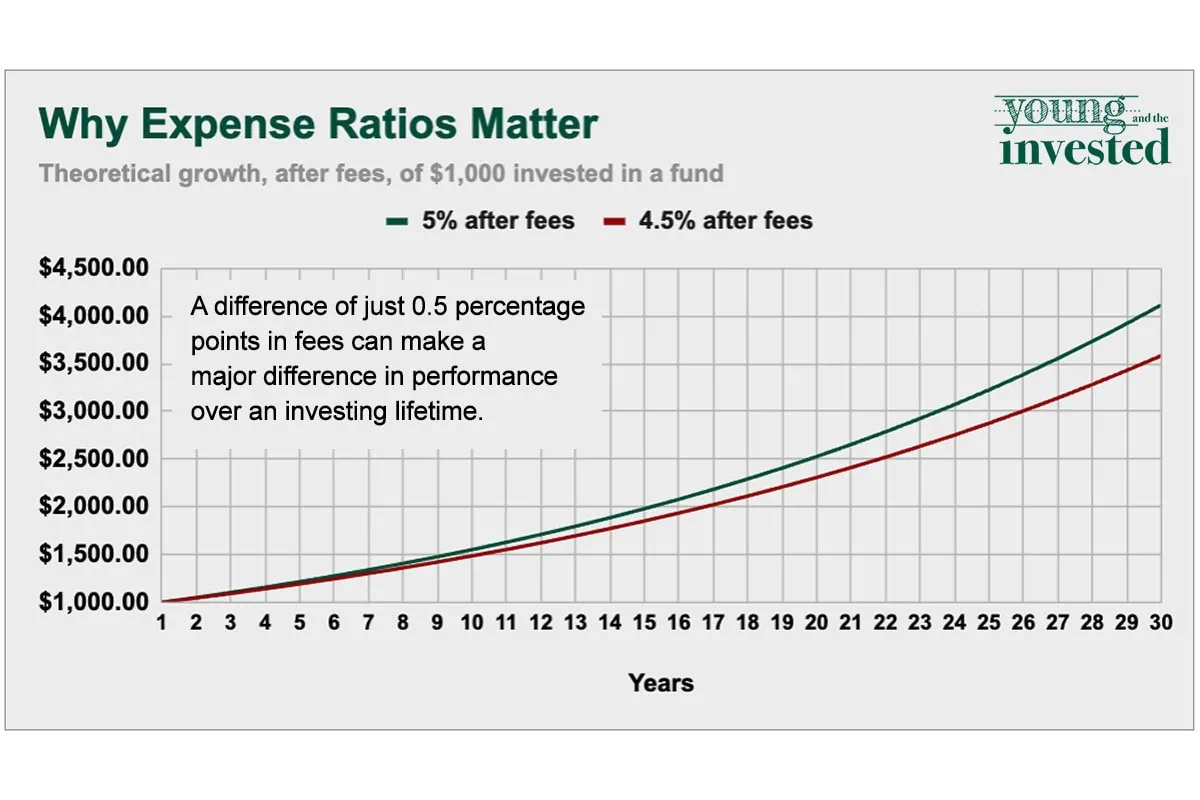
Every dollar you pay in expenses is a dollar that comes directly out of your returns. So, it is absolutely in your best interests to keep your expense ratios to an absolute minimum.
The expense ratio is the percentage of your investment lost each year to management fees, trading expenses and other fund expenses. Because index funds are passively managed and don’t have large staffs of portfolio managers and analysts to pay, they tend to have some of the lowest expense ratios of all mutual funds.
This matters because every dollar not lost to expenses is a dollar that is available to grow and compound. And over an investing lifetime, even a half a percent can have a huge impact. If you invest just $1,000 in a fund generating 5% per year after fees, over a 30-year horizon, it will grow to $4,116. However, if you invested $1,000 in the same fund, but it had an additional 50 basis points in fees (so it only generated 4.5% per year in returns), it would grow to only $3,584 over the same period.
Want to talk more about your financial goals or concerns? Our services include comprehensive financial planning, investment management, estate planning, taxes, and more! Schedule a call with Riley to discuss what you need, and what we can do for you.

Related: The 10 Best Dividend ETFs [Get Income + Diversify]
We love exchange-traded funds (ETFs) because they can provide one-click access to hundreds, even thousands of stocks, while charging often minuscule fees.
One way to put that low-cost diversification to work? Collecting dividends. But trying to choose from literally hundreds of income-producing funds could take up a lot more time than you have. So let us help you narrow the field—check out our list of 10 top dividend ETFs.
Related: 9 Best Fidelity ETFs You Can Buy [Invest Tactically]
Investors often look to exchange-traded funds (ETFs) for cheap, passive exposure to basic broader market indexes like the S&P 500.
But Fidelity’s ETF suite really shines because in addition to some of those plain-vanilla offerings, Fidelity also provides more tactical ways of tapping into specific corners of Wall Street. See what we mean by checking out our list of the best Fidelity ETFs.
Please Don’t Forget to Like, Follow and Comment
Did you find this article helpful? We’d love to hear your thoughts! Leave a comment with the box on the left-hand side of the screen and share your thoughts.
Also, do you want to stay up-to-date on our latest content?
1. Follow us by clicking the [+ Follow] button above,
2. Subscribe to Retire With Riley, our free weekly retirement planning newsletter, and
3. Give the article a Thumbs Up on the top-left side of the screen.
4. And lastly, if you think this information would benefit your friends and family, don’t hesitate to share it with them!