




Fidelity’s mutual funds offer just about anything a 401(k) investor would need to effectively put their money to work.
And fortunately, you don’t even need a Fidelity retirement account to buy them.
Most people know that Fidelity offers individual retirement accounts (IRAs) an brokerage accounts, but it’s also one of the country’s largest workplace plan providers. So if you happen to be one of the millions of people with a Fidelity 401(k), 403(b), or a similar workplace account, you’ll absolutely have access to Fidelity funds, likely including at least some of the funds I’m about to discuss.
But because Fidelity mutual funds are among some of the market’s most effective and cost-efficient, they’re also offered by other workplace plans. And because the qualities that make certain mutual funds appropriate for 401(k)s also make them appropriate for IRAs, health savings accounts (HSAs), and other tax-advantaged accounts, you don’t even need a workplace plan period to put these suggestions to use.
Read on, and I’ll introduce you to some of Fidelity’s best retirement funds for 401(k) plans.
Editor’s Note: The tabular data appearing in this article is up-to-date as of May 20, 2026.
Featured Financial Products
Disclaimer: This article does not constitute individualized investment advice. Individual securities, funds, and/or other investments appear for your consideration and not as personalized investment recommendations. Act at your own discretion.
Table of Contents
What Should You Want in a Retirement Fund?

Here are some of the most critical factors to consider when you start investing your retirement savings in an account like a 401(k).
- Fees/Expenses: The good news? Most mutual funds in 401(k) plans are “no-load,” which means you’re not charged anything when you initially buy the fund. But you’ll still pay annual expenses, and every dollar spent on fees is a dollar that can’t grow and compound over time. Sometimes, expensive funds justify their costs with outperformance. But if all else is more or less equal, the cheaper the fund, the better. Fortunately, the best Fidelity retirement funds generally charge fees that are near or at the bottom of their category.
- Dividend/interest income: It’d be nice if the stocks and bonds we owned only ever went up in price, but markets don’t work that way. Fortunately, stock dividends and bond interest provide us with an additional source of returns. This income is generally a more stable source of returns, too, making it all the more important the closer to retirement you get.
- Taxes: Your standard brokerage account is taxable, which means capital gains, dividend income, bond interest and other returns are taxable as they occur. That’s not the case with 401(k)s and other tax-advantaged accounts. This means you can be strategic about what investments you own in which accounts.
- For instance, municipal bond funds (whose income is exempt from federal taxes, and sometimes state and local taxes) are best suited for a taxable account.
- However, some investments like taxable bond funds (whose interest is subject to ordinary income taxes) and actively managed stock funds (whose “turnover” can generate taxable capital gains distributions) are best sheltered in a 401(k) or another tax-advantaged account, where those tax consequences will be snuffed out.
- Diversification: Advisors will tell you diversify your investments, which just means spreading out your money (and thus your risk) across different investments. This might mean holding multiple assets, like stocks, bonds, and commodities. This might mean holding stocks from different countries, or different sectors. Investment funds provide this diversification far more easily and cost-effectively than we can achieve on our lonesome.
- But always “look under the hood.” Some funds hold dozens of stocks, while some hold thousands. Some funds invest heavily in their biggest stocks, while others more evenly spread out their assets. So make sure you take the time to understand what your fund really owns.
What Types of Funds Are Available in 401(k) Plans?
Virtually every 401(k) plan is limited to mutual funds. On rare occasions, your plan might offer exchange-traded funds (ETFs), but it’s an awfully good bet you’ll only be able to buy mutual funds in your workplace plan.
That’s a shame, because ETFs tend to be more cost-efficient. But mutual funds have certain qualities more befitting a 401(k).
For one, mutual funds don’t trade all day on an exchange, which discourages long-term investors from panic-selling during a particularly bad day in the market. They also allow for fractional share ownership, which is important given that 401(k) plan investors are typically allocating a fixed amount of money to their account every paycheck.
Also, rather than a self-directed account, where you have your pick of virtually the entire mutual fund universe, 401(k)s usually only let you select from between 10 and 20 mutual funds. Fortunately, each fund tends to cover a specific investing style, meaning you should be able to address most of your core needs with the options made available to you.
Make sure you sign up for The Weekend Tea, Young and the Invested’s free weekly newsletter that over 10k monthly readers use to level up their money know-how.
Why Fidelity Mutual Funds?
Fidelity is a leader in mutual funds (and exchange-traded funds [ETFs], for that matter) and has been a force in the industry since the launch of its Fidelity Puritan Fund (FPURX) back in 1947.
Today, this premier fund company has more than $17 trillion in assets under administration thanks to many successes over the intervening years. That includes star money managers such as Peter Lynch—the long-time manager of the Fidelity Magellan Fund (FMAGX) who averaged an incredible 29.2% per year between 1977 and 1990—Joel Tillinghast, and Will Danoff.
However, while Fidelity first built its name on actively managed funds, over the past three decades, the firm has built out its low-cost and even no-cost index funds as part of the movement to reduce expense ratios and transaction costs for individual investors.
The end result is a fund lineup that can serve just about every need, and that’s typically competitive on price.
Related: The 7 Best Fidelity Index Funds for Beginners
The Best Fidelity Retirement Funds for Your 401(k) Right Now
In addition to the traditional data we provide with each mutual fund, we’ve also included their Morningstar Portfolio Risk Score. Here are the risk levels each score range represents:
- 0-23: Conservative
- 24-47: Moderate
- 48-78: Aggressive
- 79-99: Very Aggressive
- 100+: Extreme
Importantly, these scores are a general gauge of risk compared to all other investments. For example, a bond fund with a score of 20 might be considered a conservative strategy overall, but it could simultaneously be riskier than a number of other bond funds.
With that out of the way, let’s dig into some of the best Fidelity retirement funds to hold in a 401(k). I’ll start with the most conservative fund (by its Morningstar risk score) and finish with the most aggressive.
1. Fidelity Conservative Income Bond Fund

- Style: Ultra-short-term bond
- Assets under management: $6.8 billion
- SEC yield: 3.9%*
- Expense ratio: 0.25%**, or $2.50 per year for every $1,000 invested
- Morningstar Portfolio Risk Score: 2 (Conservative)
Bonds and bond funds are a core holding of just about any portfolio. But they’re also among the most tax-inefficient asset classes on earth, which means you should be selective about which accounts you use to hold them.
The bulk of bonds’ returns will generally come from interest paid, and interest income is taxed as ordinary income. For instance: If you’re in the 37% federal tax bracket, and you hold a bond fund in a taxable account, you’re losing 37% of your bond interest to taxes each year. But you won’t face any tax consequences for collecting that income within tax-advantaged accounts like 401(k)s, IRAs, and HSAs.
Today, I’ll look at two different Fidelity bond strategies that make sense within a 401(k).
I’ll start with short-term bonds. You’ll typically find safety in bonds that will mature in just a few years, but how much yield you’ll reap will depend on the interest-rate environment. Fortunately, right now, bonds with short maturities still offer relatively high income for relatively low risk. And that makes short-term bond funds look attractive.
Related: Best Fidelity Retirement Funds for an IRA
Fidelity Conservative Income Bond Fund (FCNVX) is an ultra-short-term bond fund, which refers to funds that primarily own fixed-income securities that will mature in less than a year. In the case of FCNVX, its management team has built a portfolio of 318 investment-grade bonds with an average maturity of around eight months.
It’s an uncomplicated portfolio made up of just corporate debt (57% of assets), U.S. Treasuries (22%) and asset-backed securities (ABSes, 17%). The remaining assets are in cash. Where FCNVX differs a little from other popular ultra-short bond funds is that it’s global in nature, with roughly two-thirds of assets in U.S. debt, and the rest in foreign issues from Canada, the U.K., Japan and other nations. Credit quality is extremely high, too, with about 80% of the portfolio tied up in bonds rated A or above.
Whenever you evaluate any bond fund, you’ll want to consider “duration,” a measure of interest-rate sensitivity. For example: A bond with a duration of two years would likely enjoy a short-term 2% rise in its price if market interest rates fell by 1 percentage point, and it would likely drop by 2% if interest rates rose by 1 point. (The actual calculation of duration is fairly complex; it’s the weighted average of the bond’s cash flows. But the key takeaway is that, all else equal, the longer a bond’s time to maturity, the higher its duration—and thus the higher the interest-rate risk.)
FCNVX has a duration of just 0.4 years, which means interest-rate fluctuations will have extremely limited impact on the fund’s performance.
* SEC yield reflects the interest earned across the most recent 30-day period. This is a standard measure for funds holding bonds and preferred stocks.
** 0.30% expense ratio reduced with a 5-basis-point waiver.
Related: 10 Best ETFs to Beat Back a Bear Market
Featured Financial Products
2. Fidelity Total Bond Fund
- Style: Intermediate-term core bond
- Assets under management: $42.3 billion
- SEC yield: 4.6%
- Expense ratio: 0.45%, or $4.50 per year for every $1,000 invested
- Morningstar Portfolio Risk Score: 15 (Conservative)
The second bond strategy I’ll cover here is a more diversified approach that involves owning a wider swath of the bond market while going farther out on the maturity spectrum.
Fidelity Total Bond Fund (FTBFX) management allocates its assets across a wide variety of bonds and other income-producing debt. The biggest chunk of assets (42%) is invested in U.S. government bonds; corporates are weighted at 37%, and mortgage-backed securities (MBSes) are another 14%. The remaining assets are sprinkled across ABSes, CMBSes, foreign sovereign debt, and more.
Related: Best Schwab Retirement Funds for a 401(k) Plan
FTBFX tends to gravitate toward investment-grade debt, but management may invest up to 20% of assets in bonds rated below investment-grade, which potentially offer higher returns in exchange for accepting slightly higher risk. You’ll likely know these bonds as “high-yield debt securities” or simply “junk.” Right now, however, just 10% of the portfolio is categorized as high-yield.
Fidelity Total Bond’s duration is 5.9 years, which is a moderate amount of interest-rate risk. A 1-percentage-point rise in interest rates would theoretically result in a short-term price decline of 5.9%. But remember: This cuts both ways. A fall in interest rates could mean significant capital gains.
Any investors considering FTBFX should know that the longest-tenured co-manager of this fund, Ford O’Neil, will be moving away from his day-to-day portfolio management duties as of the end of September 2026.
“O’Neil’s departure is undoubtedly a loss for Fidelity’s fixed-income business, including Fidelity Total Bond and Fidelity Strategic Income, both under Morningstar analyst coverage,” Morningstar analyst Max Curtin says. “Yet, the combination of the time-tested, team-based approach that O’Neil helped cultivate during his three-plus decades at Fidelity and the firm’s well-organized succession planning positions this group exceptionally well for what’s ahead.”
Do you want to get serious about saving and planning for retirement? Sign up for Retire With Riley, Young and the Invested’s free retirement planning newsletter.
3. Fidelity Real Estate Income Fund

- Style: Sector (Real estate)
- Assets under management: $4.1 billion
- SEC yield: 4.9%
- Expense ratio: 0.66%, or $6.60 per year for every $1,000 invested
- Morningstar Portfolio Risk Score: 34 (Moderate)
The Fidelity Real Estate Income Fund (FRIFX) is one of the more interesting ways you can own real estate through a publicly traded investment fund.
The easiest way for most investors to “buy” real estate is to own shares in real estate investment trusts (REITs). Publicly traded REITs trade just like normal stocks. However, these businesses enjoy a special tax status that allows them to avoid corporate taxation so long as they distribute at least 90% of their net profits as dividends. Because of this tax incentive, REITs tend to be one of the highest-yielding sectors and a perennial favorite among income investors.
Fidelity Real Estate Income is a solid option if you want to own a basket of REITs. But it’s also an unorthodox one.
Related: 9 Best Fidelity Retirement Funds [Low-Cost + Long-Term]
Manager Bill Maclay has built a portfolio of nearly 570 holdings in U.S. REITs such as datacenter specialist Equinix (EQIX), telecommunications infrastructure REIT American Tower (AMT), and logistics real estate leader Prologis (PLD). There’s nothing odd about that.
However, while your typical REIT fund will get this exposure exclusively through REIT common stock, FRIFX invests just 35% of its assets in common stock. The majority (60%) of assets are invested in real estate companies’ fixed income securities, including bonds, preferred stocks, and even mortgage-backed securities. The remaining 5% is in cash.
You might have noticed above that I used SEC yield for FRIFX. Under normal circumstances, I would cite the trailing-12-month-yield—the standard for equity funds—for a REIT product. But FRIFX’s debt-heavy portfolio mix makes an SEC yield more appropriate. And that SEC yield of nearly 5% is very competitive, even in a high-yield environment like today.
One way in which FRIFX is similar to its peers is its tax treatment. A large percentage of most REIT funds’ total returns comes from taxable dividends. So-called qualified dividends are taxed at the friendlier long-term capital gains rate (0%, 15% or 20% depending on your tax bracket). However, REITs generally pay non-qualified dividends, which are taxed at ordinary income at your marginal federal rate. Sure, FRIFX is only about 40% invested in REIT common stocks … but its preferreds generally pay non-qualified dividends, too, and the bond interest it pays is treated the same way.
All off this means REITs, most REIT funds, and FRIFX are best held in a tax-advantaged plan like a 401(k).
Related: 9 Best Real Estate Crowdfunding Sites + Platforms
Make Young and the Invested your preferred news source on Google
Simply go to your preferences page and select the ✓ box for Young and the Invested. Once you’ve made this update, you’ll see Young and the Invested show up more often in Google’s “Top Stories” feed, as well as in a dedicated “From Your Sources” section on Google’s search results page.
4. Fidelity Multi-Asset Income Fund
- Style: Moderately conservative allocation fund
- Assets under management: $3.7 billion
- SEC yield: 2.9%
- Expense ratio: 0.66%, or $6.60 per year for every $1,000 invested
- Morningstar Portfolio Risk Score: 56 (Aggressive)
The aforementioned FRIFX is in many ways similar to an “allocation fund” (aka “balanced fund,” aka “portfolio-in-a-can”) in that it holds more than one asset class. Typically, though, an allocation fund is designed to be something of a whole portfolio rolled up into one, usually owning a broad portfolio of stocks and bonds. A product that does so for just one sector doesn’t quite fit the bill.
But the Fidelity Multi-Asset Income Fund (FMSDX) does.
Morningstar classifies FMSDX as a “moderately conservative allocation fund,” which in their parlance means it targets somewhere between 30% to 50%. Right now, Lead Manager Adam Kramer and his team of three co-managers have built a portfolio that’s split roughly 45/55 between common stock and fixed-income securities.
Related: The 10 Best Fidelity ETFs for 2026 [Invest Tactically]
The equity “sleeve” is about 230 stocks, led by the likes of Google parent Alphabet (GOOG, GOOGL), Nvidia (NVDA), and Apple (AAPL). The bond sleeve is heaviest in U.S. Treasuries and other government-related securities (45% of all assets), with single-digit allocations to convertible debt, bank loans, preferred stock, emerging-market bonds, and other debt.
If you want a single fund to handle most of your equity and debt exposure, Fidelity Multi-Asset Income Fund is a pretty good solution if it matches your risk profile. As the name implies, this is a moderately conservative allocation portfolio; if you want higher concentrations of bonds or stocks, you’ll need to look elsewhere.
Performance has been exceptional since 2015 inception. Ten-year data should be made available within the coming months, but for now, FMSDX’s total returns (price plus dividends) are within the top 10% of all category funds across the trailing one-, three-, and five-year periods.
Fidelity Multi-Asset Income isn’t what I’d call tax-efficient, but it’s better than you’d expect with a sky-high turnover ratio of 225%. The fund does pay monthly dividends (a typical frequency when a fund holds bonds), but it hasn’t paid out capital gains since 2022. Still, you’re reaping an above-average amount of income, some of which is bond interest, so it’s still best held in a 401(k) or other tax-advantaged account.
Related: Best Target-Date Funds: Fidelity vs. Schwab vs. T. Rowe vs. Vanguard
Featured Financial Products
5. Fidelity 500 Index Fund

- Style: U.S. large-cap blend
- Assets under management: $791.7 billion
- Dividend yield: 1.1%
- Expense ratio: 0.015%, or 15¢ per year for every $1,000 invested
- Morningstar Portfolio Risk Score: 73 (Aggressive)
Even the pros struggle to top the S&P 500 Index for building long-term wealth. Actively managed mutual funds in the “large blend” category (a mix of value and growth) that can consistently beat the index over time are rare, particularly after considering fees and expenses. According to S&P Dow Jones Indices data, only 14% of large-cap funds were able to beat the S&P 500 over the trailing 10-year period, and that number shrinks to 10% when looking at the trailing 15 years.
“I know guys that rate active managers in all these categories, and even they’re like, ‘I’m not buying actively managed large blend; I’m just indexing,'” says Daniel Sotiroff, Senior Analyst for ETF and Passive Strategies at Morningstar. “Because it’s so brutally tough to beat a dirt-cheap index fund in the large blend category.”
Related: The 10 Best Vanguard Index Funds for 2026
They’re not just productive—because turnover in S&P 500 index funds tends to be low (at just a couple percent in any given year), they generate very little in taxable capital gains, making them extraordinarily tax-efficient ways to invest, too. Thing is, this makes them a much better fit for a taxable account (like a traditional brokerage) than a tax-advantaged account (like a 401(k) or IRA).
Regardless, given that a 401(k) is often an investor’s primary (and sometimes only) investing account, and that performance is the ultimate goal, stashing an S&P 500 index fund like the Fidelity 500 Index Fund (FXAIX) in your 401(k) is still one of the absolute smartest moves you can make.
If you believe in the American growth story, then buying a basket of America’s biggest and most recognized companies makes sense. Even Warren Buffett, the Oracle of Omaha himself—considered by many to be the greatest investor in history—has said on multiple occasions that most investors, most of the time, should simply buy and hold an S&P 500 index fund and let it run.
The Fidelity 500 Index Fund has an almost nonexistent expense ratio of just 0.015%, which is just about impossible to beat. That has helped it draw an incredible $792 billion in assets under management.
6. Fidelity Focused Stock Fund
- Style: U.S. large-cap growth stock
- Assets under management: $5.0 billion
- Dividend yield: < 0.1%
- Expense ratio: 0.69%, or $6.90 per year for every $1,000 invested
- Morningstar Portfolio Risk Score: 82 (Very aggressive)
“You never go broke taking a profit.” That’s an old Wall Street maxim with a lot of wisdom. As a general rule, buying and holding good stocks or good funds and allowing them to compound over years or even decades is the way to go. But having at least part of your portfolio in actively traded strategies can also make sense, particularly in bear markets. Actively traded strategies have their stretches when they outperform passive index strategies, and they can potentially help you to avoid major declines.
Unfortunately, active trading strategies are also woefully tax-inefficient, particularly if your holding period is less than a year. Again, short-term capital gains are taxed as ordinary income, meaning you could be sharing up to 37% of your gains with Uncle Sam.
Related: 15 Dividend Kings for Royally Resilient Income
So, it makes sense to hold funds that do a lot of active trading in a tax-deferred retirement account. There is no precise, universally accepted threshold for what constitutes “a lot” of active trading, but I would consider any fund with portfolio turnover over 30% or so to be fairly tax-inefficient. The higher that number goes, the more inefficient the fund.
Take Fidelity Focused Stock Fund (FTQGX) as an example.
This large-cap growth fund, helmed by Stephen DuFour since 2007, seeks out firms that “will grow earnings materially faster than the market and are still trading at attractive valuations.” (This strategy is typically referred to as “growth at a reasonable price,” or GARP.) It primarily owns a few dozen growth-oriented S&P 500 stocks at higher percentages than their weights in the index, as well as a handful of stocks from outside the S&P 500.
The “Focused” part of FTQGX’s name comes from the more “focused” portfolio list, with DeFour aiming to hold just 30 to 80 stocks at any given time. (Currently, that number is a svelte 43.)
Fidelity Focused Stock is within the top 25% of category funds by performance over the trailing 20 years, and it’s top-15 over the trailing three-, five-, and 10-year periods. But this high performance comes at the cost of a lot of active trading; the annual portfolio turnover is more than 150%, and the fund has reported capital-gains distributions of more than 10% on more than one occasion. In a taxable account, that’s a large potential tax liability. Thus, Fidelity Focused Stock is exactly the kind of actively managed fund best held in a tax-advantaged retirement account.
Related: 10 Best Alternative Investments [Options to Consider]
7. Fidelity Trend Fund

- Style: U.S. large-cap growth stock
- Assets under management: $4.6 billion
- Dividend yield: < 0.1%
- Expense ratio: 0.74%, or $7.40 per year for every $1,000 invested
- Morningstar Portfolio Risk Score: 91 (Very aggressive)
Another aggressive product that works well in a 401(k) is the Fidelity Trend Fund (FTRNX).
Manager Shilpa Marda Mehra owns 129 stocks she believes have above-average growth potential. At least as of the end of 2025, Shilpa believed “the investment cycle for AI should remain strong for the foreseeable future,” prompting her to focus on picks-and-shovels provider building out AI infrastructure. She also likes aerospace and defense.
Related: The 12 Best Budgeting Apps We’ve Reviewed
FTRNX is unsurprisingly heavy in technology and tech-esque companies, lead at the top by mega-caps like Nvidia, Alphabet, and Apple.
Fidelity Trend Fund has beaten its Morningstar Category average over every meaningful time period and has been in the top 10% (if not better) of category funds by performance over most time periods. Morningstar has also awarded it a Bronze Medalist rating based on its forward-looking analysis of the fund.
But again, active trading is the norm here, with annual turnover currently sitting around 60%. So, you’re best off stashing this in a 401(k) or similar account.
Related: The 7 Best Gold ETFs You Can Buy
How Does Your Portfolio Look? Ask Empower

More than 3 million users are putting their retirement on track by putting Empower’s tools and/or advisory services to work for them.
Wondering how your portfolio is shaping up? Sign up with Empower to use its free Investment Checkup tool, which can help you assess your portfolio risk, analyze past performance, and get a target allocation for your portfolio. You can even compare your portfolio to both the S&P 500 and Empower’s “Smart Weighting” Recommendation.
And if you want a fuller advisory experience? Empower’s full-service Wealth Management account pairs the firm’s tools with skilled human management. Empower will create a recommended portfolio spanning six asset classes, then help you implement your plans by giving you access to financial advisors who can guide you through retirement planning, college savings, workplace stock options, and more.
Regardless of how much money you bring to the table, if you sign up, you will be given the option to schedule an initial 30-minute financial consultation with an Empower advisor.
Do you want to get serious about saving and planning for retirement? Sign up for Retire With Riley, Young and the Invested’s free retirement planning newsletter.
Do Fidelity Mutual Funds Have a Minimum Initial Investment?
Fidelity’s mutual funds (and ETFs, for that matter) make plenty of sense for investors of all shapes and sizes, but they have a particular appeal among people who don’t have much money to work with. That’s because many Fidelity mutual funds have no investment minimums—you can literally start with as little as $1.
OK, that doesn’t matter much in a 401(k).
Related: The 12 Best Vanguard ETFs for 2026 [Build a Low-Cost Portfolio]
When you invest in a 401(k), you set percentage allocations to each fund, and the amount you contribute to each paycheck is appropriately parceled out. In other words, there really are no investment minimums within a 401(k). Still, Fidelity’s glut of zero-minimum funds comes in very handy if you’re investing in a self-directed account, be it an IRA, HSA, taxable brokerage, etc.
Featured Financial Products
What Is a Mutual Fund?

A mutual fund is an investment company that pools money from many investors to buy stocks, bonds or other securities. The investors get the benefits of professional management and certain economies of scale. A pool of potentially millions or even billions of dollars is large enough to diversify and might have access to investments that would be impractical for an individual investor to own.
Here’s an example: An investor wanting to mimic the S&P 500 Index (an index made up of 500 large, U.S.-listed companies) would generally have a hard time buying and managing a portfolio of 500 individual stocks, especially in the exact proportions of the S&P 500 Index. Another example: An investor wanting a diversified bond portfolio might have a hard time building one when individual bond issues can have minimum purchase sizes of thousands (or tens of thousands!) of dollars.
Equity funds or bond funds will generally be a far more practical solution.
To invest in a mutual fund, you’ll need to open an account with the fund sponsor or open a brokerage account with a broker that has a selling agreement in place with the fund sponsor. As a general rule, most large, popular mutual funds will be available at most brokers, so if you open a traditional investment account (like an IRA or brokerage), you’ll have access to most of the mutual funds you’d ever want to invest in.
Related: The 10 Best ETFs for Beginners
What Are Index Funds?
There are two kinds of funds: actively managed funds and index funds.
With an actively managed fund, one or more managers are in charge of selecting all of the fund’s holdings. They’ll likely have a specific strategy to adhere to, and they’ll be tasked with beating a benchmark index, but they’ll be given a lot of discretion about how to achieve that. These managers will identify opportunities, conduct research, and ultimately buy and sell a fund’s stocks, bonds, commodities, and so on.
Related: The 10 Best-Rated Dividend Aristocrats Right Now
An index fund, on the other hand, is effectively run by algorithm. The fund will attempt to track an index, which is just a group of assets that are selected by a series of rules. The S&P 500 and Dow Jones Industrial Average? Those are indexes with their own selection rules. Index funds that track these indexes will generally hold the same stocks, in the same proportions, giving you equal exposure and performance (minus fees) to those indexes.
If you guessed that it’s more expensive to pay a conference room full of fund managers than it is a computer that tracks an index, you’d be right. That’s why actively managed funds tend to cost much more in fees than index funds.
And that’s why ETFs are generally cheaper. Most (but not all) mutual funds are actively managed, while most (but not all) ETFs are index funds.
Related: The 7 Best Vanguard Index Funds for Beginners
Why Does a Fund’s Expense Ratio Matter So Much?
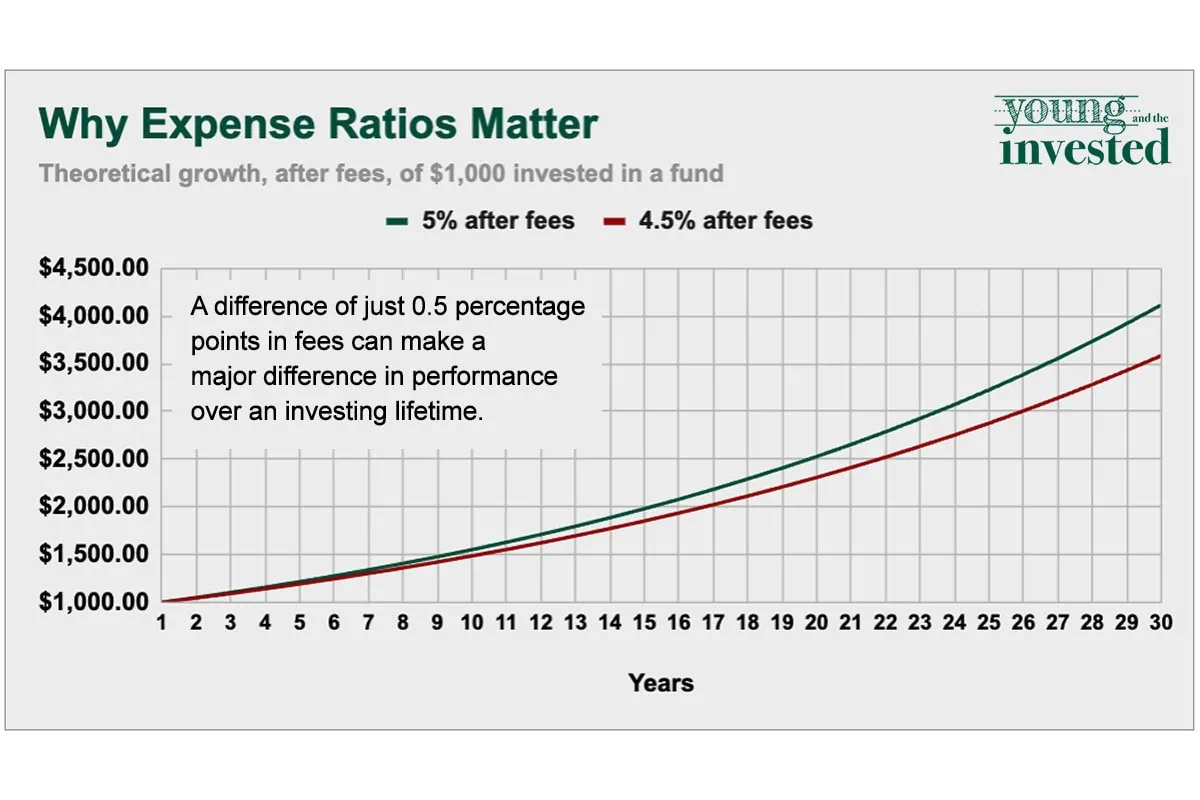
Every dollar you pay in expenses is a dollar that comes directly out of your returns. So, it is absolutely in your best interests to keep your expense ratios to an absolute minimum.
The expense ratio is the percentage of your investment lost each year to management fees, trading expenses and other fund expenses. Because index funds are passively managed and don’t have large staffs of portfolio managers and analysts to pay, they tend to have some of the lowest expense ratios of all mutual funds.
This matters because every dollar not lost to expenses is a dollar that is available to grow and compound. And over an investing lifetime, even a half a percent can have a huge impact. If you invest just $1,000 in a fund generating 5% per year after fees, over a 30-year horizon, it will grow to $4,116. However, if you invested $1,000 in the same fund, but it had an additional 50 basis points in fees (so it only generated 4.5% per year in returns), it would grow to only $3,584 over the same period.
Want to talk more about your financial goals or concerns? Our services include comprehensive financial planning, investment management, estate planning, taxes, and more! Schedule a call with Riley to discuss what you need, and what we can do for you.

Related: 15 Best Long-Term Stocks to Buy and Hold Forever
As even novice investors probably know, funds—whether they’re mutual funds or exchange-traded funds (ETFs)—are the simplest and easiest ways to invest in the stock market. But the best long-term stocks also offer many investors a way to stay “invested” intellectually—by following companies they believe in. They also provide investors with the potential for outperformance.
So if you’re looking for a starting point for your own portfolio, look no further. Check out our list of the best long-term stocks for buy-and-hold investors.
Related: 10 Best Monthly Dividend Stocks for Frequent, Regular Income
The vast majority of American dividend stocks pay regular, reliable payouts—and they do so at a more frequent clip (quarterly) than dividend stocks in most other countries (typically every six months or year).
Still, if you’ve ever thought to yourself, “it’d sure be nice to collect these dividends more often,” you don’t have to look far. While they’re not terribly common, American exchanges boast dozens of monthly dividend stocks.
Please Heart ❤️, Follow and Subscribe
Did you find this article helpful?
1. Click the Heart Button.
2. Follow WealthUpdate —-> https://flipboard.com/@WealthUpdate
3. Subscribe to Retire With Riley, our free weekly retirement planning newsletter.