



Healthcare stocks are unique among the market’s sectors in that they provide a little of everything: growth, defense, and income.
And by investing in the best healthcare ETFs, we can add diversification to that list.
As far as sectors go, healthcare is fairly wide-ranging, playing host to cash-rich pharmaceuticals, fast-moving biotechnology companies, innovative medical equipment makers, entrenched insurers, and more. But given that these stocks’ fates rest on events such as FDA approvals and Medicare reimbursement rates, it can be extremely difficult to pick winners in the space. Healthcare exchange-traded funds let us skip the guesswork and instead own entire swaths of the sector with just one purchase.
Today, I’m going to introduce you to some of the best healthcare ETFs you can buy. This is a mix of ways to approach the sector, including products that own healthcare stocks broadly, as well as those that concentrate on the sector’s most popular subsets.
Editor’s Note: Tabular data presented in this article is up-to-date as of Sept. 22, 2026.
Disclaimer: This article does not constitute individualized investment advice. These securities appear for your consideration and not as personalized investment recommendations. Act at your own discretion.
Why Should You Invest in the Healthcare Sector?

Healthcare is considered a defensive sector, with a similar underlying logic as consumer staples and utilities. When the economy weakens and money is tight, people are likely to give up on discretionary purchases like concert tickets and video games, and they’ll do so to conserve money for necessities—in the case of healthcare, that’s things like maintenance drugs, health insurance, trips to the doctor, and so on.
But there’s also a growth element to the space.
Part of it is healthcare’s constant creation of novel treatments for ailments—over the years, pharma and biotech companies have found ways to fight back against illnesses and conditions that previously had no answers.
Another part of it is simply that many of us are getting old.
“Healthcare is also underpinned by structural forces such as aging populations across the developed world, which increases the long-run demand for healthcare products, equipment and services,” say BlackRock’s Carrie King and Erin Xie. “The proportion of the U.S. population older than 65 is projected to reach 20% by 2030, according to S&P Global Market Intelligence. This cohort is estimated to spend two to three times more per person on healthcare than those under 65.”
Healthcare isn’t a monolith, however. These and other factors have different pushes and pulls across the sector’s industries. So while healthcare broadly offers that aforementioned blend of traits, investors looking to push the pedal down on just growth, or just income, might be more interested in specific segments of the sector.
The best healthcare ETFs include products that allow us to go wide or narrow.
The Best Healthcare ETFs
Picking winners in the stock market is generally an uphill battle, but that especially seems to be the case in the healthcare sector.
For instance, while we might generally guess that a company trying to address weight loss through medicine could find success, it’s much more difficult to predict whether its trial treatment will ever make it to market. Or while constantly rising healthcare premiums might make every insurer seem like a sure thing, numerous other factors can still keep their stocks grounded.
Healthcare ETFs allow us to make more general bets on the space, whether that’s on the pharma industry’s ability to keep paying generous dividends, or the biotech industry’s ability to keep delivering stock-boosting breakthroughs.
With all of that in mind, let’s look at some of the best healthcare ETFs to buy. In no particular order …
Related: The 11 Best Fidelity Funds to Buy Now
1. State Street Health Care Select Sector SPDR ETF

- Inception: Dec. 16, 1998
- Assets under management: $42.8 billion
- Dividend yield: 1.5%
- Expense ratio: 0.08%, or 80¢ per year on every $1,000 invested
The State Street Health Care Select Sector SPDR ETF (XLV) is the standard-bearer of healthcare-sector funds. It’s the oldest healthcare ETF, closing in on three decades of service. It’s the biggest, at nearly twice the size of its closest peer. And thanks to a 2025 fee reduction, it’s also the cheapest healthcare ETF you can buy.
Like all of the Select Sector funds, XLV is extremely straightforward. It’s an index fund that tracks the healthcare sector within the S&P 500, which currently amounts to 61 U.S. healthcare stocks. It’s market cap-weighted, which means the larger the company, the greater the percentage of XLV’s assets is invested in that company’s stock. For instance, right now, $1.1 trillion Eli Lilly (LLY) accounts for a whopping 15% of assets, while $12 billion dialysis specialist DaVita (DVA) accounts for just 0.1%.
By investing in the Health Care Select Sector SPDR ETF, you’re getting exposure to all of the different subsets of the healthcare sector. Pharmaceuticals are tops at nearly 40% of assets, and thus have far more sway over XLV’s performance than any other industry. However, biotechnology, healthcare providers and services, healthcare equipment and supplies, and life sciences tools and services all have double-digit weights, so they’re not being completely drowned out.
XLV is tilted toward mega-cap dividend stocks such as Merck (MRK) and Pfizer (PFE), and even Dividend Aristocrats and Dividend Kings such as Johnson & Johnson (JNJ) and AbbVie (ABBV). The result is a 1.5% yield that, while not exactly enough to bowl over high-income hunters, is about half of a percentage point better than what we’re earning from the S&P 500.
The State Street Health Care Select Sector SPDR ETF is about as much of a blunt instrument as you’ll find in the sector. But its bargain-basement fees and blue-chip composition make it one of the best healthcare ETFs we can buy.
Want to learn more about XLV? Check out the State Street Investment Management provider site.
Make sure you sign up for The Weekend Tea, our free weekly newsletter that over 10k monthly readers use to level up their money know-how.
2. Vanguard Health Care ETF
- Inception: Jan. 26, 2004
- Assets under management: $19.3 billion*
- Dividend yield: 1.5%
- Expense ratio: 0.09%, or 90¢ per year on every $1,000 invested
Vanguard Health Care ETF (VHT) is an only slightly different way to get broad exposure to the sector, but the main difference is worth exploring.
This ETF takes a backseat to XLV in age, assets, and cost, but there’s one way in which it’s well ahead of State Street’s fund: components. VHT tracks the MSCI US Investable Market Health Care 25/50 Index, which starts with a selection universe that’s much wider than the S&P 500. So instead of 60 or so holdings, Vanguard Health Care ETF ends up owning more than 400 U.S. healthcare stocks right now.
That matters because performance isn’t as beholden to the company’s mega-caps. VHT is market cap-weighted, so companies like Eli Lilly and J&J still loom large, but they generally represent smaller portions of assets than they do in XLV.
It also matters because those assets are being redistributed to smaller companies. And in the pharmaceutical and biotechnology industries especially, that means VHT likely owns not just more growth-oriented companies, but companies that are of digestible enough size to be bought out by those mega-caps.
Here’s the thing: When indexes add and subtract stocks, it’s usually because certain current components lost value and became too small, while other companies outside the index got big enough to include. But when a company is bought out, it’s usually purchased at a premium that sends shares higher—and it only disappears from the index because it gets folded into another company. So the index enjoys the proportional share of that surge, then reloads with another company that has risen through the ranks.
VHT is still mostly invested in large caps (about 65% of assets), so this is still a generally stable fund that provides above-average income. But its makeup and still-very low fees make it an attractive alternative to XLV and put it among the best healthcare ETFs on the market right now.
* Reflects only the assets in Vanguard Health Care’s ETF share class.
Want to learn more about VHT? Check out the Vanguard provider site.
Related: What Is VOO? A Quick Guide to the Vanguard S&P 500 ETF
3. VanEck Pharmaceutical ETF

- Inception: June 23, 2005
- Assets under management: $1.0 billion
- Dividend yield: 1.9%
- Expense ratio: 0.36%, or $3.60 per year on every $1,000 invested
Traditionally, much of the healthcare sector’s income production comes from the pharmaceutical space: companies that build treatments based on synthetic compounds.
This trait is on full display in the VanEck Pharmaceutical ETF (PPH), which tracks the MVIS US Listed Pharmaceutical 25 Index—an index that includes pharmaceutical R&D firms, as well as companies that produce, market, and sell pharmaceuticals.
Most of the names in here are brands you’ve likely seen through either TV ads or at your drug store: Lilly, Merck, Pfizer, Bristol-Myers Squibb (BMY), and AstraZeneca (AZN). They’re the corporations that developed and produced the drugs … or in some cases, bought the companies that did. But you also get a little exposure to companies like McKesson (MCK), whose role in the pharmaceutical chain is simply distribution.
And unlike the aforementioned broad-sector funds, PPH offers quite a bit of international diversification. American companies make up about 65% of assets, while the rest is split up among firms domiciled in the U.K., Switzerland, Denmark, and a few other developed nations.
A focus on pharmaceuticals, as well as exposure to Europe (whose blue chips tend to pay more than their American counterparts), results in a dividend yield that’s almost twice what the S&P 500 pays.
I’ll note that there’s more than one great pharmaceutical ETF out there—the Invesco Pharmaceuticals ETF (PJP) is on my 2026 list of the best ETFs to buy as a great way to leverage any bounceback in pharma. However, PPH is a better option for squeezing income out of the pharmaceutical industry, it has lower fees, and its long-term performance is comparable.
Want to learn more about PPH? Check out the VanEck provider site.
Related: 5 Dandy Dividend-Growth ETFs to Buy Now
4. State Street SPDR S&P Biotech ETF
- Inception: Jan. 31, 2006
- Assets under management: $10.4 billion
- Dividend yield: 0.4%
- Expense ratio: 0.35%, or $3.50 per year on every $1,000 invested
Biotechnology and pharmaceuticals are really just two different ways to get to the same endpoint: a treatment. Whereas pharma uses chemical compounds, biotech uses “biologics”: living organisms like cells, bacteria, and yeast.
Biotech companies generally tend to be smaller—many rely on just a handful of commercial products. Others might only have one. And some publicly traded biotechs may have just one treatment in trial stages, effectively living or dying based on that drug’s ability to get approved. It’s much higher-risk than the pharmaceutical industry, but it also has much more potential for explosive growth, whether that’s through developing successful treatments or being gobbled up in Big Pharma mergers and acquisitions (M&A).
The two biggest funds in this industry are the iShares Biotechnology ETF (IBB) and the State Street SPDR S&P Biotech ETF (XBI). I can make the case for both, but I’m highlighting XBI because it better represents the risk-reward tradeoff people expect from biotechnology stocks.
The iShares fund uses a “modified” market cap-weighting that still sorts stocks by size but puts limits on just how concentrated any one position can get. However, XBI uses a modified equal-weighting system that puts large-, mid-, and small-caps on much more even ground. Just consider their top holdings right now:
- IBB: $221 billion Amgen (AMGN), $189 billion Gilead Sciences (GILD), and $131 billion Vertex Pharmaceuticals (VRTX), at roughly 7%-8% weights apiece
- XBI: $73 billion Moderna (MRNA), $56 billion Natera (NTRA), and $11 billion Twist Bioscience, at roughly 2%-3% weights apiece.
XBI’s 165-stock portfolio also includes Gilead, Vertex, and Amgen, but at 1% of assets each, they hold far less sway over performance.
What does this all mean for investors? SPDR S&P Biotech ETF historically is a more volatile fund with higher peaks and deeper slumps. But that (as well as a lower annual fee) has resulted in considerably superior long-term performance since inception over its iShares rival, earning it a spot among Wall Street’s best healthcare ETFs.
Want to learn more about XBI? Check out the State Street Investment Management provider site.
Related: 5 Best REIT ETFs for Real Estate Income
5. Simplify Health Care ETF

- Inception: Oct. 7, 2021
- Assets under management: $361.0 million
- Dividend yield: 0.6%
- Expense ratio: 0.51%, or $5.10 per year on every $1,000 invested
Actively managed ETFs have flourished over the past few years, but they’re still relatively new (and as a result, small) compared to index products.
To wit: The Simplify Health Care ETF (PINK), which is approaching its fifth birthday, has $360 million in assets—that’s just barely enough to make the top 20 healthcare ETFs by assets, but that also makes PINK the second largest actively managed healthcare ETF.
Michael Taylor, David Berns, and Jeff Schwarte have a broad strategy of producing “multi-cap exposure to groundbreaking and innovative companies” within the healthcare and related sectors. While they own just 55 companies, they provide access to all the major healthcare industries: pharma, biotech, and the like.
Where they differ from a simple index is that they’re not bound by many rules guiding selection and weighting. PINK’s positions are effectively “dealer’s choice.” So top holdings include large allocations to juggernauts like Eli Lilly and insurer Humana (HUM), as well as smaller biotech companies like Arcutis Biotherapeutics (ARQT). It also has a few outliers—a mid-single-digit weighting in eyewear retailer Warby Parker (WRBY), and a top-five position in PureCycle Technologies (PCT), an industrial-sector firm whose recycled polypropylene (plastic) can be used in a variety of medical-industry applications.
PINK has beaten both its Morningstar category average and benchmark index over the trailing three years, and it has topped the aforementioned XLE by about 15 percentage points since inception. That alone would be enough to put PINK among the market’s best ETFs.
But there’s one more kicker: PINK is a 100% pro bono ETF that donates all net profits from fees to the Susan G. Komen breast cancer organization. From inception through June 30, 2026, the fund has given $450,000 to the cause.
Want to learn more about PINK? Check out the Simplify ETFs provider site.
Related: 3 Basic Energy ETFs for Beginner Portfolios
Learn More About These and Other Funds With Morningstar Investor

If you’re buying a fund you plan on holding for years (if not forever), you want to know you’re making the right selection. And Morningstar Investor can help you do that.
Morningstar Investor provides a wealth of information and comparable data points about mutual funds and ETFs—fees, risk, portfolio composition, performance, distributions, and more. Morningstar experts also provide detailed explanations and analysis of many of the funds the site covers.
With Morningstar Investor, you’ll enjoy a wealth of features, including Morningstar Portfolio X-Ray®, stock and fund watchlists, news and commentary, screeners, and more. And you can try it before you buy it. Right now, Morningstar Investor is offering a free seven-day trial and a discount on your first year’s subscription when you use our exclusive link.
- Morningstar Investor offers expert research, investing analysis, and advisor-grade portfolio management tools that are tailor-made for buy-and-hold investors.
- Morningstar is one of the most prized sources of mutual fund and exchange-traded fund (ETF) data in the world.
- How does your portfolio stack up? Put it through Morningstar's Portfolio X-Ray, which will provide insights such as whether you have too many overlapping holdings or whether you're paying too much in fees.
- Special Offer 1: Click our sign-up link to receive $50 off your first year of Morningstar Investor. (Annual plan only.)
- Special Offer 2: Students receive one year of Morningstar Investor access for just $25!
- Special Offer 3: Teachers receive a 60% discount on Morningstar Investor access.
- Top-flight fund research and analysis
- Portfolio management tool
- Powerful screener
- Watchlists
- Tailored news and commentary
- Below-average charting
- High monthly billing rate

Actively Managed Funds vs. Index Funds
There are infinite types of mutual funds, but all can be divided into two main camps:
- actively managed funds
- passively managed funds, also known as passive funds or, most commonly, index funds
Actively managed funds have professional managers that use their discretion to buy and sell securities. Whether they are value funds, growth funds, or anything in between, they are all essentially run the same way: A manager or team of managers buys and sells stocks, bonds, or other securities in the pursuit of price returns, dividends/income, or both.
Index funds, in contrast, are passive. There’s no manager actively looking to “beat the market.” The fund is simply looking to copy an index—which is based on a set of rules that the index automatically applies—enjoying that underlying investment exposure. Actively managed stock funds will try to cherry pick the stocks or bonds they like best. An index fund simply buys whatever its rules say to buy, then lets that portfolio run until it’s time to “rebalance” (apply the rules again).
The primary advantages of actively managed funds is that a talented manager can potentially outperform over time and may be adept at navigating a difficult period such as a bear market. But with an index fund, you generally get much lower costs in terms of management fees and trading expenses, better tax efficiency and performance that often ends up being better than that of many active managers.
Why Does a Fund’s Expense Ratio Matter So Much?
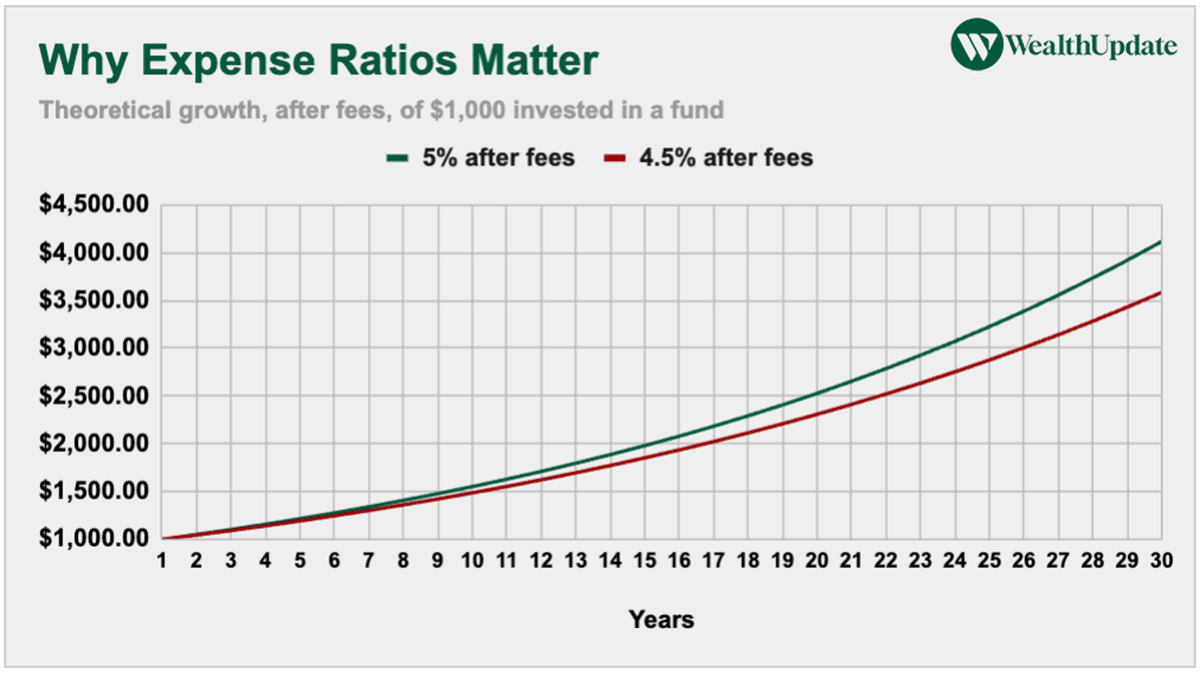
Every dollar you pay in expenses is a dollar that comes directly out of your returns. So, it is absolutely in your best interests to keep your expense ratios to an absolute minimum.
The expense ratio is the percentage of your investment lost each year to management fees, trading expenses and other fund expenses. Because index funds are passively managed and don’t have large staffs of portfolio managers and analysts to pay, they tend to have some of the lowest expense ratios of all mutual funds.
This matters because every dollar not lost to expenses is a dollar that is available to grow and compound. And over an investing lifetime, even a half a percent can have a huge impact. If you invest just $1,000 in a fund generating 5% per year after fees, over a 30-year horizon, it will grow to $4,116. However, if you invested $1,000 in the same fund, but it had an additional 50 basis points in fees (so it only generated 4.5% per year in returns), it would grow to only $3,584 over the same period.
Related: Do I Need a Financial Advisor? 7 Questions to Ask Yourself
Want to talk more about your financial goals or concerns? Our services include comprehensive financial planning, investment management, estate planning, taxes, and more! Schedule a call with Riley to discuss what you need, and what we can do for you.