



If you’re interested in earning a high income stream from your investments, you should know (if you already don’t) that you can’t get something for nothing. Often, the more dividend yield you crave, the more risk you’re forced to take on.
But high-dividend ETFs can often help you tamp down that risk a little.
High-yield dividend ETFs, as the name implies, are funds that predominantly invest in assets that produce much more income than your average ETF. They do so by investing in specific corners of the market, exposing you to different areas of the world, or even using a few special market mechanics to make the cash-rich metaphorical sausage. And importantly, by spreading their assets out across dozens, hundreds, or even thousands of investments, they help reduce the risk to your portfolio of any single security suddenly imploding.
Let me shine a light on a group of high-yield dividend ETFs that pay between 3.8% and 11.4% annually, which is roughly three to nine times better than the broader market.
Editor’s Note: This article’s tabular data is up-to-date as of April 24, 2026.
Featured Financial Products
Disclaimer: This article does not constitute individualized investment advice. Individual securities, funds, and/or other investments appear for your consideration and not as personalized investment recommendations. Act at your own discretion.
Table of Contents
Why Invest in Dividend Stocks via ETFs?

Dividend stocks certainly are common enough, but they’re also not created equally. Some companies only pay nominal dividends that are just a penny or two per share, with no prospect for dividend growth anytime soon. Others may offer generous but unsustainable dividend payouts that might be eliminated altogether in the future.
You could tether your fate to that one company’s specific strengths and weaknesses. Or you could hitch your wagon to a dividend ETF, which may own that stock … but only as a small percentage of a much larger collection of other dividend payers. Sure, you won’t enjoy the same level of gains if that stock suddenly takes off, but you also won’t endure the hardship of that stock going into the toilet.
Plus, finding the best stocks capable of consistently paying dividends and enjoying significant future dividend growth can be a daunting task, even for seasoned investors. So why not try to gain exposure to dividend-paying stocks via a single, diversified holding that’s tasked with finding great companies for you?
That’s what you get in a dividend ETF.
How Were These High-Yield Dividend ETFs Selected?
Let’s start with a few ground rules.
First, these are dividend ETFs. In other words, this list is limited to funds that own stocks; bond funds don’t apply.
Next is the yield floor. There’s no universal definition of “high yield”; much like beauty, a high dividend is in the eye of the beholder. But given that it’s a list of high-dividend ETFs, I have to set the floor somewhere, and that somewhere is 3.5%. That ensures you’ll earn well more than double (and in most cases, many times more) what you’d collect by investing in an S&P 500 index fund.
Lastly, as a quality check, I’ve only included dividend ETFs that have earned a Morningstar Medalist rating—Morningstar’s forward-looking analytical view of the fund—of at least Bronze. A quick explanation of why that matters, per Morningstar:
“For actively managed funds, the top three ratings of Gold, Silver, and Bronze all indicate that our analysts expect the rated investment vehicle to produce positive alpha relative to its Morningstar Category index over the long term, meaning a period of at least five years. For passive strategies, the same ratings indicate that we expect the fund to deliver alpha relative to its Morningstar Category index that is above the lesser of the category median or zero over the long term.”
Importantly, a Medalist rating doesn’t mean Morningstar is necessarily bullish on the underlying asset class or categorization. It’s merely an expression of confidence in the fund compared to its peers.
From the remaining universe of ETFs to choose from, I picked ETFs from a variety of sectors, geographies, and strategies. I also selected funds that have reasonable expense ratios—given their specialties, many of these cost more than a bland broad-market ETF, but they’re fair or low for their category.
Make sure you sign up for The Weekend Tea, Young and the Invested’s free weekly newsletter that over 10k monthly readers use to level up their money know-how.
An Important Note About Dividend ETFs’ Distributions
One last thing to know before diving into any dividend ETF: Their distributions tend to reflect the cash dividend payments of their underlying holdings.
What you’re getting from an ETF in a quarter is more or less your share of all the dividends that all of the holdings made within that quarter. But sometimes, individual components don’t always pay within each given quarter (even if they pay quarterly). Also, they occasionally increase regular dividends, make special payouts, or cut or even suspend regular dividends.
As a result, ETFs can have “lumpy” distributions that change from one quarter to the next.
Here’s an example: In a 12-month period, the SPDR S&P 500 ETF Trust (SPY)—the largest ETF by assets on the planet, and thus one of the most commonly owned—paid out quarterly dividends of $1.80, $1.99, $1.83, and $1.76 per share. That’s a 13% difference between the smallest and largest payouts, and some years, it’s much more.
If you’ve not yet reached retirement, this inconsistency probably won’t matter to you at all. But it could be problematic—or at the least, worth planning around—if you are in retirement and heavily depend on dividend income to pay your regular bills. So especially if you’re in the latter boat, when you research dividend funds, I highly suggest not just looking at yield, but at distribution history, too.
Related: The 16 Best ETFs to Buy for a Prosperous 2026
Best High-Dividend ETF #1: SPDR Portfolio S&P 500 High Dividend ETF

- Assets under management: $7.3 billion
- Dividend yield: 4.4%
- Expense ratio: 0.07%, or 70¢ per year on every $1,000 invested
- Morningstar Medalist rating: Gold
If you’re new to high-yield dividend ETFs, you couldn’t ask for a more straightforward introductory fund than the SPDR Portfolio S&P 500 High Dividend ETF (SPYD).
This index fund tracks the S&P 500 High Dividend Index, which itself is made up of the highest-yielding companies within the S&P 500. To determine which stocks are included, the index simply looks at the annualized yield of every component’s most recent dividend payment. The ETF typically owns anywhere between 75 to 80 equities. It also gravitates toward traditionally higher-yielding sectors; right now, assets are most heavily allocated to real estate investment trusts (REITs), financials, consumer staples, and utility stocks.
One especially noteworthy difference from the S&P 500 is how SPYD “weights” its stocks. The S&P 500 is weighted by market capitalization, which means the larger the stock, the more representation it has within the index, and the more assets an S&P 500 fund will dedicate to owning that stock. Consider this: $5.1 trillion Nvidia (NVDA) is the S&P 500’s top holding at 8% of assets, while $15 billion News Corp. (NWS) is the smallest holding at less than 0.01%.
However, SPYD equally weights each stock, so each company has an equal impact on the portfolio. Stocks’ weights will change as they rise or fall in value, but they’re still much closer in treatment—right now, $13 billion APA Corp. (APA) is SPYD’s top holding at 1.8% of assets. $58 billion Target (TGT)? 1.5%. $194 billion Verizon (VZ)? 1.4%. Also, every six months, the fund’s holdings are all brought back to level again.
Related: 5 Best Stock Recommendation Services [Stock Tips + Picks]
I bring up SPYD’s equal weighting because it has a double-edged impact on safety:
On the one hand, market cap-weighted funds let the biggest and most established stocks have the most say on performance, providing ballast to the fund. Equal-weighted funds give smaller and potentially more volatile stocks a greater voice, which can result in less steady returns. Fortunately, SPYD gravitates toward holding lower-risk stocks in the first place, blunting this issue.
On the other hand, market cap-weighted funds sometimes allow for large stocks to have a comically outsized effect—no joke, some ETFs allocate as much as 20% to a single stock, which means that single stock can make or break that fund’s year. Equal weighting reduces the chance that any one stock can derail the ETF’s performance.
Why does the latter matter in a fund filled with supposedly blue-chip firms? Occasionally, a high yield can be a sign of a troubled stock. (Remember: Dividend yield is the stock’s dividend divided by the stock’s price. A higher dividend can make that yield go up, but so can a lower stock price.) And even large-cap S&P 500 companies can hit turbulence. Spreading your risk across 75 to 80 stocks—then ensuring that risk is evenly distributed across the lot of them—helps insulate you from unexpected single-company shocks.
One last note: Morningstar gives this fund a Gold Medalist rating, citing “a sound investment process and strong management team.”
Featured Financial Products
Best High-Dividend ETF #2: Franklin International Low Volatility High Dividend ETF
- Assets under management: $4.8 billion
- Dividend yield: 3.8%
- Expense ratio: 0.40%, or $4.00 per year on every $1,000 invested
- Morningstar Medalist rating: Silver
Any group of favorably rated high-yield dividend ETFs is bound to include at least a couple international stock funds. Large, established dividend payers abroad—especially in developed countries—have for years tended to pay more than their U.S. counterparts, in part because the long-term outperformance of U.S. stocks has depressed yields.
And one of the best such funds—Franklin International Low Volatility High Dividend ETF (LVHI)—is of the low-volatility persuasion. For the uninitiated, low- and minimum-volatility ETFs are designed to wiggle less than the market, so the idea here is that when stocks lunge southward, low- and min-vol funds won’t decline as much—and might even produce some gains.
Franklin’s fund is designed to provide a portfolio of high-yielding dividend stocks that demonstrate low price and profit volatility. Its underlying index starts with a screen to identify dividend-paying companies that can pay “relatively high sustainable dividend yields,” then it grades yields based on price and earnings volatility.
Related: Closed-End Funds (CEFs): 7 High-Yield Funds That Fly Under the Radar
LVHI also puts various limits on the portfolio to eliminate overconcentration risk—for instance, no stock can make up more than 2.5% of the index at quarterly rebalancing, no sector can make up more than 25%, and REITs, which we’ll get to in a bit, can’t exceed 15%. Also, no geographic region will exceed 50% of assets, and no single country will exceed 15%. To further tamp down on volatility, LVHI hedges against currency fluctuations.
Franklin International Low Volatility High Dividend currently owns about 185 stocks from about 20 developed nations, including Canada (16%), Japan (15%), and the U.K. (14%). Most of the portfolio (~90%) is large-cap in nature, including top holdings such as Canadian Natural Resources (CNQ), British integrated oil major Shell (SHEL), and Japanese conglomerate Mitsubishi.
These large international names throw off a yield of almost 4%, and that’s actually much lower than it was a few months ago thanks to recent gains in the fund. But it also dishes out much higher returns (and much lower risk) compared to the ETF’s category average. All of this makes LVHI not just a great holding for anytime, but also one of the best ETFs for bear markets. Indeed, its losses during 2025’s near-bear drop were less than half the broader market’s.
Income investors should note that LVHI, like many international dividend funds, has “lumpy” dividends, as foreign companies often pay just semiannually or even annually. For instance: Its four most recent quarterly dividend payments ranged from 16.0¢ to 81.4¢!
Related: The 12 Best Vanguard ETFs to Buy [Build a Low-Cost Portfolio]
Best High-Dividend ETF #3: WisdomTree Emerging Markets High Dividend Fund

- Assets under management: $3.7 billion
- Dividend yield: 4.3%
- Expense ratio: 0.63%, or $6.30 per year on every $1,000 invested
- Morningstar Medalist rating: Bronze
The WisdomTree Emerging Markets High Dividend Fund (DEM) drills for dividends in a less likely basin: emerging markets (EMs).
Developed markets, like those that feature prominently in LVHI, tend to be defined by low growth but relative economic and political stability. Emerging markets go the other way: These countries are often experiencing rapid development and offer the potential for high growth, but issues such as unstable governments, poor market controls, and highly concentrated economies produce more risk. So while emerging markets are typically a hotbed for growth investors, dividend seekers typically sit these countries out.
But emerging markets do sport at least a few high dividend payers, and DEM aims to hold them.
Related: The 13 Best Mutual Funds You Can Buy
The fund’s underlying index targets the highest-paying stocks across 20 emerging markets. The selection criteria include minimums for market capitalization ($200 million), trading volume (250,000 shares over the past six months), and median daily dollar trading volume ($200,000 over the past six months).
DEM’s nearly 520-stock portfolio is lopsided from a country allocation standpoint, but that’s par for the international-fund course. China (24%), Taiwan (23%), and Brazil (7%) enjoy double-digit weightings. Several other countries—including Chile, Turkey, and the Philippines—have sub-1% weights. The ETF is expectedly top-heavy from a sector perspective, too. Financials command more than a quarter of assets, while information technology, industrials, and energy enjoy double-digit weights. Top holdings include China Construction Bank, Taiwanese semiconductor company MediaTek, and Saudi Arabian Oil.
Related: 11 Best Vanguard Funds to Buy for the Everyday Investor
I’ll also point out that DEM’s holding mix has included more smaller firms in recent years. Currently, about 60% of assets are invested in large caps, with another 20% in mid-caps and the rest in small companies.
Lastly, DEM’s distributions are mighty lumpy, too. Its past four quarterly payouts have been 23.5¢, 41.3¢, 80¢, and 57.5¢. (It also distributed an additional fourth-quarter dividend of 7.2¢.)
Do you want to get serious about saving and planning for retirement? Sign up for Retire With Riley, Young and the Invested’s free retirement planning newsletter.
Best High-Dividend ETF #4: Vanguard Real Estate ETF
- Assets under management: $34.2 billion*
- Dividend yield: 3.9%
- Expense ratio: 0.13%, or $1.30 per year on every $1,000 invested
- Morningstar Medalist rating: Silver
The real estate sector currently accounts for more than a quarter of the aforementioned SPYD’s assets. But that shouldn’t be a surprise: Ever since REITs became their own sector in 2016, they’ve typically been among the highest-yielding S&P 500 sectors.
Unlike most companies that more or less choose to pay out dividends, REITs are compelled to—by law. REITs were created by Congress in 1960 to spur real estate investing. They’re given favorable tax treatment … but in exchange, they’re required to pay out at least 90% of their taxable income to shareholders, in the form of dividends.
Related: 8 Best T. Rowe Price Funds to Buy and Hold
You could own a handful of individual REITs if you’d like, or you can load up on the sector via REIT ETFs.
The biggest name in that game is the Vanguard Real Estate ETF (VNQ). This Vanguard ETF tracks a broad index of REITs covering a variety of industries: office buildings, apartments, data centers, warehouses, senior living facilities, even driving ranges. It too is market cap-weighted. At the moment, top holdings in this 145-REIT portfolio include medical facility and senior housing company Welltower (WELL), logistics REIT Prologis (PLD), datacenter landlord Equinix (EQIX), and telecommunications infrastructure firm American Tower (AMT).
* Vanguard fund assets are spread across multiple share classes, including mutual funds and ETFs alike. Assets listed for VNQ is for the ETF share class only.
Make Young and the Invested your preferred news source on Google
Simply go to your preferences page and select the ✓ box for Young and the Invested. Once you’ve made this update, you’ll see Young and the Invested show up more often in Google’s “Top Stories” feed, as well as in a dedicated “From Your Sources” section on Google’s search results page.
Best High-Dividend ETF #5: Hoya Capital High Dividend Yield ETF

- Assets under management: $102.3 million
- Dividend yield: 11.4%
- Expense ratio: 0.50%, or $5.00 per year on every $1,000 invested
- Morningstar Medalist rating: Silver
VNQ is generally considered the gold standard of REIT ETFs, but its dividend is just a little above-average compared to other REIT funds. For income hunters looking for truly lofty yield, the Hoya Capital High Dividend Yield ETF (RIET) provides a much bigger paycheck.
RIET invests in 100 high-yielding real estate securities—mostly the common stock of REITs, but also preferred shares (which I’ll discuss in more detail when I get to another fund). The ETF divides its assets across five categories:
- 10 “Dividend Champions” (15% weight): REITs of any market capitalization that have the highest yield in their property sector
- 10 large-cap REITs (15% weight)
- 25 mid-cap REITs (30% weight)
- 25 small-cap REITs (30% weight)
- 30 preferreds (10% weight)
RIET also differs from VNQ in that it equally weights its holdings within each of those categories, then rebalances twice a year. Right now, top holdings include National Storage Affiliates Trust (NSA), net-lease landlord Realty Income (O), hotel property owner Apple Hospitality REIT (APLE), and EPR Properties (EPR), an “experiential” REIT whose portfolio includes gyms, driving ranges, ski resorts, and more.
In addition to those equity REITs, it also holds mortgage REITs (mREITs), which don’t invest in physical real estate, but instead own bundles of mortgage-backed securities (MBSes) and other “paper” real estate.
Related: The 10 Best Vanguard Index Funds You Can Buy
Hoya’s fund is young—inception was in September 2021, so it only has a little more than four years of track record to study. And even with dividends included, its performance has come up short compared to more traditional REIT ETFs. Still, Morningstar has awarded it with a Silver Medalist rating based on its relatively low fees and laudable investment process.
RIET is a rarity in that it’s a monthly dividend payer (most equity dividend ETFs pay quarterly). The monthly dividend has remained consistent since inception, with the exception of a 2%-plus hike in 2023. It’s a blessing and a curse. Yes, it means investors know what they’re getting every month. However, each monthly distribution is made up of varying levels of actual dividend income and “return of capital,” which is treated differently from a tax perspective. So again, check the distribution history and tax documents, and understand the consequences, before you invest.
Related: The 11 Best Fidelity Funds to Buy in 2026
Featured Financial Products
Best High-Dividend ETF #6: Fidelity Preferred Securities & Income ETF
- Assets under management: $83.9 million
- SEC yield: 5.2%*
- Expense ratio: 0.59%, or $5.90 per year on every $1,000 invested
- Morningstar Medalist rating: Gold
If someone is talking about “stock,” 999 times out of a thousand, they’re talking about “common stock.” If you want to buy shares of Apple (AAPL), you’d look up “AAPL” in your brokerage account and buy AAPL shares. That’s Apple’s common stock.
But that’s not the only kind of stock you can buy.
Related: 9 Best Schwab Funds You Can Buy: Low Fees, Low Minimums
Preferred stocks are a “hybrid” security that has some characteristics you find in common stock, as well as some you find in bonds. For instance, preferred stocks trade on an exchange, represent ownership in a company, and typically pay qualified dividends (which enjoy long-term capital gains tax rates). However, preferred stocks typically don’t have voting rights, tend to trade around a par value, and distribute a fixed level of income—all qualities of bonds.
Why the name “preferred”? Because their dividends have preference over common-stock dividends. If a company wants to cut its dividends, for instance, it must do so to the common-stock dividends before it does so to the preferreds. Also, many preferreds are also “cumulative,” meaning that if a dividend payment is missed, it must be paid before the company can start paying common shareholders again.
In short: Preferreds tend to act more like bonds than stocks. They’re far less volatile than stocks—they rarely have explosive upside, but they also rarely have explosive downside. That makes them defensive in nature—doubly so when you consider they offer much higher yields than your average stock.
Related: 9 Best Fidelity Index Funds to Buy
Everyday investors have a difficult time investing in individual preferred stocks because, compared to commons, information and analysis about specific preferred shares is hard to come by. So, much like bonds, it often makes more sense to own them via ETF. And preferred stock ETFs like the Fidelity Preferred Securities and Income ETF (FPFD) are among the best-yielding high-dividend ETFs you can find.
FPFD is a collection of 334 preferred stocks, a little more than 60% of which have investment-grade ratings from the major debt rating agencies. Most of the remainder is rated in the highest tier of non-investment-grade (“junk”). Like with most preferred-stock funds, FPFD overwhelmingly holds financial-sector preferreds (banks, insurance firms, financial services companies, etc.), though it does own issues from the utility, communication services, and other sectors. Top holdings right now include preferred shares from the likes of Energy Transfer (ET), The Bank of New York Mellon (BK), and AT&T (T).
This Fidelity ETF is relatively young, debuting in 2021, but Morningstar has seen enough to merit a Gold Medalist rating. While it’s not among the very cheapest preferred ETFs, it still has lower-than-average fees, and it has so far produced better-than-average performance. You also enjoy a yield of more than 5% currently. So if you’re looking for high yield but more conservative price action, FPFD is among the best dividend ETFs you can own.
* SEC yield reflects the interest earned across the most recent 30-day period. This is a standard measure for funds holding bonds and preferred stocks.
Do you want to get serious about saving and planning for retirement? Sign up for Retire With Riley, Young and the Invested’s free retirement planning newsletter.
Best High-Dividend ETF #7: JPMorgan Equity Premium Income ETF

- Assets under management: $45.3 billion
- Dividend yield: 8.4%
- Expense ratio: 0.35%, or $3.50 per year on every $1,000 invested
- Morningstar Medalist rating: Silver
While most high-dividend ETFs deliver big income by simply owning high-yield dividend stocks, a few funds go about it from a different angle, using options and other market mechanics to generate yield instead.
Take the JPMorgan Equity Premium Income ETF (JEPI), for instance.
At a glance, JEPI’s 122 portfolio holdings wouldn’t make you blink an eye. It’s a 75/25 split of large- and mid-cap stocks—roughly the same split you’ll find in an S&P 500 index tracker. Positions such as Amazon (AMZN), Broadcom (AVGO), and Johnson & Johnson (JNJ) would be found in any ol’ large-cap fund. And that fund would likely yield somewhere in the 1%-2% range.
But JEPI delivers a sweet yield of more than 8% right now.
Related: 15 Dividend Kings for Royally Resilient Income
That’s because JEPI doesn’t merely hold these stocks. It also engages in selling covered calls—a type of options trading that’s designed to generate income using stocks you already own. Managers Hamilton Reiner, Raffaele Zingone, Matt Bensen, and Judy Jansen write approximately 2% out-of-the-money call options on the S&P 500 Index. “It’s a quarter every week,” says Jon Maier, Chief ETF Strategist, Managing Director, JPMorgan Asset Management. “A quarter of the portfolio is rewritten for a month, and then a week later, a month. So it’s staggered.”
The downside to this strategy: You can limit your upside in your underlying holdings. The upside? You can reduce volatility and reap healthy dividend payments. With JEPI specifically, “the underlying portfolio is managed with lower volatility than the S&P 500. So when you have the option overlay, combined with the underlying lower-volatility portfolio, it provides volatility that’s about 60% of the S&P 500 and yields between 7% and 9%,” Maier says.
It’s rare that an options-trading strategy earns a Morningstar Medalist rating. Morningstar analyst Lan Anh Tran’s reason behind JEPI’s Silver award? “JPMorgan Equity Premium Income takes a nuanced approach to covered calls that delivers high income while reducing downside risk. This fund’s incremental improvements on a basic covered-call strategy make it a solid option in the derivative income Morningstar Category.”
Just understand that the “income” from covered calls isn’t the same as the dividend income generated by all of the other funds listed here. Options income is taxed as capital gains—usually the short-term variety, which receives less favorable treatment, as it’s taxed at your marginal income rate.
Related: The 10 Best Dividend ETFs [Get Income + Diversify]
A Note About Dividend Yields
A term you’re going to want to familiarize yourself with is dividend yield.
A dividend yield tells you how much of your investment you can expect to get back in the form of dividends. A stock’s dividend yield, for instance, is calculated on an annualized basis, and expressed as a percentage of share price. Example: If a stock trades for $50 and pays 25 cents per quarter, that’s $1.00 in annual payouts—or 2.0% of the share price. So its dividend yield is 2.0%.
But a fund’s dividend yield is calculated a little differently. It’s much more difficult to estimate future payouts for an ETF or mutual fund because they own groups of many different stocks paying on changing cycles.
The fairest way to measure yield in dividend ETFs and mutual funds is to calculate the distributions over the last calendar year. Dividends might change for these funds going forward, but a trailing 12-month look is the most faithful way to calculate yield.
What Is Yield on Cost?

When you look up an ETF’s information, the dividend yield listed is based on the past year’s worth of dividend payments and the current ETF share price.
That yield is often very different than the one current ETF shareholders enjoy. That yield is called “yield on cost,” which is the payout based on what you said, at the moment you invested.”
Let’s say you buy an ETF at $100, and it pays $1 per share annually. It yields 1.0% when you buy it ($1 / $100 x 100 = 1.0%).
In a year, that ETF has doubled to $200 per share, but the dividends it pays also doubled, to $2 per share. If you look up its information, its dividend is still 1.0% ($2 / $200 x 100 = 1.0%).
That’s not your yield on cost, however. You’re still receiving that higher dividend of $2 per share. But your cost basis is still the original $100 you bought the ETF share at. So now, your yield on cost has doubled, to 2.0% ($2 / $100 * 100 = 2.0%)!
How Do Dividend ETFs Pay Investors?
When you own an ETF, you own parts of shares of various dividend stocks with different payout schedules. However, you don’t get paid when those stocks pay out—you get paid based on the ETF’s payout schedule.
Dividend ETFs pay their investors the same way as dividend stocks do, with deposits appearing on your brokerage statement on a regular cycle. Some funds—like the Global X SuperDividend ETF (SDIV)—pay you on a monthly cycle. But the majority, including the other six dividend ETFs on this list, all pay on a quarterly schedule, which is similar to most U.S. dividend stocks.
Why Does a Fund’s Expense Ratio Matter So Much?
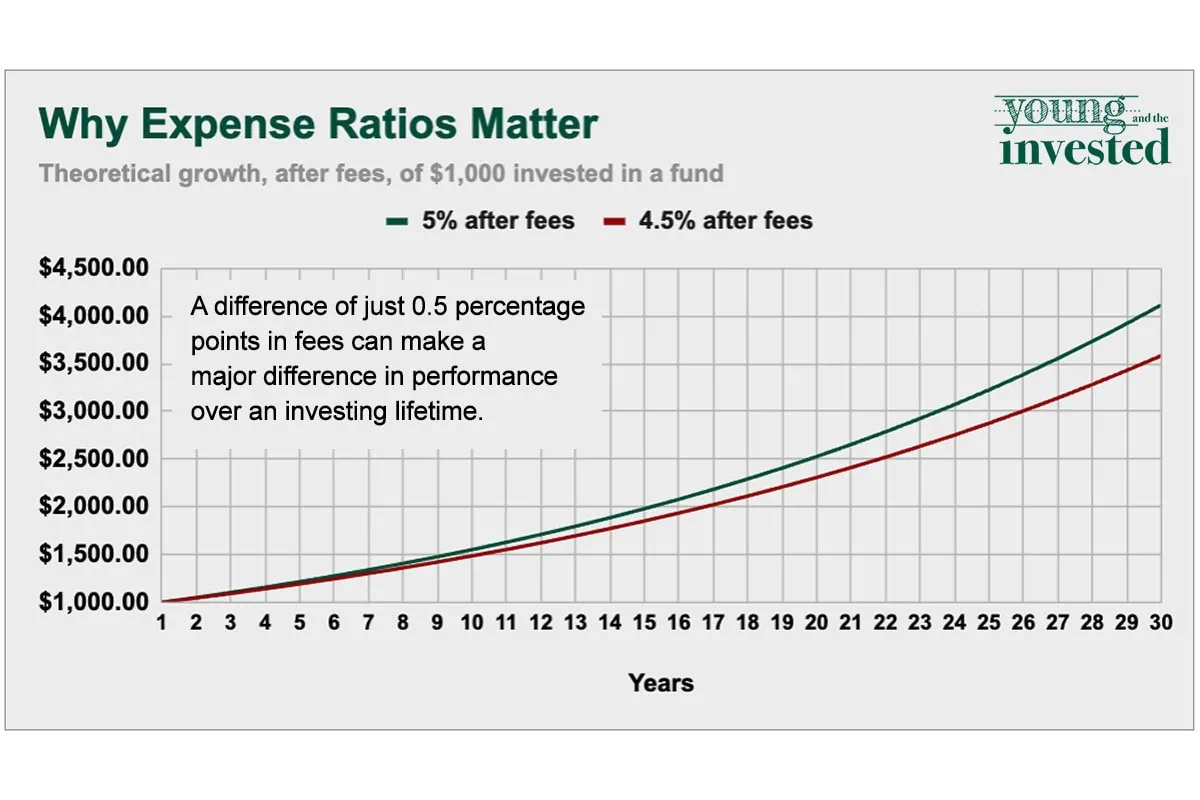
Every dollar you pay in expenses is a dollar that comes directly out of your returns. So, it is absolutely in your best interests to keep your expense ratios to an absolute minimum.
The expense ratio is the percentage of your investment lost each year to management fees, trading expenses and other fund expenses. Because index funds are passively managed and don’t have large staffs of portfolio managers and analysts to pay, they tend to have some of the lowest expense ratios of all mutual funds.
This matters because every dollar not lost to expenses is a dollar that is available to grow and compound. And over an investing lifetime, even a half a percent can have a huge impact. If you invest just $1,000 in a fund generating 5% per year after fees, over a 30-year horizon, it will grow to $4,116. However, if you invested $1,000 in the same fund, but it had an additional 50 basis points in fees (so it only generated 4.5% per year in returns), it would grow to only $3,584 over the same period.
Want to talk more about your financial goals or concerns? Our services include comprehensive financial planning, investment management, estate planning, taxes, and more! Schedule a call with Riley to discuss what you need, and what we can do for you.

Featured Financial Products
Related: 15 Stocks You Can Buy and Hold Forever
As even novice investors probably know, funds—whether they’re mutual funds or exchange-traded funds (ETFs)—are the simplest and easiest ways to invest in the stock market. But the best long-term stocks also offer many investors a way to stay “invested” intellectually—by following companies they believe in. They also provide investors with the potential for outperformance.
So if you’re looking for a starting point for your own portfolio, look no further. Check out our list of the best long-term stocks for buy-and-hold investors.
Related: 10 Dividend Stocks That Pay Us Each and Every Month
The vast majority of American dividend stocks pay regular, reliable payouts—and they do so at a more frequent clip (quarterly) than dividend stocks in most other countries (typically every six months or year).
Still, if you’ve ever thought to yourself, “it’d sure be nice to collect these dividends more often,” you don’t have to look far. While they’re not terribly common, American exchanges boast dozens of monthly dividend stocks.
Please Heart ❤️, Follow and Subscribe
Did you find this article helpful?
1. Tap or click the Heart Button.
2. Follow WealthUpdate —-> https://flipboard.com/@WealthUpdate
3. Subscribe to Retire With Riley, our free weekly retirement planning newsletter.