




Stocks, historically speaking, are a winning proposition. You just need a little patience from time to time.
Listen. If you want, you can invest in just about anything—shoes, artwork, properties, you name it. Years down the road, someone might want to buy that pair of Jordans or that Monet for more than you paid. But the easiest investment case we can make is for stocks, which are ridiculously easy to buy and hold, and which have generated spectacular returns over the long haul.
Just consider how stocks have performed across more than half a century compared to a few other popular investment assets.
According to the most recent data from the The New York University Stern School of Business, a $1,000 investment in the S&P 500 at the start of 1976, with no additional contributions, would be worth $47,778 as of the end of 2025. The same investment in corporate bonds would be worth about $9,325. Treasuries? Closer to $3,354. That amount in gold would come out to $5,295. And real estate would have only grown to $2,126.
Yes, past performance has no bearing on future returns. But by their very nature, stocks have the potential for higher returns than many other assets, now and in the future—and the longer you hold, the more compounding can do the wealth-building work for you.
If you’re embarking on building your investment portfolio, you’ve come to the right place. In our recently updated list, we’ll talk about 15 of the most reliable long-term stocks (including a pair of fresh names) with an ideal holding period of forever. We’ll also cover some fundamental principles of stock investing and address several frequently asked questions about the stock market.
Editor’s Note: Tabular data presented in this article is up-to-date as of April 8, 2026.
Featured Financial Products
Disclaimer: This article does not constitute individualized investment advice. Securities, funds, and/or other investments appear for your consideration and not as personalized investment recommendations. Act at your own discretion.
Table of Contents
Why You Should Invest in the Stock Market

Stock represents a piece of ownership in a company. It allows you to profit from a company’s success—most commonly, when the price of your shares goes up, but in many cases, also from cash distributions (dividends) the company makes to shareholders. And the case for owning them is clear:
- Stocks have higher rates of returns than just about any other asset class.
- They can be held in numerous types of investment accounts.
- They’re easier to understand than many other types of investments.
If you ask us, investment funds—whether they’re mutual funds, exchange-traded funds (ETFs), or closed-end funds (CEFs)—are the simplest and easiest ways to invest in the stock market.
But individual stocks play an important role, too. The best long-term stocks offer investors a way to stay intellectually “invested”—by compelling people to stay up-to-date on companies they believe in. Plus, they provide investors with the potential to outperform those funds.
Bottom line: Whether you hold stock funds or individual equities, stocks (as an asset class) are among the best long-term investments you can make.
Growth Stocks or Value Stocks?
Growth stocks are generally considered to be companies that are expanding sales (and often profits) at a faster-than-average clip. Typically, growth companies have either an attractive product they are bringing to new markets or a steady drumbeat of new items they can sell to existing customers to open up new revenue streams.
Technology companies are typically the most common example of growth stocks, as they bring new gadgets to market that are better or faster than previous products.
Value stocks, on the other hand, are generally considered to be companies that trade for less than some sort of intrinsic value. They might not be expanding rapidly, but they often have a strong underlying business. Think of a local bank or a utility company that might have trouble doubling in size over the next few years, but doesn’t face a lot of competition or disruption to its business model. These companies are still capable of some growth—but Wall Street sometimes undervalues these firms, and their prices can improve once other investors catch on to their true value.
You can find the best long-term stocks hiding out in both camps. Reliable growth can result in significant gains over many years; alternatively, a rock-solid value stock will most commonly weather any market disruptions much better than a company that relies on enterprise spending trends or consumer confidence to drive its sales.
What About Dividend Stocks?
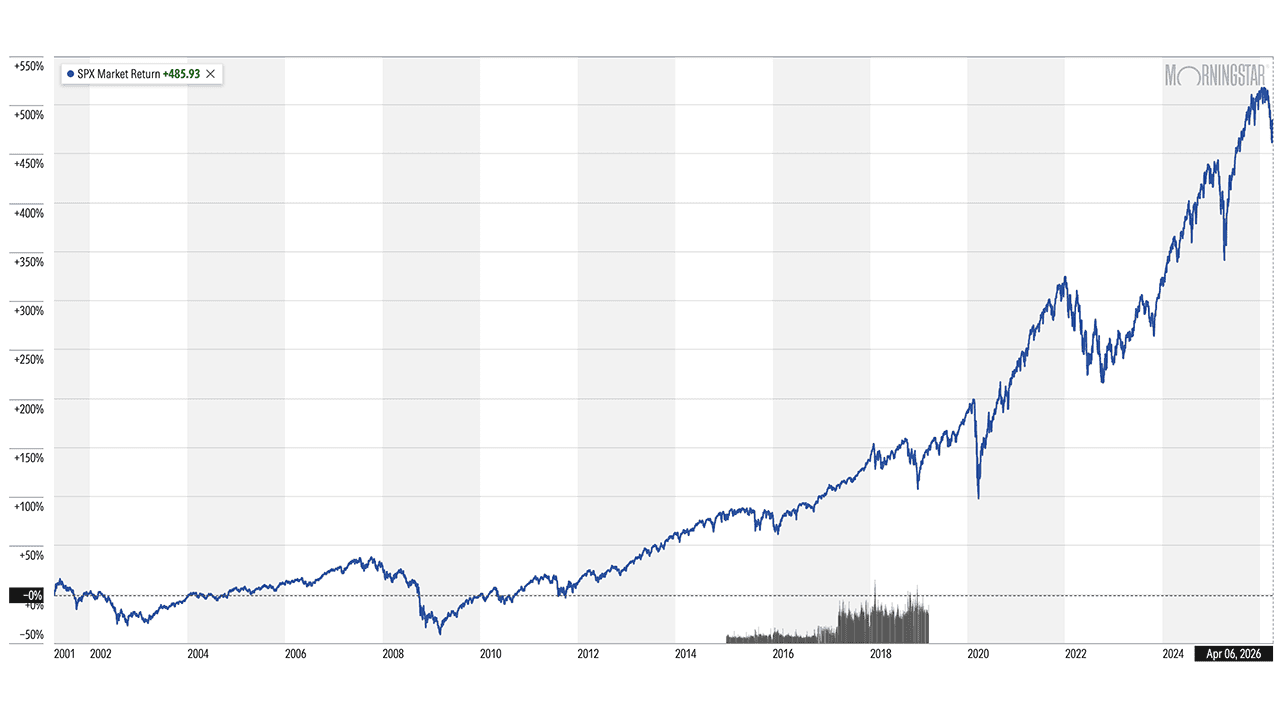
Dividend stocks (which commonly are value stocks, but can be growth stocks) are great ways to drive long-term performance of your portfolio. These companies pay a regular flow of their profits directly back to shareholders, meaning you receive some sort of return regardless of the ebb and flow of share prices.
Stocks that can both grow and pay dividends are the ultimate long-term stocks given just how much in additional returns they can generate over the long term.
The above image is a look at the return someone could expect if they received just the price returns from an S&P 500 over the past 25 years.
Related: 7 Best High-Dividend ETFs for Income-Minded Investors
But What If I Reinvested My Dividends?
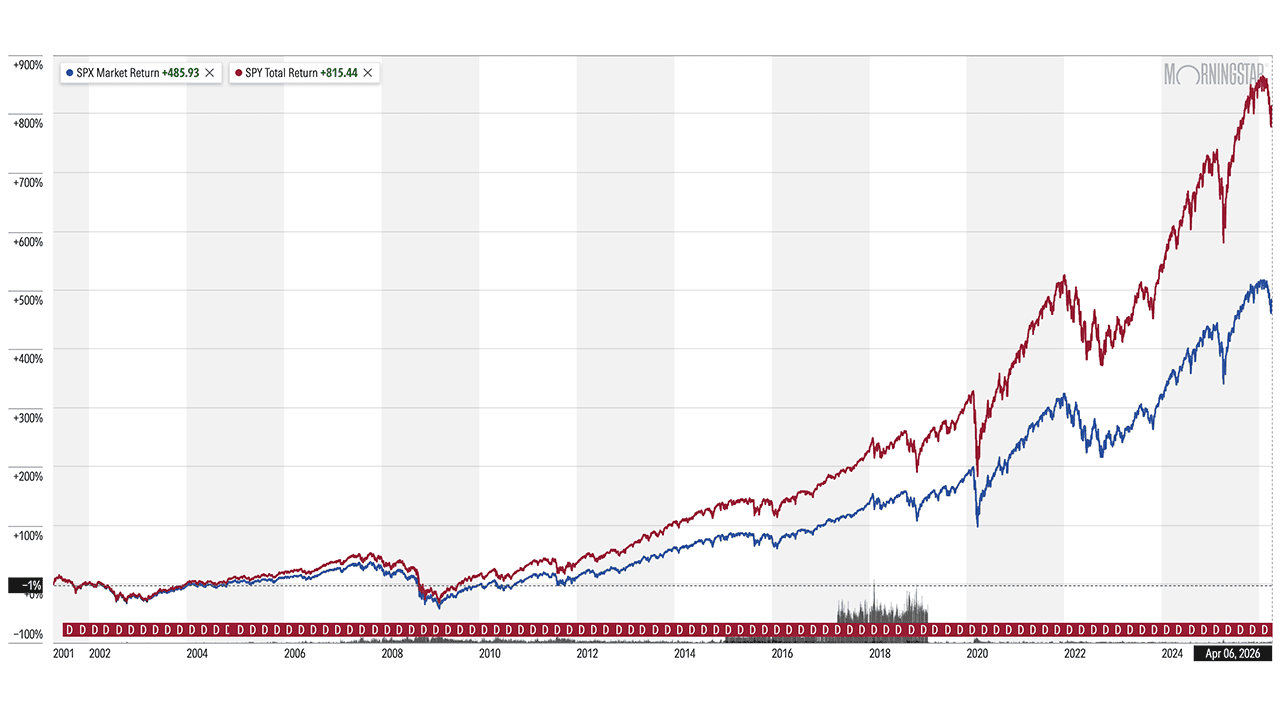
Now look at the above chart to see how much better the return is when you factor in dividends had you had reinvested those dividends back into the S&P 500 (returns illustrated by an S&P 500-tracking ETF; note that expenses are included in performance).
The price return is right around 485%. The total return (price plus dividends) is 815%!
The best long-term stocks tend to be companies that aren’t overly dependent on specific trends in the global economy, and companies that can deliver returns in any environment. Dividend growth stocks (companies that pay larger dividends over time) tend to check both those boxes, proving they have operations that generate significant profits, and are growing those profits enough to deliver larger paydays to shareholders each year.
Related: 9 Best Vanguard Retirement Funds [Save More in 2026]
What’s a Diversified Portfolio?
The best long-term stocks are part of an investment strategy that prioritizes stability and risk management over risky short-term bets that might pay off—or leave you in tears.
There are plenty of investment strategies that, after the fact, look wise simply because they worked out. But your personal financial situation matters. Ask yourself this: Would you bet $10,000 on a 50/50 chance of either doubling that money or losing every penny instantly?
If your answer is “no,” then there are certain strategies you should never consider in your toolkit, and others you should stick with even if it means your returns are not as dramatic.
One low-risk strategy that many investors deploy is the notion of a diversified portfolio that spreads your risk around in multiple vehicles. The easiest way to do that is through mutual funds and ETFs, which hold dozens if not hundreds or even thousands of stocks, bonds, and other assets. And you can keep your costs down by purchasing index funds—mutual funds or ETFs managed not by humans, but effectively a rules-based algorithm.
However, you can also look beyond the typical offerings out there and build your own diversified portfolio by hand-picking a basket of long-term stocks.
If you want more control or customization in your portfolio, there’s nothing wrong with picking individual stocks—in fact, it often makes sense to put a few individual stocks alongside the mutual funds and/or ETFs in your portfolio. Just make sure you’re doing your research to ensure you have the best stocks available, and that you are keeping an eye on diversification.
Related: Beginner’s Guide to Vanguard Target-Date Funds
15 Top Stocks for Long-Term Buy-and-Holders
If you’re looking beyond mutual funds and ETFs to build your own portfolio of the best stocks to hold for a long, long time, it’s crucial to both understand your personal investing goals as well as to do your own homework before buying (and selling!) an individual company’s shares.
That includes looking at stocks for specific strengths, like their market share or their annual earnings trends compared with their peers, as well as how a given stock performs against the broader market at large.
Related: You’ve Heard of Motley Fool, But What Other Alternatives Are Available?
There’s no one-size-fits-all approach to anything on Wall Street, so you should always look at the latest numbers and do your own personal analysis before making any trades. But to get you started, here is our updated list of standout companies that are among the best long-term stocks to buy based on share performance, earnings trends, staying power, and other factors.
Stocks are listed by dividend yield, from lowest to highest. The two names added to this list are the lowest- and highest-yielding companies, and thus can be found at the beginning and end, respectively.
Featured Financial Products
15. Nvidia
- Sector: Technology
- Market capitalization: $4.4 trillion
- Dividend yield: < 0.1%
It looks increasingly likely that artificial intelligence (AI) will stick around as a critical technological trend for some time. What exactly that looks like, and exactly how long that lasts, is anyone’s guess. But at least for the foreseeable future, AI matters. And what better way to invest in that trend than chipmaker Nvidia (NVDA), which provides the hardware, networking, and software needed to train and run AI models.
Nvidia believes AI infrastructure can become a $3 trillion to $4 trillion opportunity over the next half-decade. If so, few companies are better poised to capture profits from that growth opportunity.
But that’s not why Nvidia is among our list of stocks you can buy and hold forever. At least, it’s not the only reason why.
Related: 10 Best ETFs to Beat Back a Bear Market
Nvidia’s semiconductors have long powered numerous other technologies, still does today, and—barring a major change in how the company is operated and staffed—will likely continue doing so for years to come. Put differently: Nvidia is much more than just AI. The company made a name for itself through its gaming chips; today, the company’s products are also used in robotics, professional visualization, scientific research, self-driving cars, cryptocurrency, and more.
Artificial intelligence is merely the latest (though admittedly the most lucrative) opportunity. It could theoretically be a source of turbulence, too, with many market observers wondering aloud whether AI is in a bubble. For now, though, Wall Street’s pros have downplayed that worry.
“NVDA argues that the ground truth dynamics are not bubble-like, because three separate demand drivers are in play: (1) the transition of general purpose compute from CPU to parallel (GPU) compute; (2) the growth of generative AI replacing classic machine learning; (3) the rise of argentic AI,” says Truist Managing Director William Stein, who rates the stock at Buy. “There is another argument that we see as even more compelling. We see the telltale sign of a bubble as gear that has been ordered or shipped for which there is no operational or economic value. On its conference call, NVDA noted that its A100 chips, which began shipping six years ago, are all still in the field and are running at 100% utilization. We believe this is the clearest indication that we are not in a bubble … at least not yet.”
Related: Best Fidelity Retirement Funds for a 401(k) Plan
Nvidia’s top and bottom lines have been in a general growth trend for decades, only really ever stepping back during major economic hurdles like COVID and the Great Recession. It’s unlikely that its recent pace of expansion will continue forever—revenues ballooned by 360% between 2023 and 2025, while profits exploded by 400%—but as long as semiconductors power technological progress, NVDA seems likely to thrive.
Also, the technology sector isn’t exactly known for its dividends, as most of those businesses tend to pour their cash back into R&D in hopes of growth (and staving off would-be disruptors). So you might be surprised to learn that Nvidia has paid one since November 2012. That said, it’s just a nominal penny per share quarterly, coming out to a yield of less than a tenth of a percent. Still, NVDA is a cash-generation machine, which bodes well for future payout growth … and every dividend has to start somewhere.
Like Young and the Invested’s content? Be sure to follow us.
14. Alphabet
- Sector: Communication services
- Market cap: $3.8 trillion
- Dividend yield: 0.3%
Alphabet (GOOG, GOOGL) is another multitrillion-dollar member of the Magnificent Seven that’s worth buying and holding for a very long time. It’s a digital advertising powerhouse that not only provides the go-to search engine for most Americans, but also the infrastructure to serve display ads across all manner of content.
“We believe Alphabet is one of the best plays on several macro trends in the economy, including the shift to digital advertising, both for direct response and for brands; increased consumption of video; rise of cloud computing, in addition to several long-term initiatives including self-driving cars (Waymo),” says Truist Managing Director Youssef Squali. “Despite leaning more heavily into AI investments, recent cost-cutting initiatives have significantly improved margins for the company.”
Another sign of expert confidence? In late 2025, Berkshire Hathaway (BRK.B) disclosed a $4.3 billion stake in Alphabet, making it the holding company’s 10th largest position.
Related: 7 Low- and Minimum-Volatility ETFs for Peace of Mind
“We believe the move validates GOOG’s strong fundamentals and provides Berkshire exposure to a leading AI provider through Google Cloud and Gemini expansion,” CFRA analyst Angelo Zino says. “The endorsement likely bodes well from an investor confidence perspective. We think Berkshire likely finds more comfort investing in GOOG over other tech plays given the high free cash flow potential of its core business.”
Alphabet’s revenues have grown every year for a quarter-century, but the company isn’t resting on its laurels. Google is integrating its AI-powered assistant, Gemini, into its core services, including its ubiquitous search engine—and importantly, it’s figuring out how to reduce costs of running queries. Meanwhile, its Google Cloud services continue to expand at a rapid clip, and it has doubled down on cybersecurity with a $32 billion deal to buy Wiz.
Alphabet even initiated a dividend in April 2024, then announced its first dividend hike a year later. Sure, it’s just a 21¢ payout that translates into a sub-1% yield. But Alphabet is a cash-generation machine, which bodes well for future payout growth … and every dividend has to start somewhere.
Editor’s note: GOOGL is the ticker for the company’s Class A shares, which have voting rights. Alphabet’s Class C shares, with the ticker GOOG, are also available to regular investors but have no voting rights.
Make Young and the Invested your preferred news source on Google
Simply go to your preferences page and select the ✓ box for Young and the Invested. Once you’ve made this update, you’ll see Young and the Invested show up more often in Google’s “Top Stories” feed, as well as in a dedicated “From Your Sources” section on Google’s search results page.
13. Costco Wholesale

- Sector: Consumer staples
- Market cap: $457.3 billion
- Dividend yield: 0.5%
Retailers are difficult to rely on as buy-and-hold investments because they tend to be subject to broader spending trends and changing consumer tastes. Not to mention, predominantly brick-and-mortar retailers are anything but a sure thing in this age of e-commerce.
However, warehouse retailer Costco Wholesale (COST) is still worth a look as a long-term holding, since its unique model sidesteps most of these concerns.
Related: Best Schwab Retirement Funds for an IRA
For starters, the chain operates about 925 warehouses worldwide, with about two-thirds here in the U.S. It appeals to bargain shoppers and the staples it sells typically have low margins, but it also has a regular membership fee that generates a ton of baseline cash every year. Costco boasts about 145 million paying cardholders—and at a recently raised $65 per household (and even pricier business memberships), that creates a tremendous foundation for this retailer.
What’s more, the company’s customers are true believers in its value-conscious offerings, and there’s a veritable cult of followers behind Costco’s Kirkland Signature store brand. And if times get tough, even more customers might end up walking through the warehouse looking to save on their groceries and household goods as they pass over Costco’s competitors.
Oppenheimer is among numerous analysts who favor Costco, citing a boatload of factors, including a “unique and improving consumer value proposition, open-ended worldwide growth prospects, leading competitive position poised to continue to drive share gains, consistent track record of shareholder returns, strong management team, and potential for sustainable top- and bottom-line delivery even against a more competitive retail backdrop.”
A low-cost approach might not set the world on fire, but providing affordable offerings to loyal customers is a pretty consistent business model.
Featured Financial Products
12. Constellation Energy
- Sector: Utilities
- Market cap: $102.9 billion
- Dividend yield: 0.6%
When it comes to the best long-term stocks, the utility sector stands out as a natural place to look.
For starters, utility companies always have “wide moats,” which is a way of saying they have significant, established advantages that make it difficult to compete. Utilities are exceedingly capital-intensive businesses that are highly regulated, and thus competition is very difficult to come by—in fact, in many cases, U.S. utilities are de facto regional monopolies. Furthermore, electricity is a necessity for businesses and consumers that sees strong baseline demand even in a rough economic environment. That creates a measure of certainty for the sector, regardless of broader uncertainty or economic cycles.
Related: The 12 Best Vanguard ETFs for 2026 [Build a Low-Cost Portfolio]
If you’re looking for long-term investments, then, utilities are a natural choice. And in this sector, Constellation Energy (CEG) stands out as one of the larger and better-performing options in the sector.
Constellation is among the largest utility stocks on Wall Street. Based out of Baltimore, it sells natural gas and electricity service, with about 55 gigawatts of generating capacity—enough to power the equivalent of 27 million homes. It also produces a variety of carbon-free energy, including wind, solar, hydroelectric, and nuclear.
One doesn’t typically associate utilities with growth. The sector has delivered a total return of just more than 50% since early 2022, when Constellation was spun off of Exelon (EXC). CEG shares have returned 570%, and that’s even after factoring in its recent regression into bear-market territory.
Like Young and the Invested’s content? Be sure to follow us.
Among Wall Street’s reasons to remain optimistic is, of all things, the tech sector. In 2024, for instance, Constellation signed a 20-year power purchase agreement with Microsoft (MSFT) that will involve the restart of Three Mile Island Unit 1, as well as the launch of the Crane Clean Energy Center. And in summer 2025, it made a similarly long agreement with Meta Platforms (META) to support the Facebook parent’s energy needs.
CEG also boasts the largest fleet of nuclear plants in the U.S., which puts it in a great position amid President Donald Trump’s executive orders aiming to jump-start the nuclear industry.
At whatever point the dust settles and CEG isn’t quite as “growthy,” you can expect the company to be able to foot a healthy dividend. The current yield isn’t nearly so generous as other utility stocks out there, but distributions are already triple what they were post-spinoff.
Do you want to get serious about saving and planning for retirement? Sign up for Retire With Riley, Young and the Invested’s free retirement planning newsletter.
11. Eli Lilly

- Sector: Health care
- Market cap: $851.3 billion
- Dividend yield: 0.7%
If you’re building a wish list of long-term stocks to buy and hold, Eli Lilly (LLY) certainly belongs—if not to buy the stock itself, then at least as an illustration of what you should be looking for. That’s because pharmaceuticals are a portfolio mainstay—hundreds of millions of people worldwide rely on pharma firms’ treatments, and countless investors lean on these stocks as a source of both growth and income.
Eli Lilly was founded nearly 150 years ago in Indianapolis, by Col. Eli Lilly—a Union Army veteran! It gained fame for introducing the world’s first commercial insulin roughly a century ago, and while its product lineup has certainly broadened since then, it remains a leader in diabetic treatment.
Related: The 7 Best Gold ETFs You Can Buy
Lilly’s lineup includes cancer treatments Verzenio and Erbitux, as well as autoimmune injectable Taltz and migraine prevention drug Emgality. And its diabetes lineup includes well-known drugs such as Trulicity, Jardiance, and Humalog. But leading the way forward are two products—Mounjaro and Zepbound—that belong to a rising class of drugs: glucagon-like peptide-1 (GLP-1) receptor agonists, which help manage blood sugar levels in people with Type 2 diabetes. While that’s certainly reason enough for the drug to exist, it also serves another purpose: being an extremely effective way for patients to battle obesity. Already, these two drugs have become “blockbusters” (drugs that generate more than $1 billion in revenue in a year), and Wall Street analysts only expect demand for these and similar products to rise going forward.
But Lilly isn’t stopping there:
“The company is also working to develop other products to improve its positioning in the GLP-1 market, including Retatrutide and Orforglipron, both of which are set to have Phase 3 readouts later in 2026,” Argus Research analyst Jasper Hellweg says. “Outside of the company’s GLP-1 franchise, Lilly is working to develop an oral small-molecule thyroid hormone receptor beta agonist being for the treatment of metabolic dysfunction-associated steatohepatitis in patients with fibrosis, which, if approved, could reach blockbuster status.”
Related: 15 Dividend Kings for Royally Resilient Income
A sub-1% yield might not indicate that Lilly is income-friendly, but that’s largely an effect of LLY’s share price rising so fast. In fact, management has been pouring increasingly large gobs of its newfound cash into the dividend for years. Most recently, LLY announced a 15% dividend increase, to $1.73 per share, to take effect starting with the March 2026 payout. Not only is that the company’s 12th consecutive dividend hike, but it’s the eighth straight raise of 15%. (And LLY has paid a dividend since 1972.)
By the way: That cash distribution represents only about a quarter of 2026’s expected earnings—an extremely healthy ratio that signals more potential for dividend increases going forward.
While Lilly has long been a productive pharmaceutical stock, it has been launched into a new tier. It is now the biggest pharmaceutical company on U.S. exchanges, and increasingly appears worthy of being called a long-term buy-and-hold stock. If nothing else, it’s a representative example of the kinds of companies investors should consider when their holding time is measured in years, and not just a few months.
Do you want to get serious about saving and planning for retirement? Sign up for Retire With Riley, Young and the Invested’s free retirement planning newsletter.
10. Moody’s
- Sector: Financials
- Market cap: $79.4 billion
- Dividend yield: 0.9%
Moody’s (MCO) is a global risk management firm that is best known for providing credit ratings. That includes credit scores for individual consumers as well as “official” rankings for major corporations and governments—including the United States, via its rating on U.S. Treasury debts. Additionally, the company offers investor services that includes research and data to arm investors with information to make the best decisions.
“We expect [Moody’s] to benefit over the long run from the secular trends of global GDP growth and debt-market disintermediation,” says Argus Research analyst Kevin Heal. “Management also has opportunities to develop new products and raise margins, and to expand through targeted acquisitions.”
Related: 11 Best Vanguard Funds for the Everyday Investor
In early 2026, Moody’s announced a nearly 10% increase to its payout, to $1.03 per share. Consider that in 2016, it paid just 37¢ per share—meaning over the past decade, MCO has increased its payouts by almost 180%. That’s part of a broader long-term trend of growth and success, too, with revenue that has surged from $4.8 billion in fiscal 2019 to $7.7 billion for fiscal 2025.
The structure of the current financial system all but guarantees that consumers and businesses will need to go through Moody’s to get their seal of approval for loans. And given the history of revenue expansion and dividend growth in recent years, there’s good reason to bank on Moody’s delivering in the years ahead.
Related: 8 Best Schwab Retirement Funds [High Quality, Low Costs]
9. Microsoft

- Sector: Information technology
- Market cap: $2.8 trillion
- Dividend yield: 1.0%
When it comes to stocks with scale and staying power, Microsoft (MSFT) is another tech giant that immediately springs to mind. The technology firm is synonymous with workplace productivity, with its Windows and Office 365 software products—now bolstered by Microsoft’s Copilot AI chatbot—the gold standard for businesses around the world.
Microsoft isn’t without growth plans despite its already impressive scale, however. Its Azure cloud computing business continues to expand at a rapid clip, its remote workplace tools like Teams have now become hardwired into enterprise operations in the wake of the pandemic, demand for its AI services continues to outstrip supply, and its Xbox video game arm is a juggernaut in its own right.
Related: The 9 Best Dividend Stocks for Beginners
So, a growth stock? Yes. But a defensive stock? Also yes.
“Although not immune to macroeconomic challenges (such as declines in the PC original equipment manufacturers (OEM) market and in digital advertising), Microsoft has about as diversified and strong a set of assets as any company in the technology industry—and may even be seen as a safe haven by investors in uncertain times,” says Argus Research analyst Joseph Bonner. “The company is one of a few names with a complete, integrated commercial product set aimed at enterprise efficiency, cloud transformation, collaboration, and business intelligence. It also has a large and loyal customer base, a substantial cash cushion, and a rock-solid balance sheet.”
With long-term investing, it’s all about trying to find certainty in an uncertain world. And the dominance of Microsoft seems incredibly likely regardless of geopolitics, economic cycles, or anything else. Microsoft is one of the 25 largest corporations in the world as measured by revenue, and it has been among the three largest in market capitalization for years. And despite being tech company with a lot more growth left in the tank, it also offers a modest but rising dividend.
If you want stability and scale in a long-term stock investment, Microsoft is it.
Related: 13 Best Stock Screeners + Stock Scanners
8. Linde plc
- Sector: Materials
- Market cap: $231.9 billion
- Dividend yield: 1.3%
Materials stocks don’t often make the cut for most lists of long-term investments. They’re cyclical investments that tend to rise and fall based on broad-based economic trends and industrial demand. That said, with a little bit of research and a lot of patience, investors can still find high-quality companies in this space that are positioned to withstand the test of time.
Case in point: Ireland-based Linde plc (LIN).
Linde is the world’s largest industrial gas producer, offering oxygen, nitrogen, argon, helium, hydrogen, electronic gases, acetylene, and rare gases. It also produces air separation, synthesis, olefin, and other plants for third-party customers. And it does this across every continent.
Related: 5 Best Energy ETFs for the Rise of Oil, Natural Gas + More
While this is certainly a cyclical business, Linde offers some shelter from the economic shocks that many of its businessmates suffer. That’s in part because of its diverse offerings, but also because of the industries it supplies, which includes defensive industries such as health care and food/beverage. Most of its contracts are with blue-chip firms, too, and that keeps the cash flowing.
In fact, its business has been so relatively stable that it has—by virtue of its 2018 merger with fellow gas giant Praxair—been able to deliver more than three decades’ worth of annual dividend hikes. The most recent, a 7% hike to $1.60 per share quarterly, was its 33rd consecutive improvement to the distribution. That puts it among the ranks of the Dividend Aristocrats—an elite group of a few dozen dividend payers that have raised their payouts for at least 25 straight years.
So while long-term buy-and-holders might look away from the materials sector, Linde sticks out as a surprisingly stable “forever stock.”
Featured Financial Products
Related: 13 Best Stock & Investment Newsletters for Inbox Alpha
7. FedEx

- Sector: Industrials
- Market cap: $87.8 billion
- Dividend yield: 1.6%
FedEx (FDX) is another cyclical business—one whose shares have slumped several times in the past quarter-century. And yet, it has still been a model of buy-and-hold-worthiness.
Yes, FedEx’s logistics business is cyclical, as package volume tends to rise and fall based on broader spending trends. But there’s a long-term megatrend lifting this stock that cannot be overlooked. And if you look around the front porches in your neighborhood, you’ll probably find proof of this trend yourself via all the boxes lying around.
Related: The 11 Best Fidelity Funds You Can Own
In the age of Amazon and e-commerce, FedEx is about as safe a bet as you can make. Yes, it’s not quite as large as competitor United Parcel Service (UPS), but it’s still a massive and valuable part of the global supply chain.
FedEx has paid dividends since 2002, but over the past few years, it has really stepped up its efforts to share the wealth with stockholders. Its cash distribution has jumped by almost 125% since 2021, including a 5% increase announced in mid-2025. Meanwhile, that dividend represents just 30% of 2026’s projected earnings, making the payout not just sustainable—but plenty expandable. FDX also spent $3 billion in share repurchases during its fiscal 2025, which ended May 31.
Just more reasons why FDX is among the best long-term stocks to buy and hold.
Related: 8 Best T. Rowe Price Funds to Buy for 2026
6. Lockheed Martin
- Sector: Industrials
- Market cap: $144.8 billion
- Dividend yield: 2.2%
For better or for worse, defense giant Lockheed Martin (LMT) seems like one of those companies that will always have a sound financial foundation thanks to its focus on military matters and close relations with the U.S. Department of Defense.
Lockheed and its iconic “Skunk Works” developed many of the Cold War-era jets and missile systems that have become synonymous with modern military might. More recently, conflicts like those in Ukraine and Gaza have sparked an increase in spending on its drone and missile defense operations. And it’s worth noting that for LMT’s clear domestic ties, international sales now make up more than a quarter of revenues, providing much-needed geographic diversification.
Related: 5 Best Stock Picking Services, Subscriptions, Advisors & Sites
The for-profit nature of our military industrial complex might not sit well with some investors. But presuming you have no moral qualms about the kind of business LMT is in, this is definitely a long-term investment to consider because its business isn’t driven by consumer spending or even enterprise spending the way tech companies or apparel companies are. Instead, it’s driven by long-term contracts—and the long-term need for security amid geopolitical unrest.
This dynamic has helped Lockheed become a powerful dividend payer, too. In October 2025, LMT raised its payout by 4.5%, to $3.45 per share quarterly, marking its 23rd consecutive distribution hike.
Related: Best Vanguard Retirement Funds for a 401(k) Plan
5. Bunge Global

- Sector: Consumer staples
- Market cap: $22.9 billion
- Dividend yield: 2.2%
Bunge Global (BG) is a leading agribusiness and food company, operating across the entire agricultural supply chain through its many subsidiaries. All told, its operations span roughly 23,000 employees across more than 300 facilities in over 40 countries.
The U.S.-headquartered but Switzerland-incorporated firm is a leading global oilseed processor and producer of vegetable oils and protein meals. It sources, processes, and distributes grains such as soybeans, wheat, and corn. It produces agricultural products such as fertilizers and sugars. And that’s just some of what this ag giant does.
Related: 5 Best Stock Recommendation Services [Stock Tips + Picks]
Bunge has been a “patience stock” for years thanks to lower margins on crush (the process that produces soybean oil and protein meal), as well as delays to its proposed mega-acquisition of Canadian grain handling business Viterra. However, investors who have had patience are finally seeing the payoff, with the stock up more than 50% over the past six months amid optimism over renewable volume obligation (RVO) and the closing of its Viterra deal.
“We attended BG’s Investor Day, at which management updated its mid-cycle EPS [earnings per share] baseline including Viterra to ~$13 (from ~$8.50) and laid out a framework to achieve $15-plus mid-cycle EPS baseline by 2030,” says BMO Capital Markets Analyst Andrew Strelzik, who rates the stock at Outperform. “We came away with greater confidence in BG’s multi-year earnings trajectory. We remain constructive as BG is poised to realize an inflection in fundamentals beginning in 2026 from which it can grow, and the multi-year earnings opportunity is not yet fully reflected in shares.”
Bunge, meanwhile, can pay investors at least a modest sum for their patience. The 2%-plus yield, on a quarterly dividend of 70¢ per share, is about a percentage point better than what you’ll get from the S&P 500. That dividend has also grown by a decent 40% over the past five years, and it’s as safe as you could want it, with Bunge maintaining a conservative payout ratio of 35% of 2026 profit estimates.
Related: 11 Best Stock Advisor Websites & Services to Seize Alpha
4. BlackRock
- Sector: Financials
- Market cap: $155.3 billion
- Dividend yield: 2.4%
BlackRock (BLK) is one of the world’s largest asset management firms, boasting more than $13 trillion in assets across its many lines of business. Individual investors know it well for both its BlackRock mutual funds and closed-end funds (CEFs), as well as its iShares exchange-traded funds (ETFs). But it also manages money for institutional clients, including pension plans, foundations, charities, and insurance companies, among others.
With the exception of a few understandable hiccups (COVID, for instance), BlackRock has been in a broader consistent uptrend since the depths of the Great Recession. That has come alongside similar progression in both the company’s top and bottom lines.
It’s difficult to find any Wall Street pros with something negative to say about BLK. Shares currently enjoy 13 Buy calls versus four Holds and no Sells, and the analysts’ consensus for long-term earnings growth sits at a brisk 17% annually.
Related: 8 Best-in-Class Bond Funds to Buy
“We believe that BLK remains well positioned to deliver above-peer organic growth given its unmatched product breadth and distribution footprint (helped by its iShares franchise),” say Keefe, Bruyette & Woods analysts Aidan Hall and Kyle Voigt, who rate BlackRock’s stock at Outperform (equivalent of Buy). “Also, its scale and demonstrated ability to generate operating leverage bodes well for future earnings growth and operating leverage. The firm’s increasing alternatives presence and growing technology revenue stream add further breadth to what is already a diverse product/solutions offering.”
BlackRock has been a fount of dividend growth since the Great Recession, too. In the past decade alone, BLK has managed to average 10% annual dividend growth. While that pace had been slowing in recent years, BlackRock stepped on the pedal in early 2026, announcing a 10% hike to $5.73 per share. And a payout ratio around 40% should keep investors plenty confident in the dividend’s health and its ability to keep growing.
Related: How to Rebalance Your Portfolio: A Quick Guide
3. International Business Machines
- Sector: Technology
- Market cap: $226.0 billion
- Dividend yield: 2.7%
International Business Machines (IBM) is one of the oldest technology companies in the world, with roots going back to its founding in 1911 as the “Computing-Tabulating-Recording Company.”
The business has changed a touch in the century-plus since. A company that once sold record-keeping and measuring systems is now a global giant dealing in enterprise information-technology hardware, software, and services. Its predominant offerings revolve around hybrid cloud (an IT infrastructure meshing public cloud, private cloud, and on-premises equipment), artificial intelligence, and consulting. And its clients and partners are a who’s who of the technology world, including Microsoft, Salesforce (CRM), Samsung, Oracle (ORCL), Adobe (ADBE), and more.
Related: Best Vanguard Funds to Hold in an HSA
IBM hasn’t always been on the bleeding edge of technology—it was notoriously slow to pivot from hardware to the cloud. But it’s no dinosaur, either. For instance, IBM is viewed as having potential in quantum computing, which itself is a long-awaited accelerant for artificial intelligence. Moreover, it’s an entrenched and long-trusted giant that will seemingly always have a place as long as the business world needs new tech.
The company is also growing by acquisition, announcing in late 2025 that it would buy data streaming company Confluent for $11 billion. “IBM historically gets optimal leverage from targets that have challenges penetrating large enterprises and significant potential cost synergies,” Stifel analysts say.
IBM is a buy-and-hold-forever stock because of its income history, too. “Big Blue” has paid dividends without interruption for more than a century. And it has also increased that distribution annually for 30 consecutive years (the latest, a modest bump in April 2025), giving it Dividend Aristocrat status.
Do you want to get serious about saving and planning for retirement? Sign up for Retire With Riley, Young and the Invested’s free retirement planning newsletter.
2. Prologis
- Sector: Real estate
- Market cap: $128.1 billion
- Dividend yield: 3.2%
Real estate is often seen as a store of value for many long-term investors, and for good reason. In the words of Mark Twain, “Buy land, they’re not making it anymore.”
That simple truth makes Prologis (PLD) a great long-term stock to consider because of its portfolio of specialized properties in key markets around the world.
This real estate investment trust (REIT) is a global leader in logistics real estate with a focus on high-barrier, high-growth markets. Indeed, PLD and its warehouses are a key part of the world’s supply chain. Prologis owns and/or operates 1.3 billion square feet across 20 countries. Top clients include Amazon and FedEx, making these properties must-have hubs for distribution, but they’re just part of a diverse base of more than 6,500 customers largely in business-to-business distribution and retail fulfillment.
Related: The 7 Best Index Funds for Beginners
With projected revenue growth in the high single digits for 2026 and double digits for 2027, PLD is ramping up operations to become even more dominant in the years ahead. Dividends are now about three times what they were a decade ago; 2025 distributions of $1.01 per share were 5% better than they were in the year prior.
It’s hard to imagine any upstart firm acquiring enough property quickly enough to compete with Prologis in the years ahead. And while spending trends wax and wane, the long-term nature of PLD leases with first-class corporations means its finances (and its dividend) are very secure for the foreseeable future.
Related: Buy ‘The Future’: 5 Tech Stock ETFs You Should Own in 2026
1. Energy Transfer, LP

- Sector: Energy
- Market cap: $65.6 billion
- Distribution yield: 7.0%*
It’s no easy task to identify energy stocks with staying power in this age of climate change. However, one of the most stable stocks in the space is “midstream” energy company Energy Transfer, LP (ET).
When we think of the energy sector, we often think of companies like Exxon Mobil (XOM), Chevron (CVX), Shell (SHEL), and other companies that are engaged in the exploration and production of oil and natural gas, refining products, and/or selling gasoline and other finished products.
But Energy Transfer is an energy infrastructure company—one that’s operated as a master limited partnership (MLP)—that is focused on the capital-intensive nature of building pipelines, terminals, and storage facilities. Specifically, the Dallas-based MLP’s assets include roughly 140,000 miles of energy pipelines and other infrastructure across 44 states, and it’s responsible for transporting and storing crude oil, natural gas, natural gas liquids (NGLs), and refined products. Its additional assets include Lake Charles LNG Company, a 21% stake in Sunoco LP (SUN), and a 38% stake in USA Compression Partners LP (USAC).
Related: The 13 Best Mutual Funds You Can Buy
It’s not a glamorous business, often compared to a toll road. The Pennsylvania Turnpike cares whether a lot of cars are driving through its booths; it doesn’t so much care whether they’re Ferraris or Fords. Similarly, ET is concerned with the volume of products going through its infrastructure; the price of those products, not so much.
This makes for a consistent energy business that’s capable of fueling a massive distribution*. Indeed, Energy Transfer pays roughly six times the yield on the S&P 500, and it’s one of the best-rated high-yield dividend stocks right now. Better still: ET has been growing its payout on a quarterly basis for years!
If you want to make a swing trade on oil prices, ET is not for you. But if you’re looking to invest in a low-risk, income-oriented fashion across 2025 and well beyond, this energy infrastructure player might have a place in your portfolio.
* Distribution yield is calculated by annualizing the most recent distribution and dividing by share price. Distributions are like dividends, but they are treated as tax-deferred returns of capital and require different tax paperwork.
Related: 11 Best Alternative Investments [Options to Consider]
Do All Companies Pay Dividends?
Not all companies pay dividends. Some companies choose not to, while other companies cannot afford to.
Related: The 9 Best Dividend Stocks for Beginners
As you can tell by this list, the best dividend stocks are normally slow-and-steady companies that have consistent operations. While it might be possible for a small software company or biotech firm to double its share price overnight, these companies rarely pay dividends because they don’t have much in the way of profits—and what they do have, they want to spend on other things, like research and development to continue growing.
How Often Do Companies Pay Dividends?

The cycle of paying dividends is always different depending on the company. While it’s generally true that most U.S. corporations opt to pay their shareholders a dividend once per quarter, the dates aren’t fixed.
Specifically, one company might pay you on a January-April-July-October payment cycle while another opts for February-May-August-November.
Complicating things further, some companies pay dividends twice a year, some pay once a year, and some even pay “special” unscheduled dividends.
Want to learn more about investing, spending, taxes, and more? Sign up for Young and the Invested’s free newsletter: The Weekend Tea.
Are Stocks Affected by Interest Rates?
Yes! In multiple ways!
For one, as interest rates rise, the amount of interest paid on newly issued bonds tends to rise. When that happens, bonds (which are fairly stable, reliable investments) start looking more attractive compared to stocks (which have more potential but are riskier investments).
For instance, an investor who owns a bunch of 3% yielding dividend stocks might not look twice at a Treasury bond yielding 1%. But if that same bond started yielding, say, 5%, that’s a much more attractive proposition—even if that bond doesn’t have the same growth potential.
Related: 9 Best Fidelity ETFs for 2026 [Invest Tactically]
Also, rising interest rates make it more expensive for companies to fund their growth. Many companies will issue bonds to bring in much-needed dollars to pay for things like new equipment, research, and personnel. The goal: Make enough in profits from that growth that you come out ahead even after not just paying back the loans, but all that interest. But the greater the interest rate a company has to pay on its bond, the more difficult it is to come out ahead.
That’s why you’ll see, when the Federal Reserve raises its benchmark federal funds rate, stocks of corporations that borrow a lot to grow tend to take it on the chin.
Want to learn more about investing, spending, taxes, and more? Sign up for Young and the Invested’s free newsletter: The Weekend Tea.
What If I Need Help Picking Stocks? Consider Motley Fool Stock Advisor
Several stock picking services can help you build a portfolio, typically for an annual subscription cost. One of our favorites is Motley Fool Stock Advisor.
Motley Fool Stock Advisor is a stock picking service that focuses on stable companies with proven track records. Some of their previous picks include Zoom, Netflix, and HubSpot, all of which have gone up significantly since receiving a nod from the service.
Members have access to the service’s history of recommendations to see precisely how each of their suggestions has panned out.
The service targets stocks across a variety of industries, such as energy, industrials, transportation, financial services, technology, and healthcare.
Read more in our Motley Fool Stock Advisor review.
Want to talk more about your financial goals or concerns? Our services include comprehensive financial planning, investment management, estate planning, taxes, and more! Schedule a call with Riley to discuss what you need, and what we can do for you.

Related: The 7 Best Vanguard Funds You Can Buy
What’s better than a smart, sound dividend income strategy? How about a smart, sound dividend income strategy with very little money coming out of your pocket?
If that sounds good to you, you need look no farther than low-cost pioneer Vanguard, which offers up a number of payout-oriented products. Find out what you need to know in our list of seven top-notch Vanguard dividend funds.
Related: 10 Dividend Stocks That Pay Us Each and Every Month
The vast majority of American dividend stocks pay regular, reliable payouts—and they do so at a more frequent clip (quarterly) than dividend stocks in most other countries (typically every six months or year).
Still, if you’ve ever thought to yourself, “it’d sure be nice to collect these dividends more often,” you don’t have to look far. While they’re not terribly common, American exchanges boast dozens of monthly dividend stocks.
Please Don’t Forget to Like, Follow and Comment
Did you find this article helpful? We’d love to hear your thoughts! Leave a comment with the box on the left-hand side of the screen and share your thoughts.
Also, do you want to stay up-to-date on our latest content?
1. Follow us by clicking the [+ Follow] button above,
2. Subscribe to Retire With Riley, our free weekly retirement planning newsletter, and
3. Give the article a Thumbs Up on the top-left side of the screen.
4. And lastly, if you think this information would benefit your friends and family, don’t hesitate to share it with them!