


As investors, we have it pretty easy. Building a comprehensive, diversified portfolio of investments has never been simpler than it is today. And it’s never been cheaper, either.
In fact, one of the most difficult choices left on our plate is deciding which of several low-cost fund providers we want to provide the foundation of our investing accounts. (“Oh no, my lobster is too buttery and my steak is too juicy!”)
You’re not required to select products from only fund provider, of course—you can mix and match funds from numerous offerers. But some people prefer to buy all of their core portfolio holdings from one fund provider. That could be for any number of reasons; you might prefer one provider’s managers, for instance, or you might prefer the way their index funds are built.
Today, I’ll show you the benefits of keeping it all within the Schwab family, and how to go about it. Schwab ETFs only number around 30 or so, but they’re among the lowest-cost products on the market, and they largely tend to earn strong ratings from analysts who cover funds.
Let’s look at some of the best Schwab ETFs you can buy right now. I’ll touch on funds that address a variety of core investment needs, which each providing you access to hundreds if not thousands of securities within that space for a low annual cost.
Editor’s Note: Tabular data presented in this is up-to-date as of May 27, 2026.
Featured Financial Products
Disclaimer: This article does not constitute individualized investment advice. Individual securities, funds, and/or other investments appear for your consideration and not as personalized investment recommendations. Act at your own discretion.
Table of Contents
What Is an ETF?
If you’re familiar with ETFs, just scroll a little lower to get to the list.
For those of you new to the game, here’s a very quick introduction: “ETF” is an acronym for an “exchange-traded fund.”
In plain English, an ETF is a type of investment fund. It’s similar to a mutual fund in that it owns assets (stocks, bonds, etc.). But whereas mutual funds only change hands once a day (at the end of the day), ETFs are listed and trade on an exchange, just like individual stocks. As such, an ETF can fluctuate in price across the trading day according to the value of those underlying assets.
Are ETFs the Same Thing as Index Funds?
Not always. Most ETFs are index funds, meaning they are tied to a fixed “index” or list of securities. However, mutual can also be tied to indexes and thus be categorized as index funds, too. Similarly, both ETFs and mutual funds can instead follow a more dynamic or “active” list of investments.
It can be confusing sometimes, but the bottom line is you should always read the investment materials an asset manager provides and look for a description. In the case of Schwab, the “Objective” or “Highlights” sections at the top of most ETF pages will clearly identify whether funds are index funds, or active funds.
The Best Schwab ETFs to Buy Now

I’m writing this article to introduce you to the best Schwab ETFs to buy if you want to address basic portfolio needs in both stocks and bonds.
In other words: This isn’t an exhaustive list of every fund you’d ever want for every swing or day trading need. This is simply a smart place to start if you want to build a core buy-and-hold portfolio using Schwab ETFs.
In addition to important data information such as dividend yield and expense ratio, I’ve listed Morningstar’s Medalist and Star ratings for each ETF. Morningstar’s Medalist rating is a forward-looking analytical view of the fund, while Morningstar’s Star rating is a backward-looking view that measures a fund’s risk-adjusted return vs. its peers. Every fund on this list has a minimum Medalist rating of Silver and Star rating of 3 (out of 5).
Related: 5 Best Stock Recommendation Services [Stock Tips + Picks]
1. Schwab U.S. Large-Cap ETF
- Style: U.S. large-cap stock
- Assets under management: $71.2 billion
- Dividend yield: 1.1%
- Expense ratio: 0.03%, or 30¢ annually on a $1,000 investment
- Morningstar Medalist rating: Gold
- Morningstar Star rating: 4 stars
American investors are commonly told to build their portfolio core around large-capitalization U.S. stocks.* That large-cap stock exposure will often come from an index fund tracking the S&P 500—a collection of 500 major U.S. businesses, and a proxy for the American stock market. That’s why three of the biggest fund providers—Vanguard, State Street, and BlackRock’s iShares—offer up ETFs that track this ubiquitous index.
Schwab doesn’t. Instead, it provides something similar with the Schwab U.S. Large-Cap ETF (SCHX).
SCHX doesn’t track the S&P 500, but instead the Dow Jones U.S. Large-Cap Total Stock Market Index. Why not just offer an S&P 500 fund? Well, at the time Schwab’s ETF was launched, using this index allowed the firm to keep costs extremely low—at inception in 2009, SCHX was at least as cheap, if not cheaper, than any of the S&P 500 ETFs.
Related: The 16 Best ETFs to Buy Right Now
Schwab U.S. Large-Cap ETF holds about 750 U.S. large-cap stocks, so you’re enjoying even broader exposure than what you’d receive from an S&P 500 ETF. Of course, 97% of the S&P 500’s stocks are in SCHX. Additionally, like S&P 500 trackers (and many other index funds), Schwab’s fund is “cap-weighted,” meaning the bigger the stock, the more of it SCHX holds—Nvidia (NVDA), Apple (AAPL), and Google parent Alphabet (GOOG/GOOGL) are currently top dogs. In fact, more than 90% of SCHX’s “weight” (the percentage of the fund’s assets dedicated to a specific holding) is placed in S&P 500 holdings.
Put differently? While SCHX doesn’t track the S&P 500, it’s really similar.
Since Schwab U.S. Large-Cap ETF launched, other fund providers have lowered the expenses on their S&P 500 ETFs, so while SCHX is still cheaper than many similar funds, it doesn’t have a cost edge over as many funds as it used to. Performance is generally close to the S&P 500, though long-term it has marginally underperformed. Regardless, it remains one of Schwab’s best ETFs: a straightforward and dirt-cheap way to address one of the most crucial aspects of your portfolio.
* There are different ways to define “cap” levels. We’re adhering to Morningstar’s definition, which says the largest 70% of companies by market capitalization within a fund’s “style” are large caps, the next 20% by market cap are mid-caps, and the smallest 10% by market cap are small caps.
Make sure you sign up for The Weekend Tea, Young and the Invested’s free weekly newsletter that over 10k monthly readers use to level up their money know-how.
2. Schwab U.S. Broad Market ETF

- Style: U.S. total market stock
- Assets under management: $42.9 billion
- Dividend yield: 1.1%
- Expense ratio: 0.03%, or 30¢ annually on a $1,000 investment
- Morningstar Medalist rating: Gold
- Morningstar Star rating: 3 stars
You’ll likely be told to hold more than just domestic large caps, of course. It’s also common to put at least a little money into the shares of U.S. mid- and small-cap companies. These firms tend to be less financially secure (and their stocks more volatile) than their bigger counterparts … but, historically speaking, they hold more upside potential for those willing to take on the risk.
Related: 11 Best Vanguard Funds for the Everyday Investor
You can buy these stocks (in fund form) in one of two ways:
- Purchase mid- and small-cap funds alongside your large-cap funds.
- Purchase a “total market” fund, which allows you to hold stocks of all sizes in one place.
The first option gives you more control of how much, or how little, you want to invest in stocks of each size. But the second option is by far the easier one, allowing you to invest in a diversified portfolio of various-sized stocks with a single click.
The Schwab U.S. Broad Market ETF (SCHB) is a way to achieve the latter. It owns more than 2,400 of the largest publicly traded U.S. companies. That figure includes virtually all U.S. large-cap stocks, sure, but also various amounts of mid- and small-sized equities. Right now, around 70% of SCHB’s portfolio is invested in large-cap stocks, 20% is dedicated to mid-caps, and the remaining 10% or so is invested in small companies.
Like most of the other Schwab ETFs on this list, SCHB is market cap-weighted, so stocks such as Nvidia and Apple still have the most impact on the ETF’s performance. But you’re gaining more exposure to mid- and small-sized firms than you would by owning a fund like SCHX.
Related: 10 Best Schwab Mutual Funds You Can Buy [Low Fees, $1 Minimums]
Featured Financial Products
3. Schwab U.S. Small-Cap ETF
- Style: U.S. small-cap stock
- Assets under management: $22.3 billion
- Dividend yield: 1.1%
- Expense ratio: 0.04%, or 40¢ annually on a $1,000 investment
- Morningstar Medalist rating: Gold
- Morningstar Star rating: 3 stars
If you’d instead prefer to hold varying proportions of large- and small-cap funds, Schwab U.S. Small-Cap ETF (SCHA) is one of the least expensive versions of the latter.
Related: 14 Best Investing Research & Stock Analysis Websites
SCHA tracks the Dow Jones U.S. Small-Cap Total Stock Market Index, which has an interesting selection methodology:
“Companies not selected for the large-cap index ranked 2,000 or higher are automatically assigned to the small cap index. Current small-cap companies ranked 3,000 or higher are selected, in descending market capitalization order, until the index contains 1,750 companies. If the index does not contain 1,750 companies after applying the buffer, the largest non-constituent companies are added until the index contains 1,750 companies.”
As a result, SCHA is a predominantly small-cap fund, but not a pure one. Currently, 85% of assets are allocated to small-cap stocks, but it has a 10% allocation to mid-caps and even 5% invested in smaller large caps.
Another feature of most small-cap index funds is typically low single-stock risk—much of the time, every holding in SCHA will be weighted at less than 1% of assets, which means an implosion in any one stock won’t threaten to torpedo the whole portfolio. However, a recent red-hot run by SanDisk (SNDK) has the company at an unusually high 5% of assets right now, while Lumentum Holdings (LITE) is at more than 1%. It’s very possible that SanDisk, now at $230 billion in market cap, will be replaced the next time the fund rebalances.
SCHA, like other top Schwab ETFs, also charges razor-thin annual expenses (currently 0.04%).
Related: Best Schwab Retirement Funds for an IRA
4. Schwab U.S. Dividend Equity ETF

- Style: U.S. dividend stock
- Assets under management: $94.9 billion
- Dividend yield: 3.3%
- Expense ratio: 0.06%, or 60¢ annually on a $1,000 investment
- Morningstar Medalist rating: Gold
- Morningstar Star rating: 4 stars
Not all equity returns come from stock prices increasing—dividends often play an important role, too.
Dividends are cash payments that companies make to its shareholders. They’re a vital source of return for stocks, especially when prices are flat or down. They can be reinvested to compound your returns over time (over longer time periods, dividends have accounted for roughly 40% to 50% of equity returns). And once you hit retirement, that investment income can be used to pay your regular bills.
While you could try to get that exposure by picking individual dividend stocks, you could also diversify your risk across hundreds of payers via a dividend ETF like the Schwab U.S. Dividend Equity ETF (SCHD).
Related: 8 Best T. Rowe Price Funds to Buy Now
This Schwab index ETF holds around 105 dividend stocks selected for their high yields, track records of consistent dividend payments, and relative strength of their financial fundamentals. Specifically, SCHD requires its components to have paid dividends for at least 10 consecutive years, and it measures them based on yield, five-year dividend growth rate, return on equity (RoE), and free cash flow (FCF)/total debt.
Schwab U.S. Dividend Equity ETF skews large-cap, at about 75% of the portfolio, but mids are decently represented at roughly 20% of assets. Small companies occupy the remaining sliver. The fund also holds a number of Dividend Aristocrats—companies that have raised their dividends on an annual basis for at least 25 consecutive years—such as Chevron (CVX) and PepsiCo (PEP). And it even holds a few Dividend Kings (50-plus years) including Coca-Cola (KO) and Procter & Gamble (PG). These stocks help SCHD throw off a sizable annual yield of well more than 3% currently, which is more than triple what you’d earn from holding an S&P 500 fund.
“Schwab U.S. Dividend Equity ETF stands out for its sensible, transparent, and defensive approach,” Morningstar Associate Analyst Brian Paoli says. “The Dow Jones US Dividend 100 Index, which this fund tracks, includes 100 stocks that have a proven track record of dividend growth and stability. By requiring a minimum of 10 years of uninterrupted dividends and five years of stable dividend growth, the index has naturally favored stocks that have a healthy financial history.”
This all makes SCHD one of the best Schwab ETFs to buy if you want much higher-than-average yield while still paying a low fee.
Do you want to get serious about saving and planning for retirement? Sign up for Retire With Riley, Young and the Invested’s free retirement planning newsletter.
5. Schwab U.S. Large-Cap Growth ETF
- Style: U.S. large-cap growth stock
- Assets under management: $59.8 billion
- Dividend yield: 0.4%
- Expense ratio: 0.04%, or 40¢ annually on a $1,000 investment
- Morningstar Medalist rating: Gold
- Morningstar Star rating: 4 stars
Investors who want to outperform the S&P 500 and other major indices often start gravitate toward growth stocks—companies expected to improve their revenues, earnings, and/or other performance metrics at a greater clip than their peers.
Of course, growth stocks sometimes offer a bumpier ride along the way. Investors are happy to bid growth stocks higher, often ignoring too-hot valuations, as long as future expectations remain high. However, if the growth story gets interrupted, those investors can flee just as quickly as they arrived.
Rather than gamble on one or two individual plays, then, some investors buy ETFs to spread that risk across a few hundred names.
Related: UBS: Micron (MU) Stock Has More Than 100% Upside
The Schwab U.S. Large-Cap Growth ETF (SCHG) allows investors to do just that. SCHG tracks an index of companies that have been selected based on metrics including trailing revenue growth, trailing earnings growth, and projected earnings growth. The 200-stock portfolio is about 85% large-cap in nature, with virtually all of the remainder invested in (larger) midsized companies.
SCHG is pretty consistent with many growth funds in that a huge chunk of assets are parked in technology and adjacent sectors. Tech stocks account for almost half of this Schwab ETF’s assets; another quarter is split between communication services and consumer discretionary stocks.
While completely unremarkable from a portfolio construction point of view, Schwab U.S. Large-Cap Growth ETF is nonetheless one of the best Schwab ETFs you can buy because it has it where it counts: returns. While past performance isn’t a guarantee of future returns, SCHG has done extremely well against its peers—its trailing five-, 10-, and 15-year returns are all roughly around the top 10% of the fund’s Morningstar category.
“Schwab US Large-Cap Growth ETF accurately represents the large-growth segment of the US stock market, allowing its low fee and efficient portfolio to carve out a long-term edge,” Morningstar Associate Analyst Brendan McCann says about the fund, which recently earned a Medalist rating upgrade to Gold.
Make Young and the Invested your preferred news source on Google
Simply go to your preferences page and select the ✓ box for Young and the Invested. Once you’ve made this update, you’ll see Young and the Invested show up more often in Google’s “Top Stories” feed, as well as in a dedicated “From Your Sources” section on Google’s search results page.
6. Schwab Fundamental U.S. Large Company ETF

- Style: U.S. large-cap value stock
- Assets under management: $25.3 billion
- Dividend yield: 1.5%
- Expense ratio: 0.25%, or $2.50 annually on a $1,000 investment
- Morningstar Medalist rating: Gold
- Morningstar Star rating: 5 stars
Typically on the opposite side of growth stocks are value stocks: companies that the market is somehow undervaluing, based on one or more metrics, with the expectation that buyers will recognize that value and send shares higher.
Schwab has a value fund similar to the aforementioned SCHG: Schwab U.S. Large-Cap Value ETF (SCHV). However, I think a better Schwab fund for the task is the Schwab Fundamental U.S. Large Company ETF (FNDX).
SCHV is similar to SCHG in that it’s a market cap-weighted group of stocks that exhibit value characteristics. The index FNDX tracks, however, evaluates stocks differently: “It selects, ranks, and weights securities by fundamental measures of company size—adjusted sales, retained operating cash flow, and dividends plus buybacks—rather than market capitalization.”
Related: 8 Best Schwab Index Funds for Thrifty Investors
Schwab Fundamental U.S. Large Company ETF currently holds 735 stocks, 60% of which are invested in large caps. That means you’re also getting significant exposure to mid-caps (30%) and a little exposure to smalls (10%). Top sectors include technology, financial services, healthcare, communication services, and energy, all of which enjoy double-digit weightings at the moment.
There’s nothing special about that. Where FNDX’s selection process shines is that it boasts equivalent (and sometimes even better) valuation metrics compared to SCHV, as well as superior performance over time.
To wit, Schwab Fundamental U.S. Large Company ETF has outperformed Schwab U.S. Large-Cap Value ETF over every meaningful time frame since inception in 2013. Meanwhile, as I write this, FNDX’s portfolio price-to-earnings (P/E), price-to-book (P/B), price-to-sales (P/S), and price-to-cash flow (P/CF) are all lower than SCHV. That makes it one of the best (if not the best) Schwab ETFs to buy if you’re looking too add a value strategy to your portfolio.
Related: The 10 Best Index Funds You Can Buy for 2026
7. Schwab International Equity ETF
- Style: International large-cap stock
- Assets under management: $65.8 billion
- Dividend yield: 3.1%
- Expense ratio: 0.03%, or 30¢ annually on a $1,000 investment
- Morningstar Medalist rating: Gold
- Morningstar Star rating: 4 stars
Up until now, every Schwab ETF I’ve talked about has focused on U.S. companies.
Why not? Most everyone reading this is from the States. And besides: America’s stock markets have long been among the best-performing on the planet. Thus, most advisers will tell you to put the lion’s share of your assets into owning U.S.-based stocks and bonds.
Related: Buy ‘The Future’: 5 Tech Stock ETFs You Should Own in 2026
But those same advisors will also typically tell you to get a little geographic diversification, too. The U.S. might not carry the torch every single year, and having international exposure might help smooth out rough patches when American stocks struggle. (And in some cases, like 2025, they outperform even when U.S. equities shine.)
The Schwab International Equity ETF (SCHF) is an extremely low-cost way to do so, at just 0.03% annually. It holds a broad selection of 1,500 equities of companies domiciled outside the U.S., with most of those coming from developed-market countries such as Japan, the U.K., Canada, and France.
Like many ETFs heavy in developed-nation exposure, SCHF is loaded with blue chips; large companies enjoy an 85% weight, with virtually all the rest of assets dedicated to mid-caps. Developed-market stocks tend to offer higher dividends on average than their American counterparts; positions such as HSBC Holdings (HSBC), AstraZeneca (AZN), and Nestlé (NSRGY) contribute to a fund yield that’s about thrice what the S&P 500 pays.
“Low fees also contribute to strong performance relative to its Morningstar Category,” Morningstar Analyst Zachary Evens says about this Gold-rated ETF. “The fund returned 11.4% annualized for the five years through September 2025, outpacing its average peer by more than 1 percentage point. Its volatility was slightly higher, but risk-adjusted returns also were favorable relative to the category average. Going forward, investors should expect the strategy to do well when developed markets do well.”
Related: The 11 Best Fidelity Funds You Can Own
8. Schwab U.S. Aggregate Bond ETF
- Style: U.S. intermediate core bond
- Assets under management: $9.9 billion
- SEC yield: 4.3%*
- Expense ratio: 0.03%, or 30¢ annually on a $1,000 investment
- Morningstar Medalist rating: Gold
- Morningstar Star rating: 3 stars
Investors are also told to allocate some of their nest egg to bonds, which serve a very different purpose than stocks.
With stocks, price changes are the primary driver of returns—you can receive dividend income, too, but in general, you’re expected to get more performance from the stock growing in value. But bonds tend to be much less volatile and mostly trade around a “par” value. Instead, their performance largely comes from the interest income they generate. As a result, younger investors are told to invest almost exclusively in stocks, then slowly raise their allocation to bonds as they get older, as they shift from wealth creation to wealth preservation.
You could hold individual bonds, but they’re even more difficult to assess than stocks, and it’s much more difficult to find publicly available information and analysis on them. So, many investors buy a bond fund instead and let a fund manager or index do the heavy lifting.
Related: 8 Best High-Yield Dividend ETFs for Income-Hungry Investors
The Schwab U.S. Aggregate Bond ETF (SCHZ), for instance, gets you under a vast umbrella of more than 12,200 bonds and other debt securities in just one click. It’s a diversified portfolio largely made up of U.S. Treasury bonds, corporate bonds, and mortgage-backed securities, all of which have earned ratings within the “investment-grade” spectrum of debt. SCHZ’s holdings also span a wide number of maturities, from just a few months to more than 20 years.
Schwab U.S. Aggregate Bond ETF has a portfolio duration of 5.8 years. Duration is a measure of interest-rate risk—in this ETF’s case, a duration of 5.8 years implies that if interest rates fell by a percentage point, SCHZ’s price would enjoy a short-term improvement of 5.8% (and vice versa). Remember: Bond prices and interest rates have an inverse relationship.
If you’re building a basic portfolio, SCHZ is one of the best Schwab ETFs to buy to get essential debt exposure. It’s is not a scintillating fund (few bond funds are!), but it offers a moderate level of income for a moderate amount of risk.
* SEC yield reflects the interest earned across the most recent 30-day period. This is a standard measure for funds holding bonds and preferred stocks.
Related: 7 Best Closed-End Funds (CEFs) Paying Us Up to 15.2%
9. Schwab Short-Term U.S. Treasury ETF
- Style: U.S. short-term government bond
- Assets under management: $12.7 billion
- SEC yield: 4.0%
- Expense ratio: 0.03%, or 30¢ annually on a $1,000 investment
- Morningstar Medalist rating: Gold
- Morningstar Star rating: 3 stars
As a general rule, the longer a bond’s maturity, the higher the risk. Think about it: If you buy a two-year bond from a financially strong company, you’ll be pretty confident it can repay that bond in full. However, if you buy a 20-year bond from that same company … sure, you might still have plenty of faith in the company, but 20 years is a lot longer for something to go wrong. As a result, issuers typically have to offer higher yields to convince investors to take that added risk.
Related: 7 Best Vanguard Dividend Funds [Low-Cost Income]
Short-term bond funds, then, typically offer investors a relatively safe place to invest while earning a modest amount of income.
The Schwab Short-Term U.S. Treasury ETF (SCHO) further ratchets down risk by holding only short-term debt from the U.S. Treasury—an institution that enjoys some of the highest debt ratings on the planet given their long history of paying back its debtors. This Schwab ETF currently invests in almost 100 different Treasury issues with an average maturity of two years. And it has a duration of just 1.9 years, meaning if interest rates rose a full percentage point, SCHO’s price would decline by a mere 1.9%.
Also worth noting: The “yield curve” was inverted (meaning short-term rates were higher than long-term rates) for a two-year stretch that started in 2022. While the inversion ended in 2024, SCHO still offers a yield of 4%, which is mighty competitive given its relatively modest risk profile. That’s only a little less yield than SCHZ, which has a significantly longer average maturity and a much higher level of interest-rate risk.
Do you want to get serious about saving and planning for retirement? Sign up for Retire With Riley, Young and the Invested’s free retirement planning newsletter.
Featured Financial Products
10. Schwab U.S. TIPS ETF
- Style: U.S. inflation-protected bond
- Assets under management: $15.6 billion
- SEC yield: 13.4%
- Expense ratio: 0.03%, or 30¢ annually on a $1,000 investment
- Morningstar Medalist rating: Gold
- Morningstar Star rating: 3 stars
The Schwab U.S. TIPS ETF (SCHP) is the other newest addition to this list, and it focuses on a small but useful niche within the debt market.
Treasury Inflation-Protected Securities, or TIPS, are government bonds whose returns are connected to changes in the consumer price index—specifically, the “Non-seasonally Adjusted Consumer Price Index for All Urban Consumers” (CPI-U). As the CPI (and thus inflation) increases, so too do TIPS. Here’s an example to help you out:
You buy $50,000 in U.S. TIPS with a 4% coupon. Inflation in the first year is 5%. The face value of your TIPS would be adjusted higher by 5% ($2,500), to $52,500. The 4% coupon would remain the same, but it would be based on the adjusted face value. So instead of receiving $2,000 in annual interest, you would receive $2,100. (Note: Like other Treasury-issued bonds, TIPS pay semiannually.)
Related: 10 Best ETFs to Beat Back a Bear Market
But TIPS have their downsides, too. They not only face the same interest-risk issues of regular bonds, but expectations for low inflation (and even deflation) can weigh on their value. Also, while all bond funds’ yields tend to vary a little bit over time, TIPS yields can vary wildly depending on the inflation environment. SCHP currently shows a wild SEC yield of more than 13%. But it was in the low single digits just a few months ago.
Schwab’s inflation-protected ETF owns about 50 different TIPS issues with a weighted average maturity of 7.3 years. Its duration is a moderate 6.5 years. Both of these are in line with other popular TIPS funds.
One thing to know if you’re going to hold SCHP or another TIPS fund? TIPS, much like traditional Treasuries, are exempt from local and state taxes. It’s a nice perk if you’re investing through a taxable brokerage account; that advantage is blunted somewhat if you hold it in a tax-advantaged account like an individual retirement account (IRA) or health savings account (HSA).
But in short: If you’re looking to hedge against inflation, SCHP is one of the best Schwab ETFs you can buy.
Related: 10 Best Alternative Investments [Options to Consider]
How Do You Invest in Schwab ETFs?
Once you know which Schwab ETFs you want to invest in, buying them couldn’t be easier.
As long as you have a brokerage account that allows you to buy ETFs that trade on a major U.S. exchange (which is the vast majority of brokerage accounts), you simply pop in the ticker and buy your desired number of shares.
That’s literally it.
If you’re asking us, Young and the Invested’s highest-rated brokerages include Robinhood, Webull, and Moomoo. But you can get Schwab ETFs through E*Trade, Fidelity, Schwab (of course), Vanguard, and many, many other brokerages.
However, since this is an article about Schwab ETFs, we suggest considering Schwab’s brokerage account to invest in their funds. We provide more details below.
Related: 5 Best Silver ETFs You Can Own
Learn More About These and Other Funds With Morningstar Investor

If you’re buying a fund you plan on holding for years (if not forever), you want to know you’re making the right selection. And Morningstar Investor can help you do that.
Morningstar Investor provides a wealth of information and comparable data points about mutual funds and ETFs—fees, risk, portfolio composition, performance, distributions, and more. Morningstar experts also provide detailed explanations and analysis of many of the funds the site covers.
With Morningstar Investor, you’ll enjoy a wealth of features, including Morningstar Portfolio X-Ray®, stock and fund watchlists, news and commentary, screeners, and more. And you can try it before you buy it. Right now, Morningstar Investor is offering a free seven-day trial and a discount on your first year’s subscription when you use our exclusive link.
Related: The 10 Best Vanguard Index Funds You Can Buy
Why Does a Fund’s Expense Ratio Matter So Much?
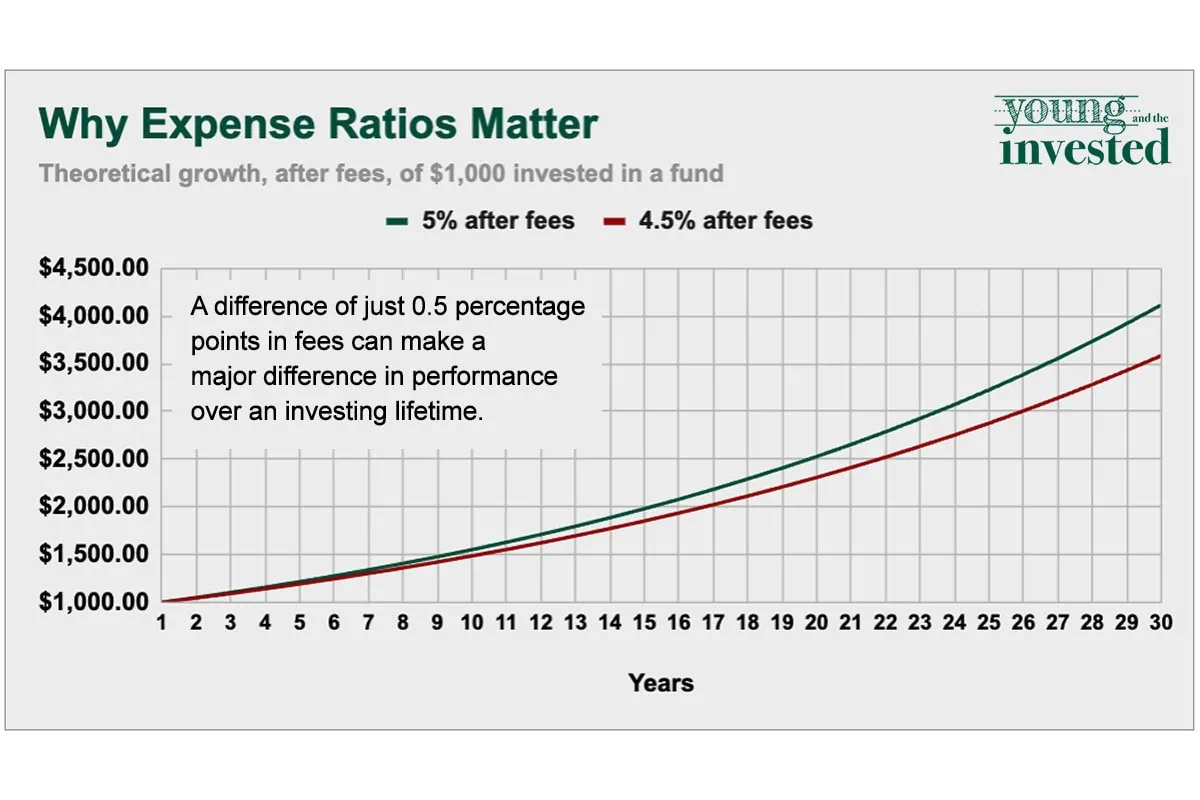
Every dollar you pay in expenses is a dollar that comes directly out of your returns. So, it is absolutely in your best interests to keep your expense ratios to an absolute minimum.
The expense ratio is the percentage of your investment lost each year to management fees, trading expenses and other fund expenses. Because index funds are passively managed and don’t have large staffs of portfolio managers and analysts to pay, they tend to have some of the lowest expense ratios of all mutual funds.
This matters because every dollar not lost to expenses is a dollar that is available to grow and compound. And over an investing lifetime, even a half a percent can have a huge impact. If you invest just $1,000 in a fund generating 5% per year after fees, over a 30-year horizon, it will grow to $4,116. However, if you invested $1,000 in the same fund, but it had an additional 50 basis points in fees (so it only generated 4.5% per year in returns), it would grow to only $3,584 over the same period.
Like Young and the Invested’s Content? Be sure to follow us.
Want to talk more about your financial goals or concerns? Our services include comprehensive financial planning, investment management, estate planning, taxes, and more! Schedule a call with Riley to discuss what you need, and what we can do for you.

Related: The 10 Best-Rated Dividend Aristocrats Right Now
Dividend growth puts more cash in our pockets and signals that the company we’re invested in is confident in its ability to keep churning out profits. And there’s no more heralded group of dividend growers than the Dividend Aristocrats, which are companies that have paid higher cash distributions each year for at least a quarter-century.
But even Aristocrats aren’t created equally. Check out which dividend growers Wall Street loves the best right now in our list of the top-rated Dividend Aristocrats.
Related: 15 Stocks You Can Buy and Hold Forever
As even novice investors probably know, funds—whether they’re mutual funds or exchange-traded funds (ETFs)—are the simplest and easiest ways to invest in the stock market. But the best long-term stocks also offer many investors a way to stay “invested” intellectually—by following companies they believe in. They also provide investors with the potential for outperformance.
So if you’re looking for a starting point for your own portfolio, look no further. Check out our list of the best long-term stocks for buy-and-hold investors.
Please Heart ❤️, Follow and Subscribe
Did you find this article helpful?
1. Click the Heart Button.
2. Follow WealthUpdate —-> https://flipboard.com/@WealthUpdate
3. Subscribe to Retire With Riley, our free weekly retirement planning newsletter.