



Many investors have the same, simple wants when it comes to the funds they’ll stuff into their retirement accounts.
They want straightforward funds with strategies they can understand. They want to buy from a name they know and trust. And they don’t want fees to dig too deeply into their returns.
Investors don’t, however, usually need to check off all those boxes with the same fund provider. They’re happy to purchase, say, a U.S. stock fund from Vanguard, an international stock fund from T. Rowe Price, and a bond fund from Pimco. And there’s absolutely nothing wrong with that.
But a handful of providers can meet all of those asks by their lonesome—and Schwab is among them. It’s one of the largest investment account providers, boasting nearly 39 million brokerage accounts and another 5.6 million workplace plan participant accounts. However, “Chuck” also is among the country’s leading fund providers, with more than $1 trillion in assets under management (AUM).
Today, I’ll introduce you to some of Schwab’s best funds for retirement savers, whether you invest via a 401(k), individual retirement account (IRA), health savings account (HSA), or another tax-advantaged vehicle. Each of these products tackles a widely used investment strategy that many savers put to use. Each fund also boasts low annual fees, and you can get started in any one of them with as little as $1.
Editor’s Note: The tabular data presented in this article is up-to-date as of March 12, 2026.
Featured Financial Products
Disclaimer: This article does not constitute individualized investment advice. Individual securities, funds, and/or other investments appear for your consideration and not as personalized investment recommendations. Act at your own discretion.
Table of Contents
Why Schwab Mutual Funds?
Charles Schwab is a U.S.-based brokerage and banking company founded in 1971 as a traditional brokerage company and then as a discount brokerage service in 1974. It’s the largest publicly traded investment services firm with more than $12 trillion in client assets. And it offers a wide range of financial services, such as investment advice and management, trading services, financial planning, banking services, workplace and individual retirement plans, annuities, and more.
But why would you invest in its mutual funds?
Schwab’s 100-plus mutual funds have attracted more than $1 trillion in AUM. That’s in large part because they feature not only below-industry-average annual expenses, but they also charge no load or transaction fees, and most have no initial investment minimum—you can start with as little or as much money as you can afford. Schwab also offers products for whichever management style you prefer; it has numerous actively managed funds run by seasoned teams, but it’s also one of the largest providers of indexed mutual funds.
In short: Schwab’s retirement funds are among some of the best on the market, you have plenty to choose from, and they won’t leave your wallet in tatters.
What Should You Look For in a Retirement Fund?
Here are some of the most critical factors to consider as you invest for retirement:
— Costs: Let’s say that for every $1,000 you had invested in a mutual fund, $5 of that went to pay the fund company. Well, that’s $5 that can no longer grow and compound for you over time. So if all else is equal, the lower the cost, the better. However, occasionally, a fund justifies its higher fees. Good news here: Schwab’s costs are frequently below the category average.
— Taxes: A taxable account, such as a standard brokerage account, is better suited to take advantage of tax-advantaged investments like municipal bonds. Conversely, you can make the most of tax-inefficient investments—like actively managed stock funds (which can throw off large capital gains distributions because of heavy trading) and bond funds (which throw off interest income that’s typically taxed at your marginal rate)—by stuffing them into tax-advantaged retirement accounts like 401(k)s and IRAs.
— Diversification: You’ve likely always been told that you should hold a diversified portfolio, which means that you hold a variety of investments, not just one or two. That could mean holding multiple assets (stocks, bonds, commodities), but that could also mean holding, say, stocks from different countries, or stocks from different sectors. And investment funds, which can own any number of stocks, bonds, or other holdings all at once, can help you achieve that diversification. But every fund has its own level of built-in diversification. Some funds hold dozens of stocks while others hold thousands. Some funds invest heavily in their biggest stocks while others spread their assets out more evenly. So always consider how diversified a fund really is, as well as whether that level of diversification suits your needs.
— Income: You ideally want your retirement portfolio to produce regular income—in the form of both bond interest and dividend income. Stock prices can suffer during nasty corrections and bear markets, but income-generating funds can help provide for your living expenses without forcing you to sell at an inopportune time.
Schwab’s wide assortment of retirement-focused funds provides just about any investor with the tools to address these and other vital planning considerations.
The Best Schwab Retirement Funds You Can Buy

These retirement funds are best held in tax-advantaged retirement accounts, such as a 401(k) or IRA. That’s because many of them feature at least one (if not more) of the following traits:
1. High turnover: Turnover refers to how often investments are rotated in and out of a fund. If a mutual fund sells a stock for a profit, that generates a capital gain, which can be passed on to you in the form of a capital-gains distribution. You would then owe capital gains taxes on that distribution during that tax year. Funds with high turnover can be really tax-inefficient, as they can pass along a lot of short-term capital gains that are taxed as ordinary income, at rates up to 37%, not to mention an additional 3.8% for the net investment income tax.
2. Dividends: When a company pays you a dividend, that dividend income is taxable. Most dividends from traditional stocks are considered “qualified,” which means they’re at least taxed at more favorable long-term capital gains tax rates. However, dividends from some entities, such as many real estate investment trusts (REITs), are nonqualified, meaning they’re taxed at the less favorable ordinary income rates.
3. Interest income: Interest income, which is paid out by bonds, preferred stocks, and other fixed-income assets, is also tax-inefficient, as it’s taxed as ordinary income (again, up to 37%). And given that interest income is typically the bulk of your return from bonds, most of your returns are being taxed at those unfavorable rates.
While dividends, capital-gains distributions, interest income, and other fund payments have tax consequences inside of a taxable brokerage account, they don’t when they occur within a tax-deferred account such as a 401(k) or IRA—you’ll only ever be subject to taxes when you withdraw funds, likely at retirement. (That said, some of these Schwab retirement funds will still do perfectly fine even inside of a good, old-fashioned brokerage account.)
Now that we’re through with introductions, let’s explore some of the best Schwab funds you can use to assemble a long-term retirement portfolio.
Do you want to get serious about saving and planning for retirement? Sign up for Retire With Riley, Young and the Invested’s free retirement planning newsletter.
1. Schwab S&P 500 Index Fund
— Style: U.S. large-cap stock
— Management: Index
— Assets under management: $133.6 billion
— Dividend yield: 1.1%
— Expense ratio: 0.02%, or 20¢ per year for every $10,000 invested
Another year, another 12 months of getting beat by an algorithm.
“In our largest and most closely watched comparison, 79% of all active large-cap U.S. equity funds underperformed the S&P 500, worse than the 65% rate observed in 2024 and the fourth-worst year for active large-cap managers over the 25-year history of our SPIVA Scorecards,” says S&P Dow Jones Indices in its year-end 2025 S&P Indices Versus Active Funds (SPIVA) report. “Headwinds from unrelenting large-cap outperformance subsumed the tailwinds from higher dispersion, resulting in fewer potential opportunities for stock pickers to capitalize on.”
And it’s not just one year. Only 14% of large-cap managers have managed to beat the S&P 500 over the trailing 10-year period, and that number drops to just 10% over the trailing 15 years.
Related: The 11 Best Fidelity Funds You Can Own
So if the pros can’t even beat it, maybe we should just join it.
The Schwab S&P 500 Index Fund (SWPPX) is one of the least expensive ways to do just that, charging a razor-thin expense ratio of just 0.02%. That’s one of the lowest fees for an S&P 500 tracker across mutual funds and ETFs alike.
The S&P 500 is a collection of the largest and most dominant American companies. To be selected for this stock market index, a company must have a market capitalization of at least $22.7 billion, its shares must be highly liquid (shares are frequently bought and sold), at least 50% of its outstanding shares must be available for public trading, it must have positive earnings in the most recent quarter, and the sum of its previous four quarters must be positive. (Note: Once a company is in the index, it doesn’t necessarily get kicked out if it fails to meet all of the criteria at some point in the future, but the selection committee would take that under consideration.)
The S&P 500’s makeup will shift over time, but right now, technology stocks such as Nvidia (NVDA) and Apple (AAPL) dominate the fund at 35% of assets. Financial stocks, consumer discretionary companies, and communication services firms also have significant weights above 10%.
Turnover tends to be low in this Schwab index fund, as only a handful of stocks enter or leave the index in any given year. This makes SWPPX an extremely tax-efficient option for taxable investment accounts. But if you do the majority of your investing through a tax-advantaged retirement account, consider holding SWPPX there, too. Sure, you won’t enjoy a premium tax edge, but you’ll still be putting your money into one of Schwab’s best retirement funds.
Featured Financial Products
Related: 11 Best Vanguard Funds for the Everyday Investor
2. Schwab U.S. Large-Cap Value Index Fund
— Style: U.S. large-cap value stock
— Management: Index
— Assets under management: $996.2 million
— Dividend yield: 1.7%
— Expense ratio: 0.035%, or 35% per year for every $1,000 invested
The Schwab U.S. Large-Cap Value Index Fund (SWLVX) provides access to large-cap value stocks, but it does so in a counterintuitive way.
SWLVX tracks the Russell 1000 Value Index, which is made up of Russell 1000 companies with “relatively lower price-to-book ratios, lower I/B/E/S forecast medium term (2-year) [earnings] growth and lower sales per share historical growth (5 years).”
Let me translate that for you: Only one of the three main criteria (price-to-book) is a direct valuation metric; those other two metrics seek to define value through relatively low growth.
Related: 10 Best ETFs to Beat Back a Bear Market
Also, that lone true valuation metric (P/B) is a little odd in and of itself. Sure, it’s helpful when trying to value capital-intensive businesses (manufacturers, energy companies, banks), but it’s not very useful when trying to value companies (like technology firms) that have a lot of intangible assets, such as patents and intellectual property. Also curious is the fact that, despite effectively being the inverse of the Russell 1000 Growth Index, which includes fewer than 400 of the Russell 1000’s stocks, Russell 1000 Value is made up of some 860 of the Russell 1000’s stocks.
I suppose we can put all of these oddities aside, however. Because Schwab U.S. Large-Cap Value Index Fund’s resulting portfolio does end up being bargain-priced across a range of metrics—not just P/B, but also P/E and P/CF as well.
Related: 8 Best Schwab Index Funds for Thrifty Investors
Schwab U.S. Large-Cap Value Index is currently heaviest in financials, which account for more than 20% of assets. Industrials, technology, and health care account for more than 10% of assets each. Top holdings include the likes of Google parent Alphabet (GOOGL), Berkshire Hathaway (BRK.B), and JPMorgan Chase (JPM).
While it’s not technically a dividend fund, SWLVX provides an above-average level of dividend on par with some large-cap equity funds that explicitly try to provide more income. And it’s certainly more than the 1.1% the S&P 500 is paying.
Make sure you sign up for The Weekend Tea, Young and the Invested’s free weekly newsletter that over 10k monthly readers use to level up their money know-how.
3. Schwab International Index Fund
— Style: International large-cap stock
— Management: Index
— Assets under management: $13.4 billion
— Dividend yield: 3.2%
— Expense ratio: 0.06%, or 60¢ per year for every $1,000 invested
Of course, if you’re looking for substantial dividend income in your retirement portfolio, it doesn’t hurt to look overseas, too.
Consider the Schwab International Index Fund (SWISX). For a measly 0.06%, SWISX invests you in 710 stocks across primarily developed markets in Europe and Asia. Japan is tops at 22% of assets, though you also get significant exposure to the U.K., France, Germany, and Switzerland, as well.
Related: 7 Low- and Minimum-Volatility ETFs for Peace of Mind in 2026
Almost 90% of Schwab International Index’s holdings are large-cap stocks, while most of the rest are mid-caps. Top holdings are full of blue-chip multinationals such as Dutch semiconductor firm ASML Holding (ASML), British pharmaceutical company AstraZeneca (AZN), Swiss foods giant Nestlé (NSRGY), and German software firm SAP (SAP).
As a general rule, international blue-chip funds will out-yield their U.S. counterparts. That’s certainly the case with SWISX, whose heavy bent toward large firms results in an outsized dividend yield north of 3% that’s almost three times what the S&P 500 pays. And that high level of income makes SWISX an ideal pick for tax-advantaged accounts like IRAs and 401(k)s.
Also, many financial experts will generally point you toward a little international exposure for diversification purposes. Yes, U.S. markets have long been among the most productive in the world, and if you believe in the American economy’s ability to keep growing, that should remain the case. But from time to time—including as recently as 2025—international stocks do outperform American equities.
Related: Best Vanguard Retirement Funds for a 401(k) Plan
4. Schwab Global Real Estate Fund

— Style: Global real estate
— Management: Active
— Assets under management: $288.5 million
— Dividend yield: 2.8%
— Expense ratio: 0.72%, or $7.20 per year for every $1,000 invested
Real estate is a preferred asset class, but buying physical properties is extremely inaccessible to people with modest funds. However, real estate investing was democratized in 1960 with the creation of real estate investment trusts (REITs), which are companies specifically designed to own (and sometimes operate) real estate.
The good news? Many REITs are publicly traded, just like plain ol’ stocks, and they’re prolific dividend payers to boot. You see, REITs enjoy a special tax status that allows them to avoid corporate taxation so long as they distribute at least 90% of their net profits as dividends. Because of this tax incentive, REITs tend to be one of the highest-yielding sectors and a perennial favorite among income investors.
The bad news? This also makes REITs very tax-inefficient, as a large percentage of the total return comes from taxable dividends. What’s more, REIT dividends are generally classified as nonqualified dividends, which again, are taxed like ordinary income and can face rates as high as 37%, depending on your bracket. Thus, it makes more sense to hold REITs and REIT funds in a tax-advantaged fund like a 401(k) or IRA rather than a taxable brokerage account.
Related: 7 Best Fidelity Retirement Funds [Low-Cost + Long-Term]
Schwab investors looking for real estate exposure could consider the Schwab Global Real Estate Fund (SWASX). The fund is a diversified REIT fund with a global presence, split roughly 55/45 between U.S. and international REITs. That means you get access to American REITs such as medical/senior housing property owner Welltower (WELL) and datacenter specialist Equinix (EQIX), as well as real estate companies from Europe, Asia, Australia, and Canada. All told, the portfolio’s holdings represent about 20 different types of real estate, albeit unevenly; industrial, diversified, and retail real estate account for the largest shares of assets.
This is a growth-focused real estate fund that focuses on total return, including both capital gains and income. But the income portion is no slouch, either; the 2.8% current yield is more than double the S&P 500’s modest 1.1% yield.
Another reason to consider SWASX for your retirement account? Turnover. There is no precise, universally accepted threshold for what constitutes “a lot” of active trading, but I would consider any fund with portfolio turnover over 30% or so to be fairly tax-inefficient. The higher that number goes, the more inefficient the fund. Schwab Global Real Estate has annual turnover of about 85%. All of that trading creates capital-gains distributions, but you can snuff out the IRS consequences in a tax-advantaged account.
Make Young and the Invested your preferred news source on Google
Simply go to your preferences page and select the ✓ box for Young and the Invested. Once you’ve made this update, you’ll see Young and the Invested show up more often in Google’s “Top Stories” feed, as well as in a dedicated “From Your Sources” section on Google’s search results page.
5. Schwab Small-Cap Equity Fund
— Style: U.S. small-cap stock
— Management: Active
— Assets under management: $652.6 million
— Dividend yield: 0.1%
— Expense ratio: 1.09%, or $10.90 per year for every $1,000 invested
There’s a lot of wisdom in the old Wall Street maxim, “you never go broke taking a profit.”
As a general rule, buying and holding good stocks or good funds and allowing them to compound over years or even decades is the way to go. But having at least part of your portfolio in actively traded strategies can also make sense, particularly in bear markets. Actively traded strategies have their stretches when they outperform passive index strategies, and they can potentially help you to avoid major declines.
Related: 11 Best Stock Trading Apps [Free + Paid]
But as mentioned before, active trading strategies are tax-inefficient. And you see a lot more of that in the world of small-cap equities. Because smaller companies are often younger companies, the small-cap space tends to move quickly. Successful companies “graduate” to mid- or even large-cap status, and those that are unsuccessful often disappear altogether. So it’s common to see a lot of turnover.
Case in point: Check out Schwab Small Cap Equity Fund (SWSCX), managed by Wei Li, Iain Clayton, and Holly Emerson. Their 360-stock portfolio’s annual turnover sits at a whopping 108%, effectively meaning that each year, on average, the entire portfolio turns over (and then a little more on top). That has resulted in some significant capital gains returns over the years.
Small-cap stocks have only recently started to get their groove back after years of lagging their large-cap peers. Regardless, SWSCX has managed to return an annualized 10.4% since inception, and that’s not too shabby. Also, while the strategy itself is pretty aggressive compared to other strategies, among small-cap blend funds, it actually presents pretty average-level risk.
Related: 7 Best High-Yield Dividend Stocks: The Pros’ Picks
6. Schwab U.S. Aggregate Bond Index Fund
— Style: U.S. intermediate-term bond
— Management: Index
— Assets under management: $5.9 billion
— SEC yield: 4.1%*
— Expense ratio: 0.04%, or 40¢ per year for every $1,000 invested
Most investors need at least some exposure to bonds, which is debt that’s issued by governments, companies, and other entities. Their interest payments and relative lack of volatility make them an excellent tool for providing a portfolio with stability and income.
Exactly how much bond exposure you need will vary by age, however. Debt isn’t great for generating wealth, which is your prime concern when you’re younger; but it’s outstanding for protecting wealth, which becomes increasingly pivotal as you age. So generally speaking, you’ll want to be heavily invested in stocks and modestly invested in bonds (if at all!) when you’re younger, and that mix should increasingly shift toward bonds as you age.
Related: 9 Best Fidelity Index Funds to Buy for 2026
You might not want to buy individual bonds, however. Data and research on individual issues is much thinner than it is for publicly traded stocks. And some bonds have minimum investments in the tens of thousands of dollars. So, your best (and most economical) bet is to buy a bond fund, which allows you to invest in hundreds or even thousands of bonds with a single click.
In the case of the Schwab U.S. Aggregate Bond Index Fund (SWAGX), you can currently invest in more than 11,000 debt issues. The biggest chunk of portfolio assets (45%) is invested in U.S. government and agency bonds; mortgage-backed securities (MBSes) and corporate bonds account for another 25% apiece. The remaining assets are peppered around foreign government-related bonds, municipal bonds, and other debt.
SWAGX holds bonds across the maturity spectrum, from less than a year to more than two decades, but the weighted average maturity comes in at around 8 years. Duration—a measure of interest-rate sensitivity—is 5.8 years. I’m simplifying a bit here, but this basically implies that a 1-percentage-point hike in interest rates would result in a 5.8% short-term decline in the fund, and vice versa. This is moderate interest-rate risk, which is perfectly acceptable for a basic core bond holding like this.
You get all of this for a mere 0.04% in annual fees, making it one of the best Schwab retirement funds you can buy if you want to tap into the bond market.
* SEC yield reflects the interest earned across the most recent 30-day period. This is a standard measure for funds holding bonds and preferred stocks.
Related: Best Schwab Retirement Funds for an IRA
7. Schwab Balanced Fund
— Style: Moderate allocation
— Management: Active
— Assets under management: $736.4 million
— Dividend yield: 1.9%
— Expense ratio: 0.51%*, or $5.10 per year for every $1,000 invested
Schwab Balanced Fund (SWOBX) and other funds like it go by many names: “Balanced funds.” “Allocation funds.” “Portfolios-in-a-can.” Regardless of the moniker, what they do is all the same—they hold both stocks and bonds, giving you access to a pair of core assets in a single investment.
SWOBX specifically is a moderate allocation fund—one that currently holds a roughly 60/40 split between stocks and bonds/cash.
Related: The Best Dividend Stocks: 10 Pro-Grade Income Picks for 2026
Managers Zifan Tang and Patrick Kwok achieve their blends not with individual stocks and bonds, but with a small collection of Schwab funds. At the moment, roughly half of SWOBX’s assets are invested in U.S. equities, while another 10% are in international equities, Meanwhile, virtually all of its bond holdings come from Schwab U.S. Aggregate Bond Index Fund, meaning you’re getting exposure to U.S. government bonds, investment-grade corporate debt, MBSes, and SWAGX’s other holdings.
Allocation funds like Schwab Balanced are an ultra-simple way to get stock and bond coverage in the click of a button. Indeed, if you wanted, this Schwab retirement fund could act as your entire portfolio—but only if its stock/bond allocations make sense for achieving your financial goals. SWOBX alone might be too conservative for most investors; if that’s the case for you, it might make more sense as part of a more broadly diversified holdings set.
Schwab Balanced’s turnover is low at under 10%, and capital-gains distributions are usually in the low single digits. But the bond portfolio also generates a decent amount of interest income. Thus, tax-advantaged accounts like IRAs and HSAs are still the most fitting home for SWOBX.
* SWOBX has a temporary fee waiver to limit operating expenses. The result is a fee reduction from 0.53% to 0.51%. This waiver will remain as long as Schwab Asset Management serves as the adviser to the fund. The agreement can only be amended or terminated with the approval of the fund’s Board of Trustees.
Related: The 7 Best Gold ETFs You Can Buy
8. Schwab Target-Date Funds

— Style: Target-date
— Management: Active
— Expense ratio: Schwab Target Funds: 0.25%-0.58%*, or $2.50-$5.80 per year for every $1,000 invested; Schwab Target Index Funds: 0.08%, or 80¢ per year for every $1,000 invested
One of the challenges in retirement planning is getting the asset allocation right, or having an asset class mix that is appropriate for an investor at your age and stage of life. An ideal portfolio for a 20-year-old is likely going to be very different from that of a 40-year-old, and both those portfolios will be different from what’s ideal for a 60-year-old.
That’s where target-date funds can really add value.
Target-date funds—also called life-cycle funds—are a type of mutual fund that are designed to change their asset allocation over time. Target-date funds start out invested heavily in stocks, then slowly reduce their stock exposure and replace it with bond exposure as they approach their target retirement date, following a glide path.
The target retirement dates are intended to be estimates; they don’t have to be super precise. Generally, most mutual fund families will create target-date funds in five-year increments (say, 2025, 2030, 2035, etc.).
Related: The 7 Best Closed-End Funds (CEFs) for 2026
And given the hyper-specific focus on retirement, target-date funds tend to be a mainstay of 401(k) and other retirement plans.
Schwab offers two target-date fund series, both of which hold various funds to provide exposure to U.S. and international stocks and bonds:
— Schwab Target Funds: These hold a collection of actively managed and index funds. While most of Schwab Target Funds’ holdings are other Schwab mutual funds, they will also hold funds from outside providers, including Dodge & Cox and Baird.
— Schwab Target Index Funds: These primarily hold Schwab ETFs.
In general, all of these Schwab retirement funds tend to be economical, but the Schwab Target Index Funds are flat-out cheap, at just 0.08% in annual expenses. And at least as far as Morningstar Medalist ratings go, the Target Index series is considered the better of the two, earning a Bronze rating.
Also worth noting is that Schwab Target Index Funds, despite the name, do have human managers: the aforementioned Zifan Tang and Patrick Kwok.
For a longer primer on Schwab’s target-date lineups, take a look at our Beginner’s Guide to Schwab Target-Date Funds.
* Schwab Target Funds have temporary fee waivers to limit operating expenses. These waivers will remain as long as Schwab Asset Management serves as the adviser to the funds. The agreement can only be amended or terminated with the approval of the fund’s Board of Trustees.
Related: The 7 Best Index Funds for Beginners
Featured Financial Products
Learn More About These and Other Funds With Morningstar Investor

If you’re buying a fund you plan on holding for years (if not forever), you want to know you’re making the right selection. And Morningstar Investor can help you do that.
Morningstar Investor provides a wealth of information and comparable data points about mutual funds and ETFs—fees, risk, portfolio composition, performance, distributions, and more. Morningstar experts also provide detailed explanations and analysis of many of the funds the site covers.
With Morningstar Investor, you’ll enjoy a wealth of features, including Morningstar Portfolio X-Ray®, stock and fund watchlists, news and commentary, screeners, and more. And you can try it before you buy it. Right now, Morningstar Investor is offering a free seven-day trial and a discount on your first year’s subscription when you use our exclusive link.
Do you want to get serious about saving and planning for retirement? Sign up for Retire With Riley, Young and the Invested’s free retirement planning newsletter.
What Is the Minimum Investment Amount on Schwab Mutual Funds?
Schwab is one of the most friendly fund companies for beginners. That’s not just because both its mutual funds and ETFs sport below-industry-average expense ratios, but because you don’t need much money to invest in them in the first place. Most Schwab mutual funds have no investment minimum—you can literally start with as little as $1.
That’s extremely beneficial in self-directed accounts like an IRA. Many mutual funds from other providers require high minimums in the thousands of dollars, hamstringing investors with little capital to work with.
What Are Index Funds?
There are two kinds of funds: actively managed funds and index funds.
With an actively managed fund, one or more managers are in charge of selecting all of the fund’s holdings. They’ll likely have a specific strategy to adhere to, and they’ll be tasked with beating a benchmark index, but they’ll be given a lot of discretion about how to achieve that. These managers will identify opportunities, conduct research, and ultimately buy and sell a fund’s stocks, bonds, commodities, and so on.
An index fund, on the other hand, is effectively run by algorithm. The fund will attempt to track an index, which is just a group of assets that are selected by a series of rules. The S&P 500 and Dow Jones Industrial Average? Those are indexes with their own selection rules. Index funds that track these indexes will generally hold the same stocks, in the same proportions, giving you equal exposure and performance (minus fees) to those indexes.
If you guessed that it’s more expensive to pay a conference room full of fund managers than it is a computer that tracks an index, you’d be right. That’s why actively managed funds tend to cost much more in fees than index funds.
And that’s why ETFs are generally cheaper. Most (but not all) mutual funds are actively managed, while most (but not all) ETFs are index funds.
Why Does a Fund’s Expense Ratio Matter So Much?
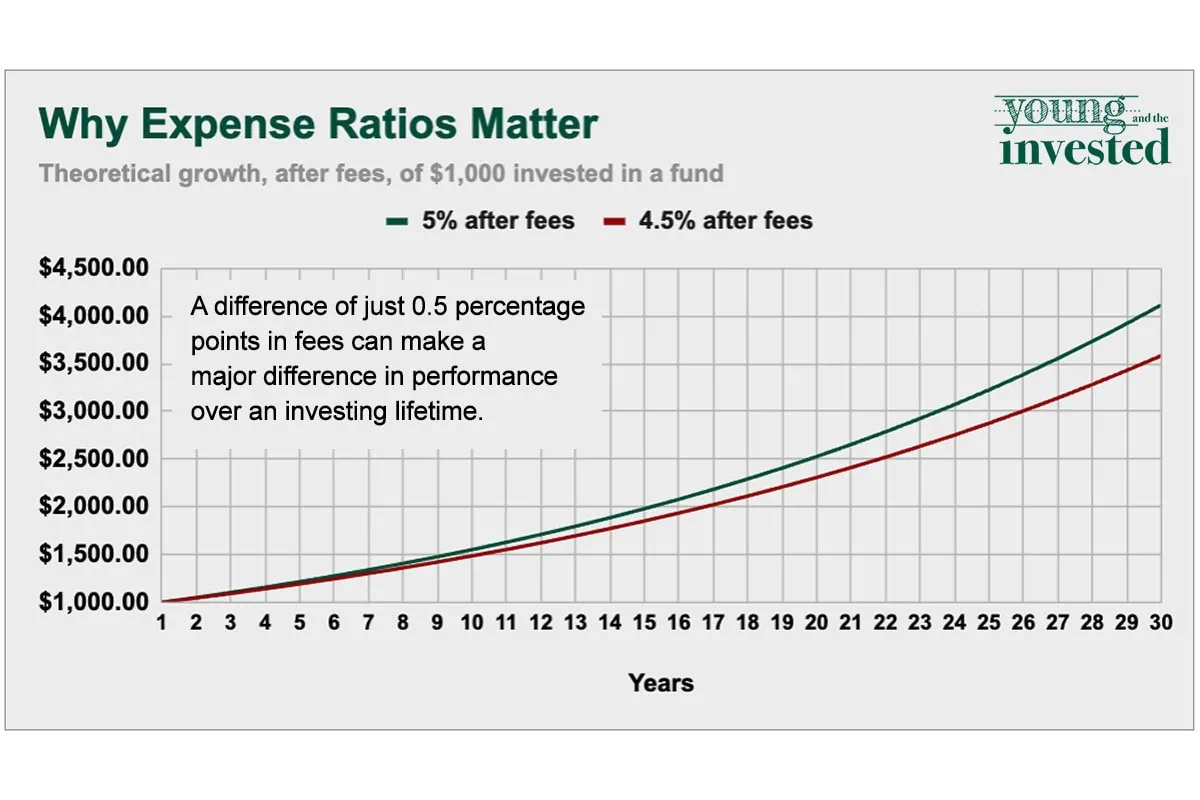
Every dollar you pay in expenses is a dollar that comes directly out of your returns. So, it is absolutely in your best interests to keep your expense ratios to an absolute minimum.
The expense ratio is the percentage of your investment lost each year to management fees, trading expenses and other fund expenses. Because index funds are passively managed and don’t have large staffs of portfolio managers and analysts to pay, they tend to have some of the lowest expense ratios of all mutual funds.
This matters because every dollar not lost to expenses is a dollar that is available to grow and compound. And over an investing lifetime, even a half a percent can have a huge impact. If you invest just $1,000 in a fund generating 5% per year after fees, over a 30-year horizon, it will grow to $4,116. However, if you invested $1,000 in the same fund, but it had an additional 50 basis points in fees (so it only generated 4.5% per year in returns), it would grow to only $3,584 over the same period.
Like Young and the Invested’s Content? Be sure to follow us.
Want to talk more about your financial goals or concerns? Our services include comprehensive financial planning, investment management, estate planning, taxes, and more! Schedule a call with Riley to discuss what you need, and what we can do for you.

Related: 15 Best Long-Term Stocks to Buy and Hold Forever
As even novice investors probably know, funds—whether they’re mutual funds or exchange-traded funds (ETFs)—are the simplest and easiest ways to invest in the stock market. But the best long-term stocks also offer many investors a way to stay “invested” intellectually—by following companies they believe in. They also provide investors with the potential for outperformance.
So if you’re looking for a starting point for your own portfolio, look no further. Check out our list of the best long-term stocks for buy-and-hold investors.
Related: 7 Best Vanguard Dividend Funds You Can Buy [Low-Cost Income]
What’s better than a smart, sound dividend income strategy? How about a smart, sound dividend income strategy with very little money coming out of your pocket?
If that sounds good to you, you need look no farther than low-cost pioneer Vanguard, which offers up a number of payout-oriented products. Find out what you need to know in our list of seven top-notch Vanguard dividend funds.
Please Don’t Forget to Like, Follow and Comment
 Young and the Invested
Did you find this article helpful? We’d love to hear your thoughts! Leave a comment with the box on the left-hand side of the screen and share your thoughts.
Also, do you want to stay up-to-date on our latest content?
1. Follow us by clicking the [+ Follow] button above,
2. Subscribe to Retire With Riley, our free weekly retirement planning newsletter, and
3. Give the article a Thumbs Up on the top-left side of the screen.
4. And lastly, if you think this information would benefit your friends and family, don’t hesitate to share it with them!