



The technology sector is the market’s premiere font of growth—truly explosive companies with seemingly limitless potential that are willing to throw all their cash at research, development, marketing, and anything else they can to take market share.
Which makes tech dividend stocks such an oddity.
Yes, technology companies can walk and chew gum at the same time, metaphorically speaking. It happens all the time. Some of the market’s largest tech names, including Nvidia (NVDA) and Microsoft (MSFT), pay some portion of their cash directly back to shareholders. But it’s unusual to find meaningful sources of yield in this sector.
Unusual … but not impossible.
Today, let’s look at some of the best tech dividend stocks you can buy. The companies on this list are among some of Wall Street’s favorite ways to invest in the sector, not just for their ability to keep growing, but also for their above-average (to high) levels of dividend income.
Editor’s Note: Tabular data presented in this article is up-to-date as of April 24, 2026.
Featured Financial Products
Disclaimer: This article does not constitute individualized investment advice. Individual securities, funds, and/or other investments appear for your consideration and not as personalized investment recommendations. Act at your own discretion.
Table of Contents
Why Do People Typically Invest in Tech Stocks?

The technology sector’s appeal is pretty straightforward: Disruptive technologies can sometimes lead to dramatic revenue (and eventually profit) growth, and dramatic gains in a firm’s stock price as a result.
And as time has passed, technology has increasingly become a part of everything—to the point where technology is a primary driver of growth for other sectors. Technology and communications are effectively intertwined. E-commerce completely changed consumer companies. Technological advances are shaping offerings in the health care and financial industries.
Unsurprisingly, then, it’s difficult to find better growth opportunities than what the tech sector has to offer.
Why Do People Invest in Dividend Stocks?
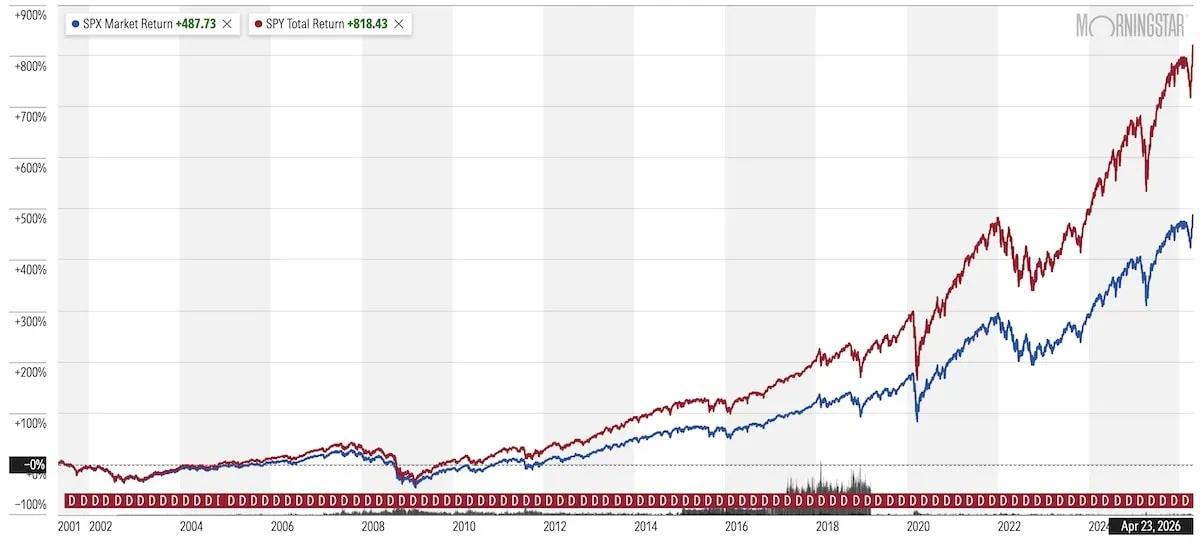
A dividend is a cash payment that a company makes to its shareholders. It’s an excellent additional source of investment return that complements price gains—and it means different things for different investors.
For anyone who isn’t yet retired, cash from dividend stocks is just more fuel to reinvest so you can keep growing your portfolio.
Consider the 25-year chart above. This looks at both the price performance of the S&P 500 (blue line) over the past quarter-century, as well as the total return (red line), which is price plus dividends. Look at how much dividends have added to the equation: The price performance is an impressive 488%, but dividends add another 330 points of return!*
Dividends can also mean something more once you’ve reached retirement: a source of passive income.
When you retire, you no longer receive a regular paycheck from an employer. Instead, you have to rely on Social Security checks and whatever you’ve saved up for retirement. Investors typically withdraw money from their nest egg to pay the bills in retirement, but a steady stream of stock-dividend and bond-interest income can reduce how much of your investment accounts you have to draw down—keeping your nest egg better intact for longer.
* I used the SPDR S&P 500 ETF Trust (SPY), an S&P 500 index fund, to produce the index’s total return in Morningstar. The SPY’s total return factors in the fund’s small annual expenses, while the index’s price return does not. Thus, the S&P 500 Index’s total return, on its own, is actually a little better than what’s presented in this chart.
Related: The 10 Best Index Funds You Can Buy for 2026
How I Picked These Tech Dividend Stocks
This list of the best technology dividend stocks is pretty straightforward, selected based on the following criteria:
1. Market cap: I started with a selection universe of companies listed on major U.S. exchanges with a market capitalization of at least $300 million, which is the bottom of the range for small-cap stocks. (Stocks smaller than that can be considered small caps, but are often broken out into micro- and nano-cap stocks.)
2. Wall Street rating: From there, I excluded any company with a consensus analyst rating (provided by S&P Global Market Intelligence) of Hold or below. S&P boils down consensus ratings down to a numerical system where …
- 1 to 1.5: Strong Buy
- 1.5 to 2.5: Buy
- 2.5 to 3.5: Hold
- 3.5 to 4.5: Sell
- 4.5 to 5: Strong Sell
Indeed, every dividend stock on this list has a rating of 2 or less, indicating that at worst they enjoy a very firm consensus Buy rating, if not an outright Strong Buy rating.
3. Dividend yield: I then looked for stocks that yield more than the broader market, using the S&P 500 as a proxy. The S&P 500 currently yields 1.1%, so I excluded any stocks yielding less than 1.5% to give me a little wiggle room if the market’s yield expands. And, in fact, no stock on this list currently yields less than 2%.
Now, let’s take a look at the stocks, which are listed in descending order of their consensus rating (from the “worst” rating to the best.)
Related: 7 Best High-Yield Dividend Stocks: The Pros’ Picks
5. Cisco Systems
- Market cap: $354.1 billion
- Dividend yield: 1.9%
- Consensus analyst rating: 1.85 (Buy)
Cisco Systems (CSCO) is one of the world’s largest technology conglomerates and one of the biggest names in networking. It provides data center switching, network security, threat intelligence, connectivity solutions, communication platform-as-a-device software, webscale products, internet, cable, and professional services, among other offerings.
CSCO struggled alongside the rest of the sector in 2026’s early innings, even getting punished despite a solid fiscal second-quarter report. But shares have since taken flight with the rest of the market.
“Cisco reported another strong quarter (link) as key forward looking metrics like ‘AI’ and ‘Product’ orders surpassed expectations, providing increased visibility into not just strong growth in the second half of FY26 but also FY27 given the timing of revenue recognition for ‘AI’ orders,” says UBS analyst David Vogt, who rates the stock at Buy.
Related: 15 Best Investment Apps and Platforms [Free + Paid]
“The company’s focus metrics—including software revenue, annualized recurring revenue, and remaining performance obligations—continue to outperform total operations,” adds Argus Research analyst Jim Kelleher (Buy). “The richer and less-hardware-intensive product mix and rising service revenue on the huge installed base are helping boost margins in a now improving revenue environment.”
Another more recent driver for Cisco shares? In April, several reports said Cisco was in talks to acquired privately held Astrix Security.
“While the financial impact of an acquisition would be immaterial in the near term, gaining a toehold in technology that can preemptively manage agentic AI is an interesting opportunity in our view, particularly coupled with the rest of Cisco’s security portfolio,” UBS’s Vogt says. “Given Cisco’s strategy to lever Splunk across its channel as well as targeting increasing share in AI systems markets across enterprise and sovereign customers, adding the ability to preemptively assess, identify, and remediate non-human identities should be a natural fit in our view.”
Vogt and Kelleher are two of 17 analysts who call CSCO a Buy. That compares well to nine Hold calls and nary a Sell. Collectively, they see Cisco maintaining roughly 7% average annual growth in its bottom line over the next five years.
Cisco started paying dividends 15 years ago, and it has grown the distribution on an annual basis every year since. The pace of growth hasn’t been all that rapid in recent years—its penny-per-share hikes since 2020 have amounted to annual raises of less than 3%. That includes its most recent improvement, announced in February 2026, to 42¢ per share. Still, CSCO pays twice the market average, and that dividend is well-covered, at less than 40% of earnings estimates for this year.
Make sure you sign up for The Weekend Tea, Young and the Invested’s free weekly newsletter that over 10k monthly readers use to level up their money know-how.
4. Amdocs

- Market cap: $7.0 billion
- Dividend yield: 3.5%
- Consensus analyst rating: 1.80 (Buy)
Amdocs (DOX) provides software and services primarily to communications, media, and financial services providers, offering solutions to “accelerate our customers’ migration to the cloud, differentiate in the 5G era, digitalize and automate their operations,” and a number of other buzzterms that are better understood by explaining what Amdocs actually does for various industries.
For instance, its Monetization products enable a range of e-commerce abilities, such as billing and partner lifecycle management. And its OTT & digital subscription products help media companies store content on the cloud, bill for subscriptions, and manage digital IDs.
“We view the company as the predominant global player in the billing and customer experience space for telcos, with a demonstrated ability to execute large-scale and complex projects,” Oppenheimer analyst Timothy Horan (Buy) says. “We expect increasing customer investment into Cloud and 5G, as well as escalating competitive rivalry in the wireless sector to grow demand for DOX’s offerings, particularly managed services.
Related: 7 Best Value Stocks for 2026 [Smart Picks to Buy]
“Amdocs’s high level of revenue visibility, solid execution, share buybacks, and dividends should support a premium valuation versus the market.”
Amdocs went down with the tech sector; it hasn’t enjoyed the same bounce-back of late, though shares have at least stabilized. The continued doubt might be in part because of the March departure of CEO Shuky Sheffer, who was replaced by Shimie Hortig, formerly president of Amdocs’ Americas division.
That has led to a weaker bull camp than previously. Just five analysts cover the stock right now; three of them call DOX a Buy, while the other two say it’s a Hold. They also have a moderate long-term earnings growth forecast of just about 10%.
But there’s nothing wrong with dividend growth. DOX has been improving upon its payout for more than a decade, and has grown it by 74% since 2020. That includes an 8% raise, to 56.9¢ per share, announced in February 2026.
Related: The 10 Best Dividend ETFs [Get Income + Diversify]
3. NXP Semiconductors
- Market cap: $61.3 billion
- Dividend yield: 1.7%
- Consensus analyst rating: 1.72 (Buy)
A couple semiconductor companies find themselves among the market’s best tech dividend stocks, too.
First up: Dutch chip firm NXP Semiconductors (NXPI), an automotive specialist. Its microcontrollers, processors, near-field communications (NFC) solutions, sensors, and more. While its products are used in applications such as mobile, communications, industrial, and Internet of Things, NXPI’s primary business is automotive—on that front, it’s one of the world’s largest suppliers.
“We believe NXP is among the best-positioned names in our coverage universe to capitalize on rising semiconductor content in automobiles, and one of the few pure plays leveraged to the growing markets for secure ID, secure transactions, and mobile payment,” say Oppenheimer analysts, who rate the stock at Outperform.
Related: 7 Best Growth Stocks to Buy for 2026 [Find Your Edge]
It’s perhaps not as scintillating as being a straight-up AI play, but there’s plenty to like.
“NXPI has revenue drivers that are not broad-based macro-driven, but rather company-specific product cycles developed by an engaged management team, and margin expansion drivers that are under-valued by investors,” says Truist Managing Director William Stein, who rates the stock at Buy. “Idiosyncratic product cycles abound, including in automotive, IoT, and mobile. It’s these product cycles that back our thesis.”
Stein is among 25 Buys on NXPI, which compares well to just six Holds and one Sell. The long-term earnings view is decent, too, with annual average profit-growth expectations sitting around 15% right now.
The dividend-growth picture is mixed, however. On the one hand, the dividend is 170% higher than it was in 2020. On the other hand, all that growth came across three giant “chunk” raises in 2021, 2022, and 2023. The payout has remained level since then, at $1.014 per share.
Make Young and the Invested your preferred news source on Google
Simply go to your preferences page and select the ✓ box for Young and the Invested. Once you’ve made this update, you’ll see Young and the Invested show up more often in Google’s “Top Stories” feed, as well as in a dedicated “From Your Sources” section on Google’s search results page.
Related: 10 Best Dividend Mutual Funds You Can Buy Now
2. Microchip Technology
- Market cap: $48.2 billion
- Dividend yield: 2.0%
- Consensus analyst rating: 1.58 (Buy)
Microchip Technology (MCHP) is an Arizona-based producer of microcontrollers, analog semiconductors, and a number of other components. Its products are used across a variety of industries, including automotive, industrial, computing, communications, lighting, motor control, thermal management, radio frequency (RF), and more. Admittedly, MCHP isn’t your standard AI or smart-device play, but it’s still exposed to many of the tech trends investors want to see.
“MCHP has established a highly diversified, high-performance analog and embedded computing business model, with an impressively diverse revenue base across multiple metrics,” say Stifel analysts Tore Svanberg and Kyle Smith (Buy). They also point out that it’s leveraged to six secular megatrends in semiconductors, including networking/connectivity, edge computing, datacenter, e-mobility, sustainability, and AI.
Related: The 16 Best ETFs to Buy for a Prosperous 2026
The stock didn’t do much in 2025, underperforming the S&P 500. The company has been in the midst of shrinking its manufacturing footprint, cutting executive salaries, and reducing other costs. However, MCHP has bounced since the market’s March bottom and is now up nearly 40% year-to-date. Most recently, it delivered a promising fiscal third-quarter earnings print in which it also reported strong order activity. That has kept the bull camp robust, with Microchip Technology garnering 20 Buy ratings versus just six Holds and no Sells.
“As MCHP heads into three seasonally stronger quarters with advantaged end-market exposure and fresh signs its new product efforts are gaining strong design-in traction, we see an opportunity to buy the dip with an enhanced entry point,” B. Riley Securities analysts Craig Ellis and Rebecca Zamsky (Buy) wrote after the February report.
While Microchip Technology might not be as growthy as the likes of Nvidia (NVDA) or Advanced Micro Devices (AMD), the pros still see a lot of bottom-line upside from the company, projecting profits to improve by 29% annually on average over the next five years.
Also, Microchip Technology had built a long streak of quarterly dividend raises, but that streak stopped as of the February 2025 payout; MCHP kept its dividend level throughout the rest of the year. Regardless, the quarterly 45.5¢ per share comes out to a yield of nearly 3%, which beats most tech stocks by a considerable distance.
Do you want to get serious about saving and planning for retirement? Sign up for Retire With Riley, Young and the Invested’s free retirement planning newsletter.
Featured Financial Products
1. Opera Limited
- Market cap: $1.5 billion
- Dividend yield: 4.8%
- Consensus analyst rating: 1.14 (Strong Buy)
Norwegian web browser company Opera Limited (OPRA), actually a subsidiary of China’s Kunlun Tech, might not be the first name you think of when you think of web browsers. It’s largely popular in Africa and increasingly so in Europe.
But it has been around for quite some time—indeed, its Opera browser launched in 1995, making it one of the oldest desktop browsers still in use.
The Opera browser now exists in several forms, including Opera Mini, Opera GX for PCs and mobile, Opera for Android and iOS, and Opera for Computers. Its other products include sports score app Apex Football, virtual private network offering Opera VPN Pro, and AI-powered personalized news discovery and aggregation service Opera News.
And like with many browsers, Opera is now in the AI game, recently shipping its Opera Neon agentic AI.
“We view Opera Neon as a differentiated offering given its model-agnostic approach, which should appeal to users and allow them to get the best capabilities across multiple LLM models,” say B. Riley Securities analysts Naved Khan and Ryan Powell, who rate shares at Buy. “Commentary from [management] suggests that while agentic browsing is not yet mainstream, the company expects to learn how AI power users are using the browser and plans to implement key findings into its broader product suite.”
Opera doesn’t have a huge Wall Street following, but all seven covering analysts rate the stock at Buy. In fact, its consensus rating is so high that OPRA isn’t just one of the best tech dividend stocks you can buy, but one of the best tech stocks period. And their consensus view is for average annual profit growth of about 22% over the long run.
But what really stands out about Opera is its massive dividend, which at more than 5% is high for any sector and easily puts it among the top tech dividend stocks you can buy. Just note that OPRA only pays biannually (instead of the U.S. standard quarterly), and that its 40¢-per-share dividend hasn’t budged since it was initiated in 2023.
What Is Dividend Yield?
Perhaps the most important metric in the dividend universe is known as dividend yield. This is a simple financial ratio that tells you the percentage of a company’s share price that is paid out across a year’s worth of dividend distributions.
Expressed as a mathematical equation, it’s simply:
Dividend yield = annual dividend / price x 100
The idea here is to normalize dividend payments regardless of stock price, different quarterly payments, even different payment frequencies (like monthly or annually). For instance, each of the following fictional stocks all have a dividend yield of 2.5%:
- Alpha Corp. currently trades for $40 a share. It pays a 25¢ quarterly dividend, for $1.00 per year in full. ($1 / $40 x 100 = 2.5%)
- Beta Inc. pays $1 in the first quarter, $2 in Q2, $3 in Q3 and $4 in Q4. That’s $10 in dividends for the full year. It trades for $400 a share. ($10 / $400 x 100 = 2.5%)
- Gamma Ltd. pays $2.50 just once per year. It trades for $100 a share. ($2.50 / $100 x 100 = 2.5%)
The idea is to focus on the percent of your initial investment you get back, and help you compare apples to apples.
Taking this math a step further, you learn that a company can suddenly feature a very high dividend yield through one of two very different ways: the share price falling very quickly, or the dividend growing very rapidly.
Alpha Corp., which trades for $40 per share, pays a 25¢ quarterly dividend that yields 2.5%. In a month, it yields 5.0%. Here are two ways that could have happened.
- Alpha Corp. doubled its dividend to 50¢ per share, for a full $2 per share across the year. The share price stays the same. ($2 / $40 x 100 = 5.0%)
- Alpha Corp. kept its dividend the same, but its share price plunged in half to $20 per share. ($1 / $20 x 100 = 5.0%)
Clearly, that 5% yield appears to be much safer and reliable in one scenario than the other.
Related: 14 Best Investing Research & Stock Analysis Websites
What Is a Payout Ratio?
As with dividend yield, it’s important to normalize the dividend payout ratio for a stock. This is simply the percentage of a company’s earnings per share that is being distributed via dividends. It’s calculated as:
Payout ratio = dividends per share / earnings per share x 100
As an example, a stock that makes $100 million in profits and has 10 million shares of public stock has $10 in earnings per share. And if that company pays $5 annually in dividends, it has a payout ratio of 50% ($5 / $10 x 100 = 50%).
Related: What Are the Average Retirement Savings By Age?
What Is ‘Yield on Cost’?
When you look up a stock’s information, the dividend yield listed is based on the most recent dividend and the current stock price.
That yield is often actually different than the one current shareholders enjoy. That yield is called “yield on cost,” which is the payout based on what you paid, at the moment you invested.
Let’s say you buy a stock at $100, and it pays $1 per share. It yields 1.0% when you buy it ($1 / $100 x 100 = 1.0%).
In a year, that stock has doubled to $200 per share, and it also doubled its dividend to $2 per share. If you look up its information, its dividend is still 1.0% ($2 / $200 x 100 = 1.0%).
That’s not your yield on cost, however. You’re still receiving that higher dividend of $2 per share. But your cost basis is still the original $100 you bought the share at. So now, your yield on cost has doubled, to 2.0% ($2 / $100 * 100 = 2.0%)!
Want to talk more about your financial goals or concerns? Our services include comprehensive financial planning, investment management, estate planning, taxes, and more! Schedule a call with Riley to discuss what you need, and what we can do for you.

What If I Need Help Picking Stocks?

Motley Fool Stock Advisor is a stock picking service that espouses my favorite, plain-vanilla trading style: buy-and-hold. Fool analysts provide recommendations for both “Steady Eddies” and potential high-flying stocks with sound fundamentals—an ideal combination of holdings if you want to generate strong performance without risking extremely high volatility.
Importantly, Stock Advisor doesn’t just give you a list of tickers and call it a day—it also provides investment rationales and research for each pick to help educate you before you buy.
Stock Advisor stock picks have performed exceptionally well over the service’s roughly 24-year existence. The service has made 190 stock recommendations that have historically delivered 100%+ returns.
The service charges a discounted rate for the first year and has a 30-day membership-fee-back period. Read more in our Motley Fool Stock Advisor review, or sign up for Stock Advisor today.
- Motley Fool Stock Advisor is a stock service that provides recommendations for both "steady Eddie" and high-flying stocks, as well as a few ETFs for investors who want diversified holdings, too.
- Just getting started? Stock Advisor provides 10 "Foundational Stocks" you can use to anchor your portfolio.
- You're not alone! Stock Advisor membership also gives you access to a community of investors who also want to outperform the market and love talking shop.
- Enjoy access to GamePlan: Motley Fool's financial planning hub, which includes advice on personal finances, taxes, retirement, and more, as well as calculators and other financial tools.
- Limited-Time Offer: Get your first year with Stock Advisor for $99 (vs. $199 usual value)—a 50% discount for new members!—by clicking our link.*
- Discounted introductory price
- Strong outperformance compared to the S&P 500
- High overall average return for stock picks
- High renewal price
- Not every stock is a winner

Featured Financial Products
Related: 15 Best Long-Term Stocks to Buy and Hold Forever
As even novice investors probably know, funds—whether they’re mutual funds or exchange-traded funds (ETFs)—are the simplest and easiest ways to invest in the stock market. But the best long-term stocks also offer many investors a way to stay “invested” intellectually—by following companies they believe in. They also provide investors with the potential for outperformance.
So if you’re looking for a starting point for your own portfolio, look no further. Check out our list of the best long-term stocks for buy-and-hold investors.
Related: 10 Dividend Stocks That Pay Us Each and Every Month
The vast majority of American dividend stocks pay regular, reliable payouts—and they do so at a more frequent clip (quarterly) than dividend stocks in most other countries (typically every six months or year).
Still, if you’ve ever thought to yourself, “it’d sure be nice to collect these dividends more often,” you don’t have to look far. While they’re not terribly common, American exchanges boast dozens of monthly dividend stocks.
Please Heart ❤️, Follow and Subscribe
Did you find this article helpful?
1. Tap or click the Heart Button.
2. Follow WealthUpdate —-> https://flipboard.com/@WealthUpdate
3. Subscribe to Retire With Riley, our free weekly retirement planning newsletter.