




The technology sector started 2026 with a whimper, but after shaking off the cobwebs, tech stocks have gone back to doing what they’ve been doing for so long: growing.
Tech stocks have been one of the best sources of equity growth for literally decades, but investing in the sector doesn’t come without the occasional case of nausea. And rightly so: Technology is constantly in a state of flux. Businesses that make their money by innovating … well, those innovations have a tendency to upend their very own industry again and again. Some companies are better than others at rolling with the punches, but others are unable to avoid the steamroller of progress.
The good news? The world is plenty large enough for the tech sector to produce numerous winners. You can’t exactly throw a dart at the board and know you’ll pick a winner. But understanding what technologies are emergent, who’s leading the way, which businesses are best capturing opportunities, and which executives are best at managing resources can go a long way in separating the wheat from the chaff.
Today, we’re going to lean on Wall Street’s analyst community to light the way. The following are some of the best tech stocks to buy now—a group of companies that currently enjoy extremely high marks from the research professionals who cover them.
Editor’s Note: Tabular data presented in this article is up-to-date as of Aug. 27, 2026.
Featured Financial Products
Disclaimer: This article does not constitute individualized investment advice. Individual securities, funds, and/or other investments appear for your consideration and not as personalized investment recommendations. Act at your own discretion.
Table of Contents
Why Invest in the Tech Sector?

Investors flock to the market’s top tech stocks for good reason: Disruptive technologies can sometimes lead to dramatic revenue growth, and dramatic gains in a firm’s stock price as a result.
In fact, technology companies sometimes chase that revenue growth for years without ever focusing on bottom-line profits. Just consider a couple of the best-performing tech (and “tech-esque”) stocks in history: Amazon.com (AMZN) and Meta Platforms (META), which both prioritized ramping up their long-term scale over short-term profitability.
And look where they are now. Both are among the biggest companies on the planet, outperforming the market by wide margins over the last several years.
This is why many investors look for growth stocks within the tech sector and tech-adjacent companies. It’s not for the short-term profits or dividends, but rather the hopes of a “moonshot” stock that grows exponential revenue growth in short order, delivering life-changing profits to its investors in the process.
The Best Tech Stocks to Invest In
Some of the best-performing tech stocks are very recognizable names. But before you buy any of them, don’t forget that investing is fundamentally about the future. That means learning about the product pipeline and R&D beyond what’s on the surface.
Leading tech firms are often the parent company of lesser-known products or services that could be just as interesting. Particularly when it comes to entrenched mega-cap tech stocks, their future potential depends on revenue streams that have yet to be fully realized yet—not the big-name products consumers currently use.
Related: What Is VOO? A Quick Guide to the Vanguard S&P 500 ETF
Every stock on this list also has a favorable view from Wall Street’s analyst community. The consensus analyst rating, courtesy of S&P Global Market Intelligence, is the average of all known analyst ratings of the stock, boiled down to a numerical system where …
- Less than 1.5: Strong Buy
- 1.5-2.5: Buy
- 2.5-3.5: Hold
- 3.5-4.5: Sell
- More than 4.5: Strong Sell
In short, the lower the number, the better the overall consensus view on the stock. In the case of this list, I’ve included only stocks that have received a 2 or lower—in other words, clear-cut Buys in the analysts’ eyes.
The tech stocks here are listed in reverse order of market capitalization (so, from smallest to largest).
Make sure you sign up for The Weekend Tea, our free weekly newsletter that over 10k monthly readers use to level up their money know-how.
8. Datadog

- Industry: Cybersecurity
- Market capitalization: $86.9 billion
- Dividend yield: N/A
- Consensus analyst rating: 1.48 (Strong Buy)
Cybersecurity has been a growing theme for decades, lifting the fortunes of companies that specialize in it and prompting some larger tech conglomerates to add security capabilities to their repertoire.
Datadog (DDOG) is in the former group. The company operates an observability and security platform for cloud applications that is used by thousands of customers. Among its products and solutions are infrastructure and application performance monitoring, log management, digital experience monitoring, data observability, network monitoring, error tracking, and more.
The company’s revenues have been growing like a weed for years—the top line tripled between its last full year as a private company (2018) and its first full year as a publicly traded company (2020), then more than quintupled between 2020 and 2024. Datadog also delivered its first full-year profit on a GAAP (generally accepted accounting principles) basis in 2023, then reported a 280% jump in earnings in 2024. Profits pulled back considerably in 2025 but are expected to rebound over the next two years.
Related: 7 Best Value Stocks to Buy Right Now
Wall Street generally loves what it sees going forward, too. DDOG’s bull camp is jam-packed at 41 Buys, dwarfing the remaining four Holds and two Sells.
Datadog, like many cybersecurity stocks, was down heavily in 2026 on worries about the capabilities for Anthropic and other AI tools to disrupt the industry’s business models. But DDOG and the industry have rebounded violently since, analyst optimism largely remains in place as customers have been increasingly demanding AI as part of the tech stack.
“Non-AI native growth accelerated to high-20s% and is mostly independent of broader AI demand but directly related to hiring from 2024-2025, [and] … management essentially de-risked its AI exposure,” says Andrew DeGasperi, BNP Paribas Equity Research senior analyst, who rates the stock at Outperform (equivalent of Buy). “So far, our thesis remains unchanged, and we view Datadog as one of the few names that benefits from AI monitoring/security product adoption as agents proliferate at the enterprise level.”
“We believe Datadog can leverage net new customer acquisitions, grow its wallet share among existing users, and drive increased penetration among international markets to sustain a healthy double-digit top-line growth profile and demonstrate improving profitability in the coming years,” add Stifel’s Brad Reback and Robert Galvin, who also rate shares at Buy.
Featured Financial Products
Related: 12 Best Vanguard ETFs You Can Buy [Build a Low-Cost Portfolio]
7. Jabil
- Industry: Electronic components
- Market capitalization: $32.6 billion
- Dividend yield: 0.1%
- Consensus analyst rating: 1.40 (Strong Buy)
Jabil (JBL) is a global supplier of engineering, supply chain and manufacturing solutions that help companies across numerous industries get new products off the ground quicker, reduce costs, or simply do what they do better.
It does this through a trio of segments: Intelligent Infrastructure (cloud and datacenter infrastructure, networking and communications, capital equipment), Regulated Industries (automotive and transportation, healthcare and packaging, renewables and energy infrastructure), and Connected Living & Digital Commerce (consumer-driven smart products, digital commerce, warehouse automation).
While Jabil doesn’t necessarily have the immediate shelf appeal of semiconductor stocks, it’s still a vital cog in the advancement of numerous tech trends.
Related: 7 Best Growth Stocks to Buy Right Now [Find Your Edge]
“Considering Jabil’s exposure to several highgrowth, AI-driven end markets—such as cloud/DC infrastructure, EV/ADAS, and industrial automation—we see the firm as a longer-term beneficiary of the emergence of accelerated compute technology.” say Stifel analysts Ruben Roy and Sahej Singh, who rate the stock at Buy.
UBS analyst David Vogt recently joined the bull camp, upgrading JBL stock to Buy “on a multiyear growth cycle fueled by AI investment from Amazon, Meta, and Google, rising healthcare demand as capacity comes online, and scaling automation and robotics markets.” They see the company’s diversified portfolio and newer offerings driving at least 20% annual earnings growth over the next three fiscal years.
Jabil doesn’t have a particularly large analyst following, but those that do follow the stock are overwhelmingly bullish. Right now, JBL stock has nine Buy ratings against just one Hold and no Sells. And as a group, the pros see Jabil driving almost 30% average annual earnings growth over the next three to five years.
Make Young and the Invested your preferred news source on Google
Simply go to your preferences page and select the ✓ box for Young and the Invested. Once you’ve made this update, you’ll see Young and the Invested show up more often in Google’s “Top Stories” feed, as well as in a dedicated “From Your Sources” section on Google’s search results page.
Need Help Picking Stocks? Consider These Top-Rated Services
|
Best Introductory Stock Picking Service

|
Data-Driven Stock Picking Service

|
Best Proprietary Ranking System

|
|
Primary Rating:
4.7
|
Primary Rating:
4.3
|
Primary Rating:
4.2
|
|
$99/yr. ($100 first-year savings)
|
$449/yr. ($50 discount)*
|
30-day free trial, then $249/yr.
|
6. Microsoft

- Industry: Enterprise software
- Market capitalization: $3.8 trillion
- Dividend yield: 0.7%
- Consensus analyst rating: 1.36 (Strong Buy)
Microsoft (MSFT) is one of the most dominant names in technology and among the largest tech stocks on the planet. The average person knows Microsoft for its iconic Windows and Office productivity software for personal computers, as well as its Xbox gaming console and related software. But Microsoft also is a major player in cloud computing, via its still-growing Azure cloud services, and an emerging titan in artificial intelligence—a position it further cemented in 2025 with the announcement of a strategic partnership with Anthropic.
None of this has immunized MSFT from the sector’s pain. In fact, while Microsoft shares are finally back in the green year-to-date, they’re still significantly underperforming the tech sector and broader market, and still have failed to reclaim last year’s highs.
And yet, Microsoft is among the best-loved tech stocks on Wall Street, currently boasting 52 Buys against three Holds and no Sells.
While the market has been gung-ho about artificial intelligence for years, the past few months have seen investors increasingly cautious about the potential for an AI bubble, especially as it pertains to large language model (LLM) technologies.
Related: The Best Dividend Stocks: 10 Pro-Grade Income Picks
“We note investor concerns around hyperscalers’ high exposure to frontier LLM model providers (mainly OpenAI and Anthropic),” HSBC’s Stephen Bersey, Head of U.S. Technology Research, who rates the stock at Buy. “Microsoft likely tried to allay some of these concerns by showcasing growth ex OpenAI. … We see strong global inference growth on the near-term horizon as global enterprises adopt AI into their core enterprise business system. Ultimately, if a single large user were to back out of its AI infrastructure commitments, we believe that this free capacity could be consumed quickly by overall strong global market demand.
Another way in which Microsoft is on the bleeding edge of AI is through a new generation of AI data centers.
“Microsoft has made headlines for Fairwater—a large-scale, purposefully designed distributed network of AI data centers, [leveraging] sophisticated silicon and cooling techniques that require near-zero water waste,” says Goldman Sachs analyst Kash Rangan (Buy). “Microsoft is planning to take on massive training workloads that can cover hundreds of thousands of GPUs. With shorter-than-usual cable lengths coupled with AI WAN, Microsoft can connect multiple distributed data centers to do training in one cohesive swoop. Therefore, millions of GPUs can be involved in a single training run. This leads to lower latency and greater power density, thereby creating the perfect recipe to train larger models in the future.
Revenue projections for the current fiscal year are currently in the high teens, while the pros see profits climbing by 16% annually over the longer term. That, as well as the overwhelming Buy camp, puts MSFT among the best tech stocks to buy in 2026 despite its lackluster 2026.
5. Broadcom
- Industry: Semiconductors
- Market capitalization: $1.8 trillion
- Dividend yield: 0.7%
- Consensus analyst rating: 1.33 (Strong Buy)
Broadcom (AVGO) is one of the world’s largest semiconductor companies. It designs, develops, manufactures, and supplies semiconductor and infrastructure software products for a wide variety of uses, including (but hardly limited to) artificial intelligence (AI), data centers, networking, wireless, storage, and industrial automation.
The company has been an innovator in its own right, but you can also chalk up much of its scale to a history of aggressive merger-and-acquisition (M&A) activity. The company—itself the product of a 2016 merger between Broadcom Corporation and Avago Technologies (hence the AVGO ticker)—has swallowed up the likes of LSI Corporation, Brocade, CA Technologies, VMware, and Symantec’s enterprise security business.
Related: 10 Best Schwab ETFs to Buy [Build Your Core for Cheap]
Regardless of how it got there, the resulting entity is one of Wall Street’s most beloved chip stocks, at 45 Buys, just four Holds, and zero Sells. They see it as a high-growth machine capable of ratcheting its earnings up by 47% annually on average over the long term.
“We believe AVGO has one of the most strategic and financially attractive business models in the industry,” say Oppenheimer analysts, who rate the stock at Outperform. Among the reasons they love Broadcom are a “diversified revenues from enterprise, wireless, server/storage, and industrial,” “growth supported from steady high-margin infrastructure software,” and “one of the best gross margin, operating margin and free cash flow margin profiles, driven in part by its long record of successful accretive M&A.”
That bullishness for 2026 came despite a drop into bear-market territory in 2025 that has continued into the new year, prompted by the company’s warning about AI chip sales cutting into its gross profit margins. But shares have stabilized, and the pros remain unfazed.
Related: 7 Best AI ETFs for the Artificial Intelligence Era
“We have been somewhat surprised by AVGO’s underperformance YTD, particularly given the continued strength of the company’s AI growth trajectory,” say Morgan Stanley analysts, who rate the stock at Overweight (equivalent of Buy). “We think there are a few reasons for the weakness, including investor preference for growthier ‘bottleneck’ stories across the AI semiconductor ecosystem, but the most persistent overhang remains the debate around MediaTek versus Broadcom share on Google TPU.
“Our view is that MediaTek participation is real, but not disruptive: AVGO should remain the majority TPU supplier over time, with ~80% share, and we see the bearish calls for 50% share or eventual displacement as premature.”
Also worth noting is AVGO’s rapidly growing dividend, which has doubled in just the past five years alone. That puts Broadcom not just among the best tech stocks to buy, but also the best dividend-growth stocks to buy, too.
Related: 9 Best Fidelity Retirement Funds [Low-Cost + Long-Term]
4. Allegro MicroSystems

- Industry: Semiconductors
- Market capitalization: $9.3 billion
- Dividend yield: N/A
- Consensus analyst rating: 1.33 (Strong Buy)
Allegro MicroSystems (ALGM), another semiconductor company, designs, develops, manufactures, and markets integrated circuits (ICs) for intelligent sensing and power. The company’s products can be found all over your vehicle—in the HVAC, infotainment systems, lighting, seat electronics, braking, steering, even engine management and transmission. But its products also have industrial applications (automation, data centers, clean energy), as well as consumer applications (appliances, computers, gaming, even garden tools).
Related: The 11 Best Fidelity Funds to Buy Now
Allegro, like much of the rest of the semiconductor community, was on a tear for most of the year before turning tail in July. The change of direction should be nothing new to Allegro shareholders. ALGM came public in late 2020, and while the stock enjoyed an initial burst across its first couple months of trading, the past five-plus years have been spent traversing short-term hills and valleys, but producing no real long-term progress.
And yet, it’s hard to find a more dedicated bull camp. A dozen analysts cover the stock currently, and all but one of them see ALGM as a buy. Moreover, they see the company generating a whopping 62% average annual earnings growth over the next few years.
What gives?
Related: 9 Space ETFs for the Next Frontier of Investing
“Allegro has re-oriented around four core secular growth areas: autos’ ADAS [advanced driver assistance systems] and electrification, and industrial data center and robotics,” UBS analyst Timothy Arcuri says. “The sales organization has restructured around end markets rather than regionally, and management has cut R&D spending on non-secular sockets to invest more in industrial secular growth and manufacturing cost efficiency while maintaining auto secular growth sockets at the current level.”
Despite those issues, Arcuri still sees the stock as a Buy.
“Allegro is seeing continued strength in data center and robotics/industrial automation, broadly consistent with analog peers,” he says. “Similarly, ALGM joins the growing list of analog companies implementing price increases that should be a tailwind to GM into 2H.”
Related: 13 Best Stock Screeners & Stock Scanners
3. Monolithic Power Systems
- Industry: Semiconductors
- Market capitalization: $64.4 billion
- Dividend yield: 0.6%
- Consensus analyst rating: 1.31 (Strong Buy)
Semiconductor stocks will always feature prominently in any list of the best tech stocks, but Monolithic Power Systems (MPWR) isn’t your average chip company.
MPWR designs, produces, and sells power circuits found in the automotive, enterprise data, consumer, communications, industrial, and other markets worldwide. These systems help convert and control voltages of a wide array of electronic systems, from servers, apps, and notebooks to home appliances and satellite communications. That’s a big change from where Monolithic used to be.
Related: 9 Best Vanguard Retirement Funds [Save More in 2026]
“MPS is one of the best-positioned semiconductor names for upside this year,” say Oppenheimer analysts, who rate the stock at Outperform. “A deep product pipeline and steady flow of design wins have steadily diversified MPWR away from traditional consumer products and into the communications, industrial, automotive, and networking markets. MPWR sets up well to outperform the broader semiconductor market with both an improving margin profile and an accelerating top-line outlook.”
Monolithic’s boffo 2026 calmed down during the summer months, though it’s still up 40% year-to-date as I write this. You can thank a couple of solid quarterly earnings reports and a 28% hike to the dividend, to $2 per share quarterly.
Related: 8 Best Health Savings Account (HSA) Providers
“Monolithic Power reported another strong beat-and-raise quarter as AI infrastructure demand pulls through significant power silicon content,” say William Blair’s Sebastien Naji and Ana Bilbao, who rate the stock at Buy. “An even stronger third-quarter guide calls for higher growth in the back half of 2026 as new generation GPU and ASIC programs ramp up. MPS’s continued technology leadership, strong alignment to AI spending, and diverse set of growth vectors position it well to maintain its track record of outperformance.”
MPWR isn’t as well covered as many of the other tech stocks on this list, but it’s one of the best rated. Currently, Monolithic Power Systems’ stock enjoys 15 Buys versus just one Hold and no Sells.
Looking forward, analysts expect revenues to improve by a little less than 40% annually over the next two years, and longer-term estimates peg profit growth at 34% per year on average.
Do you want to get serious about saving and planning for retirement? Sign up for Retire With Riley, our free retirement planning newsletter.
2. Nvidia
- Industry: Semiconductors
- Market capitalization: $5.5 trillion
- Dividend yield: 0.5%
- Consensus analyst rating: 1.28 (Strong Buy)
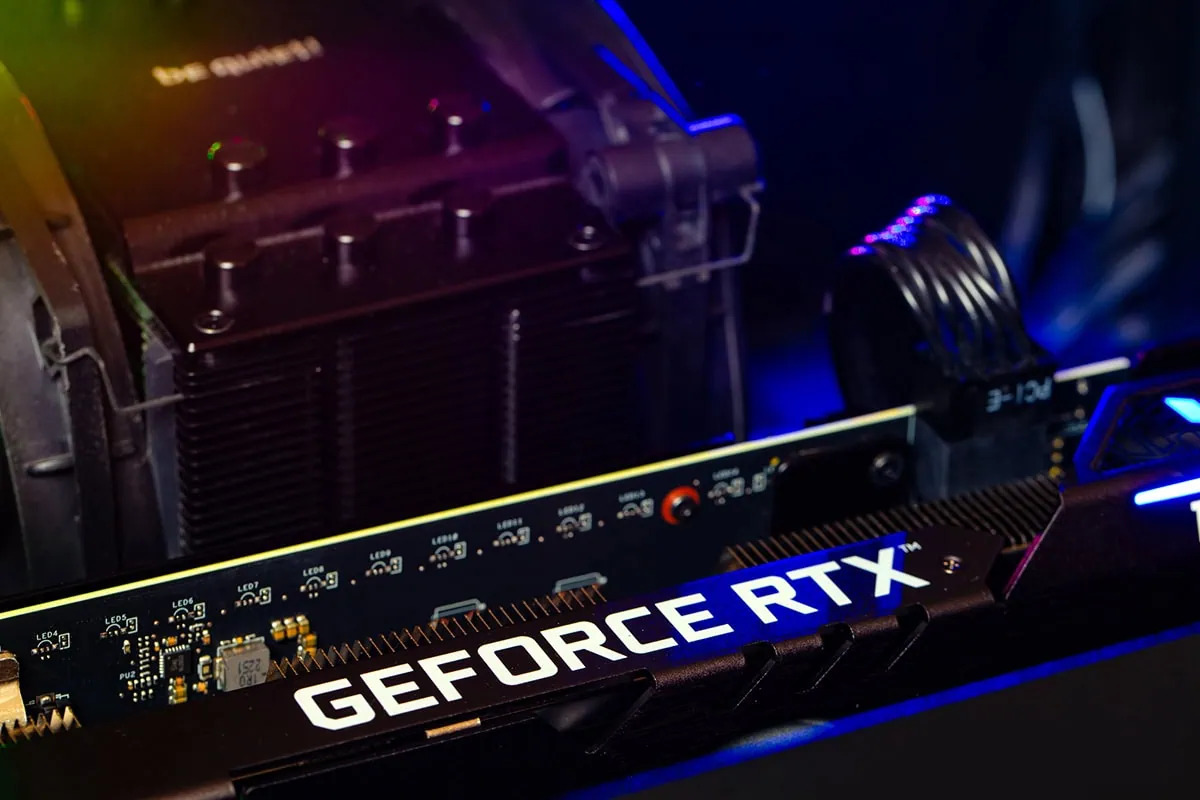
Nvidia (NVDA) is the world’s top chip stock thanks to its dominance in semiconductors that are used in cutting-edge technologies. Applications for this firm’s hardware include self-driving cars, cryptocurrency mining, and other in-demand and growth-oriented areas of the 21st century economy.
But No. 1 with a bullet is the artificial intelligence market.
On the one hand, Nvidia believes AI infrastructure can become a $3 trillion to $4 trillion opportunity over the next half-decade. On the other hand, many investors are starting to wonder whether AI is in a bubble, and they keep waiting for each Nvidia earnings report for signals that the technology is slowing down.
Related: Best Fidelity Retirement Funds for a 401(k) Plan
They’ll have to keep waiting.
“This was the quarter you’ve been waiting for,” Truist Managing Director William Stein wrote after Nvidia’s fiscal second-quarter earnings report. “In several recent quarters, NVDA delivered a beat-and-raise, and investors shrugged it off,” he said. “This quarter, NVDA also noted that demand supports 100% sales growth next year, but that supply constraints will limit growth to 70% (consensus was +47%). We expect this strong statement will allow NVDA to extend its after-hours rise, and that the broader AI trade (suppliers with high AI concentration) will begin to recover.”
That’s not to say there won’t be bumps. Indeed, NVDA nearly fell into bear-market territory in late 2025, though the stock has since recovered somewhat and finished the year up nearly 40%. This year has been up-and-down, too, though the post-earnings surge has NVDA trading just below previous all-time highs and up 20% year-to-date.
Related: 8 Best-in-Class Bond Funds to Buy
Wall Street’s pros remain unflinchingly optimistic about the stock, with NVDA boasting a whopping 58 Buy calls, two Holds and one Sell. They largely expect AI’s specialization to continue the red-hot growth at Nvidia. Analysts see revenue growth averaging roughly 65% across the next two years, and long-term earnings growth at a clip of more than 45%. Indeed, NVDA sits on our list of the market’s best growth stocks right now, too.
One last thing to note: Nvidia has paid a dividend since November 2012. However, for most of that time, it was a nominal penny per share quarterly that yielded less than a tenth of a percent. But in May 2026, the company unleashed a massive 2,400% increase to the distribution, to 25¢ quarterly. While the yield is still only 0.5%, consider this: An investor who bought the stock at around $29 per share near the start of 2022 is now enjoying a yield of more than 3%.
Featured Financial Products
1. Arista Networks
- Sector: Technology
- Market cap: $253.6 billion
- Dividend yield: N/A
- Consensus analyst rating: 1.27 (Strong Buy)
Arista Networks (ANET) delivers client-to-cloud networking solutions, primarily for large-scale datacenters, cloud providers, and enterprise environments. That makes it a critical provider of artificial intelligence (AI) infrastructure. Their offerings include high-speed Ethernet switches, the extensible Operating System (EOS), and network management software like CloudVision.
And Arista’s positioning in technology’s most important trends has Wall Street unanimously bullish: All of ANET’s 30 covering analysts rate shares at Buy, putting it among the best tech stocks to buy right now.
Related: 13 Best Stock & Investment Newsletters for Inbox Alpha [2026]
“Arista is benefiting from accelerating [cloud service provider] and enterprise demand and strengthening in cloud-based data center networking in support of large language models, multimodal models, inference, agentic AI, and other AI-driven areas,” says Argus analyst Jim Kelleher, who rates the stock at Buy. “The Cloud Titan category, capturing the largest CSPs and hyperscalers, rose by 30% in 2025, matching the 2024 growth rate. We expect Cloud Titan demand to sustain mid-double-digit growth in 2026. In the AI & Specialty Provider category, which includes neoclouds, along with large cloud companies such as Apple Inc. and Oracle Corp., revenue soared 49% in 2025. We are modeling continued mid-double-digit growth in this category for 2026.”
“Arista remains a leading AI infrastructure provider, counting on strong relationships with the hyperscalers, a growing order backlog, and multiple AI networking tailwinds,” say William Blair analysts, who rate the stock at Outperform.
After the company issued cautious 2026 guidance earlier in May, they said “we would take advantage of the weakness.” ANET shares have improved by more than 40% since then to bring their year-to-date gains to more than 50%.
Wall Street’s consensus price target implies another 20% or so of headroom over the next 12 months. Meanwhile, the pros’ long-term profit growth targets are for 20%-plus annually.
Related: 8 Best High-Yield Dividend Stocks: The Pros’ Picks
Is Technology the Best Sector in the Stock Market?
Technology stocks regularly are among the best-performing stocks on Wall Street, and they historically beat the broader S&P 500 index. But that should not be misunderstood to mean that the tech sector is a sure thing. For instance, the technology sector slumped by 28.2% in 2022—more than 10 percentage points worse than the broader market.
In other words, there are lots of reasons to like technology stocks and the tech sector. But there’s no such thing as a sure thing when it comes to investing.
Are There Any Downsides to Investing in Tech Companies?
Many tech companies can be quite volatile as they pursue their long-term potential, often at the cost of short-term profits—or even short-term stock performance. One of the most common downsides of investing in tech stocks is that they can move up and down much more dramatically than sleepy sectors such as utility stocks or consumer staples.
That’s also what makes them popular stocks to buy, however. Those big moves are great when they are in an investor’s favor. Just be aware that the big downside of investing in tech companies is … well, the potential for bigger downsides.
Related: 7 Best Vanguard Dividend Funds [Low-Cost Income]
Want to talk more about your financial goals or concerns? Our services include comprehensive financial planning, investment management, estate planning, taxes, and more! Schedule a call with Riley to discuss what you need, and what we can do for you.

Related: The 10 Best Dividend ETFs to Buy
We love exchange-traded funds (ETFs) because they can provide one-click access to hundreds, even thousands of stocks, while charging often minuscule fees.
One way to put that low-cost diversification to work? Collecting dividends. But trying to choose from literally hundreds of income-producing funds could take up a lot more time than you have. So let us help you narrow the field—check out our list of 10 top dividend ETFs.
Related: 10 Dividend Stocks That Pay You Each and Every Month
The vast majority of American dividend stocks pay regular, reliable payouts—and they do so at a more frequent clip (quarterly) than dividend stocks in most other countries (typically every six months or year).
Still, if you’ve ever thought to yourself, “it’d sure be nice to collect these dividends more often,” you don’t have to look far. While they’re not terribly common, American exchanges boast dozens of monthly dividend stocks.
Please Heart ❤️, Follow and Subscribe
Did you find this article helpful?
1. Click the Heart Button.
2. Follow WealthUpdate —-> https://flipboard.com/@WealthUpdate
3. Subscribe to Retire With Riley, our free weekly retirement planning newsletter.