



A good sign that your brand has reached a peak is when your name becomes synonymous with what it does or one of its best features. When you search something online, you “Google” it. When people look for the next great growth stock, they seek out “the next Apple.” And if you want to find low-cost index funds, chances are the first thing you’ll think of is Vanguard.
And why not? Vanguard started this game, after all.
Vanguard founder Jack Bogle created the original index mutual fund back in 1975. Not only has that product become one of the world’s largest mutual funds, but several other Vanguard index funds have become juggernauts in their own right. Indeed, Vanguard has dozens of indexed products that have brought in literally trillions of dollars in investor assets, and most of them will fill an investing need at a bargain-basement cost.
But you don’t need dozens of funds. No investor does. Most of us can build a thriving portfolio with just a handful of funds (and, if you like a little spice, a few individual stocks). So if you are looking at the Vanguard family to either build a portfolio from scratch or augment what you already own, you probably want to narrow your focus on the crème de la Vanguard crème.
Let’s get started. I want to introduce you to some of the best Vanguard index funds you can buy now. Most of these funds can serve as pillars of your core portfolio, but a few are best used as satellite holdings to help you drive some outperformance. And they all charge astoundingly low fees.
Editor’s Note: Tabular data shown in this article is up-to-date as of June 4, 2026.
Featured Financial Products
Disclaimer: This article does not constitute individualized investment advice. Securities, funds, and/or other investments appear for your consideration and not as personalized investment recommendations. Act at your own discretion.
Table of Contents
Why Should You Buy Index Funds?

Investment funds allow you to own different segments of the market. Funds tend to own stocks and/or bonds, but they might hold other assets, too.
For most of their history, human managers decided exactly which investments the fund would buy. But in 1975, Vanguard changed all that with the advent of the index fund.
An index measures the performance of a group of assets, and those assets are determined by the index’s rules. An index fund “tracks” the index by actually investing in all (or in some cases, a representative sampling of) the underlying assets. An index’s strategy can be broad, like the S&P 500, which measures a wide assortment of American companies. Or the focus can be as narrow as, say, music producers and paranormal investigators from the Korean Peninsula.
I don’t necessarily recommend buying my hypothetical KPop Demon Hunters Index Fund. But for a few reasons, I think if you buy index funds, you’ll be, ahem, golden.
For one, index funds are inexpensive. An actively managed index fund has one or more managers, all of whom expect to be paid for their troubles. An index fund technically has a manager overseeing the fund, but they’re not performing stock research and deciding on trades—the index’s rules determine those actions. Thus, fund providers can afford to charge (often much) lower expenses on index funds.
Index funds aren’t chumps, either. I’ll provide an eye-opening example a little later, but human managers often struggle to beat the benchmark indexes in the first place. So if you have a fund that simply tracks a benchmark index, and it’s also charging less than most of the human managers trying to beat that benchmark, well … that fund has a decent potential for success.
Also worth noting? Turnover—how much the fund tends to buy and sell holdings—is often extremely low in index funds, as only a handful of holdings tend to enter or leave the underlying index in a given year. Why does that matter? Turnover can generate capital gains, which funds must distribute to shareholders, and those gains distributions are taxable. But index funds’ capital gains distributions are typically small if not zero, making them very tax-efficient investments for taxable brokerage accounts.
Why Buy Vanguard Funds?
Vanguard Group is one of the largest asset managers in the world, currently boasting more than $12 trillion in assets under management (AUM).
Again, one of the primary drivers of that success is Vanguard’s dirt-cheap expenses. The average asset-weighted expense ratio for U.S. mutual funds and ETFs is 0.44%, or $4.40 annually for every $1,000 invested. Vanguard’s average, across 400-plus funds, is a scant 0.06%, or a mere 60¢ annually per $1,000 invested. That’s an astoundingly low number—one that means even when a Vanguard fund isn’t the absolute cheapest in its category, it’s still going to be one of your most cost-effective options.
These numbers are tiny, measured in mere basis points (a basis point is one one-hundredth of a percentage point). But they add up to massive savings. Christine Benz, Morningstar’s Director of Personal Finance and Retirement Planning, wrote in 2023 that in the previous year alone, “Vanguard’s cost advantage saved its investors collectively about $26 billion compared with what they would have shelled out if they had invested in funds with average expenses.”
Vanguard isn’t sitting still, either. That average expense ratio was 0.08% in 2024, then declined to 0.07% in 2025 after Vanguard cut expenses on 168 share classes across 87 funds. The drop to 0.06% occurred in early 2026 when the company announced it would slash fees on another 84 share classes across 53 funds. All told, Vanguard estimates that’s $600 million in savings for investors, which the firm claims is its “largest-ever two-year combined cost reduction.”
Much of Vanguard’s success on the fee-fighting front can be chalked up to founder Jack Bogle, who created the first index mutual fund and helped proliferate this fund type. Now, low-cost index funds can be found the world over, bringing costs down for millions of investors—even those who don’t buy Vanguard’s products.
But Bogle, too, was responsible for more than just cheap investing. His investment philosophies helped shape Vanguard into the titan it is today, and sparked a group (the Bogleheads) who energetically follow in his footsteps.
Related: Best Vanguard Retirement Funds for a 401(k) Plan
How Were These Index Funds Selected?

Vanguard boasts one of the largest collections of indexed mutual funds on the planet—more than 130 at last check. That’s not an easy number to pare down.
So, as I normally do, I’ve started by booting up Morningstar Investor and running a quality screen that I customize for every search. In this case, I began by including only Vanguard index funds that have earned the top Morningstar Medalist rating of Gold. Unlike Morningstar’s Star ratings, which are based upon past performance, Morningstar Medalist ratings are a forward-looking analytical view of a fund. Says Morningstar:
“For actively managed funds, the top three ratings of Gold, Silver, and Bronze all indicate that our analysts expect the rated investment vehicle to produce positive alpha relative to its Morningstar Category index over the long term, meaning a period of at least five years. For passive strategies, the same ratings indicate that we expect the fund to deliver alpha relative to its Morningstar Category index that is above the lesser of the category median or zero over the long term.”
As I’ve written in other Young and the Invested articles, a Medalist rating doesn’t mean Morningstar is necessarily bullish on the underlying asset class or categorization. It’s merely an expression of confidence in the fund compared to its peers.
Because one of the primary draws of Vanguard index funds is low fees, I also decided to only consider funds whose expense ratios are well below their category average. But that ended up being pretty redundant—most Vanguard index mutual funds already fit that bill.
Believe it or not, that still left us with a remaining universe of several dozen Vanguard index funds. From there, it was dealer’s choice: I selected a range of products that fit various portfolio goals and have good-to-great track records.
One last note: All the Vanguard funds on this list have a $3,000 minimum initial investment. If that sounds steep, don’t worry—most Vanguard index mutual funds have ETF share classes that trade for as little as the price of one share (or less if you have a brokerage that allows fractional shares). So all the funds here should be quite accessible.
Do you want to get serious about saving and planning for retirement? Sign up for Retire With Riley, Young and the Invested’s free retirement planning newsletter.
1. Vanguard 500 Index Fund Admiral Shares
- Style: U.S. large-cap stock
- Assets under management: $1.7 trillion*
- Dividend yield: 1.0%
- Expense ratio: 0.04%, or 40¢ per year for every $1,000 invested
The original fund I mentioned earlier, called the First Index Investment Trust, was shortly thereafter rebranded as the Vanguard 500 Index Fund Admiral Shares (VFIAX)—a fund that’s not only still around today, but one of the largest funds, at well more than a trillion dollars in assets across its various share classes.
VFIAX tracks the S&P 500 Index—the iconic, diversified benchmark that has played a starring role in mutual fund managers’ nightmares for decades. Year-end 2025 data from S&P Dow Jones Indices’ SPIVA (S&P Indices versus Active) shows that only 14% of actively managed large-cap funds have managed to beat the S&P 500 over the trailing 10-year period, and that number dips to 10% when looking at the trailing 15 years.
“I know guys that rate active managers, and even they’re like, ‘I’m not buying an actively managed; I’m just indexing,'” says Daniel Sotiroff, Senior Analyst for ETF and Passive Strategies at Morningstar. “You can’t improve upon [the S&P 500]. You can’t outdo it.”
So, rather than try to outdo it, maybe the best course of action is to join it.
Related: 11 Best Vanguard Funds for the Everyday Investor
The Vanguard 500 Index Fund Admiral Shares holds shares of 500 large, dominant U.S. companies. But it doesn’t hold them equally. The S&P 500 is “market-cap weighted,” which means the larger the company, the more weight the stock has in the index (and thus the more impact it has on returns). Thus, right now, VFIAX dedicates the greatest portions of its assets to large-cap stocks** like Nvidia (NVDA), Google parent Alphabet (GOOG, GOOGL), and Apple (AAPL), whose market caps are measured in trillions of dollars. VFIAX is also considered to a “blend” fund, which means it has relatively even exposure to value stocks and growth stocks.
Financial experts frequently suggest using an S&P 500 fund as the core of your portfolio given its exposure to hundreds of larger, more financially stable companies across all sectors—from tech to healthcare to real estate. Because of this diversity of holdings, the S&P 500 not only provides access to the growth of the American economy, but a modest level of dividend income, too. VFIAX’s yield might not seem like much right now. However, reinvested over time, the S&P 500’s dividends make up roughly 35% to 50% of the index’s returns over the very long term (depending on the time period and study you’re looking at).
Also, as I mentioned before, most Vanguard index mutual funds have an ETF share class. In this case, VFIAX’s sister fund, the Vanguard S&P 500 ETF (VOO, 0.03% expense ratio) is the more popular of the two, recently reaching $1 trillion in assets on its own; VFIAX represents the remaining $700 million or so. You can currently buy VOO for around $700 per share.
* Many Vanguard funds have multiple share classes, including ETFs. Listed net assets for Vanguard funds in this story refer to assets under management across all of a given fund’s share classes.
** There are different ways to define “cap” levels. We’re adhering to Morningstar’s definition, which says the largest 70% of companies by market capitalization within a fund’s “style” are large-caps, the next 20% by market cap are mid-caps, and the smallest 10% by market cap are small caps.
Related: 10 Best ETFs to Beat Back a Bear Market
Featured Financial Products
2. Vanguard Small-Cap Index Fund Admiral Shares

- Style: U.S. small-cap stock
- Assets under management: $182.7 billion
- Dividend yield: 1.2%
- Expense ratio: 0.05%, or 50¢ for every $1,000 invested
Small-cap companies exhibit more potential for explosive growth than their larger peers, so investors who have both an interest in additional upside and a healthy risk appetite often try to chase down the market’s more diminutive firms.
Why the growth potential? Well, they benefit from the business law of large numbers, for one: It’s much easier to double your revenues from $1 million than $1 billion. But also, as these stocks become noticed by institutional investors and fund managers, large investments can help drive their prices further higher, too.
There’s a catch, however. Smaller stocks are frequently riskier and more volatile. A more diminutive company’s revenues might be dependent on just one or two products or services, meaning a single disruption could have massive financial consequences. Small caps also have less access to capital than their larger peers, meaning they’re less likely to get a lifeline should they suffer from broader economic headwinds.
Related: 7 Best Vanguard Dividend Funds [Low-Cost Income]
High risk, high reward. A small company could feasibly double overnight … or get cut in half.
But if you wanted to harness small caps’ upside while mitigating some of that risk, you could invest in a small-company fund, such as the Vanguard Small-Cap Index Fund Admiral Shares (VSMAX).
Vanguard scatters that risk across 1,310 U.S. stocks. To be precise, they’re not all “true” small caps—a good third of the portfolio includes smaller mid-cap stocks. But this kind of bleed isn’t unusual for cap-based funds; different fund companies and index providers may define each cap class by different thresholds.
Single-stock risk is extremely minimal in VSMAX. Not too long ago, SanDisk (SNDK) represented the fund’s biggest holding at more than 1% of assets, largely because rapid stock gains had sent it well into large-cap territory. However, once stocks become too big, they’re removed from the index. Now, engineering firm Emcor Group (EME) enjoys the fund’s largest allocation, at just 0.5% of the portfolio’s assets. Put differently: These minimal concentrations mean you won’t enjoy the full potential of any wild upswing in any individual stock, but you also won’t feel the full brunt of a collapse, either.
VSMAX is also available as an ETF: The Vanguard Small-Cap ETF (VB, 0.03% expense ratio), which goes for around $295 per share currently.
Do you want to get serious about saving and planning for retirement? Sign up for Retire With Riley, Young and the Invested’s free retirement planning newsletter.
3. Vanguard Growth Index Fund Admiral Shares
- Style: U.S. large-cap growth stock
- Assets under management: $393.8 billion
- Dividend yield: 0.4%
- Expense ratio: 0.05%, or 50¢ per year for every $1,000 invested
You don’t have to invest in small companies to seek out better returns, of course. Those with a healthy risk appetite can simply gravitate toward growth stocks in the large-cap space.
A growth stock is generally viewed as a company that is improving sales and profits with each passing year—typically at a faster clip than the industry average. This should, in theory, result in faster stock price appreciation as other shareholders get wise to this success and decide to buy in themselves.
Related: The 13 Best Mutual Funds You Can Buy Right Now
Like with small caps, the upside can be nice, but the train can come to a halt awfully quickly once expectations start to outpace the company’s actual results, leading to an abrupt, sharp drop in share prices. If that one stock is a significant portion of your portfolio, that could mean crippling losses. But you can mitigate that risk by owning bunches of growth stocks within a mutual fund like the Vanguard Growth Index Fund Admiral Shares (VIGAX).
VIGAX tracks an index of large-cap companies that exhibit various growth traits, including better-than-average historical growth in sales and earnings, as well as better-than-average expected short- and long-term growth in earnings.
Related: 8 Best High-Yield Dividend ETFs for Income-Hungry Investors
The fund holds 150 predominantly U.S. growth stocks. As should be no surprise, tech stocks such as NVDA, AAPL, and Microsoft (MSFT) account for the majority (53%) of assets. Communication services companies like Facebook parent Meta Platforms (META) and Alphabet account for 18%, while consumer discretionary stocks, such as Amazon.com (AMZN) and Home Depot (HD), represent another 12%. The remaining assets are spread among the other eight market sectors, with many receiving less than 2% of assets.
VIGAX’s ETF share class is the Vanguard Growth ETF (VUG), which costs 0.03% annually and trades around $90 per share following a recent share split.
Make sure you sign up for The Weekend Tea, Young and the Invested’s free weekly newsletter that over 10k monthly readers use to level up their money know-how.
4. Vanguard Value Index Fund Admiral Shares
- Style: U.S. large-cap value stock
- Assets under management: $245.0 billion
- Dividend yield: 1.9%
- Expense ratio: 0.05%, or 50¢ per year for every $1,000 invested
Typically on the opposite side of growth stocks are value stocks: companies that the market is somehow undervaluing, based on one or more metrics, with the expectation that buyers will recognize that value and send shares higher.
Related: The 12 Best Vanguard ETFs for 2026 [Build a Low-Cost Portfolio]
The Vanguard Value Index Fund Admiral Shares (VVIAX) starts with the same broad investment universe of large-cap stocks that VIGAX does. However, it instead evaluates stocks by value factors such as book-to-price, sales-to-price, dividend-to-price, and historical and future earnings-to-price ratios. (“But Kyle,” you say. “I thought it was price-to-earnings, price-to-sales, and so on.” It typically is. I wish I could tell you why CRSP flipped the script. I cannot.)
Morningstar Associate Analyst Brian Paoli sums it up: “Vanguard Value ETF has a reasonably priced portfolio of large-cap U.S. stocks trading at attractive valuations.”
Related: 8 Best T. Rowe Price Funds to Buy Now
The resulting portfolio of about 310 components is most heavily clustered in the financial sector, which makes up more than 20% of assets. But healthcare, industrials, technology, and consumer staples stocks all enjoy double-digit weightings, too.
Value strategies also tend to be thicker in dividend payers than growth strategies, and that’s very much the case here. Top holding Berkshire Hathaway (BRK.B) might be known for not paying distributions to it shareholders, but many of its other holdings are high-yield dividend stocks such as JPMorgan Chase (JPM) and Exxon Mobil (XOM).
VVIAX’s ETF shares, the Vanguard Value ETF (VTV, 0.03% expense ratio), trade for around $215 per share.
Make Young and the Invested your preferred news source on Google
Simply go to your preferences page and select the ✓ box for Young and the Invested. Once you’ve made this update, you’ll see Young and the Invested show up more often in Google’s “Top Stories” feed, as well as in a dedicated “From Your Sources” section on Google’s search results page.
5. Vanguard Dividend Appreciation Index Fund Admiral Shares
- Style: U.S. large-cap dividend stock
- Assets under management: $127.8 billion
- Dividend yield: 1.5%
- Expense ratio: 0.07%, or 70¢ per year for every $1,000 invested
Never buy an investment fund without looking under the hood. That advice goes double for dividend funds, where the word “dividend” in the name doesn’t necessarily mean you’re collecting a fat yield.
Take Vanguard Dividend Appreciation Index Fund Admiral Shares (VDADX) and its sub-2% yield, for instance.
This Vanguard dividend fund targets U.S. companies that consistently increase their cash distributions over time. Its tracking index is made up of firms that have improved their payouts on an annual basis for at least 10 consecutive years. High yield isn’t a priority. In fact, VDADX’s underlying index actually implies that high current yields are a liability, as it excludes the 25% highest-yielding eligible companies.
Related: The 10 Best ETFs for Beginners
Why? Well … without getting too far into the weeds, high dividends can sometimes be the result of significant price drops, and in some cases might not be sustainable.
That said, VDADX’s different view on dividends produces two important potential benefits:
- High quality: Only firms with strong financials and excellent cash flows can afford to keep paying shareholders more every year. So, in a way, VDADX’s commitment to dividend growers acts like a quality screen, ensuring you’re owning a higher grade of stock.
- Higher yield on cost over time: These companies might not yield much right now, but if they continue raising their dividends, you should enjoy a higher “yield on cost”—what you’re actually earning based on the price at which you bought an investment. (Example: A $100 stock paying $1 in annual dividends yields 1% [$1 / $100 = 1%]. But if you bought the stock at $50 a couple of years ago, your yield on cost is actually 2% [$1 / $50 = 2%] … plus you enjoyed a 100% price gain along the way.)
VDADX holds roughly 330 predominantly large-cap stocks with bulletproof balance sheets and the ability to churn out cash—which they increasingly fork over to shareholders in the form of dividends. All of these dividend-growth stocks have raised their payouts for at least 10 years, but some have much longer histories of uninterrupted improvement. That includes Dividend Aristocrats, which are stocks that have raised their cash distributions annually for at least 25 consecutive years. And it even includes a few Dividend Kings (Aristocrats whose streaks are at 50 years or longer) such as Procter & Gamble (PG) and Johnson & Johnson (JNJ).
Related: The 11 Best Fidelity Funds You Can Own
Vanguard Dividend Appreciation Index Fund does not, however, hold real estate investment trusts (REITs). Its underlying index explicitly excludes them.
It seems like an odd exclusion, if only because REITs tend to be one of the market’s highest-yielding sectors. One possible explanation? Most common stocks, like those held in this Vanguard fund, pay qualified dividends, which enjoy favorable tax treatment at the long-term capital gains tax rate. Most REIT dividends, however, are non-qualified, which are taxed as ordinary income at federal income tax rates. By excluding REITs, VDADX can pay out 100% qualified dividend income, helping shareholders avoid a potential tax headache.
I mentioned above that all the Vanguard index funds on this list have relatively low expenses. VDADX is a great example. The average fee on large-cap funds like this is 0.68%, according to Morningstar. But Vanguard Dividend Appreciation charges a mere 0.07%. Fees are even lower for VDADX’s ETF class, Vanguard Dividend Appreciation ETF (VIG, 0.04% expense ratio), which goes for about $235 per share.
Related: The 7 Best Index Funds for Beginners
6. Vanguard European Stock Index Fund Admiral Shares

- Style: European stock
- Assets under management: $38.1 billion
- Dividend yield: 2.8%
- Expense ratio: 0.08%, or 80¢ per year for every $1,000 invested
You might have noticed that all of the aforementioned funds have had a specifically U.S.-centric bent. That’s good—U.S. markets have long been among the most productive in the world, and if you believe in the American economy’s ability to keep growing, that should remain the case.
Related: The 7 Best Mutual Funds for Beginners
But most experts would tell you that it’s worth having at least some exposure to international stocks. That’s because every now and then (including in 2025), the rest of the world will beat America.
Many investors who want international exposure often favor so-called “developed markets,” which tend to be stable, low-growth, developed markets like Japan, Australia, and much of western Europe. Indeed, some investors opt just to own Europe-specific funds such as Vanguard European Stock Index Fund Admiral Shares (VEUSX).
VEUSX, which tracks the FTSE Developed Europe All Cap Index, holds 1,228 stocks from across the continent. It’s a predominantly large-cap portfolio, with bigger companies making up about 80% of assets. Mid-caps account for another 15%, and small firms are responsible for the rest. Many of these companies also tend to be familiar multinationals such as U.K. financial HSBC Holdings (HSBC), Swiss foods giant Nestlé (NSRGY), and German automation company Siemens (SIEGY).
Related: 7 Best Closed-End Funds (CEFs) Paying Us Up to 15.2%
European large caps also tend to pay larger dividends than their American counterparts, which helps explain a current yield of nearly 3%. You’ll get the same level of income from the ETF class, Vanguard FTSE Europe ETF (VGK, 0.06% expense ratio), which trades at less than $90 per share.
Vanguard European Stock Index is one of the narrower strategies on the list, but its low fees, history of above-average returns, and a Gold Morningstar rating make it one of the best Vanguard index funds you can buy.
Related: 10 Best Alternative Investments [Options to Consider]
Featured Financial Products
7. Vanguard International Dividend Appreciation Index Fund Admiral Shares
- Style: Foreign large-cap growth stock
- Assets under management: $9.2 billion
- Dividend yield: 2.1%
- Expense ratio: 0.16%, or $1.60 per year for every $1,000 invested
Vanguard International Dividend Appreciation Index Fund Admiral Shares (VIAAX) has a similar thrust to Vanguard Dividend Growth in that it’s interested in owning high-quality companies, which it does by identifying and holding companies with a history of increasing their dividends.
VIAAX tracks the S&P Global Ex-U.S. Dividend Growers Index, which consists of international firms that have improved their payouts on an annual basis for at least seven consecutive years. Also, as an additional quality screen, the index excludes the 25% highest-yielding eligible companies from the index. REITs are kept out, too.
Related: 15 Best Investment Apps and Platforms [Free + Paid]
Vanguard International Dividend Appreciation Index is most invested in developed European and Asian markets such as Japan, Switzerland, and the U.K., though it also offers heavy exposure to Canadian stocks. The fund also owns some firms from higher-growth “emerging markets” such as India and China.
Many of the 345 dividend-growth stocks it holds will be plenty familiar to Americans. It shares several of the same components with VEUSX, but its geographic diversification shows in other top holdings such as Royal Bank of Canada (RY) and Japan’s Mitsubishi UFJ Financial Group (MUFG). VIAAX’s dividend yield isn’t as high as Vanguard’s European fund, but at north of 2%, you’re still getting more income than you are in its U.S. counterpart, VDADX.
You can get this Vanguard fund as an ETF, too: the Vanguard International Dividend Appreciation ETF (VIGI, 0.07% expense ratio), which you can buy for around $95 per share.
Related: The 7 Best Gold ETFs You Can Buy
8. Vanguard Total World Stock Index Fund Admiral Shares

- Style: Global large-cap growth stock
- Assets under management: $95.3 billion
- Dividend yield: 1.6%
- Expense ratio: 0.09%, or 90¢ per year for every $1,000 invested
Do you just want to own all the stocks?
If that’s the case, you probably want a “total market” fund, which will own most of the equities available within a particular country or geography. For instance, U.S. total-market funds typically own a couple thousand large-, mid-, and small-cap stocks.
However, if you’d like to expand your ambitions to the rest of the world, you’d be hard-pressed to find a better solution than the Vanguard Total World Stock Index Fund Admiral Shares (VTWAX).
The aforementioned VEUSX and VIAAX are “foreign” or “international” funds, which means they deal explicitly in stocks from outside the U.S. A “global” or “world” fund like VTWAX, however, invests both domestically and internationally.
Related: 8 Best Real Estate Crowdfunding Sites + Platforms
Vanguard Total World Stock Index sports a massive portfolio of more than 10,000 stocks, and no, that’s not a typo. Holdings are predominantly large-cap in nature, with a median market cap of almost $140 billion. As is typical of a global fund, the U.S. accounts for the majority (60%) of assets, while the remainder is spread across roughly 40 countries—from significant holdings in companies from Japan (6%) and the U.K. (3%) to marginal allocations to countries such as Chile, Ireland, and Qatar (each 0.1%). Top holdings are decidedly American, though, led by Apple, Amazon (AMZN), and other big S&P 500 names.
The international bent also helps raise the dividend profile somewhat, with a fund yield of roughly 60 basis points more than an S&P 500 fund. (A basis point is one one-hundredth of a percentage point.)
This Vanguard fund has ETF shares, too: The Vanguard Total World Stock ETF (VT, 0.06% expense ratio) trades around $160 per share.
Related: How to Invest in Grocery Stores [Buy Real Estate, Not Stock]
Do you want to get serious about saving and planning for retirement? Sign up for Retire With Riley, Young and the Invested’s free retirement planning newsletter.
9. Vanguard Intermediate-Term Corporate Bond Index Fund Admiral Shares
- Style: Intermediate-term corporate bond
- Assets under management: $68.8 billion
- SEC yield: 5.1%*
- Expense ratio: 0.06%, or 60¢ per year for every $1,000 invested
Most investors will want some exposure to bonds—debt issued by governments, companies, and other entities that pay interest to bondholders. But how much will largely depend on your age.
Bonds tend to be much less volatile than stocks, for better or worse; it limits downside, yes, but it also limits upside. Instead, most of the return from bonds comes from the steady stream of interest income they produce. They’re not great for generating wealth, which is your prime concern when you’re younger, but they’re outstanding for protecting wealth, which becomes increasingly pivotal as you age.
But it’s tough to go out and buy a single bond. Data and research on individual issues is much thinner than it is for publicly traded stocks, plus, some bonds have minimum investments in the tens of thousands of dollars. So, your best (and most economical) bet is to buy a bond fund, which can provide you with access to hundreds if not thousands of bonds.
Related: 11 Best Investment Opportunities for Accredited Investors
For instance, the Vanguard Intermediate-Term Corporate Bond Index Fund Admiral Shares (VICSX) allows you to invest in nearly 2,300 investment-grade corporate bonds with maturities of between five and 10 years.
Investment-grade corporates are a little riskier than similar-maturity Treasuries, but you get a bit more yield as a result … and they’re not exactly poor-quality bonds. VICSX’s portfolio is split roughly 50/50 between BBB-rated bonds (the lowest investment-grade rating) and A-rated or above. Meanwhile, the focus on intermediates provides a fair blend of risk and income.
Duration (a measure of interest-rate risk) is 6.1 years, which implies that a 1-percentage-point increase in market interest rates would lead to a short-term decline of 6.1% in the fund, and vice versa.
VICSX’s ETF version is the Vanguard Intermediate-Term Corporate Bond ETF (VCIT, 0.03% expense ratio), which goes for about $85 per share.
* SEC yield reflects the interest earned across the most recent 30-day period. This is a standard measure for funds holding bonds and preferred stocks.
Related: 7 Best Stock Advisor Websites & Services to Seize Alpha
10. Vanguard Short-Term Bond Index Fund Admiral Shares

- Style: Short-term bond
- Assets under management: $70.4 billion
- SEC yield: 4.2%
- Expense ratio: 0.06%, or 60¢ per year for every $1,000 invested
Stocks aren’t the only asset with varying levels of risk and potential reward. Bonds can run the gamut, too.
If you can remember back to 2022-23, volatility ripped through not just the stock market, but also the bond market. Bonds that were set to mature in 20 to 30 years actually saw greater price declines than the S&P 500!
Related: The 10 Best Dividend ETFs [Get Income + Diversify]
That’s because maturity is a major factor in determining bond risk. As a general rule, the longer the bond, the greater the risk that the bond might not be repaid. Interest rates matter, too. When rates go higher, new bonds pay more, which tempt people to sell their old bonds for the new, higher-paying bonds. But the temptation is much greater when you’re dealing with longer-term bonds with lots of payments remaining—and not so great for short-term bonds with one or just a couple payments left.
Investors looking to ratchet down their risk by investing in shorter-term debt, then, might consider the Vanguard Short-Term Bond Index Fund Admiral Shares (VBIRX)—a diversified bond index fund including both government and corporate bonds.
This bond fund attempts to track the performance of the Bloomberg U.S. 1-5 Year Government/Credit Float Adjusted Index. Now, this fund doesn’t hold all of the bonds in the benchmark—instead, it uses “sampling” to hold fewer bonds while still closely matching index characteristics such as sector weight, maturity, coupon, and credit quality. Even then, this is a very diversified portfolio of roughly 3,190 bonds (versus the benchmark’s 4,040 or so).
Related: The 7 Best Fidelity Index Funds for Beginners
This Vanguard index fund currently invests about 70% of assets in bonds issued either by the U.S. Treasury or other federal agencies; most of the rest is spent on corporate bonds. Given the relatively short duration—just 2.6 years right now—the fund’s risk to rising interest rates is low.
A 4%-plus yield despite this conservative portfolio makes this one of the best Vanguard index funds for beginners, and really, one of the best index funds you can buy overall.
You can also invest in this strategy through the ETF shares. Vanguard Short-Term Bond ETF (BSV, 0.03% expense ratio) trades for around $80 per share.
Related: 9 Best Vanguard Retirement Funds [Save More in 2026]
Featured Financial Products
Learn More About These and Other Funds With Morningstar Investor

If you’re buying a fund you plan on holding for years (if not forever), you want to know you’re making the right selection. And Morningstar Investor can help you do that.
Morningstar Investor provides a wealth of information and comparable data points about mutual funds and ETFs—fees, risk, portfolio composition, performance, distributions, and more. Morningstar experts also provide detailed explanations and analysis of many of the funds the site covers.
With Morningstar Investor, you’ll enjoy a wealth of features, including Morningstar Portfolio X-Ray®, stock and fund watchlists, news and commentary, screeners, and more. And you can try it before you buy it. Right now, Morningstar Investor is offering a free seven-day trial and a discount on your first year’s subscription when you use our exclusive link.
What Is the Minimum Investment Amount on Vanguard Mutual Funds?
Vanguard funds are known for being shareholder-friendly. The Vanguard mutual fund company blazed new trails with the index fund, and Vanguard has done more than any other investment firm to keep costs to a minimum for investors.
But there is one hitch. Many of Vanguard’s cheapest funds in terms of fees have initial investment minimums of around $3,000.
If that is a problem for you, don’t sweat it. Most popular Vanguard index funds are also available as ETFs. Most self-directed HSAs will allow you to buy as little as one share, and some even allow for fractional shares. And if you use a commission-free brokerage, you can buy those ETFs without incurring additional fees. ETF prices vary, of course, but many cost less than $100, and they rarely exceed $400 per share.
Why Does a Fund’s Expense Ratio Matter So Much?
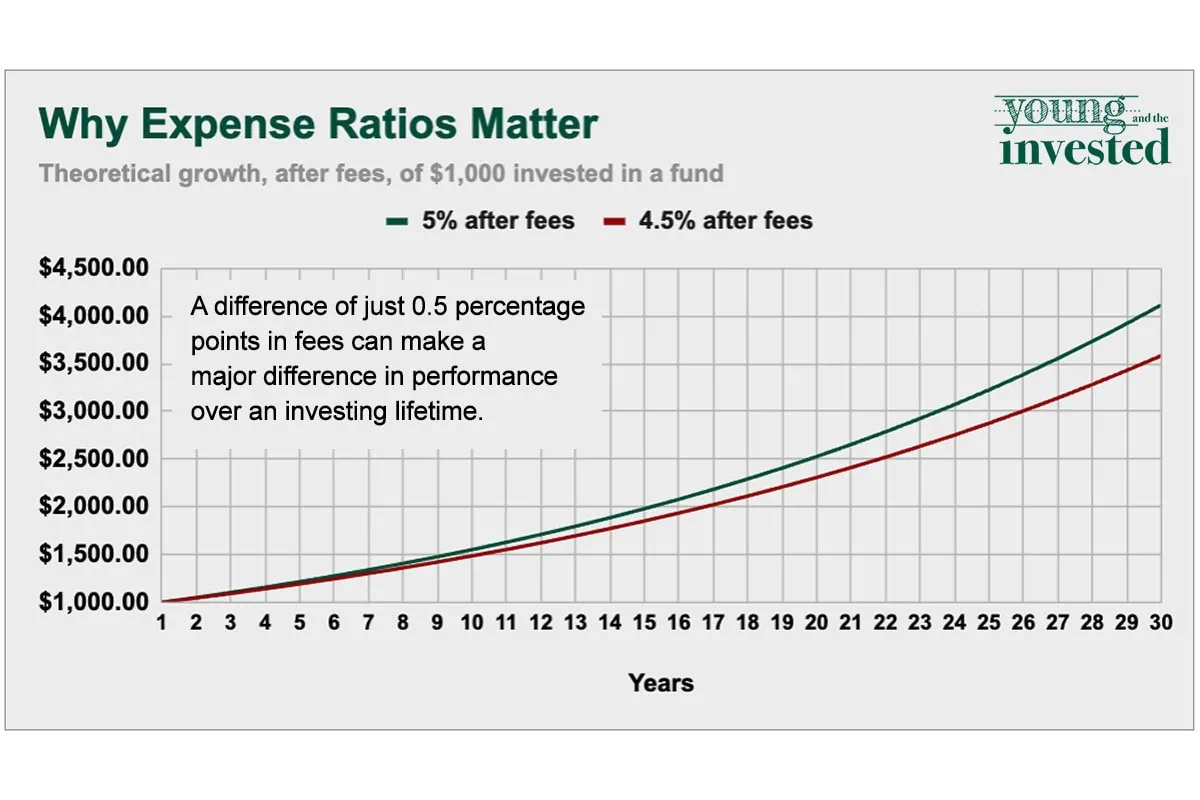
Every dollar you pay in expenses is a dollar that comes directly out of your returns. So, it is absolutely in your best interests to keep your expense ratios to an absolute minimum.
The expense ratio is the percentage of your investment lost each year to management fees, trading expenses and other fund expenses. Because index funds are passively managed and don’t have large staffs of portfolio managers and analysts to pay, they tend to have some of the lowest expense ratios of all mutual funds.
This matters because every dollar not lost to expenses is a dollar that is available to grow and compound. And over an investing lifetime, even a half a percent can have a huge impact. If you invest just $1,000 in a fund generating 5% per year after fees, over a 30-year horizon, it will grow to $4,116. However, if you invested $1,000 in the same fund, but it had an additional 50 basis points in fees (so it only generated 4.5% per year in returns), it would grow to only $3,584 over the same period.
Want to talk more about your financial goals or concerns? Our services include comprehensive financial planning, investment management, estate planning, taxes, and more! Schedule a call with Riley to discuss what you need, and what we can do for you.

Related: 15 Stocks You Can Buy and Hold “Forever”
As even novice investors probably know, funds—whether they’re mutual funds or exchange-traded funds (ETFs)—are the simplest and easiest ways to invest in the stock market. But the best long-term stocks also offer many investors a way to stay “invested” intellectually—by following companies they believe in. They also provide investors with the potential for outperformance.
So if you’re looking for a starting point for your own portfolio, look no further. Check out our list of the best long-term stocks for buy-and-hold investors.
Related: The 10 Best-Rated Dividend Aristocrats Right Now
Dividend growth puts more cash in our pockets and signals that the company we’re invested in is confident in its ability to keep churning out profits. And there’s no more heralded group of dividend growers than the Dividend Aristocrats, which are companies that have paid higher cash distributions each year for at least a quarter-century.
But even Aristocrats aren’t created equally. Check out which dividend growers Wall Street loves the best right now in our list of the top-rated Dividend Aristocrats.
Please Heart ❤️, Follow and Subscribe
Did you find this article helpful?
1. Click the Heart Button.
2. Follow WealthUpdate —-> https://flipboard.com/@WealthUpdate
3. Subscribe to Retire With Riley, our free weekly retirement planning newsletter.