




Vanguard has changed retirement saving as we know it in many ways. But one of the lasting legacies that strikes truest with the average American is just how inexpensive they’ve made it to invest.
Under visionary founder Jack Bogle, Vanguard created the concept of the index fund—a product that by its nature allows for lower costs. Thirty years later, expenses have plummeted lower on funds across the board—though Vanguard remains a favorite in most types of retirement plans, including the ubiquitous 401(k).
Indeed, you’re likely to find a wealth of Vanguard options in your 401(k) and other retirement plans. And given that they’re typically competitive on both price and performance, they should be among the first funds you look at.
I want to shine a light on the best Vanguard funds for a 401(k) plan. These funds have been selected for a number of reasons, including their size, strategy, and potential for showing up in 401(k)s, though your plan might hold all, some, or none of these. However, they’ve also been selected for their tax-inefficiency, as the tax-deferred nature of a 401(k) allows you to enjoy the fund’s performance without the year-to-year tax consequences.
This last part also makes these funds ideal for holding in other tax-advantaged accounts, such as individual retirement accounts (IRAs) and health savings accounts (HSAs).
Editor’s Note: Tabular data appearing in this article is up-to-date as of April 16, 2026.
Featured Financial Products
Disclaimer: This article does not constitute individualized investment advice. Individual securities, funds, and/or other investments appear for your consideration and not as personalized investment recommendations. Act at your own discretion.
Table of Contents
What Should You Want in a Retirement Fund?

When you invest your retirement savings in an account like a 401(k), you’ll want to keep a few things in mind.
Costs are first and foremost. Let’s say you pay $5 in expenses for every $100 a mutual fund earned you. That’s $5 that wouldn’t grow and compound for you over time. So if all else is equal, the lower the cost, the better. But occasionally, a fund justifies its higher fees. No worries in that department: The best Vanguard retirement funds’ fees typically sit near or at the bottom of their category.
Income matters, too. You probably want your retirement portfolio to produce at least some regular income—in the form of both bond interest and dividend income. Stock prices can suffer during nasty corrections and bear markets, but income-generating funds can help provide for your living expenses without forcing you to sell at an inopportune time. How much income your account should produce depends on your own circumstances. For instance, older investors tend to be more concerned with income while younger investors focus more on growth.
Don’t forget taxes. A taxable account (like a standard brokerage account) is better suited to take advantage of certain tax-advantaged investments, such as municipal bonds. For tax-advantaged accounts, such as 401(k)s, some of the best investments include bond funds (where the interest income won’t be taxed) and actively managed stock funds (where the capital gains distributions from heavy trading, aka “turnover,” won’t be taxed).
Diversification matters (in more than one way). You’ve probably heard that your portfolio should be “diversified,” which means holding a variety of investments, whether that’s holding multiple assets (stocks, bonds, alternative investments), but that could also mean holding, say, stocks from different countries, or stocks from different sectors. And investment funds, which can own any number of stocks, bonds, or other holdings all at once, can help you achieve that diversification. Also, every fund has its own level of built-in diversification. Some funds hold dozens of stocks while others hold thousands. Some funds invest heavily in their biggest stocks while others spread their assets out more evenly. So always consider how diversified a fund really is, as well as whether that level of diversification suits your needs.
Why Vanguard Mutual Funds?
Vanguard Group is one of the largest asset managers in the world at more than $12 trillion in assets under management (AUM) currently.
Again, one of the primary drivers of that success is Vanguard’s dirt-cheap expenses. The average asset-weighted expense ratio for U.S. mutual funds and ETFs is 0.44%, or $4.40 annually for every $1,000 invested. Vanguard’s average, across 400-plus funds, is a scant 0.06%, or a mere 60¢ annually per $1,000 invested. That’s an astoundingly low number—one that means even when a Vanguard fund isn’t the absolute cheapest in its category, it’s still going to be one of your most cost-effective options.
Vanguard isn’t sitting still, either. That average expense ratio was 0.08% in 2024, then declined to 0.07% in 2025 after Vanguard cut expenses on 168 share classes across 87 funds. Its drop to 0.06% occurred in early 2026 when the company announced it would slash fees on another 84 share classes across 53 funds. All told, Vanguard estimates that’s $600 million in savings for investors, which the firm claims is its “largest-ever two-year combined cost reduction.”
Vanguard also grew into the powerhouse mutual fund company it is today by taking care of its clients and genuinely looking after their interests. Vanguard funds really started and continue to accelerate the trend of fee compression. But it’s not only the best Vanguard retirement funds that benefit. We all collectively pay less in fees and expenses and enjoy better returns because of the index revolution started and led by Vanguard’s founder Jack Bogle.
The Best Vanguard Retirement Funds for Your 401(k)
With all that out of the way, let’s dig into some of the best Vanguard retirement funds to hold in a 401(k) to consider diving into this year.
These Vanguard retirement funds are ordered by their Morningstar Portfolio Risk Score for the trailing 10-year period. Here are the risk levels each score range represents:
- 0-23: Conservative
- 24-47: Moderate
- 48-78: Aggressive
- 79-99: Very Aggressive
- 100+: Extreme
Importantly, these scores are a general gauge of risk compared to all other investments. For example, a bond fund with a score of 20 might be considered a conservative strategy overall, but it could simultaneously be riskier than a number of other bond funds.
Related: 11 Best Vanguard Funds for the Everyday Investor
1. Vanguard Short-Term Treasury Index Fund Admiral Shares
- Style: Short-term U.S. Treasury bond
- Management: Index
- Assets under management: $33.4 billion*
- SEC yield: 3.8%**
- Expense ratio: 0.06%, or 60¢ per year for every $1,000 invested
- Morningstar Portfolio Risk Score: 6 (Conservative)
No retirement asset allocation is complete without bond funds. As an asset class, bond funds play an important role in lowering volatility and providing regular income. However, bond interest is taxable at your federal income tax rate—if you’re in the 37% tax bracket, then you’re losing 37% of your bond interest to taxes—and because interest is the predominant source of returns on bonds, bond funds are best held in tax-advantaged accounts such as IRAs.
Between 2022 and 2024, the yield curve was inverted (inversion is when short-term rates are higher than long-term rates). That’s no longer the case, but short-term bonds still offer relatively high yields for relatively low risk. Thus, it makes sense to keep a decent chunk of your overall bond exposure in short-term bond funds, such as the Vanguard Short-Term Treasury Index Fund Admiral Shares (VSBSX).
Related: The 16 Best ETFs to Buy for a Prosperous 2026
VSBSX tracks the Bloomberg US Treasury 1-3 Year Bond Index—a collection of roughly 90 federal bond issues with maturities of between one and three years. U.S. Treasuries are among the best-rated bonds on the planet, meaning that the major credit-rating agencies believe bonds issued by our federal government are likelier than most to repay you fully with interest. These bonds are considered all the more secure given their short maturities—at most, these bonds will mature in just three years, which is a relatively small time for the security of those bonds to change.
One of the most critical metrics to consider when considering bond funds is duration, which is a measure of interest-rate sensitivity. As an example, a bond with a duration of two years would see its price rise by 2% if interest rates fell by 1 percentage point (or conversely, would see its price fall by 2% if interest rates rose by 1 percentage point). The actual calculation of duration is fairly complex; it’s the weighted average of the bond’s cash flows. But the key takeaway is that, all else equal, the longer a bond’s time to maturity, the higher its duration—and thus the higher the interest-rate risk.
Related: 9 Best Vanguard Retirement Funds [Save More in 2026]
VSBSX has a very low duration of just 1.9 years. And in return, you currently receive a yield that’s closer to 4% than it is to 3%. That combination of low risk and competitive income makes Vanguard Short-Term Treasury Index Fund one of the very best Vanguard retirement funds you can own in an 401(k).
This mutual fund, like many Vanguard index funds, is also available as an ETF: the Vanguard Short-Term Treasury ETF (VGSH, 0.03% expense ratio), which trades around $60 per share currently.
* Many Vanguard funds have multiple share classes, including ETFs. Listed net assets for Vanguard funds in this story refer to assets under management across all of a given fund’s share classes.
** SEC yield reflects the interest earned across the most recent 30-day period. This is a standard measure for funds holding bonds and preferred stocks.
Featured Financial Products
Related: Tax-Loss Harvesting: How Investors Can Cut Their Tax Bill
2. Vanguard Total Bond Market Index Fund Admiral Shares
- Style: Intermediate-term core bond
- Management: Index
- Assets under management: $387.5 billion
- SEC yield: 4.3%
- Expense ratio: 0.04%, or 40¢ per year for every $1,000 invested
- Morningstar Portfolio Risk Score: 15 (Conservative)
While bond funds play an important role in lowering volatility and providing regular income, they don’t need to be as conservative as a short-term Treasury fund.
Vanguard Total Bond Market Index Fund Admiral Shares (VBTLX), for instance, holds longer-dated bonds but remains one of the very best Vanguard retirement funds because of its high-quality portfolio, competitive yield, and rock-bottom fees and expenses.
A share of VBTLX plugs you into a massive portfolio of nearly 11,400 bonds. About half of assets are Treasury or agency debt backed by the U.S. government. A quarter is invested in corporate bonds, and another 20% is used to own government mortgage-backed securities (MBSes). The remaining sliver is spread across foreign bonds, commercial mortgage-backed securities (CMBSes), asset-backed securities (ABSes), and other debt.
Related: The 10 Best Vanguard Index Funds You Can Buy
Risk is higher than Vanguard’s short-term government-bond fund for a number of reasons. For one, roughly a third of VBTLX’s bonds aren’t government- or agency-related—they’re corporates and other issues with ratings that, while high, are lower than U.S. Treasury debt. Time remaining on these bonds is longer, too, with an average effective maturity of more than eight years. As a result, duration is higher—at 5.7 years, a percentage-point increase in market interest rates would theoretically send the fund 5.7% lower in the short term.
On the flip side, you’re rewarded with a higher yield and more potential upside should the Fed cut rates. And with an expense ratio of just 0.04%, Vanguard Total Bond Market Index Funds is all but free to own.
Also note that VBTLX is available in ETF form as the Vanguard Total Bond Market ETF (BND). It charges 0.03% annually and goes for around $75 per share as I write this.
* SEC yield reflects the interest earned across the most recent 30-day period. This is a standard measure for funds holding bonds and preferred stocks.
Do you want to get serious about saving and planning for retirement? Sign up for Retire With Riley, Young and the Invested’s free retirement planning newsletter.
3. Vanguard Balanced Index Fund Admiral Shares
- Style: Moderate allocation
- Management: Index
- Assets under management: $58.8 billion
- Dividend yield: 2.1%
- Expense ratio: 0.18%, or $1.80 per year for every $1,000 invested
- Morningstar Portfolio Risk Score: 40 (Moderate)
Most of the funds that you and I own, and that we talk about, are single-asset funds: stock funds, bonds funds, and so on. And we mix and match these funds to put together a whole portfolio for ourselves.
However, funds like Vanguard Balanced Index Fund Admiral Shares (VBIAX)—referred to as “balanced” or “allocation” funds—are a whole portfolio unto themselves, giving us virtually everything we need in a single product. And Vanguard Balanced Index Fund specifically is a “moderate allocation” fund that invests roughly 60% of its assets in stocks, and the other 40% in bonds.
Related: 7 Best Vanguard Dividend Funds [Low-Cost Income]
The stock “sleeve” is a massive 3,200 stocks wide. Large-cap stocks* account for the majority (70%) of assets, while mid-caps make up 20% and smalls are responsible for the remaining 10%. Top holdings are similar to what you’d get in a large-cap equity fund: Nvidia (NVDA), Apple (AAPL), Google parent Alphabet (GOOG, GOOGL). It’s heavily tilted toward the technology sector, though it also has significant weights in financials, health care, communication, and industrials.
The bond portfolio is extremely broad, too, at more than 10,000 debt issues. The allocation is extremely similar to VBTLX; half of the fund’s bond assets are invested in U.S. Treasuries or agency debt, 25% is in corporates, 20% is in government MBSes, and the rest is sprinkled across several debt types.
Related: Best Fidelity Retirement Funds for a 401(k) Plan
Balanced funds aren’t without their weaknesses. For instance, many of the most popular such funds have little to no international exposure (in stocks and bonds alike); that’s the case with VBIAX, so if you do want that exposure, you’d have to add it via additional individual securities or funds. Also, you have to want the specific balance the fund offers—a 60/40 fund, for instance, won’t deviate much from that blend. So if Vanguard Balanced Index Fund Admiral Shares is too conservative (or aggressive) for you, you’d either have to find a different fund to act as your core, or augment your portfolio with additional exposure where you need it.
VBIAX has a moderate amount of turnover, plus it generates both dividend and interest income. So it’s one of the best Vanguard funds for 401(k)s and other tax-advantaged accounts, but it will definitely have tax consequences in a traditional brokerage account.
* There are different ways to define “cap” levels. We’re adhering to Morningstar’s definition, which says the largest 70% of companies by market capitalization within a fund’s “style” are large caps, the next 20% by market cap are mid-caps, and the smallest 10% by market cap are small caps.
Make Young and the Invested your preferred news source on Google
Simply go to your preferences page and select the ✓ box for Young and the Invested. Once you’ve made this update, you’ll see Young and the Invested show up more often in Google’s “Top Stories” feed, as well as in a dedicated “From Your Sources” section on Google’s search results page.
4. Vanguard Target Retirement Funds

- Style: Target-date
- Management: Active
- Expense ratio: 0.08%, or 80¢ per year for every $1,000 invested
- Morningstar Portfolio Risk Score: 20-62 (Conservative to Aggressive)
The only way in which allocation funds fall short of truly being a self-contained portfolio is that their mix of assets always remains the same. That’s great if that’s the particular allocation you need at a given moment in your life. But one of the greatest challenges in retirement planning is getting the asset allocation right: that is, having an asset class mix that is appropriate for an investor at your age and stage of life. An ideal portfolio for a 20-year-old is likely going to be very different from that of a 40-year-old, and both those portfolios will be different from what’s ideal for a 60-year-old.
This is where Vanguard Target Retirement Funds can really add value.
Target-date funds (TDFs)—also called life-cycle funds—are basically allocation funds that change their asset allocation over time. TDFs start out invested heavily in stocks, but as they approach their target retirement date, they slowly reduce their stock exposure and replace it with bond exposure, following a glide path along the way.
Related: Best Target-Date Funds: Fidelity vs. Schwab vs. T. Rowe vs. Vanguard
The target retirement dates are intended to be estimates; they don’t have to be super precise. Generally, most mutual fund families will create target-date funds in five-year increments (say, 2030, 2035, 2040, etc.).
And given the hyper-specific focus on retirement, target-date funds tend to be a mainstay of 401(k) plans.
Vanguard Target Retirement Funds hold varying blends of both U.S. and international stocks of various sizes, as well as U.S. and international bonds. Their target dates currently span from 2020 through 2070; the series also includes Vanguard Target Retirement Income Fund (VTINX), which is designed for investors who are in retirement.
This TDF lineup is unsurprisingly dirt-cheap, at just 0.08% annually, and the entire series earns a respectable Silver Medalist rating from Morningstar.
Related: How to Rebalance Your Portfolio: A Quick Guide
5. Vanguard Developed Markets Index Fund Admiral Shares
- Style: International large-cap stock
- Management: Index
- Assets under management: $282.2 billion
- Dividend yield: 2.9%
- Expense ratio: 0.05%, or $4.80 per year for every $1,000 invested
- Morningstar Portfolio Risk Score: 71 (Aggressive)
U.S. markets have long been among the most productive in the world, and if you believe in the American economy’s ability to keep growing, that should remain the case. Still, America’s stock markets do catch the occasional cold, and that’s why most experts will tell you it’s worth having at least some exposure to international stocks.
You can do that via funds such as the Vanguard Developed Markets Index Fund Admiral Shares (VTMGX).
Related: Best Schwab Retirement Funds for an IRA
VTMGX owns shares in nearly 3,900 companies from “developed markets” outside the U.S. Developed markets can best be described as mature nations that have advanced economies, well-regulated capital markets, and robust infrastructure. They don’t provide the same level of growth as their counterparts, “emerging markets,” but they’re generally considered more stable.
This index fund predominantly owns large-cap stocks, which make up roughly 80% of assets. Mid-caps account for another 15%, while the remainder is invested in smalls. Geographically speaking, European and Pacific nations make up the bulk of the portfolio, led by Japan (21%) and the U.K. (12%), though Canada is also well represented at 11%. Top holdings include multinationals such as Dutch semiconductor firm ASML Holding (ASML), Korean conglomerate Samsung Electronics, and British bank HSBC Holdings (HSBC).
As is common with developed-country funds, VTMGX’s yield is far greater than U.S. blue-chip funds, at 3% currently. That’s a high level of dividend income that, for tax purposes, is best suited to the confines of a tax-advantaged account like a 401(k).
VTMGX is also available in ETF form as the Vanguard FTSE Developed Markets ETF (VEA). It charges 0.03% and trades around $70 per share.
Featured Financial Products
Related: 13 Best Stock Screeners + Stock Scanners
6. Vanguard 500 Index Fund Admiral Shares

- Style: U.S. large-cap stock
- Management: Index
- Assets under management: $1.4 trillion
- Dividend yield: 1.2%
- Expense ratio: 0.04%, or 40¢ per year for every $1,000 invested
- Morningstar Portfolio Risk Score: 74 (Aggressive)
If we’re talking about tax consequences alone, a taxable account is much better positioned to take advantage of an index fund’s tax efficiency than a tax-advantaged account. However, given that a 401(k) is often an investor’s primary (and sometimes only) investing account, and given that performance is the ultimate goal, an S&P 500 index fund absolutely belongs in any 401(k).
Why? Well, the S&P 500 is hard to beat. According to S&P Dow Jones Indices, by midyear 2025, “In our largest and most closely watched comparison, 54% of actively managed large-cap U.S. equity funds underperformed the S&P 500.” So, a little fewer than half of managers outdid the benchmark. The problem? Historically speaking, that’s good. Over the trailing 10 years, only 14% of large-cap managers beat the S&P 500, and that drops to just 12% for the trailing 15 years.
If the pros can’t beat it, we might as well join it.
Related: The 10 Best Index Funds You Can Buy for 2026
The Vanguard 500 Index Fund Admiral Shares (VFIAX), by virtue of tracking the S&P 500, holds shares of 500 large U.S. companies. But it doesn’t hold them equally. The S&P 500 is “market-cap weighted,” which means the larger the company, the more weight the stock has in the index (and thus the more impact it has on returns). Thus, right now, VFIAX dedicates the largest portions of its assets to companies like Nvidia (NVDA), Apple, and Microsoft, whose market caps are measured in trillions of dollars. It’s also considered to be a “blend” fund, which means it has relatively even exposure to value stocks and growth stocks.
Even among index funds, S&P 500 “trackers” are particularly tax-efficient. Turnover is extremely low given that only a handful of stocks enter or leave the index in any given year. So VFIAX typically makes little to no capital gains distributions. This makes this Vanguard fund an extremely tax-efficient option for regular ol’ taxable accounts. But again, if you primarily invest through your 401(k) plan, and your goal is simply to maximize performance, there’s no good reason not to hold VFIAX in your 401(k).
VFIAX is Vanguard’s oldest index strategy, and it remains one of the very best Vanguard retirement funds—for 401(k)s or wherever else you can stash it.
If for whatever reason your investment options exclude mutual funds but include ETFs, you can buy it as the Vanguard S&P 500 ETF (VOO). VOO charges 0.03% in annual expenses and trades around $635 per share currently.
Related: The 12 Best Vanguard ETFs to Buy [Build a Low-Cost Portfolio]
7. Vanguard Explorer Fund Investor Shares
- Style: U.S. small-cap growth stock
- Management: Active
- Assets under management: $19.8 billion
- Dividend yield: 0.4%
- Expense ratio: 0.44%, or $4.40 per year for every $1,000 invested
- Morningstar Portfolio Risk Score: 86 (Very Aggressive)
Retirement savers with a high risk tolerance who want to try to turbocharge their returns might consider Vanguard Explorer Fund Investor Shares (VEXPX), which invests in predominantly American small- and midsized stocks with growth potential.
The actively managed VEXPX owns about 740 stocks with an average market cap of $8 billion—well within the traditional mid-cap range ($2 billion to $10 billion), though the majority of its holdings fall into the small- ($500 million to $2 billion) and micro-cap ($500 million or less) ranges. Top holdings include the likes of optical materials specialist Coherent (COHR) and insurance software company Guidewire Software (GWRE).
Related: 5 Best Stock Recommendation Services [Stock Tips + Picks]
While larger companies also have the potential for outsized growth, smaller companies, as a group, tend to be more explosive—for better or worse. They benefit from investing’s rule of large numbers (effectively, doubling your revenues from $1 million to $2 million is a lot easier than doing so from $1 billion to $2 billion). And when institutional investors become interested in these stocks, large influxes of new investment money can send their stocks skyward.
But they’re riskier. Smaller firms have fewer and narrow revenue streams, meaning if a core product line struggles, it can more easily lead to stock turbulence and losses. They also have less access to capital than larger companies, so if times get tight, it’s harder for them to survive.
Funds like VEXPX help defray that risk by allowing you to buy many smaller companies at once, so one stock’s failure doesn’t torpedo your portfolio’s worth. That risk is further reduced by Explorer’s management style—holdings are selected by five different investment advisors that manage independent subportfolios, allowing them to use their specialities to generate outsized returns while preventing any one manager’s strategy from upending the entire fund’s performance.
Turnover is elevated, too, at about 50%, but you can snuff out that liability by holding VEXPX in a 401(k) or other tax-advantaged account.
Related: iShares Target-Date ETFs: A Retirement Tool for All
8. Vanguard Growth Index Fund Admiral Shares

- Style: U.S. large-cap growth stock
- Management: Index
- Assets under management: $317.9 billion
- Dividend yield: 0.4%
- Expense ratio: 0.05%, or 50¢ per year for every $1,000 invested
- Morningstar Portfolio Risk Score: 87 (Very aggressive)
You don’t have to invest in small companies to seek out better returns, of course. Those with a healthy risk appetite can simply gravitate toward growth stocks in the large-cap space.
A growth stock is generally viewed as a company that is improving sales and profits with each passing year—typically at a faster clip than the industry average. This should, in theory, result in faster stock price appreciation as other shareholders get wise to this success and decide to buy in themselves.
Related: 8 Best Schwab Index Funds for Thrifty Investors
Like with small caps, the upside can be nice, but the train can come to a halt awfully quickly once expectations start to outpace the company’s actual results, leading to an abrupt, sharp drop in share prices. If that one stock is a significant portion of your portfolio, that could mean crippling losses. But you can mitigate that risk by owning bunches of growth stocks within a mutual fund like the Vanguard Growth Index Fund Admiral Shares (VIGAX).
VIGAX tracks an index of large-cap companies that exhibit various growth traits, including better-than-average historical growth in sales and earnings, as well as better-than-average expected short- and long-term growth in earnings.
The fund holds 150 predominantly U.S. growth stocks. As should be no surprise, tech stocks such as Nvidia (NVDA), Apple (AAPL), and Microsoft (MSFT) account for the majority (51%) of assets. Communication services companies like Facebook parent Meta Platforms (META) and Google parent Alphabet (GOOGL) account for 17%, while consumer discretionary stocks, such as Amazon.com (AMZN) and Home Depot (HD), represent another 13%. The remaining assets are spread among the other eight market sectors, with many receiving less than 2% of assets.
VIGAX’s ETF share class is the Vanguard Growth ETF (VUG), which costs 0.03% annually and trades around $485 per share.
Related: 10 Best Alternative Investments: Options to Consider
Learn More About These and Other Funds With Morningstar Investor

If you’re buying a fund you plan on holding for years (if not forever), you want to know you’re making the right selection. And Morningstar Investor can help you do that.
Morningstar Investor provides a wealth of information and comparable data points about mutual funds and ETFs—fees, risk, portfolio composition, performance, distributions, and more. Morningstar experts also provide detailed explanations and analysis of many of the funds the site covers.
With Morningstar Investor, you’ll enjoy a wealth of features, including Morningstar Portfolio X-Ray®, stock and fund watchlists, news and commentary, screeners, and more. And you can try it before you buy it. Right now, Morningstar Investor is offering a free seven-day trial and a discount on your first year’s subscription when you use our exclusive link.
What Is the Minimum Investment Amount on Vanguard Mutual Funds?
Vanguard funds are known for being shareholder-friendly. It blazed new trails with the index fund, and Vanguard has done more than any other investment firm to keep costs to a minimum for investors.
There is one hitch. Many of Vanguard’s cheapest funds in terms of fees have initial investment minimums of around $3,000—and some can be even more.
But if you’re investing through a 401(k), don’t sweat it.
Funds don’t have minimum investment requirements when you buy them through a 401(k) plan. When you invest in a 401(k), you decide what percentage of your total contribution you want to allocate to each fund, and every time contributions are taken from your paycheck, the appropriate amount is parceled out.
However, if you’re considering investing in a Vanguard fund outside of a 401(k), note that many Vanguard index funds are also available as ETFs. Most brokers will allow you to buy as little as one share, and some even allow for fractional shares. And if you use a commission-free brokerage, you can buy those ETFs without incurring additional fees. ETF prices vary, of course, but many cost less than $100, and they rarely exceed $500 per share.
What Are Index Funds?

There are two kinds of funds: actively managed funds and index funds.
With an actively managed fund, one or more managers are in charge of selecting all of the fund’s holdings. They’ll likely have a specific strategy to adhere to, and they’ll be tasked with beating a benchmark index, but they’ll be given a lot of discretion about how to achieve that. These managers will identify opportunities, conduct research, and ultimately buy and sell a fund’s stocks, bonds, commodities, and so on.
An index fund, on the other hand, is effectively run by algorithm. The fund will attempt to track an index, which is just a group of assets that are selected by a series of rules. The S&P 500 and Dow Jones Industrial Average? Those are indexes with their own selection rules. Index funds that track these indexes will generally hold the same stocks, in the same proportions, giving you equal exposure and performance (minus fees) to those indexes.
If you guessed that it’s more expensive to pay a conference room full of fund managers than it is a computer that tracks an index, you’d be right. That’s why actively managed funds tend to cost much more in fees than index funds.
And that’s why ETFs are generally cheaper. Most (but not all) mutual funds are actively managed, while most (but not all) ETFs are index funds.
Do you want to get serious about saving and planning for retirement? Sign up for Retire With Riley, Young and the Invested’s free retirement planning newsletter.
What Types of Funds Are Available in 401(k) Plans?
Virtually every 401(k) plan is limited to mutual funds. While a handful of plans might offer exchange-traded funds (ETFs), they’re typically limited to mutual funds—and a handful, at that. Rather than a self-directed account, where you have your pick of virtually the entire mutual fund universe, 401(k)s only let you invest in, say, 10, 15, or 20 mutual funds, each of which cover a specific investing style.
Would it be nice to invest in ETFs, which typically offer lower costs? Sure. But mutual funds have certain qualities more befitting a 401(k).
For one, mutual funds don’t trade all day on an exchange, which discourages long-term investors from panic-selling during a particularly bad day in the market. They also allow for fractional share ownership, which is important given that 401(k) plan investors are typically allocating a fixed amount of money to their account every paycheck.
What Is a Mutual Fund?
A mutual fund is an investment company that pools money from many investors to buy stocks, bonds or other securities. The investors get the benefits of professional management and certain economies of scale. A pool of potentially millions or even billions of dollars is large enough to diversify and might have access to investments that would be impractical for an individual investor to own.
Here’s an example: An investor wanting to mimic the S&P 500 Index (an index made up of 500 large, U.S.-listed companies) would generally have a hard time buying and managing a portfolio of 500 individual stocks, especially in the exact proportions of the S&P 500 Index. Another example: An investor wanting a diversified bond portfolio might have a hard time building one when individual bond issues can have minimum purchase sizes of thousands (or tens of thousands!) of dollars.
Equity funds or bond funds will generally be a far more practical solution.
To invest in a mutual fund, you’ll need to open an account with the fund sponsor or open a brokerage account with a broker that has a selling agreement in place with the fund sponsor. As a general rule, most large, popular mutual funds will be available at most brokers, so if you open a traditional investment account (like an IRA or brokerage), you’ll have access to most of the mutual funds you’d ever want to invest in.
Why Does a Fund’s Expense Ratio Matter So Much?
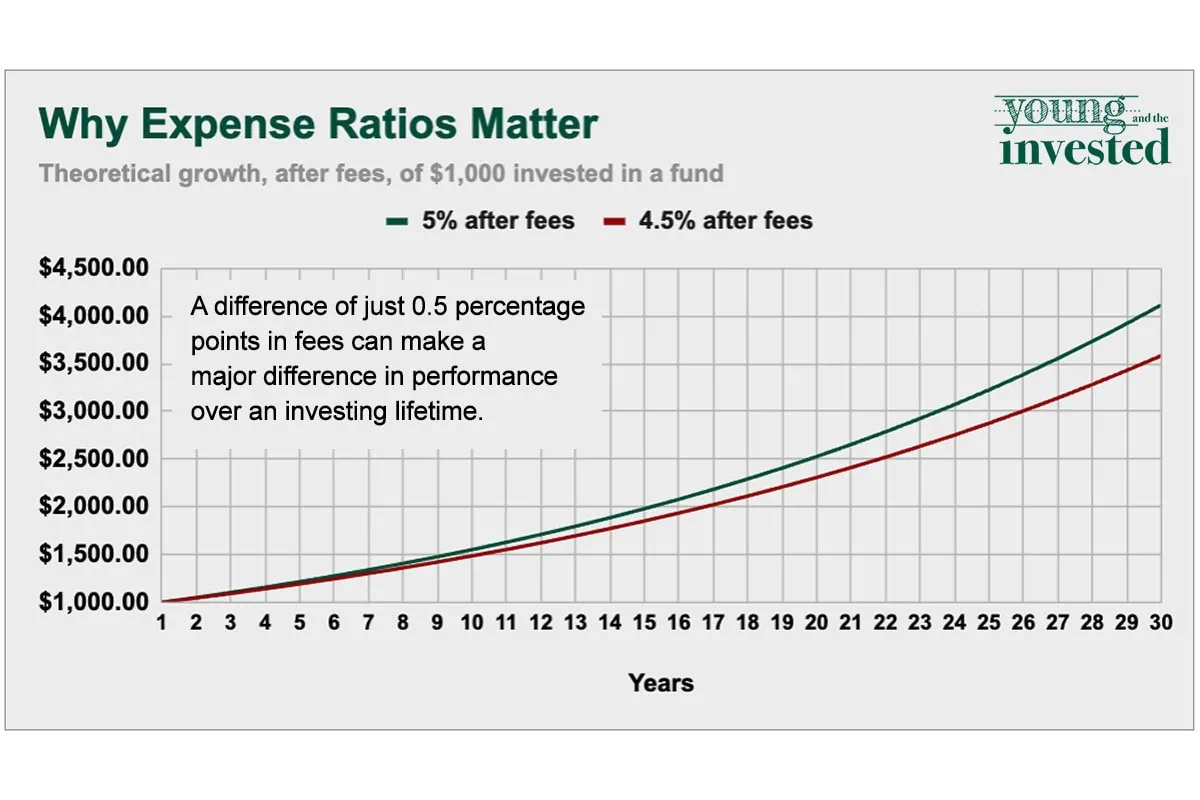
Every dollar you pay in expenses is a dollar that comes directly out of your returns. So, it is absolutely in your best interests to keep your expense ratios to an absolute minimum.
The expense ratio is the percentage of your investment lost each year to management fees, trading expenses and other fund expenses. Because index funds are passively managed and don’t have large staffs of portfolio managers and analysts to pay, they tend to have some of the lowest expense ratios of all mutual funds.
This matters because every dollar not lost to expenses is a dollar that is available to grow and compound. And over an investing lifetime, even a half a percent can have a huge impact. If you invest just $1,000 in a fund generating 5% per year after fees, over a 30-year horizon, it will grow to $4,116. However, if you invested $1,000 in the same fund, but it had an additional 50 basis points in fees (so it only generated 4.5% per year in returns), it would grow to only $3,584 over the same period.
Like Young and the Invested’s content? Be sure to follow us.
Want to talk more about your financial goals or concerns? Our services include comprehensive financial planning, investment management, estate planning, taxes, and more! Schedule a call with Riley to discuss what you need, and what we can do for you.

Related: The 10 Best Dividend ETFs You Can Buy Now
We love exchange-traded funds (ETFs) because they can provide one-click access to hundreds, even thousands of stocks, while charging often minuscule fees.
One way to put that low-cost diversification to work? Collecting dividends. But trying to choose from literally hundreds of income-producing funds could take up a lot more time than you have. So let us help you narrow the field—check out our list of 10 top dividend ETFs.
Related: 10 Dividend Stocks That Pay You Each and Every Month
The vast majority of American dividend stocks pay regular, reliable payouts—and they do so at a more frequent clip (quarterly) than dividend stocks in most other countries (typically every six months or year).
Still, if you’ve ever thought to yourself, “it’d sure be nice to collect these dividends more often,” you don’t have to look far. While they’re not terribly common, American exchanges boast dozens of monthly dividend stocks.
Please Don’t Forget to Like, Follow and Comment
Did you find this article helpful? We’d love to hear your thoughts! Leave a comment with the box on the left-hand side of the screen and share your thoughts.
Also, do you want to stay up-to-date on our latest content?
1. Follow us by clicking the [+ Follow] button above,
2. Subscribe to Retire With Riley, our free weekly retirement planning newsletter, and
3. Give the article a Thumbs Up on the top-left side of the screen.
4. And lastly, if you think this information would benefit your friends and family, don’t hesitate to share it with them!