




Financial experts commonly tell us that the key to achieving long-term investment success is simply to make an investment plan and stick to it. The first part is easy; the second is where it gets tricky. But products like Fidelity’s target-date funds can help.
Investing isn’t necessarily difficult, but it does require your attention. You have to regularly check your allocation to make sure the risk you’re taking is appropriate for your age and stage of life. You generally don’t want to be too heavy in bond funds early in your career because you’re unlikely to keep pace with inflation. You have the ability to take more risk because time is on your side; you have years or even decades to recover losses. You’re also pulling in a paycheck and have the ability to offset losses by simply saving and investing more.
But you generally don’t want to be too heavy in stock mutual funds later in life, as you won’t have time to recover any potential losses. The calculus changes. You have less time to recoup losses, and once you are retired you can’t replace losses by saving and investing more. So, it’s important to invest more conservatively and avoid gambling with your golden years.
In an ideal investment plan, you follow a glidepath (a plan that shifts your investing mix over time) from more aggressive to more conservative over the course of your investing life. It can be difficult to do this on your own, however. You might not have the skills, time, nor patience, plus market noise has a way of distracting us. When the market is ripping higher, it’s natural to want to take more risk, regardless of whether you should. And when the market is looking rough, it’s psychologically hard to add risk even when you need to in order to meet your long-term goals. But target-date funds (TDFs) can stay our hand.
Today, I want to talk to you about four Fidelity target-date fund lineups: the three Fidelity Freedom target-date fund series, as well as a fourth set of sustainable TDFs. I’ll start by going over what a target-date fund is and does, discuss why shifting assets is so important, and then delve into specifically what Fidelity’s target-date funds have to offer.
Editor’s Note: The tabular data is up-to-date as of Aug. 10, 2026.
Featured Financial Products
Disclaimer: This article does not constitute individualized investment advice. Individual securities, funds, and/or other investments appear for your consideration and not as personalized investment recommendations. Act at your own discretion.
Table of Contents
What Is a Target-Date Fund?

Target-date funds are a type of mutual fund that have become a retirement planning staple. You might also know them as lifecycle funds, age-based funds, and dynamic-risk fund.
Whatever you call them, the concept is simple: Target-date funds invest in a more aggressive portfolio of predominantly equity funds to start, then gradually shift to a more conservative portfolio of mostly bond funds as they approach a target retirement date. However, the target-date fund’s allocation to stocks will generally never go to zero. Retirees need at least some growth, which means they should maintain at least a little exposure to the stock market.
The beauty of the target-date fund is that it changes your asset allocation to match your risk tolerance as you age—and it does it automatically without requiring you to actually do anything.
Also, the target retirement dates are intended to be estimates; they don’t have to be super precise. Most mutual fund families will create target date funds in five-year increments (say, 2025, 2030, 2035, etc.).
For the investor, the math here is simple enough.
Target-Date Funds Example
Let’s say you turned 40 years old in 2025, and that you expect to work until age 70. Your expected retirement date would be in the year 2055. So, investing in a target-date fund with a retirement date of 2055 would make sense.
If your retirement date falls in between five-year increments, that’s no problem! If you planned on retiring in 2058, for instance, you could invest in a 2055 fund, a 2060 fund, or a combination of the two.
What if your expected retirement age changes? No problem! Target-date funds are normal mutual funds and can be bought or sold as your needs change.
Do you want to get serious about saving and planning for retirement? Sign up for Retire With Riley, our free retirement planning newsletter.
What Is Asset Allocation?

A lot of investors (and particularly young investors) dream of making a killing picking stocks. And why not? Stock picking is stimulating and, if done well, can add some zeros to your net worth!
When push comes to shove, however, your asset allocation strategy is far more important than individual stock picking when it comes to meeting your financial goals. Asset allocation sits at the core of target-date funds and, really, at the core of all financial planning.
But what exactly is asset allocation?
Every planner has their own take, but the basic idea is simple. You diversify your portfolio across different asset classes (stocks and bonds, for instance) that, ideally, move at least somewhat independently of each other. A typical asset allocation will include:
- Stocks (or stock mutual funds)
- Fixed-income investments (bonds or bond funds)
- Cash
- Alternative assets such as gold, commodities, or real estate
You arrange the parts so that the overall portfolio has a risk and return profile that makes sense for you. And (importantly) you rebalance the portfolio when the weights to each asset start to divert from your plan.
Related: 8 Best Schwab Index Funds for Thrifty Investors
Empower Advisory Group offers a comprehensive wealth management service known as Personal Strategy Investment Services.
This managed account solution provides clients with discretionary investment management, personalized portfolio construction, and access to financial planning support.

Asset Allocation Example
Let’s say your ideal asset allocation had you 70% allocated to stocks and 30% allocated to fixed income.
First, let’s say the stock market crashes. Your stock weighting has suddenly dropped to just 50%, and your fixed-income investments have jumped to 50% of your portfolio’s worth. You need to rebalance your portfolio to get back to 70/30. You would do that by selling off some of the fixed-income investments and buying some stock.
Now, let’s say instead that the stock market shoots higher, and you find yourself allocated 80% to stocks and 20% to fixed-income investments. If you wanted to rebalance back to 70/30, you would sell some of your stocks and buy new fixed-income investments.
The idea here is to constantly reduce risk and smooth out your returns by buying low and selling high.
Asset allocation within a target-date fund takes it a step further. Apart from regular rebalancing due to market moves, the target-date fund’s asset allocation decisions involve gradually reducing the risk (buying fewer and less risky stocks, and buying more bonds) as the fund gets closer to its target retirement date.
Related: Best Vanguard Retirement Funds for a 401(k) Plan
Make sure you sign up for The Weekend Tea, our free weekly newsletter that over 10k monthly readers use to level up their money know-how.
A Look at Fidelity’s Target-Date Funds
Fidelity is, of course, one of the largest mutual fund companies in the world. Fidelity’s mutual funds and Fidelity’s ETFs are among some of the best-rated and fee-friendly on the market.
The same goes for Fidelity’s target-date funds. The company currently offers a massive batch of 56 products split evenly among four different lineups. They’re popular funds that frequently show up in 401(k) plans but also command billions in assets from people investing through their individual retirement accounts.
All Fidelity target-date funds share a few characteristics in common, most notably that they all hold underlying funds managed by Fidelity. (Essentially, you can think of a Fidelity target-date fund as a portfolio of regular Fidelity mutual funds specifically allocated for a person your age.)
But there are significant differences, such as fees and specific holdings, from one lineup to the next. And those differences will ultimately educate which target-date fund is appropriate for you.
Related: Beginner’s Guide to Schwab Target-Date Funds
Featured Financial Products
Fidelity Freedom Funds
The Fidelity Freedom Funds are a family of 14 total funds: 13 target-date funds with target retirement dates currently spanning 2010 to 2070, as well as an income-focused fund, the Fidelity Freedom Income Fund (FFFAX):
| Fund | Ticker | Expense Ratio* |
|---|---|---|
| Fidelity Freedom Retirement Fund | FFFAX | 0.46% |
| Fidelity Freedom 2010 Fund | FFFCX | 0.46% |
| Fidelity Freedom 2015 Fund | FFVFX | 0.49% |
| Fidelity Freedom 2020 Fund | FFFDX | 0.54% |
| Fidelity Freedom 2025 Fund | FFTWX | 0.58% |
| Fidelity Freedom 2030 Fund | FFFEX | 0.61% |
| Fidelity Freedom 2035 Fund | FFTHX | 0.63% |
| Fidelity Freedom 2040 Fund | FFFFX | 0.66% |
| Fidelity Freedom 2045 Fund | FFFGX | 0.68% |
| Fidelity Freedom 2050 Fund | FFFHX | 0.68% |
| Fidelity Freedom 2055 Fund | FDEEX | 0.68% |
| Fidelity Freedom 2060 Fund | FDKVX | 0.68% |
| Fidelity Freedom 2065 Fund | FFSFX | 0.68% |
| Fidelity Freedom 2070 Fund | FRBDX | 0.68% |
| * Represents "acquired fund fees and expenses," which are the fees and expenses of the underlying funds. | ||
Fund managers build the allocations for each up exclusively from underlying Fidelity funds. And each of the Fidelity Freedom Funds are expected to reach their most conservative allocation 10 to 19 years after the target date. At that point, the target asset allocation is expected to be similar to Fidelity Freedom Retirement (25% stocks, 70% bonds, and 5% cash or short-term funds). Once the fund has passed its target date, its assets will eventually be merged with FFFAX.
While the process is designed to follow a glidepath, the funds are actively managed and involve a degree of human discretion.
Let’s take a look at a couple examples.
Related: The 16 Best ETFs to Buy for the Rest of 2026
Fidelity Freedom 2070 Fund (FRBDX)
The most aggressive fund currently in the lineup is the Fidelity Freedom 2070 Fund (FRBDX), which would be appropriate for an investor in their early 20s who intends to retire around the age of 65.
FRBDX allocates 94% of its assets to stocks (split between 53% U.S. and 41% international)*. The remaining 6% is invested in bonds. That’s the highest exposure to stocks within this Fidelity Freedom series; the closer to retirement, the less exposure to equity and the more exposure to debt.
Fidelity Freedom 2070 gets its stock exposure through funds such as the Fidelity Series Emerging Markets Opportunities Fund (FEMSX), Fidelity Series Large Cap Stock Fund (FGLGX), and Fidelity Series Growth Company Fund (FCGSX). Its bond exposure is provided through funds such as the Fidelity Series Long-Term Treasury Bond Index Fund (FTLTX). Note: Fidelity’s “Series” share class is only open to Freedom Funds and other asset management programs; you and I can’t just buy them through our brokerage accounts.
FRBDX charges 0.68% in annual expenses, which is lower than the average across traditional actively managed mutual funds.
Related: 10 Best ETFs to Beat Back a Bear Market
Fidelity Freedom 2035 Fund (FFTHX)
Now, let’s consider the Fidelity Freedom 2035 Fund (FFTHX). The 2035 fund would be appropriate for someone in their mid-50s that planned to retire around the age of 65. This fund is more conservative than the 2070 fund, but it still has a 69% allocation to stocks (38% U.S. equities, 31% international equities). It charges 0.63% in annual expenses.
Remember: Fidelity’s concept of what an ideal asset allocation is for a person at a given age might not exactly line up with yours. By the time you’re 60, you might consider having a 69% allocation to stocks to be far too aggressive. So, while target-date funds are designed to be “set it and forget it,” you still need to periodically check in to make sure you’re comfortable with the risk being taken.
Related: How to Start a Retirement Plan [Build Your Retirement Savings]
Fidelity Freedom Index Funds

Index funds have made the world a better place for investors ever since Vanguard’s John Bogle launched the concept in 1975. Due in large part to their lower fees and lower frictional expenses like brokerage commissions, index funds generally outperform their actively managed counterparts over time.
So, if index funds are good for your stock and bond funds, why not for your target-date funds too?
That’s exactly what the Fidelity Freedom Index Funds offer. It’s the exact same target-date concept as the original Fidelity Freedom funds, but this family of index target-date funds builds its portfolios exclusively from Fidelity’s large selection of low-cost index funds:
| Fund | Ticker | Expense Ratio* |
|---|---|---|
| Fidelity Freedom Index Retirement Fund | FIKFX | 0.12% |
| Fidelity Freedom Index 2010 Fund | FKIFX | 0.12% |
| Fidelity Freedom Index 2015 Fund | FLIFX | 0.12% |
| Fidelity Freedom Index 2020 Fund | FPIFX | 0.12% |
| Fidelity Freedom Index 2025 Fund | FQIFX | 0.12% |
| Fidelity Freedom Index 2030 Fund | FXIFX | 0.12% |
| Fidelity Freedom Index 2035 Fund | FIHFX | 0.12% |
| Fidelity Freedom Index 2040 Fund | FBIFX | 0.12% |
| Fidelity Freedom Index 2045 Fund | FIOFX | 0.12% |
| Fidelity Freedom Index 2050 Fund | FIPFX | 0.12% |
| Fidelity Freedom Index 2055 Fund | FDEWX | 0.12% |
| Fidelity Freedom Index 2060 Fund | FDKLX | 0.12% |
| Fidelity Freedom Index 2065 Fund | FFIJX | 0.12% |
| Fidelity Freedom Index 2070 Fund | FRBVX | 0.12% |
| * Represents "acquired fund fees and expenses," which are the fees and expenses of the underlying funds. | ||
Let’s look at an example.
Related: Best Schwab Retirement Funds for a 401(k) Plan
Fidelity Freedom Index 2035 Fund (FIHFX)
We’ll compare the Fidelity Freedom Index 2035 Fund (FIHFX) to its sister product, the Fidelity Freedom 2035 Fund.
The index-only Fidelity Freedom fund has an expense ratio of just 0.12% compared to 0.63% for the active target-date fund. Those 51 basis points (a basis point is one one-hundredth of a percentage point) might not sound like much of a difference, but over time it compounds. If you invested $10,000 into both funds over the course of 10 years, and both earned 10% before fees, you would earn $1,278 more from the index fund once fees were factored in—and the difference would get wider with time.
Related: How Much to Save for Retirement by Age Group [Get on Track]
But understand there can be slight differences in asset allocation between the active Fidelity Freedom funds and their Index Freedom Fund peers.
The indexed 2035 fund invests roughly 65% of assets in equities, which is more conservative than the active 2035 fund’s 68%. The U.S./international splits are a little different, at 39/26for FIHFX but 38/30 for FFTHX.
This isn’t a static allocation, either. Sometimes, the actively managed FFTHX has an even more aggressive stance, favoring stocks as a whole (and U.S. stocks specifically) more than FIHFX. Sometimes it’s less. You can chalk this up to the preferences of FFTHX’s managers. For what it’s worth, the actively managed 2070 fund has an average annual return of 10.6% over the trailing five-year period, versus 10.1% for its indexed sister. That lead might revert over time—but it might not.
Thus, when choosing between the active and indexed Fidelity Freedom funds, you have to weigh the benefits of manager discretion against the lower cost of index investing.
Fidelity Freedom Blend Funds
Typically, the term “blend fund” actually refers to a type of stock fund that holds both value and growth stocks. But in the case of the Fidelity Freedom Blend Funds, what Fidelity is “blending” is active and passive management.
That is, Fidelity Freedom Blend Funds are target-date funds that hold a combination of actively managed and indexed Fidelity funds to meet their goals:
| Fund | Ticker | Expense Ratio* |
|---|---|---|
| Fidelity Freedom Blend Retirement Fund | FHBZX | 0.41% |
| Fidelity Freedom Blend 2010 Fund | FHAYX | 0.41% |
| Fidelity Freedom Blend 2015 Fund | FHAWX | 0.42% |
| Fidelity Freedom Blend 2020 Fund | FHAVX | 0.43% |
| Fidelity Freedom Blend 2025 Fund | FHAUX | 0.44% |
| Fidelity Freedom Blend 2030 Fund | FHATX | 0.45% |
| Fidelity Freedom Blend 2035 Fund | FHASX | 0.47% |
| Fidelity Freedom Blend 2040 Fund | FHARX | 0.47% |
| Fidelity Freedom Blend 2045 Fund | FHAQX | 0.47% |
| Fidelity Freedom Blend 2050 Fund | FHAPX | 0.47% |
| Fidelity Freedom Blend 2055 Fund | FHAOX | 0.47% |
| Fidelity Freedom Blend 2060 Fund | FHANX | 0.47% |
| Fidelity Freedom Blend 2065 Fund | FFBSX | 0.47% |
| Fidelity Freedom Blend 2070 Fund | FRBYX | 0.47% |
| * Represents "acquired fund fees and expenses," which are the fees and expenses of the underlying funds. | ||
We cover an example of how this plays out with the Fidelity Freedom Blend 2065 Fund (FFBSX).
Related: The 13 Best Mutual Funds for the Rest of 2026
Fidelity Freedom Blend 2035 Fund (FHASX)
Fidelity Freedom Blend 2035 Fund (FHASX) holds index funds including the Fidelity Series Large Cap Value Index Fund (FIOOX) and Fidelity Series Blue Chip Growth Index Funds (FSBDX), as well as actively managed funds, such as the emerging-markets fund FEMSX. It currently has a 38/30 blend of U.S. and international stocks, for a total of around 68%—it’s more aggressive than the indexed 2035 fund, and more conservative than the actively managed 2035 by just a few basis points.
As you might expect, expenses for FHASX’s expense ratio of 0.47% falls in between the purely indexed target-date fund and the fully actively managed fund. Performance falls in the middle, too. The Blend series debuted in 2018, so we can’t use 10-year returns. But by five-year returns, the actively managed fund has grown by 7.8% annually versus 7.4% for FHASX and 7.3% for the indexed 2035 product.
Related: Retirement Plan Contribution Limits and Deadlines for 2026
Featured Financial Products
Fidelity Sustainable Target Date Funds

In 2023, Fidelity launched its Fidelity Sustainable Target Date lineup, which like the Freedom funds, includes a product specific to every five years, as well as an income fund.
| Fund | Ticker | Expense Ratio* |
|---|---|---|
| Fidelity Sustainable Target Date Retirement Fund | FSUDX | 0.41% |
| Fidelity Sustainable Target Date 2010 Fund | FSUYX | 0.41% |
| Fidelity Sustainable Target Date 2015 Fund | FSVNX | 0.42% |
| Fidelity Sustainable Target Date 2020 Fund | FSWDX | 0.43% |
| Fidelity Sustainable Target Date 2025 Fund | FSWOX | 0.44% |
| Fidelity Sustainable Target Date 2030 Fund | FSXAX | 0.45% |
| Fidelity Sustainable Target Date 2035 Fund | FSXKX | 0.47% |
| Fidelity Sustainable Target Date 2040 Fund | FSXVX | 0.48% |
| Fidelity Sustainable Target Date 2045 Fund | FSYHX | 0.49% |
| Fidelity Sustainable Target Date 2050 Fund | FSYWX | 0.49% |
| Fidelity Sustainable Target Date 2055 Fund | FSZHX | 0.49% |
| Fidelity Sustainable Target Date 2060 Fund | FSZSX | 0.49% |
| Fidelity Sustainable Target Date 2065 Fund | FTGPX | 0.49% |
| Fidelity Sustainable Target Date 2070 Fund | FRCQX | 0.49% |
| * Represents "acquired fund fees and expenses," which are the fees and expenses of the underlying funds. | ||
In addition to leading investors down the proper glidepath to retirement, these funds also try to invest in assets with positive environmental, social, and governance (ESG) characteristics. It can do so by investing in:
- Actively managed funds that buy securities of issuers that are believed to have good or improving sustainability or ESG characteristics
- Index funds that track an ESG index
- Funds that don’t necessarily have a principal ESG investment strategy, but that have at least 80% of assets in debt securities that the adviser believes have positive ESG characteristics
Related: The 10 Best Dividend ETFs [Get Income + Diversify]
Like with Fidelity Freedom Blend Funds, Fidelity Sustainable Target Date Funds sport expense ratios falling between their fully passive and fully active brethren. Fidelity Sustainable Target Date 2035 Fund (FSXKX), for instance, charges 0.49% annually.
FTGPX is a bit more aggressive than all of the previously mentioned funds, at a 69/31 split of stocks and bonds. However, given the extremely short time since inception, performance numbers here don’t tell us much.
Learn More About These and Other Funds With Morningstar Investor

If you’re buying a fund you plan on holding for years (if not forever), you want to know you’re making the right selection. And Morningstar Investor can help you do that.
Morningstar Investor provides a wealth of information and comparable data points about mutual funds and ETFs—fees, risk, portfolio composition, performance, distributions, and more. Morningstar experts also provide detailed explanations and analysis of many of the funds the site covers.
With Morningstar Investor, you’ll enjoy a wealth of features, including Morningstar Portfolio X-Ray®, stock and fund watchlists, news and commentary, screeners, and more. And you can try it before you buy it. Right now, Morningstar Investor is offering a free seven-day trial and a discount on your first year’s subscription when you use our exclusive link.
How Do Fidelity Freedom Funds Compare to Vanguard Target Retirement Funds?

As a general rule, you’re going to get a very similar experience in both Fidelity Freedom funds and Vanguard Target Retirement funds. Both offer low-cost access to an asset allocation model that glides from more aggressive to more conservative as you reach your targeted retirement date.
But there can be differences, and those differences matter.
Let’s compare the Fidelity Freedom Index 2040 Fund (FBIFX) to the Vanguard Target Retirement 2040 Fund (VFORX). Both have rock-bottom expense ratios of 0.12% and 0.08%, respectively. It’s close enough that fees alone aren’t going to move the needle much in terms of returns.
Related: 6 Best Money Market Funds [Protect Your Savings in 2026]
The asset allocations are noticeably different, however. FBIFX currently has 48% of assets invested in U.S. stocks and another 32% in international equities—so, 80% invested in stocks. Meanwhile, VFORX is currently invested 44% in U.S. equities and 29% in international equities, for a total stock exposure of 73%.
As another example, let’s consider funds that already assume you’re in retirement. The Fidelity Freedom Index 2020 Fund Investor Class (FPIFX) has 44% of its assets invested in stocks, whereas the Vanguard Target Retirement 2020 Fund (VTWNX) weights stocks at about 34%. Also worth noting: FPIFX has a sub-1% weight in the Fidelity Series Commodity Strategy Fund (FCSSX), which means you’re getting a little bit of commodities exposure. That’s uncommon among the larger target-date series.
The Fidelity target-date funds consistently have more stock exposure than the Vanguard target-date funds of a comparable target date. They’re a little more aggressive, and that’s neither good nor bad. But it’s something you should consider as you choose the right target-date fund for you.
Related: The 10 Best ETFs for Beginners
Are Indexed Target-Date Funds Better Than Actively Managed Funds?
This is an eternal debate, and the answer is “it depends.”
Some active managers effectively beat their indexed competition even after the higher fees, trading expenses and tax considerations are taken into account. Most, however, do not. Over the past two decades, there have been only three years—2005, 2007, and 2009—in which a majority of large-cap managers beat the S&P 500. So, as a general rule, it is safe to assume that indexed target-date funds will be your better option over time.
Furthermore, active management can muddle the waters of a target date strategy, particularly if the active manager regularly makes defensive moves, such as going to cash. The percentage of the portfolio you have exposed to stocks is determined by the number of years until the retirement date, and active management can potentially skew your weights outside of the target.
Do you want to get serious about saving and planning for retirement? Sign up for Retire With Riley, our free retirement planning newsletter.
Why Does a Fund’s Expense Ratio Matter So Much?
Every dollar you pay in expenses is a dollar that comes directly out of your returns. So, it is absolutely in your best interests to keep your expense ratios to an absolute minimum.
The expense ratio is the percentage of your investment lost each year to management fees, trading expenses and other fund expenses. Because index funds are passively managed and don’t have large staffs of portfolio managers and analysts to pay, they tend to have some of the lowest expense ratios of all mutual funds.
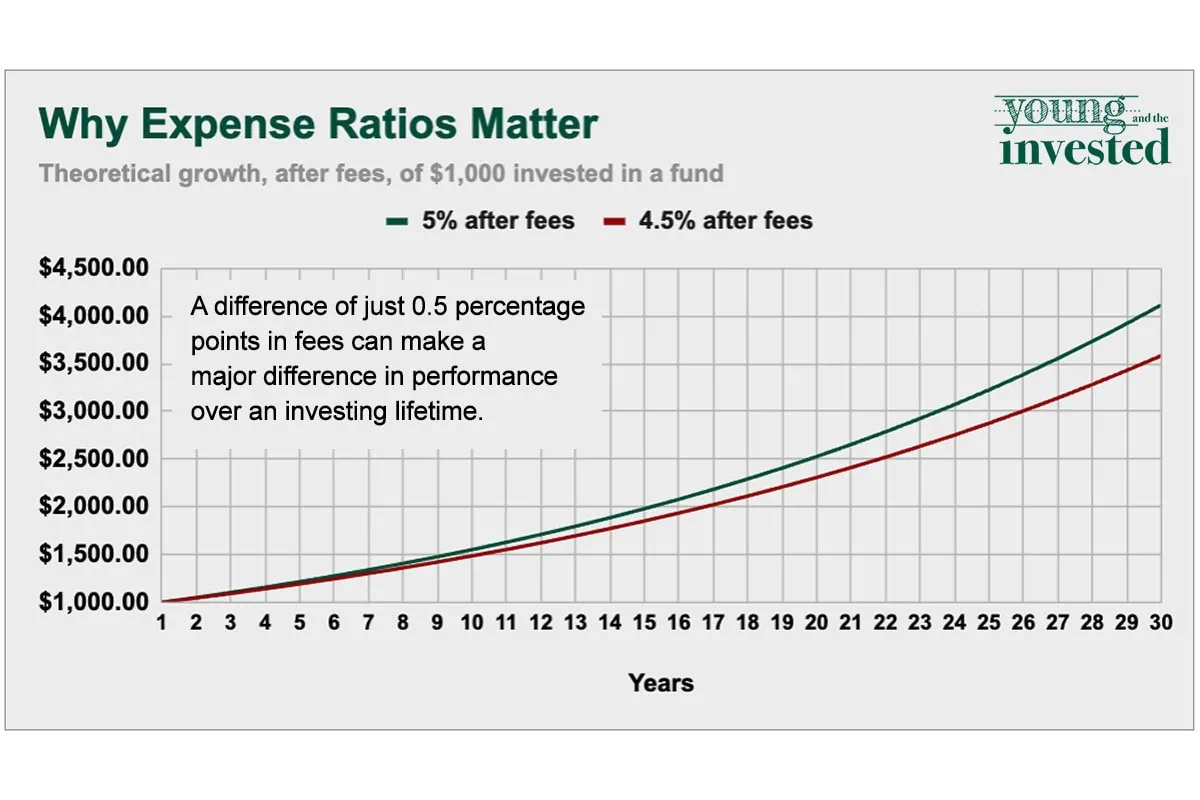
This matters because every dollar not lost to expenses is a dollar that is available to grow and compound. And over an investing lifetime, even a half a percent can have a huge impact. If you invest just $1,000 in a fund generating 5% per year after fees, over a 30-year horizon, it will grow to $4,116. However, if you invested $1,000 in the same fund, but it had an additional 50 basis points in fees (so it only generated 4.5% per year in returns), it would grow to only $3,584 over the same period.
Empower Advisory Group offers a comprehensive wealth management service known as Personal Strategy Investment Services.
This managed account solution provides clients with discretionary investment management, personalized portfolio construction, and access to financial planning support.
What Is the Minimum Investment Amount on a Fidelity Fund?
Every Fidelity fund has its own minimum investment amount specific to that fund. But Fidelity has been a trailblazer in making its funds available to beginning investors with ultra-low minimums, and many Fidelity funds have no minimum investment at all.
Part of our criteria in selecting the best Fidelity index funds was accessibility, and every fund selected here has a minimum investment of zero, meaning you can literally start your investment with any dollar amount.
Want to talk more about your financial goals or concerns? Our services include comprehensive financial planning, investment management, estate planning, taxes, and more! Schedule a call with Riley to discuss what you need, and what we can do for you.

Disclosure About Allocation Math
* All allocations reported in this article have been adjusted to represent percentage of total exposure, which isn’t always 100%.
For instance: FRBDX technically allocates 100% of assets to stocks, then another 6% to bonds. Yes, that adds up to 106%.
Target-date funds sometimes use derivatives such as options and futures to accomplish their investing goals in a way they couldn’t by purchasing and selling assets alone. Fidelity currently lists negative 6% of assets in “net other assets,” which is a catch-all for receivables, payables, assets that don’t fall into the composition categories, and offsets to derivative positions. A significant (1%+) negative number may point to the use of derivatives.
Is this good or bad? It’s difficult to say. Use of derivatives can increase risk, but it can also be a more cost-efficient way to replicate parts of an allocation. Also, the implied use of derivatives in Fidelity Freedom Funds is modest.
But the negative number is how we get to 100%. The very rough math for FFSFX: 100% stocks plus 6% bonds plus negative 6% net other assets = 100%. To get the adjusted allocations for stocks and bonds, I divided the figure by 106 and multiplied by 100. So, for FFSFX’s stock allocation, 100 / 106 * 100 = ~94%.
Lastly, not all Fidelity Freedom Funds use derivatives. For instance, net other assets in the indexed FIHFX are less than one-tenth of 1%.
Related: 8 High-Quality, High-Yield Dividend Stocks
It’s difficult to resist the charm of high-yield dividend stocks. Their ability to generate outsized amounts of cash makes them the stuff of dreams for those living on a fixed income—as well as for any investors who simply want a little performance ballast during periods of rough stock-price returns.
But we prefer quantity and quality. For instance, our favorite high-yield dividend stocks deliver much sweeter yields than the average stock, show more signs of fundamental quality than most, and have the confidence of Wall Street’s analyst community.
Related: 10 Best Monthly Dividend Stocks for Frequent, Regular Income
The vast majority of American dividend stocks pay regular, reliable payouts—and they do so at a more frequent clip (quarterly) than dividend stocks in most other countries (typically every six months or year).
Still, if you’ve ever thought to yourself, “it’d sure be nice to collect these dividends more often,” you don’t have to look far. While they’re not terribly common, American exchanges boast dozens of monthly dividend stocks.
Please Heart ❤️, Follow and Subscribe
Did you find this article helpful?
1. Click the Heart Button.
2. Follow WealthUpdate —-> https://flipboard.com/@WealthUpdate
3. Subscribe to Retire With Riley, our free weekly retirement planning newsletter.