


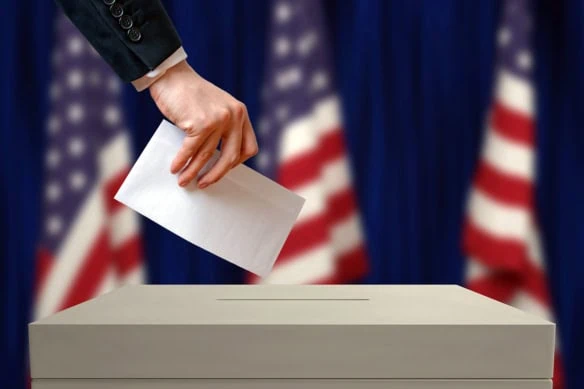
The midterms are coming! The midterms are coming!
We might be invoking Paul Revere because the financial media has indeed been sounding the alarm about how the economic and stock-market landscapes could change based on the results of the upcoming 2026 midterm elections.
Or we might be invoking him because Kyle has been replaying Assassin’s Creed III of late, and his mind has been clouded with revolutionaries sending the Brits packing.
Who’s to say?
But more to the point of today’s letter: Many investors are taking action in anticipation of what they believe will happen once Americans submit their ballots. And our thoughts on that can be summed up in the famous three words of one of our favorite home-inspections-related accounts:
“Don’t do that.”
2 in 5 Americans Have Made Pre-Midterm Portfolio Shifts

A sizable 40% of investors have made changes to their retirement savings or portfolios in anticipation of the midterm elections, according to a recent Nationwide survey¹ of 2,029 investors, as well as 538 advisors and financial professionals. And a little more than 20% say they’re considering doing so before we reach November.
Roughly 3 in 4 investors believe the outcome of these midterm elections could have a meaningful impact on their long-term financial plan. That’s indeed possible if not outright likely!
But it’s not just prudent planning driving their portfolio shifts. More than half (56%) say the upcoming midterm elections are making them feel more anxious.
“Political anxiety isn’t emerging in a vacuum; it’s colliding with an economy that already has investors on edge from ongoing inflation and rising interest rates,” says Mark Hackett, chief market strategist for Nationwide’s Investment Management Group. “As a result, we’re seeing some investors move from concern to action, whether that means adjusting portfolios or seeking out strategies they believe will perform better in today’s uncertainty.”
Indeed, 15% of respondents said they moved money into conservative or lower-risk investments, while another 13% said they diversified into different asset classes or sectors.
Empower Advisory Group offers a comprehensive wealth management service known as Personal Strategy Investment Services.
This managed account solution provides clients with discretionary investment management, personalized portfolio construction, and access to financial planning support.

Investments and Elections: 5 Questions, 15 Answers From the Pros

The problem is that, much like trying to time the market is a sucker’s game, changing your retirement and investment goals based on what happens in Washington, D.C. can be counterproductive, too.
But don’t take our word for it.
This week, we tapped a trio of investment experts for their thoughts about investing around the upcoming elections, as well as around politics in general, and what they tell their clients when discussing political subjects.
Young and the Invested Tip: To be clear: Rebalancing is good, and we’ll even show you how to do it. But don’t reshuffle because you think you’re an elections psychic.
1. Why do people feel compelled to adjust their portfolios ahead of midterms and presidential elections?
Massimo Santicchia, Head of U.S. Equities at registered investment advisory firm Procyon: Elections concentrate uncertainty around a specific date, making investors feel they need to act. Political convictions also tend to influence how people perceive economic risk. When investors strongly favor one outcome, they may overestimate the financial consequences of the alternative. The desire to protect accumulated wealth is understandable, but taking action can create a false sense of control.
The fact that we know when an election will occur does not mean we know how markets will react to its outcome.
Jason Stephens, Partner and Managing Director at wealth management firm Evertern Wealth: In my more than 25 years of advising families through multiple election cycles, I have found that investors generally dislike uncertainty more than they dislike volatility. Elections create an emotional environment where people feel they need to do something to protect their wealth, particularly when the headlines suggest significant changes to taxes, government spending, interest rates, or economic policy.
The challenge is that investors often allow their political views to influence their investment decisions. Whether someone is a Republican or Democrat, their financial goals, retirement needs, and long-term investment objectives generally don’t change because of an election. Unfortunately, emotions can lead investors to make decisions that ultimately hurt their long-term returns.
Adam Phillips, Managing Director of Investments at EP Wealth Advisors, a registered investment advisor: The media attention surrounding midterms adds noise and can create the urge to trade, as taking action can help calm anxiety and give investors a sense of control. In this polarized environment, investor sentiment is often influenced by political beliefs, so midterms present another opportunity to vote with one’s wallet, even if that’s often not the prudent thing to do.
2. Do you believe it is a good idea to make investment decisions in anticipation of elections?
Santicchia: Generally, no. Investing based on an election requires getting several predictions right: who wins, which policies are implemented, how those policies affect the economy, and how financial markets respond. That’s a difficult combination to forecast consistently. Consider 2022, when both stocks and bonds suffered significant losses. The dominant forces were inflation reaching 9.1% and 425 basis points² of Federal Reserve tightening, rather than the midterm election. Our focus is on measurable economic and financial conditions, including growth, inflation, interest rates, and credit risk. Those are the variables that ultimately influence asset returns.
Stephens: I would distinguish between making tactical adjustments to a portfolio and making wholesale changes based on an anticipated election outcome.
We absolutely evaluate how different election outcomes could affect sectors of the economy, corporate earnings, tax policy, and interest rates. For example, certain sectors may benefit from changes in regulation, fiscal spending, or tax policy. These can create opportunities to modestly adjust portfolio allocations.
However, I would strongly caution against making significant changes to a long-term investment strategy based on who you believe will win an election. Markets have historically performed well under both Republican and Democratic administrations. More importantly, corporate earnings, economic growth, and interest rates tend to have a much greater influence on long-term investment returns than which political party controls Washington.
Phillips: Generally, we advise against making significant portfolio changes ahead of political elections. We’ve seen plenty of evidence that pre-election polls can get it wrong. But even if expected political results materialize, the policy and market impacts are far from certain. Investing based on the data allows us to keep our emotions and political biases out of decision making. For instance, we’re in the middle of what is expected to be another solid earnings season, with expected year-over-year growth of 30%. No matter your political leanings or the outcome in November, it’s hard to be too pessimistic on the market outlook in the current environment.
Young and the Invested Tip: We believe in being ready for anything. Our favorite ETFs include funds built for the long haul, as well as more tactical plays.
3. Does your opinion change after election results are decided?
Santicchia: The election result resolves one uncertainty, but the economic consequences may take months or years to develop. What matters is whether the resulting policies actually change growth expectations, corporate profitability, inflation, or interest rates. Markets also anticipate political outcomes, so the initial reaction may already reflect expectations formed well before election day. I would avoid making significant portfolio adjustments based solely on the immediate market reaction. We should respond to evidence that the investment environment is changing, rather than assume that an election result tells us what comes next.
Stephens: Once the election is behind us, some uncertainty is removed, but that doesn’t necessarily mean investors should immediately reposition their portfolios.
One of the things we pay particular attention to is whether we have a divided government or one party controlling both Congress and the White House. Historically, markets have often performed well during periods of divided government, as significant legislative changes become more difficult to implement, creating a degree of policy stability.
We may make tactical adjustments to certain sectors as the policy outlook becomes clearer, but we are far more interested in what gets implemented than what politicians promised during their campaigns. There is often a significant difference between campaign rhetoric and actual economic policy. Ultimately, our investment decisions will continue to be driven primarily by corporate earnings, economic growth, interest rates, and long-term fundamentals rather than political predictions.
Phillips: Our views may change once election results are known and we have additional information, but changes would likely be made at the margin. As a hypothetical, if Democrats were to sweep in November, we might consider changes to our artificial intelligence exposure given the greater likelihood of legislation that could slow the pace of datacenter development.
4. How much of a role should the political environment have in a person’s long-term investment choices?
Santicchia: Politics can influence taxes, regulation, government spending, and economic policy, so it deserves consideration. But its role should be proportional to its actual financial impact. An investor’s time horizon, liquidity needs, risk tolerance, and long-term financial objectives should remain the foundation of portfolio construction. Political developments may warrant adjustments when they produce identifiable changes in those fundamentals. An investment portfolio should reflect an investor’s financial objectives, not their political preferences.
Stephens: Politics should be a consideration in investment management, but it should never be the foundation of someone’s financial plan.
When we work with families, we are generally planning for the next 10, 20, or even 30 years, often across multiple generations. During that period, we will experience numerous elections, changes in political leadership, recessions, and periods of market volatility. Our primary focus is on maintaining an appropriate asset allocation, generating sufficient cash flow, managing taxes, and preserving purchasing power over time.
That said, tax legislation, estate planning rules and changes in government policy can have a meaningful impact on a family’s overall financial picture. In many cases, the greatest opportunity surrounding an election may not be changing investments at all, but rather reviewing tax strategies, Roth conversions, estate planning, or charitable giving.
Phillips: Politics is generally noise over the short term and should have little impact on one’s long-term portfolio decisions. Long-term market performance does not reflect a party bias. Policy can certainly influence the trajectory of the economy, but we’re more focused on the broader macroeconomic environment when determining our outlook and positioning client portfolios. Inflation, job growth, valuations, and earnings growth are ultimately more important drivers of long-term market performance.
Young and the Invested Tip: If you’re planning your finances out across multiple generations, you’ll want to be familiar with dynasty trusts.
5. What messaging have you found most effective in convincing clients to stay put around elections? Any anecdotes?
Santicchia: Throughout my career, beginning in 1998, I have encountered investors who became effectively paralyzed by elections, geopolitical crises or seasonal market narratives. My experience has taught me that simply telling investors not to worry is rarely effective. They need to understand the investment process and, particularly, what would actually cause a portfolio adjustment.
I usually bring the conversation back to a simple question: Has something changed in your financial circumstances or in the underlying investment environment, or are we reacting to uncertainty about an event we cannot control?
There’s an important distinction between remaining disciplined and remaining static. Some systematic strategies can reduce market exposure when their signals deteriorate; others remain invested and manage risk through diversification, rotation, or security selection.
The goal is not to convince investors to do nothing. It is to give them confidence that every investment decision—including the decision to maintain their current allocation—follows a disciplined, repeatable process.
Stephens: One of the most effective things I tell clients is that we don’t need to predict the next election correctly to have a successful investment strategy.
I remind families that over the past 25 years, we have navigated the technology bubble, the financial crisis, a global pandemic, inflation, rising interest rates, and numerous elections. Investors who maintained a disciplined, diversified investment strategy generally fared much better than those who repeatedly attempted to move in and out of the market based on headlines.
I also like to bring the conversation back to their individual financial plan. If a family has sufficient liquidity to fund several years of anticipated expenses, they should not feel compelled to sell long-term investments simply because they are uncomfortable with an election outcome.
I have had conversations with clients during previous election cycles who were convinced the market would decline significantly if a particular candidate won. My response has always been similar: Let’s revisit why we own these investments, what our cash flow needs are, and whether anything has fundamentally changed in our long-term outlook.
In many cases, simply reviewing the financial plan and showing clients that their retirement and lifestyle objectives remain intact is far more effective than debating politics or attempting to forecast the market.
My bottom line is that elections may influence how we position a portfolio at the margin, but they should not determine whether someone remains invested. Successful long-term investing requires discipline, not political predictions.
Phillips: While past performance is no guarantee, facts are friendly, and it’s important to remind investors that long-term market performance does not reflect a party bias. Following every midterm election since 1950, the S&P 500 has delivered positive returns over the subsequent 12 months. That’s a pretty compelling argument to stay the course, whether one agrees with the results or not.
Want to talk more about your financial goals or concerns? Our services include comprehensive financial planning, investment management, estate planning, taxes, and more! Schedule a call with Riley to discuss what you need, and what we can do for you.

¹ Nationwide Retirement Institute Study: Midterm Elections (October 2026)
² A basis point is one one-hundredth of a percentage point.
—
We very much appreciate you stopping by this week. And for everyone currently enjoying pumpkin spice season, this is a gentle reminder that it is also apple season. Cosmic Crisps deserve love, too.
Riley, Kyle & Hannah
Like what you’re reading but not yet a subscriber? Get our weekly financial insights and updates delivered to your inbox every Saturday morning by signing up for The Weekend Tea today! You can also follow us on Flipboard for more great advice and insights.