

The United States is very close to officially swearing in a new captain of its monetary policy.
In remarks following April’s Federal Open Market Committee (FOMC) meeting, Federal Reserve Chair Jerome Powell confirmed it would be his last time heading the central bank’s regular policy-setting summit.
Powell, whose second four-year term as chair is set to expire in mid-May, has big shoes to fill. Under his watch, the Federal Reserve successfully steered the economy through the COVID pandemic, helped limit inflation (relative to other developed nations) during the 2021-2023 surge in prices, and maintained the Fed’s independence under political pressure.
Today, we’re going to talk about his likely successor—and what it could mean for the direction of interest rates, inflation, and other issues.
Featured Financial Products
Let’s Talk About the Fed
It’s probably a safe enough assumption that everyone here broadly understands that the Federal Reserve helps set interest rates.
Past that, however, everyone’s knowledge is anyone’s guess, so I’m going to provide a few basics here so all readers are able to get something out of this.
What is the Federal Reserve System? It’s the central bank of the United States. It’s overseen by the Board of Governors of the Federal Reserve System—a seven-member board of appointed officials who serve 14-year terms. It also has 12 regional operating arms called Federal Reserve Banks.
What is the Chair of the Federal Reserve? This person oversees the Federal Reserve system. They’re nominated by the President of the United States (and confirmed by the Senate), but they must come from within the ranks of the Board of Governors.
Young and the Invested Tip: If interest rates do eventually go lower, that should mean good things for these and many other bond funds.
What does the Federal Reserve do? Like other central banks, it manages a country’s (America’s) currency, money supply, and monetary policy with some sort of economic goal in mind. In the case of the Fed, it has what’s called a “dual mandate” from Congress to 1.) ensure the U.S. reaches maximum employment while 2.) limiting inflation.
What is the Federal Open Market Committee? This branch of the Fed does a few things, but most notably, it sets the target range for the “federal funds rate.” This is the rate at which commercial banks charge one another for overnight loans. This rate ultimately influences a wide variety of interest rates that directly affect you and me—mortgages, auto loans, credit cards—as well as the cost of capital for businesses. The FOMC is run by the seven Federal Reserve Board governors, as well as five presidents of Federal Reserve Banks. These “voting” members elect the FOMC’s own chair; historically, they have always elected the Fed chair to lead the FOMC.
What is monetary policy? Monetary policy is how the central bank uses tools at its disposal to affect a nation’s money supply. Don’t confuse that with fiscal policy, which involves spending and taxation—here in the U.S., that’s controlled by Congress and the president.
What tools does the Fed use? The Federal Reserve says it has three policy tools:
- Open market operations: Buying and selling securities—usually Treasuries and mortgage-backed securities (MBSes)—in the open market. The Fed uses open market operations to steer interest rates toward its target range, buying securities to add money to the money supply and lower the interest rate, or selling securities to pull money out of the money supply and push interest rates higher. The FOMC is in charge of this tool.
- Discount window: The Federal Reserve can lend to depository institutions like banks to help them manage short-term liquidity risks. These loans are made at a different rate—the federal discount rate—and give banks access to funds when they can’t immediately get them from other lenders. This role is particularly important during times of economic stress.
- Reserve requirements: The Fed also requires banks to hold a certain amount of cash to cover deposits. (And if they don’t have enough, they might end up borrowing through the discount window, so there’s that connection.) While this speaks to bank safety, it can also heavily influence the money supply. For instance, reducing reserve requirements can spur lending and help to lower interest rates. The Board of Governors is in charge of both the discount window and reserve requirements.
That should be enough to get everyone up to speed.
Powell Is Out. Warsh Is (Likely) In.
Getting back to the original topic: Jerome Powell isn’t leaving the Federal Reserve entirely. He’s a member of the Board of Governors with a term that doesn’t expire until Jan. 31, 2028, and he has said he plans to continue serving, albeit “while keeping a low profile.”
But his term as Fed chair (and, effectively, FOMC chair) ends in mid-May. And he’s expected to be replaced by Kevin Warsh—President Donald Trump’s nominee to succeed Stephen Miran, a temporary Fed governor who started his term in March 2025. Warsh previously served as a Fed governor from 2006 to 2011 before resigning and has since worked as a partner at investment firm Duquesne Family Office.
Warsh hasn’t yet been fully confirmed by the Senate, but he was advanced by the Senate Banking Committee in late April, and his full floor confirmation vote is scheduled for May 11—a few days ahead of Powell’s May 15 term expiration.
So … what does all this mean for the central bank, interest rates, and the American economy?
Make sure you sign up for The Weekend Tea, Young and the Invested’s free weekly newsletter that over 10k monthly readers use to level up their money know-how.
What Does a New Fed Chair Mean for the Central Bank?
The Federal Reserve chair is often said to be the second-most powerful person in the United States. It makes sense from 10,000 feet—they’re the head of the system in charge of America’s monetary policy—but it’s a bit more complicated in practice.
The chair’s most concrete power is the one that’s rarely discussed: management of the Fed. They’re in charge of the Federal Reserve’s staff, and they get to set meeting agendas. These powers can hold a great deal of sway over not only what the Fed addresses, but also the information that is meted out to other Fed and FOMC members ahead of votes.
Young and the Invested Tip: One of the Fed’s most-watched economic signals is job growth. Here’s what the most recent employment report had to say.
“But doesn’t the FOMC chair set rates? I thought Powell had been setting rates this whole time.”
Not exactly. When it comes to policy decisions, the Federal Reserve chair has only one vote out of seven governors, and the FOMC chair has just one vote out of 12 members. That’s it. There are no unilateral policy decisions. If the FOMC wants to raise interest rates, for instance, it needs to get a simple majority (so, seven votes if everyone is present).
However, there are a few really compelling reasons why people think Powell and other Fed chairs rule with an iron fist.
- The chair speaks for the Fed/FOMC. They’re the main attraction at press conferences. They also testify on behalf of the Federal Reserve. When the Fed speaks, it’s usually through the chair’s mouth.
- We’re lazy. Financial media (ourselves included) frequently takes whatever the FOMC majority called for and ascribes it to the Fed chair. But, to be fair, that’s in part because …
- The FOMC chair has never been outvoted. The FOMC as we know it dates back to 1936, and in that time, the FOMC has never gone against the chair’s vote. Ever. In April, the board voted 8-4, and that marked the highest level of dissent in decades. Yes, the board could vote against the chair’s opinion someday, but it hasn’t happened yet. (For what it’s worth, the chair has previously been outvoted on the Board of Governors, but it’s not common.)
In other words: Warsh can’t waltz into the Fed and rule by decree. But he’ll still wield a lot of power, so it’s worth understanding his policy preferences and the effects he could have.
Interest rates
It’s the top issue under any Fed chair, and it brings us to an important pair of terms you’ll hear a lot around Federal Reserve governors:
- Hawkish: Prioritizes limiting inflation, favors higher interest rates.
- Dovish: Prioritizes economic growth, favors lower interest rates.
So, what is Warsh? Hawkish or Dovish?
Well, that depends.
“As a Fed governor, Warsh was quite hawkish after the GFC. More recently, he has offered a more dovish view of monetary policy. Coincidentally or not, this also aligns with the president’s views,” says Michael Feroli, Chief U.S. Economist at JPMorgan. “So it may take a while to learn who the real Kevin Warsh is if, as most seem to presume, we start with the dovish Kevin Warsh.”
But whether we’ll actually see dovish policy implemented is another question. Because, again, it’s not entirely (or even mostly) the chair’s decision.
“With Powell choosing to stay on as a Fed governor, those in favor of cuts, including incoming Chair Kevin Warsh, are in the minority,” says Sonu Varghese, Chief Macro Strategist with Carson Group. “Warsh is going to have a hard time convincing a majority to cut rates.”
“He may lean dovish, but he’s got to get seven votes, and I think he won’t have seven votes—he’ll have to persuade,” Rod Kaplan, Goldman Sachs Vice Chairman and former president of the Federal Reserve Bank of Dallas, said on a recent episode of Goldman Sachs’ Exchanges podcast. “He’s got a diversity of folks. First governors and then presidents who aren’t going to be quickly replaced. They have longer terms, at least for the next two or three years and longer. He’ll have to persuade, and I think that’ll be a good thing for him. It’ll be a good thing for the Fed.”
Feroli adds that his reasoning for being dovish—”the potential for AI to boost the supply side of the economy”—could fall flat with board members who are tiring of stubbornly high inflation. He points toward Powell’s comments in March, which include some of the arguments against:
“I think you have to be cautious about that, in particular if you’re talking about AI, about generative AI. So, remember: In the short term what’s happening is we’re building data centers everywhere. And that’s actually putting pressure on all kinds of goods and services that go into building these things. So that’s actually probably pushing inflation up at the margin. In addition, it probably raises the neutral rate in the near term. … You’re not looking at something that would immediately call for lower rates or that would be lowering inflation.”
That prompts an interesting question: If Warsh can’t convince the FOMC to cut rates, would he dissent against the committee?
“We don’t think so, as both contemporary observers and historians would likely see this as a sign of a failed chairmanship,” Feroli says. “Similarly, while he has advocated for more dissent, we suspect that after he becomes chair, Warsh will begin to see the case for collegiality.”
Inflation
“Perhaps the most underappreciated element of Warsh’s testimony [in his Senate confirmation hearing] was his stated preference for how the Fed measures inflation,” says James St. Aubin, CIO of Ocean Park Asset Management.
The Fed’s current preferred measure of inflation is the Personal Consumption Expenditures Price Index, Excluding Food and Energy (core PCE). But Warsh thinks this measure is misleading.
Young and the Invested Tip: Gold’s reliability as an inflation hedge is often oversold, but it’s still a great source of defense. These are the best ETFs to own the yellow metal.
“He told the Senate Banking Committee that he prefers measures that remove the most extreme price movements on both ends of the distribution,” St. Aubin says. “Both the Dallas Fed and the Cleveland Fed publish versions of this gauge. The Dallas Fed’s trimmed mean sits around 2.4% and Cleveland’s measure at 2.8%, compared to the current core PCE of 3.2%.”
The Dallas trimmed mean strips out extreme price moves in both directions—potentially more useful as a long-term inflation gauge. But Kaplan warns that this metric might not be sufficient in certain situations.
“The danger with the Dallas Trimmed Mean is when you have an individual spike in one or two items, the Dallas Trimmed Mean will carve it out,” he says. “What tends to happen with an oil spike is over the months, it bleeds out into other items. So what starts as an unusual item up, starts affecting 20 or 30 items. Sometimes a Trimmed Mean measure lags.”
St. Aubin agrees, pointing to Bank of America research showing trimmed measures haven’t always read lower than core PCE. For instance, in 2019 and 2020, trimmed readings ran higher, which would’ve made a case for tighter policy. “If that pattern repeats, Warsh could be stuck defending a framework that works against his dovish impulse,” he says.
“I think you should look at the Dallas Trimmed Mean and other indices,” Kaplan adds, “but you have to look at the whole dashboard and you have to look at the trend.”
Do you want to get serious about saving and planning for retirement? Sign up for Retire With Riley, Young and the Invested’s free retirement planning newsletter.
The Fed balance sheet
The Federal Reserve’s balance sheet refers to the central bank’s assets and liabilities—largely the Treasuries and MBSes it owns. Warsh is in favor of reducing the Fed’s $6.7 trillion balance sheet and believes in limiting the use of quantitative easing (QE)—purchasing securities to inject liquidity into the economy.
“He believes that the central bank’s holdings of government bonds are too large and has made no secret of his desire to shrink them as soon as practicable,” says Mickael Benhaim, Head of Fixed Income Investment Strategy & Solutions at Pictet Asset Management. “His lack of enthusiasm for measures such as quantitative easing suggests the Fed cannot necessarily be relied on to offer a backstop in the face of severe economic or market turbulence.”
“Over time, his preference for a smaller Fed balance sheet—combined with liquidity rules that encourage banks to hold more T-bills and fewer reserves—could force private investors to hold more longer-duration (and therefore riskier) fixed-income securities.”
Feroli believes Warsh will find a more receptive audience on this front, though it might take time to get the ball rolling.
“Although this issue has been debated before, we think many on the committee will welcome giving the issue another look,” he says. “The bigger challenge will be reducing banks’ demand for reserves such that reducing the size of the balance sheet does not lead to a disruptive shortage of reserves. The Fed has several options to reduce banks’ demand for reserves. … However, for almost all of these there would likely need to be a period of study and debate that could last at least several months. As such, we don’t see this as much of an issue for 2026 or even 2027.”
Federal Reserve guidance
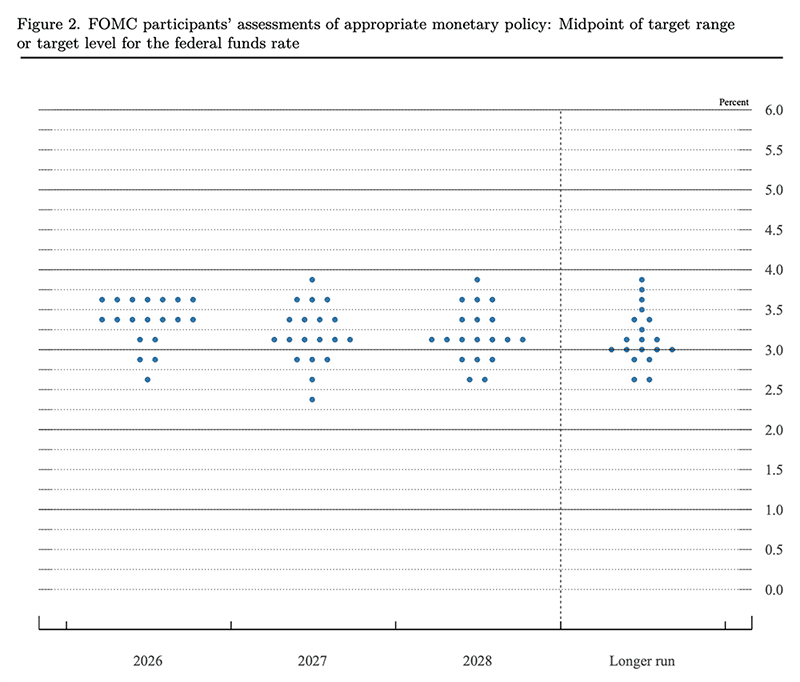
The Federal Reserve also tends to provide some forward-looking guidance in its various communications. That includes the “dot plot,” which is an anonymous chart that shows FOMC members’ projections for where they believe the Federal funds rate should be in the future.
Young and the Invested Tip: Lower interest rates also bode well for dividend payers with high yields, as their payouts look even better compared to bonds’ smaller coupons.
“Kevin Warsh will be of the view that Fed presidents should talk less,” Kaplan said on Goldman’s podcast. “He believes—and I agree with part of what he’s saying—that the Fed has used forward guidance too much. The dot plot is a good example of giving people more forward visibility, and I think his worry is that dot plot sort of boxes the Fed members into a position.
“I think you may see him either get rid of the dot plot or downgrade it and encourage Fed presidents to talk less.”
This also could have some negative influence on the fixed-income markets.
“If Warsh reduces reliance on forward guidance, the range of possible policy paths between FOMC meetings widens, which will increase uncertainty and therefore the volatility of short-term interest rates on securities with maturities of up to two years,” Benhaim says. “If communication is less regular and less clear, each economic data release and FOMC meeting will carry more information, raising the risk of sudden market moves when policy surprises occur.”
But based on prior Powell comments, it would appear that any changes to the dot plot, or the quarterly Summary of Economic Projections (SEP) report, would need to go through a committee vote. And that could keep the guidance humming for the foreseeable future.
“We suspect many on the FOMC are in favor of keeping the dot plot—despite mixed reviews from the public—because it allows them to have a say in the Fed’s overall suite of communications,” Feroli says.
—
Thank you for spending some of your weekend with us! We’ll talk to you again next week.
Riley & Kyle
Like what you’re reading but not yet a subscriber? Get our weekly financial insights and updates delivered to your inbox every Saturday morning by signing up for The Weekend Tea today! You can also follow us on Flipboard for more great advice and insights.