


July 1999. Faneuil Hall. Boston, Massachusetts.
This is Kyle, flying solo this week, and that’s when and where I got my first taste for the “beautiful game.”
I was in Boston with my mom and older cousins to visit a few universities that I’d eventually shun for Ohio State. We were in a Faneuil Hall bar that I was explicitly warned I was too young to be in, and the U.S. women’s national team was locked in a World Cup final shootout after drawing with China in regulation.
1-1. 2-2. Scurry save. Lilly puts the U.S. up 3-2. Ouying scores. Hamm responds. Wen makes it 4-4.
Some of you know what came next—even if you didn’t watch a minute of the match.
Brandi Chastain rifled one past Gao, then relieved herself of her jersey in one of the most iconic celebrations in U.S. sports history. The USWNT wins the second of their record four stars. And the bar erupted into screams and hugs.
From there?
Watching the 2002 World Cup while working late-night sign-ins at the dorm (then watching the USMNT boot El Tri from Cleveland). Using a college colleague’s press pass to watch America’s Hardest Working Team. McBride. Guillermo. Higuaín. Cucho. Nagbe. Losing my voice at more than one “dos a cero.” Crying with close friends over Columbus’ third star. Howling as I write this because I realized I have a plausible excuse to get “Eric Denton Own Goal Fan Club” into a newsletter.
I say all of that to say this: This is the first Weekend Tea to overlap with the World Cup. And if you thought for a second that we’d pass up the opportunity to mix in some fútbol with your finances …
… well, it’s honestly kinda sweet that you think about us in your free time. Keep it up.
Featured Financial Products
Let’s Get It Started
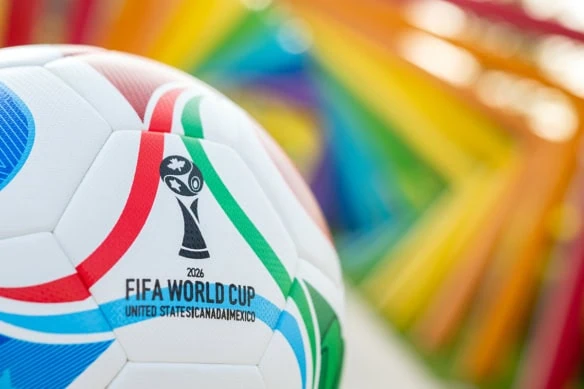
The 2026 World Cup is finally here. As I write this, co-host Mexico has already kicked things off (and the refs have already kicked three players off), and by the time you read this, the other co-hosts—Canada and ourselves—will have finished their Matchday 1 tilts.
It’s the beginning of what is the world’s premier sports tournament … and a financial juggernaut without equal.
The World Cup generates billions of dollars in economic activity, which translates not only into wild financial trivia, but also some potentially actionable advice.
Today, for the love of the game, we’ll share both: a “by-the-numbers” look at the World Cup, and a few ways you can “buy the numbers.”
Do you want to get serious about saving and planning for retirement? Sign up for Retire With Riley, Young and the Invested’s free retirement planning newsletter.
World Cup 2026: By the Numbers
Soccer’s* roots go back nearly 2,000 years, and the World Cup itself is one more four-year cycle away from a century. That is a long, long time for soccer to put up numbers … and it absolutely has.
Let’s start with the by-the-numbers, courtesy of BofA Global Research’s thematic investing team:
- 66 billion: The accumulated air kilometers (I know, I know) of all the people traveling to see the games—enough to traverse the distance between the earth and the edge of our solar system three times!
- 40.9 billion¹: Global GDP, in U.S. dollars, that the 2026 World Cup could generate
- 40.5 billion²: The annual GDP of Senegal, also in U.S. dollars
- 6 billion: Three-quarters of the world’s population, and the number of people expected to engage with the tournament
- 2.7 billion: Number of people who digitally streamed games during the 2022 World Cup, which was almost on par with the number of linear-TV viewers (2.9 billion)
- 6.5 million³: Expected attendance for the 2026 World Cup—double the previous record (3.6 million in 1994, the last time the U.S. hosted)
- 824,000: Number of jobs that the tournament could support
- 746,811: The value, in U.S. dollars, of the World Cup trophy, which has climbed by 3,000% since 1974 due to higher gold prices
- 185,000: America’s share of those jobs
- 90: Petabytes of data expected to be directly generated from the tournament (A petabyte is 1,000 terabytes, or 1 quadrillion bytes)
- 7: The percentage share of global internet traffic that the July 19 World Cup final could consume
- 0.4: Percentage points in GDP lift that host nations have experienced, on average, in the year following the tournament
Young and the Invested Tip: One of the most famous numbers in retirement? 4. As in the “4% rule.” It’s the most famous retirement withdrawal strategy … and it’s not 4% anymore.
They’re fun, eye-popping numbers, but they also speak to just how massive the economic opportunity can be.
I emphasize “can” because, historically, it’s not a guarantee.
“The announcement of the winning bid to host a World Cup and the tournament itself often coincided with major economic and investment booms and busts,” says BofA’s thematic research team. “For example, World Cups coinciding with ‘booms’ have included Italy in 1990 preceded by Italy’s ‘secondo miracolo economico,’ USA in 1994 which was followed by the U.S. tech boom, South Africa in 2010 after their “virtuous cycle” decade, and the Qatar World Cup in 2022 which followed the Gulf boom of 2010s.
“In contrast, the LatAm debt crisis preceded Mexico 1986, the Asia financial crisis Japan/Korea in 2002, and Brazil in 2014 came just after a structural peak in the oil price.”
Indeed, JPMorgan researchers recently wrote that “while anticipation for the [2026 World Cup] is high, expectations for likely beneficiaries are quite low given a challenging macro backdrop, geopolitical uncertainty and growing concerns about the low-end consumer.” But they think “given the magnitude of this approaching catalyst, we expect market sentiment to improve.”
World Cup 2026: Buy the Numbers
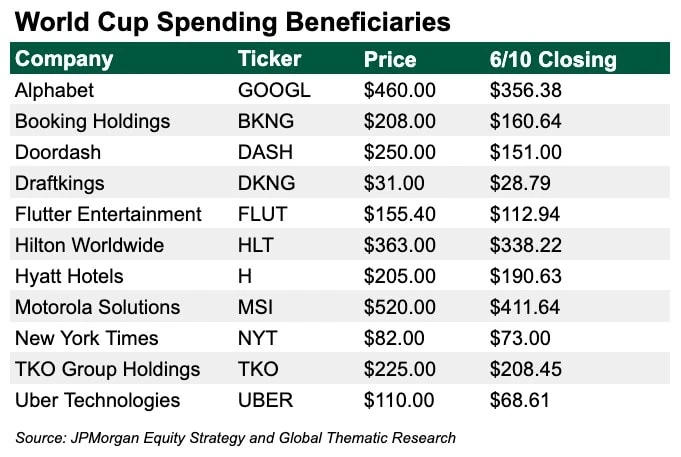
In the same note, JPMorgan highlighted two groups of World Cup stocks expected to benefit from the tournament: spending beneficiaries, and tournament/FIFA sponsors.
The former include companies from the lodging, advertising, rideshare/food delivery, rental car companies, restaurants, airports, secondary ticketing, and consumer industries.
Among JPMorgan’s Overweight (Buy)-rated picks in these areas:
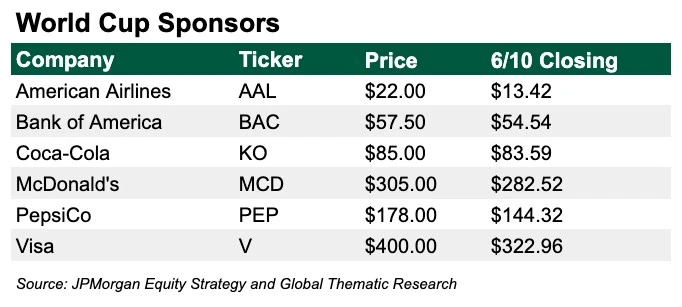
JPMorgan’s research team adds that World Cup sponsors have delivered strong relative performance through the past two events, so it also recommends exposure to some of the tournament’s official brands.
Among its Overweight-rated sponsors:
Just understand that JPMorgan also believes there are several risks to the World Cup theme, including changes to U.S. immigration policy and geopolitical headwinds.
Also, some of the stocks mentioned could see offsets if consumers focused on the 2026 World Cup do so at the expense of concerts, entertainment, and travel to non-host cities.
Young and the Invested Tip: Looking for growth stocks that aren’t necessarily tethered to the tourney? Check out these picks that earn high marks from Wall Street’s analyst community.
Featured Financial Products
* I’m calling it soccer. Get over it.
¹ FIFA-WTO study
² International Monetary Fund
³ To be fair, this World Cup has 104 matches. That’s 40 games more than the 64-match format used in the 1998-2022 tournaments, and literally double the matches in the record-breaking ’94 Cup.
—
Thank you for spending a little time with us this weekend! And if you want yet another reason to take an interest in the World Cup, just look up the many stories of international travelers experiencing the U.S. for the first time, including this German soccer fan who discovered the wonders of Waffle House.
Riley & Kyle
Like what you’re reading but not yet a subscriber? Get our weekly financial insights and updates delivered to your inbox every Saturday morning by signing up for The Weekend Tea today! You can also follow us on Flipboard for more great advice and insights.