



America’s employment situation rebounded sharply in August with a much-better-than-expected jobs print—one that many experts believes sets the stage for the Federal Reserve to raise rates for the first time in more than three years at its upcoming policy meeting.
The Labor Department reported Friday that nonfarm payrolls (NFP) jumped by 162,000 in August, soaring past Dow Jones-polled economists’ expectations for growth of 53,000. Jobs totals for the prior two months were upwardly revised by a combined 55,000, too. July’s initial read of -23,000 was changed to +21,000, while June’s 20,000 payrolls were altered to 31,000.
“Unless we get a huge downward surprise to the inflation reports next week, today’s stronger-than-expected employment report means the Fed can move rates higher,” Steve Wyett, Chief Investment Strategist at BOK Financial. “Recent comments from voting members show some continued reticence for rate increases, but the persistence of above target inflation is becoming harder to justify without Fed action.”
The unemployment rate remained level at 4.1%, meeting expectations. Average hourly earnings were better by 0.3%, to $37.75. On a year-over-year basis, that’s 3.1% higher, which also matched estimates.
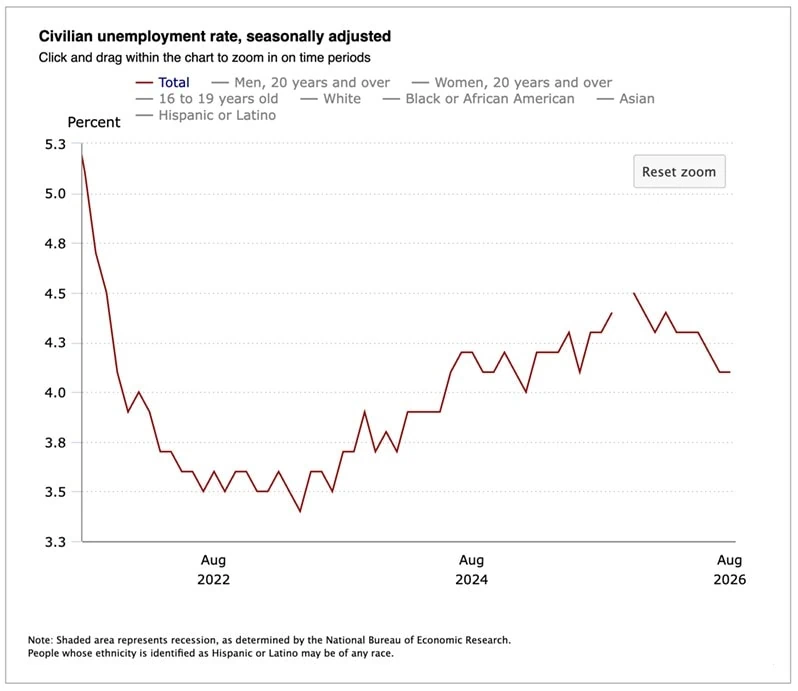
Here’s a brief look at the August jobs report’s most pertinent details:
| Reported | Estimated | Previously | |
|---|---|---|---|
| August payrolls | +162,000 | +53,000 | -23,000 (July) |
| August unemployment | 4.1% | 4.1% | 4.1% (July) |
| August hourly earnings (YoY) | +3.1% | +3.1% | +3.2% (July) |
| July payrolls (revised) | +21,000 | N/A | -23,000 |
| June payrolls (revised) | +31,000 | N/A | +20,000 |
| Source: U.S. Bureau of Labor Statistics. | |||
“We think this volatility in monthly jobs data throughout the year reflects a combination of usual seasonality due to the low-hiring environment (weak data in months where hiring should be strong) coupled with large changes in the immigrant work force which can skew annual employment patterns in abnormal ways,” Citi economist Veronica Clark says. “Throughout this year and into next, we still expect job growth to average around a low ~30k breakeven rate or possibly a bit softer.”
Related: Empower Personal Strategy Review: Wealth Management More People Can Afford
Employment strength was widespread last month. Food service and drinking places enjoyed the greatest expansion in August, adding 59,000 jobs against a 12-month average of just 12,000 gained. Construction gained 22,000 jobs during the month, while manufacturing gained 16,000.
Healthcare grew its payrolls yet again, though its 13,000 jobs added is actually much slower than its 12-month average of 32,000. And local government education added another 42,000 jobs, though the category hasn’t changed much since January 2025.
Jason Pride, Chief of Investment Strategy & Research at Glenmede, cited that education print as to why August’s report is “the clearest demonstration this year that a single payroll print carries almost no useful information on its own.”
“The original July [overall payrolls] figure sat well inside the roughly 122,000 confidence band around the monthly change, which is another way of saying it was never statistically distinguishable from zero,” he says. “The category responsible was local government education, which added 42k in August after last month’s decline and has shown little net change since January 2025, with strong suspicions these swings were seasonal-adjustment artifacts rather than genuine job loss and subsequent gain. The three-month average now stands at 71,000, up from 38,000, and remains a more useful figure than any single month.”
Related: Dividend Kings: The Full List of American Dividend Royalty
The only significant area of employment weakness last month came from the information industry. The field suffered its second significant loss in three months, shedding 23,000 jobs after gaining just 5,000 in July and losing 19,000 in June.
“If you squint, you might see the outlines of the AI displacement,” says Brad Conger, Chief Investment Officer, Hirtle & Co. “Sectors with high AI adoption (information, financial) were weaker. Sectors that are building/equipping/powering data centers (construction, manufacturing, utilities) were stronger. That should support incomes in the lower leg of the K.”
Friday’s news follows a weak ADP private-sector employment report showing growth of 38,000 jobs last month, which was shy of expectations for 47,000. That said, U.S. companies revealed fewer plans for layoffs in August (53,000), according to Challenger, Gray & Christmas, marking a four-year low for the month.
“Today’s report was strong, and we could see markets take a react-first, ask-questions-later approach,” says Tim Urbanowicz, Chief Investment Strategist, Innovator ETFs from Goldman Sachs Asset Management. “But once the dust settles, we think investors will realize the broader trend of labor market rebalancing is still intact.”
Fed Rate-Hike Expectations Cool Down
The market has been pricing in the likelihood that the Federal Reserve will raise the federal funds rate at least once in 2026, though the perceived chance of that happening at the upcoming Federal Open Market Committee (FOMC) meeting has been slipping since July’s weak jobs data.
However, the CME FedWatch Tool, which uses Fed funds futures prices to track the probability of a change to the federal funds rate, now shows a 58% chance that the Federal Reserve will raise its benchmark rate by a quarter-point, to 3.75%-4.0%, when the FOMC meets Sept. 15-16. That’s up from a roughly 50/50 chance suggested yesterday, though in line with where it had been for weeks prior.
“Solid job creation, particularly in healthcare and private sector employment, supports the idea that the demand for labor is accommodating the stagnating supply,” says Jerry Tempelman, Former Senior Analyst at the NY Fed and VP of Economic and Fixed Income Research at Mutual of America Capital Management. “All in all, today’s numbers do little to alter the market presumption that the Fed will raise short-term interest rates at its upcoming monetary policy meeting.”
Related: Stifel: Taiwan Semiconductor (TSM) Is a “Must-Own” Stock
More Expert Reactions to August’s Jobs Report
Here’s what other strategists, financial managers, and experts had to say about last month’s employment situation:
Jeff Schulze, Head Investment Strategist, Franklin Templeton Institute
“The August payroll release quelled any lingering labor fears putting next week’s inflation data firmly in the driver’s seat for the FOMC’s rate decision later this month. This print was unambiguously strong with surging private payrolls, upward prior month revisions, and solid breadth with the diffusion index reaching its best level since 2024. Three-month average job creation jumped to 71,000, suggesting the labor market is cruising well above the breakeven speed—a welcome development on the economic front.
“Although [Fed Chair Kevin] Warsh threw cold water on the inflationary read through for wage growth at Jackson Hole, the muted trend in average hourly earnings continues to suggest limited inflationary pressure emanating from labor markets.”
Steve Rick, Chief Economist, TruStage
“A stronger-than-expected August jobs report would show that the labor market remains resilient despite the slowdown we saw in July. If hiring rebounds meaningfully from last month’s decline, it would ease concerns that the economy is losing momentum too quickly. At the same time, continued strength would give the Federal Reserve more room to remain focused on bringing inflation sustainably back toward its 2% target.”
Bradford Smith, Portfolio Manager, Janus Henderson Investors
“A monster jobs report for August reminds us that this labor statistic has become highly volatile while nudging up the probability of a September hike slightly. The addition of 162,000 jobs will certainly go in the ‘hike’ column as the Fed weighs whether to increase the policy rate in the face of persistent inflation this month, but Chairman Warsh has already directed the market to look through this number and focus on the inflation data coming next week in form of the CPI print. … After a hawkish appearance from Chairman Warsh at Jackson Hole last week, there is a clear bias at the Fed to take action if the incoming data does not show further progress on disinflation.”
Sonu Varghese, Chief Macro Strategist, Carson Group
“August payrolls were strong across the board, including in cyclical sectors like construction and manufacturing. Add in elevated inflation, and the Fed looks well offsides against an economy that’s running hot.”