



Kids’ debit cards have truly become mainstream over the past few years, and we couldn’t be happier. While those unfamiliar with these products might see them as a disaster in the making, we see these cards as tightly controlled tools to help children learn money basics and help teens grow into their financial responsibilities.
And as far as I’m concerned, the Greenlight debit card and the Chase First BankingSM account are among the best in this field.
WealthUpdate helps parents whittle down their choices by comparing big groups of cards, like the best debit cards for kids and the best debit cards for teens. But if you’re here, it means you’ve narrowed your search to just a couple selections—namely, Greenlight and Chase First BankingSM—and are trying to make a final choice. So the question is no longer just about which card has the higher rating, but instead about which card is best for your family.
We can help.
Today, I’m going to provide an in-depth look at Greenlight and Chase First BankingSM, including an overview of each, a breakdown of their costs, a list of noteworthy features, and more. I’ll also provide each card’s vital stats side by side to make your comparison shopping a little bit easier. And, on the off chance you’re still not convinced about either one, I’ll run through a few other highly competitive debit cards you might have missed.
Table of Contents
Greenlight vs. Chase First Banking Comparison
  |  |
|
|---|---|---|
| WealthUpdate Rating | ☆ 4.8 / 5 | ☆ 4.6 / 5 |
| App Store Rating | ☆ 4.8 / 5 | ☆ 4.8 / 5 |
| Price* | Core: $5.99/mo. Max: $10.98/mo. Infinity: $15.98/mo. Family Shield: $19.98/mo. | No monthly fees |
| Billing | Monthly | N/A |
| Special Offer | N/A | N/A |
| Allowed Cards Per Subscription | 5 | 1 |
| Minimum Age** | No | 6 |
| Features That Make This Card Stand Apart | Exceptional parent controls; Max, Infinity, Family Shield: Identity theft, purchase, and phone protection | Access to 5,000+ branches |
Basics | | |
| Spending | Yes | Yes |
| Saving | Yes | Yes |
| Investing | Stocks and ETFs (Max, Infinity, Family Shield plans) | No |
| Giving/Donating | Yes | No |
Funding | | |
| Funding Source(s) | Bank account, debit card, Venmo, PayPal | Chase bank account |
| Direct Deposit | Yes | No |
| Allowance | Yes | Yes |
| Chores | Yes | Yes |
| Gifting | Yes | No |
| Cash Reload Fee | N/A (No cash reload) | N/A (No cash reload) |
Saving/Spending | | |
| Savings APY | Core: 2% Max: 3% Infinity: 5% Family Shield: 6% | N/A |
| Round-Ups | Yes | No |
| Other Savings Features | Parent-Paid Interest | None |
| ATM Network | None | Chase (14,000+ ATMs) |
| ATM Transaction Fee | $0 (Greenlight does not charge an ATM fee, but it is not part of an ATM network, so an ATM operator fee will apply) | $0 in-network (Operator fee may apply at out-of-network ATMs) |
| Card Network | Mastercard | Visa |
| Compatible Mobile Wallets | Apple Pay, Google Pay | N/A |
Parents | | |
| Parental Controls | High (Store-level controls and limit setting) | High (Store-level controls and limit setting) |
| Parental Monitoring | Yes | Yes |
| Parental Notifications | Yes | Yes |
Other Features | | |
| Cash Back | Core: No Max, Infinity, Family Shield: 1% | No |
| Builds Credit | No | No |
| Customization options | Any image you want | No |
| Refund Policy | No refunds given, month-to-month pricing | N/A |
 | |
|
| * Prices do not include processing fees when applicable. ** Many cards have different suggested minimum ages. We are only listing any hard-and-fast minimum age requirements. |
||
Greenlight Overview
- Available: Sign up here
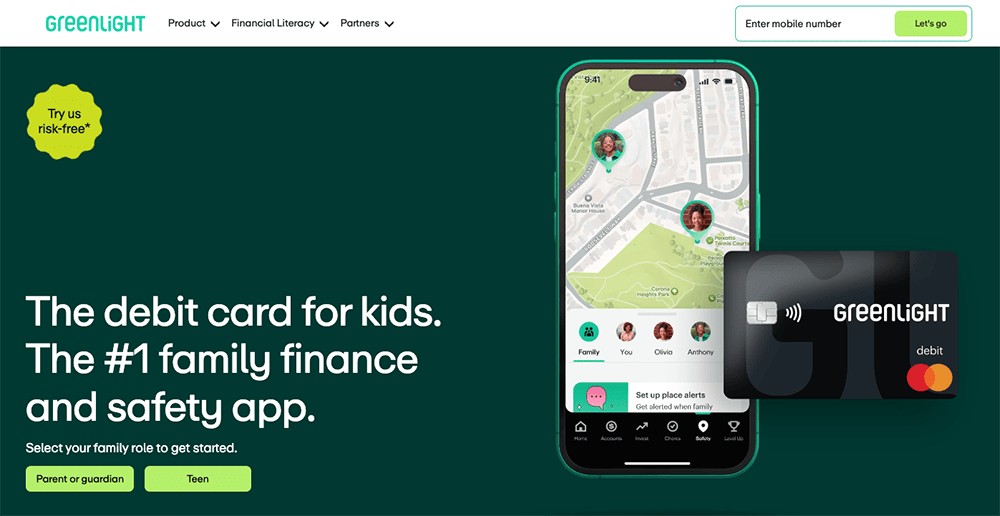
The Greenlight debit card allows kids to begin spending, but provides parents with peace of mind by giving them control over where their kids can spend money. Parents also can choose to receive alerts that tell them when, and how much, money is spent on the Greenlight debit card.
Greenlight works like a prepaid debit card, allowing you to transfer money onto the card for your child to pay for expenses at approved locations. You can choose how much money to load onto the card, and your child will be cleared to make approved purchases so long as a money balance backs up the card.
If your child asks for extra money to get added to the card, you can have them take a photo of the purchase they want to make and receive your approval. This gives you control and allows you to have discussions with your child about why a purchase might be a good or bad idea. And if your child has a job, they can add their own funds to the card via direct deposit.
The Greenlight debit card is a great choice for parents looking to teach their kids the importance of saving money, pay their children an allowance or track their chores, and show them how to make prudent financial decisions.
Greenlight boasts numerous other features, too:
- Parents can open an investment account for kids to get their children investing in stocks and exchange-traded funds (ETFs) for the first time.
- Greenlight offers monthly savings rewards based on your tier, listed in the box below.
- Max, Infinity, and Family Shield families can also earn 1% cash back on their spending.
- You may also set up “Parent-Paid Interest” between you and your child, which allows you to foot the bill and pay interest on accounts for up to five kids.
Each monthly Greenlight subscription includes debit cards for up to five kids. Replacement cards cost $3.50 each but are free the first time. If you need to replace your card quickly, you can get express delivery for $24.99. The company also offers a personalized card, with your own photo or design, for $9.99.
Greenlight has no minimum age requirements for this card, but recommends starting at age 6 or older. Read more in our Greenlight card review or sign up today.
- Greenlight is a financial solution for kids that allows them to spend with a debit card, earn money on savings, and even invest their money.
- Greenlight offers flexible parental controls for each child and real-time notifications of each transaction. And it's the only debit card that lets you choose the exact stores where kids can spend on the card.
- Parents can use this app to teach kids how to invest with a brokerage account through Greenlight Max, Infinity, and Family Shield plans.
- Greenlight also provides educational materials such as "Level Up" lessons that simplify investing concepts, as well as videos about their favorite companies.
- Families can earn 2% (Core), 3% (Max), 5% (Infinity), or 6% (Family Shield) per annum on their average daily savings balance of up to $5,000 per family. Also, Max and Infinity families can earn 1% cash back on their monthly expenditures.
- Unlike many apps that simply provide features and controls, Greenlight is also designed to spark discussions with children about spending, investing, and more, fostering a better educational experience.
- Best-in-class parental controls (can prohibit specific stores)
- Can add brokerage account to invest in stocks
- Intuitive Parent + Kid apps
- Competitive cash back & interest rates
- Parent-Paid Interest
- High price points
- No cash reload options
- No parent / child lending

Related: 8 Best Greenlight Alternatives [Cards for Kids & Teens]
Greenlight Plans + Costs
Greenlight has three subscription tiers that unlock and/or upgrade various sets of features:
| Plan | Monthly Fee | Features Offered Under Plan |
|---|---|---|
| Greenlight Core | $5.99 | Standard features: - Greenlight debit cards for up to five kids - Educational app - Core financial tools - Granular parental controls (store-level and category-level) - Savings Reward: Earn 2% on savings - Ability to earn, save, spend, and give |
| Greenlight Max | $10.98 | Everything under the Greenlight Core plan, plus: - Higher Savings Reward: Earn 3% on savings - Ability to invest in stocks and ETFs - Parental controls for investing (parents must approve all trades) - 1% cash back on purchases - Purchase protection (repair or replace Greenlight purchases that are stolen or damaged) - Cell phone protection (coverage for damaged, lost or stolen phones for up to five kids) - Identity theft protection (single-bureau credit monitoring, dark web monitoring) |
| Greenlight Infinity | $15.98 | Everything under the Greenlight Max plan, plus: - Higher Savings Reward: Earn 5% on savings - Family location sharing (can toggle on/off) - SOS alerts (swipe to send an alert to emergency contacts, 911, or both) - Crash detection (alerts 911 when a crash is detected) - Real-time driving reports to know your children are safe on the road |
| Greenlight Family Shield | $19.98 | Everything under the Greenlight Infinity plan, plus: - Higher Savings Reward: Earn 6% on savings - Financial account monitoring - Suspicious activity alerts - Up to $100,000 coverage against deceptive transfer fraud Up to $1 million in identity theft coverage |
One thing to note about Greenlight: It does not have a fee-free ATM network. So while Greenlight doesn’t charge ATM fees, your child likely will incur third-party charges whenever they withdraw money from an ATM.
Related: Best Investing Apps for Teens Under 18 [Stock Trading Apps]
Greenlight Features

Greenlight is an app and debit card that’s rich in bells and whistles. Read on as I go through some of its most noteworthy features. (Note: Features available on all plans unless otherwise noted.)
Greenlight Card
Every Greenlight account comes with Greenlight cards—a Mastercard-branded prepaid debit card—for up to five kids.
In general, prepaid debit cards are an ideal solution for parents who want to start giving their kids some financial independence without completely opening the floodgates. With Greenlight, parents load the parent wallet via either a debit card or an ACH transfer from a checking account. (Neither loading method charges a fee.) Parents then load each child’s Greenlight card from the parent app, and their kids can only spend what’s on the card. This prevents common spending missteps such as getting hit with non-sufficient funds fees or overdraft charges.
The Greenlight card can be used virtually anywhere Mastercard is accepted, in-store and online, in the U.S. and more than 150 other countries worldwide. (And no foreign transaction fees, either!)
Greenlight debit card accounts are Federal Deposit Insurance Corporation (FDIC)-insured for up to $250,000 per individual through the card’s partner bank, Community Federal Savings Bank (CFSB). And because the Greenlight card is a Mastercard, you enjoy Mastercard’s Zero Liability Protection, which doesn’t hold cardholders responsible for any unauthorized transactions as long as they used reasonable care from protecting the card from loss or theft and promptly reported any fraud to Greenlight.
Want to shake things up? Your kid can upgrade to a custom Greenlight card for a one-time fee of $9.99. And Greenlight offers one of the most customizable cards, allowing people to decorate their card with a picture of themselves, a pet, a graphic, and other types of fun images.
Related: 10 Best Money Apps for Teens Under 18 [Invest, Pay + More]
Parental Controls
I think parental controls are one of the most important features of a kids’ debit card, and Greenlight has them in spades. In fact, I think Greenlight is the industry leader in parental controls.
Greenlight uses a permission-based spending rules system that allows parents to set rules that limit not just spending amounts, but types of spending categories and even specific stores. (In my personal testing of this product, I was able to limit spending at a local creamery where my family celebrates weekly “Ice Cream Fridays,” effectively making any store, big or small, within reach of the robust parental controls offered through the Greenlight product.)
Greenlight also offers spending notifications, real-time money requests and approvals if children don’t have enough money for a purchase, and the ability to freeze a kid’s debit card if the card is lost or stolen or the parents want to temporarily disable it for some other reason.
Chores + Allowance
Greenlight lets parents automate allowance, and even link it to chores.
The parent picks a frequency (monthly, biweekly, even weekly) and amount for allowance. Then, they can set up rules determining how much is paid out, and when:
- The allowance is paid out with no connection to chores.
- A percentage of the allowance will be paid out depending on what percentage of their chores they completed. (In other words, they can get part of their allowance if they do part of the chores.)
- The allowance will only be paid out if all chores are completed.
Chores can be assigned on a one-time or recurring basis. And parents can help kids divvy up their allowance or earnings among Spending, Saving, Investing, and Giving.
Related: 40+ Ways to Make Money as a Teenager [Fast + Smart]
Savings Reward
Earned interest on savings accounts is a great way to motivate children to save more. While Greenlight technically doesn’t offer interest, it offers something awfully close: the Savings Reward.
Your child receives a monthly savings boost—1% for Core plans, 2% for Max, 5% for Infinity, and 6% for Family Shield—based on the average daily savings balance in their Greenlight account, on up to $5,000 of savings. (So, kids can earn a maximum of $50, $100, or $250 annually depending on the plan.)
Parent-Paid Interest
Parents can also help their kids save faster by turning on Parent-Paid Interest.
With Parent-Paid Interest, a parent sets an annual interest rate between 1% to 100%, then every month, the applicable amount (based on the average daily balance of a kid’s Total Savings, which is whatever’s saved in both General Savings and Savings Goals) is paid from the parent’s wallet to the child’s General Savings area.
Round Ups
Greenlight offers yet another way to help their kids save even faster: Round Ups. Round-up apps all generally work the same: Whenever you spend, the purchase amount is rounded up to the nearest dollar (or some other preset dollar level or percentage), and the “spare change” is set aside in savings. Some round-up apps are more flexible and customizable than others; Greenlight’s Round Ups feature is pretty straightforward, rounding up purchases to the nearest dollar.
Investing (Varies by Plan)
Greenlight offers commission-free investing across all its plans, though there’s a significant step up from the Core plan to the Max and Infinity plans.
With the Core plan, parents have access to Investing for Parents Lite, which allows parents to invest via a handful of exchange-traded funds (ETFs).
The Max, Infinity, and Family Shield plans open up the full Investing for Parents, as well as Investing for Kids. Both provide access to more than 4,000 stocks and ETFs, and thanks to fractional shares, children and parents can invest with as little as $1. When kids invest, parents must approve every trade placed.
Not sure what you should invest in? Take Greenlight’s personalized quiz, and Greenlight will recommend a fund for you.
Level Up
Kids can learn more money management techniques through the financial literacy game Level Up. This interactive game teaches both young children and teens budgeting, investing, and other money skills with a curriculum and educational challenges that go beyond the K-12 national standards for personal finance education.
You can sign up for Greenlight here.
Other Comparisons
Chase First BankingSM Overview
- Available: Sign up here
Ready to teach your little ones about earning, saving, and spending money, but not quite sure if you have the time, patience, and/or expertise? Chase First BankingSM offers simple banking for both of you in one location—the Chase Mobile® App—for free.
Chase First BankingSM helps parents teach teens and kids about money by giving parents the control they want and kids the freedom they need to learn. Among the account’s many features?
- One of the best free debit cards for kids and teens—it works anywhere Visa is accepted, and can be used to withdraw money fee-free* from more than 14,000 Chase ATMs nationwide
- Savings goals that you can track via the Chase Mobile® App
- Parental controls, such as setting limits on where and how much they can spend and withdraw from ATMs
- Account alerts that let you know where your child is spending
- Recurring chores and allowance
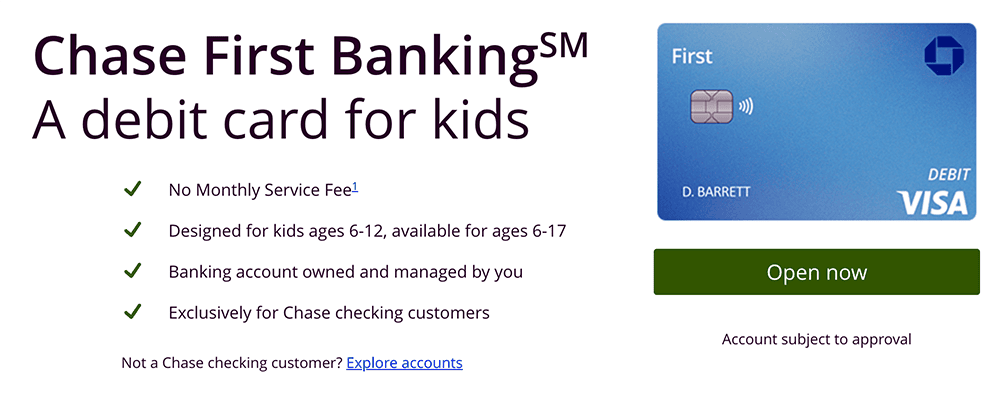
The account is designed with kids 6-12 in mind, and available for ages 6-17. To get started, you’ll first need to be a Chase customer with a qualifying Chase checking account. If you don’t already have one, consider opening a Chase Total Checking® or Chase Secure BankingSM account to qualify.
- Chase Total Checking® also grants access to thousands of branches and ATMs. You can pay $0 in monthly fees, subject to meeting certain conditions.** And you can collect a $400 new-customer bonus when you make total direct deposits of $1,000 or more within 90 days of coupon enrollment.
- Chase Secure BankingSM offers the same Chase ATMs and branch locations as well as a $125 sign-up bonus when you make stated qualifying activities and meet certain conditions.
Once you open a qualifying Chase Checking account, you may use our link to apply for a Chase First BankingSM account for your child.
- Chase First Banking is a free, just-for-kids banking account that teaches children and teens about their finances through the Chase Mobile® app and a Visa debit card.
- The account is designed with kids 6-12 in mind, and available for ages 6-17.
- Kids can use their debit card anywhere Visa is accepted, and withdraw money fee-free* from thousands of Chase ATMs.
- Parents can enjoy peace of mind by limiting how much and where their children can spend and withdraw money, and set up spending alerts.
- Parents can reward responsibility with allowance transfers, set to repeat on the schedule you choose.
- You must be a current Chase customer with a qualifying Chase checking account to sign up. If you don’t already have one, consider opening a Chase Total Checking or Chase Secure Banking account to qualify.
- Free account
- No monthly maintenance fees
- Chore and allowance functionality
- Parental controls on spend/ATM limit and location
- No paired investment account
- No interest

Related: 11 Best Debit Cards for Kids [2026]
Chase First BankingSM Plans + Costs

Chase First BankingSM is a primarily fee-free kids’ debit card.
| Plan | Monthly Fee | Features Offered Under Plan |
|---|---|---|
| Chase First BankingSM | N/A | - Chase First BankingSM debit card - Parental controls - Savings goals - Allowance and chores - Physical bank locations |
A few situations where fees may be charged include:
- Expedited shipment of a replacement debit card ($15)
- Using the debit card at a non-Chase ATM ($3)
- Using the debit card to make an ATM withdrawal or transfer inquiry outside the U.S., Puerto Rico, and the U.S. Virgin Islands ($3 for transfers or inquiries, $5 per withdrawal)
- For international card purchases or withdrawals, you have to pay 3% of the amount after conversion to U.S. dollars.
But note that these are all pretty common fees for debit cards.
Related: 9 Best Debit Cards for Teens [Reviewed by a CPA + Father]
Chase First BankingSM Features

Chase First BankingSM Card
The Chase First BankingSM card is a Visa-branded debit card that can be used anywhere Visa is accepted (at physical stores and online), as well as at more than 14,000 fee-free Chase ATMs. The card is protected by Visa’s Fraud Protection and Zero Liability guarantee; as long as you dispute fraudulent charges within the stated time frame, you can avoid having to pay for those charges.
Admittedly, Chase First BankingSM has some of the strictest funding limitations of all kids’ debit cards. You must fund the account from a qualifying Chase checking account, such as Chase Total Checking® or Chase Secure BankingSM. That means you can’t fund the account from other traditional funding sources, like third-party payment apps, cash, and any other bank’s debit cards or checking accounts.
Chase First Banking accounts also have a $100 daily ATM withdrawal limit and a $400 daily purchase limit.
Parental Controls
Chase First BankingSM offers some of the best parental controls among all the kids’ debit cards I have reviewed.
You can use the Chase Mobile® App to set limits for where and/or how much your kid or teen can spend. Don’t want them eating too much fast food? Set a $15 limit at fast-food restaurants. Worried about your kid overspending in general? Just limit how much the card can be used for anywhere. You can even set withdrawal limits at ATMs.
Parents can also enable account alerts. There are three categories of alerts, including:
- Balance & spending
- Security
- Chase First Banking (transfer money requests, ATM use, card declined, etc.)
You can choose to be notified via email, push notification, text message, or a combination of multiple alerts.
Has the card gone missing? Don’t worry about it. It can be locked or unlocked from the app. Children can also lock and unlock their cards, but if a parent locks the card, the kid can’t unlock it.
Savings Goals
Children can create savings goals and transfer money toward those goals at any time. Parents can transfer money to the kid’s goals as well. And the Chase Mobile® App makes it easy to track their progress.
Related: BusyKid vs. Acorns Early
Allowance + Chores
Whether you want to pay daily, weekly, or monthly, it’s easy to set up recurring allowance transfers through the Chase Mobile app. You can also assign repeating chores and pay your kid when they’ve completed them.
Physical Locations
Many of the most popular debit cards for teens and kids are offered by online banks with no brick-and-mortar locations. Chase, however, has more than 5,000 physical locations. If you find comfort that you could speak face-to-face with a human if anything goes wrong, this debit card and accompanying account could be a good fit for you. Plus, you can deposit cash and checks for free.
You can sign up for Chase First BankingSM here.
Other Comparisons
Greenlight vs. Chase First BankingSM: Our Editors’ Choice Is …
Greenlight is one of the best kids’ debit cards period, so it’s no surprise that it gets the nod over Chase First BankingSM.
But it’s not by much.
Greenlight is a feature powerhouse. Parental controls are more numerous and customizable. Grenlight provides a gaggle of features—including identity theft, purchase, and phone protection; SOS alerts, and crash detection—that most simply don’t.
On the other hand, Chase First BankingSM has no monthly fees, and it offers more features than just about any free card we can think of, including allowance, chores, and goal setting. Also, for those who feel more comfortable using banks with physical locations, Chase® is the clear choice.
The main differentiator for us is investing: Greenlight offers it, but Chase First BankingSM doesn’t.
If you’re willing to pay for a kids’ debit card, Greenlight remains one of the best offerings we can think of. But if you’d prefer a card with no monthly fees, Chase provides a lot of bang for … well, no buck.
|
Our Pick: Greenlight
|
Runner-Up: Chase First Banking
|
|
Primary Rating:
4.8
|
Primary Rating:
4.6
|
Related: Best Credit Cards for Kids [Build Credit & Money Habits Early]
Other Debit Cards for Kids to Consider
If you’re still not convinced about Greenlight or Chase First BankingSM, you might want to look at these other highly rated options:
| App | Apple App Store Rating + Best For | Fees | Promotions |
|---|---|---|---|
 Acorns Early Acorns Early | ☆ 4.6 / 5 Strong parental controls | Acorns Early Lite: $8/mo. Acorns Gold (Includes Acorns Early Invest): $12/mo. | Acorns Early Lite: Free 30-day trial + $5 allowance upon signup. Acorns Gold: $20 bonus investment when you sign up and make recurring investments. |
 Cash App Families (For Teens) Cash App Families (For Teens) | ☆ 4.8 / 5 Excellent parental controls and no monthly fees. | No subscription fees | None |
| Cash App Families Managed Accounts (For Kids) | ☆ 4.8 / 5 Excellent parental controls and no monthly fees. | No subscription fees | None |
 Till Financial Till Financial | ☆ 4.8 / 5 Teaching about smart spending | Till Free: No monthly fees. Till Premium: $7.99/mo. | None |
| Note: Apple App Store Rating as of Sept. 3, 2026. | |||