


It can be difficult to teach children how to spend and save responsibly, but it doesn’t have to be. A debit card can be a valuable educational tool, especially when the teen is in charge of their own spending with guardrails installed by parents.
Debit cards represent the first pathway into financial responsibility because they start to give kids and teens control over their spending and provide them an early glimpse into what it’s like to manage money on their own. That’s not just true of traditional debit cards, but prepaid debit cards as well.
The question is: Which prepaid debit card can give your child the best leg up on their financial education?
This article will give you everything you need to know as you begin your search for the best prepaid debit cards for teens and kids. We’ll give you a full breakdown of all the best options, explain how prepaid cards differ from traditional cards, and arm you with additional knowledge so you can make the most educated choice.
Featured Financial Products
Best Prepaid Debit Cards for Kids & Teens—Top Picks
|
Best Premium Debit Card for Kids + Teens

|
Best Debit Card for Customer Service

|
|
Primary Rating:
4.8
|
Primary Rating:
4.4
|
|
Starts at $5.99/mo. (for up to five kids)
|
Free 30-day trial. Acorns Early: $5/mo. for 1 child. $10/mo. for 2-4 children. Acorns Gold: $12/mo., includes Acorns Early for up to 4 children.
|
What Are the Best Prepaid Debit Cards for Teens?
We’ve compiled a list of the best debit cards for teens that should work for your needs below. Look at each and compare which one makes the most sense for your needs.
| App | Apple App Store Rating + Best For | Fees |
|---|---|---|
 Greenlight Greenlight | ☆ 4.8 / 5 Customer rating and parental controls | Core: $5.99/mo. Max: $9.98/mo. Infinity: $14.98/mo. (Each plan supports up to 5 children.) |
 Acorns Early Acorns Early | ☆ 4.7 / 5 Accessible customer service support | Acorns Early: $5/mo. for 1 child. $10/mo. for 2-4 children. Acorns Gold: $12/mo., includes Acorns Early for up to 4 children. |
 Copper Banking Copper Banking | ☆ 4.8 / 5 Teen financial independence | Copper: $4.95/mo., Copper + Invest: $7.95/mo. |
 FamZoo FamZoo | ☆ 4.6 / 5 Financial literacy resources | Free trial, then $5.99/mo./family. (Discounts available for longer periods of prepayment.) |
 BusyKid BusyKid | ☆ 3.4 / 5 Teaching balanced financial approach via chores & allowance | $4/mo. (Supports up to 5 cards) |
 Current Current | ☆ 4.8 / 5 Innovation and product features | Free (no monthly fees) |
 Till Financial Till Financial | ☆ 4.7 / 5 Teaching about smart spending | Free (no monthly fees) |
| *Apple App Store Rating as of Jan. 19, 2025. | ||
1. Greenlight (Best Paid Debit Card for Kids and Teens)
- Available: Sign up here
- Price: Core: $5.99/mo. Max: $9.98/mo. Infinity: $14.98/mo. (All plans include cards for up to 5 children)
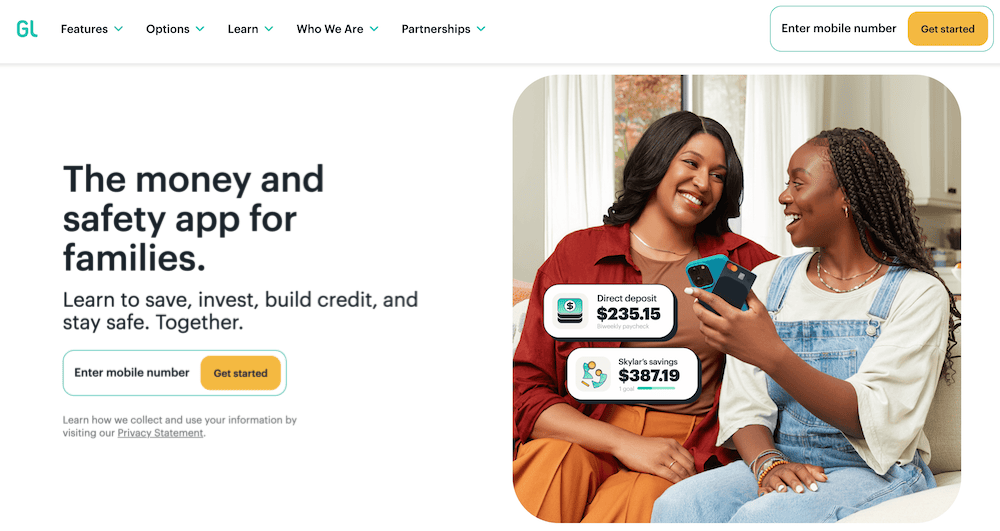
The Greenlight debit card allows kids to begin spending, but provides parents with peace of mind by giving them control over where their kids can spend money. Parents also can choose to receive alerts that tell them when, and how much, money is spent on the Greenlight debit card.
Greenlight works like a prepaid debit card, allowing you to transfer money onto the card for your child to pay for expenses at approved locations. You can choose how much money to load onto the card, and your child will be cleared to make approved purchases so long as a money balance backs up the card.
If your child asks for extra money to get added to the card, you can have them take a photo of the purchase they want to make and receive your approval. This gives you control and allows you to have discussions with your child about why a purchase might be a good or bad idea.
And if your child has a job, they can add their own funds to the card as well.
Each monthly Greenlight subscription includes debit cards for up to five kids. Replacement cards cost $3.50 each but are free the first time. If you need to replace your card quickly, you can get express delivery for $24.99. The company also offers a personalized card, with your own photo or design, for $9.98 per year.
Greenlight boasts numerous other features, too. For instance, parents can open an investment account for kids to get their children investing in stocks and ETFs for the first time.
Greenlight also offers monthly savings rewards based on your tier: 2% per annum for Core members, 3% per annum for Max, and 5% per annum for Infinity. You may set up “Parent-Paid Interest” between you and your child. This allows you to foot the bill and pay interest on accounts for up to five kids.
The Greenlight debit card is a good choice for parents looking to teach their kids the importance of saving money and making prudent financial decisions. This financial product can be an effective learning tool for helping kids to understand why saving should be a priority and how to simplify paying an allowance or tracking chores.
Greenlight has no minimum age requirements but recommends starting at age 6 or older.
Read more in our Greenlight Card review.
- Greenlight is a financial solution for kids that allows them to spend with a debit card, earn money on savings, and even invest their money.
- Greenlight offers flexible parental controls for each child and real-time notifications of each transaction. And it's the only debit card that lets you choose the exact stores where kids can spend on the card.
- Parents can use this app to teach kids how to invest with a brokerage account through Greenlight Max, Infinity, and Family Shield plans.
- Families can earn 2% (Core), 3% (Max), 5% (Infinity), or 6% (Family Shield) per annum on their average daily savings balance of up to $5,000 per family. Also, Max and Infinity families can earn 1% cash back on their monthly expenditures.
- Unlike many apps that simply provide features and controls, Greenlight is also designed to spark discussions with children about spending, investing, and more, fostering a better educational experience.
- Best-in-class parental controls (can prohibit specific stores)
- Can add brokerage account to invest in stocks
- Intuitive Parent + Kid apps
- Competitive cash back & interest rates
- Parent-Paid Interest
- High price points
- No cash reload options
- No parent / child lending
Related: 13 Best Allowance and Chore Apps for Kids [Easier Family Life]
Do you want to get serious about saving and planning for retirement? Sign up for Retire With Riley, Young and the Invested’s free retirement planning newsletter.
2. Acorns Early (Best for Customer Service)
- Available: Acorns Early Lite | Acorns Gold
- Price: Acorns Early Lite: Free 30-day trial, then $8/mo. Acorns Early: $12/mo.
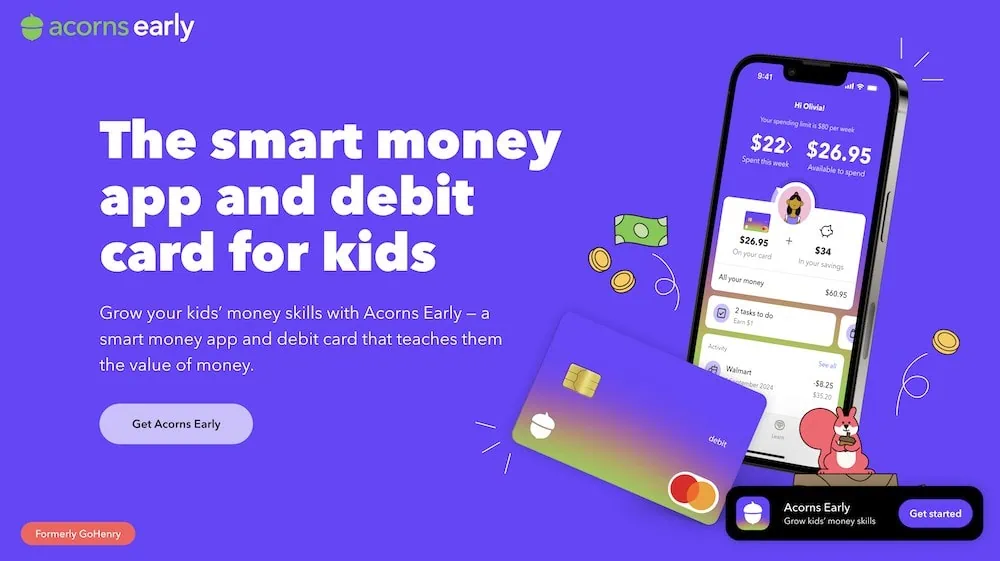
Many reviewers have long painted Acorns Early (formerly GoHenry) as just a way to spend. However, I see it as a real financial solution for minors—a debit card, yes, but also an app-based ecosphere that provides education and experience for the child, as well as ways for parents to keep their kids safe and teach them responsibility.
An Acorns Early account includes a smart money app, as well as Visa debit cards for up to four children. These debit cards can be used to spend anywhere Visa is accepted (so, millions of vendors online and in stores), as well as withdraw cash from ATMs. An Acorns Early account also allows kids to set savings goals, which they can fund manually or via autosave. And the app also hosts educational materials to help children and teens alike develop good money habits.
This FDIC-insured account also enjoys a variety of safety features, including chip and PIN protection, secure PIN recovery, and fraud protection. Acorns Early also offers parents additional peace of mind by providing a number of controls, including:
- Real-time spending notifications
- Card lock/unlock
- Savings goal lock/unlock
- Adjustable spending limits on a per-transaction and per-week basis
- Card category block/unblock for in-store purchases, online purchases, and ATM withdrawals
- Adjustable spending block/unblock at stores that sell age-restricted goods such as firearms and alcohol
Also, kids can only spend whatever money is available on the card because it’s a prepaid debit card. That means parents don’t have to worry about costly overdraft fees or their kids running up a debt.
Acorns Early also stands out to us as one of the best prepaid debit cards for kids because of its outstanding customer service, which it inherited from GoHenry. Acorns Early users enjoy seven-day-a-week phone service (9 a.m. to 8 p.m. ET Monday-Friday, 9 a.m. to 5 p.m. ET Saturday-Sunday), as well as 24/7 live chat support.
Acorns Early has no minimum age requirements but recommends starting at age 6 or older. Parents have two ways of signing up for Acorns Early:
- Sign up for Acorns Early Lite. This subscription level provides you with everything mentioned above.
- Sign up for Acorns Gold. Acorns Gold is the top Acorns subscription tier for adults, and it provides a wealth of banking, investing, and other features. However, it also includes a subscription to Acorns Early (again, good for up to four children), and it unlocks Acorns Early Invest: a UGMA/UTMA custodial account you can use to invest for your kids’ future.
Acorns frequently offers small bonuses for anyone who signs up with our links. You can check out current offers in the box below, or read more about this app in our Acorns Early review.
- Acorns allows you to sign up for investment, retirement, and checking accounts for you and your family, learn how to earn more money, and grow your investing knowledge.
- Famous for investing spare change automatically through Round-Ups, this all-in-one financial app helps younger generations start investing earlier.
- Invest in expert-built portfolios made up of diversified ETFs.
- Silver tier includes perks such as a 25% match on Acorns Earn rewards (up to $200/mo.), generous APYs on Checking and Emergency Fund, and live Q&As with investing experts.
- Gold tier includes perks such as a 50% match on Acorns Earn rewards (up to $200/mo.), $10,000 in life insurance, and picking individual stocks for your portfolio.
- Gold also comes with a free Acorns Early account for up to four children. It's also the only tier to offer Acorns Early Invest: a UGMA/UTMA custodial account where you can save toward your kids' future and get a 1% match on up to $7,000 in contributions annually.
- Earn even more with Later Match: Acorns will match up to 1% (Silver) or 3% (Gold) of all new IRA contributions in your first year.*
- Special offer: Get a free $20 bonus investment when you sign up with our link and start making recurring investments.**
- Robo-advisor with affordable fees (on larger portfolios)
- Fixed fee model
- Round-ups
- FDIC/SIPC insurance
- IRA match (Personal Plus and Premium)
- High fixed fees for small balances
- Limited investment selections
- Must subscribe to Premium for any self-directed investing options

Related: Acorns Early (Formerly GoHenry) vs. Greenlight
3. Copper Card (Best for Kid Independence)
- Available: Sign up here
- Price: 30 days free. Copper $4.95/mo., Copper + Invest: $7.95/mo.
Copper Banking was founded on the belief that kids and teens should have equal access to financial education and should be empowered to learn by doing. Now, the company is on a mission to help children gain real-world experience by giving them access to their money in a way that traditional banks can’t.
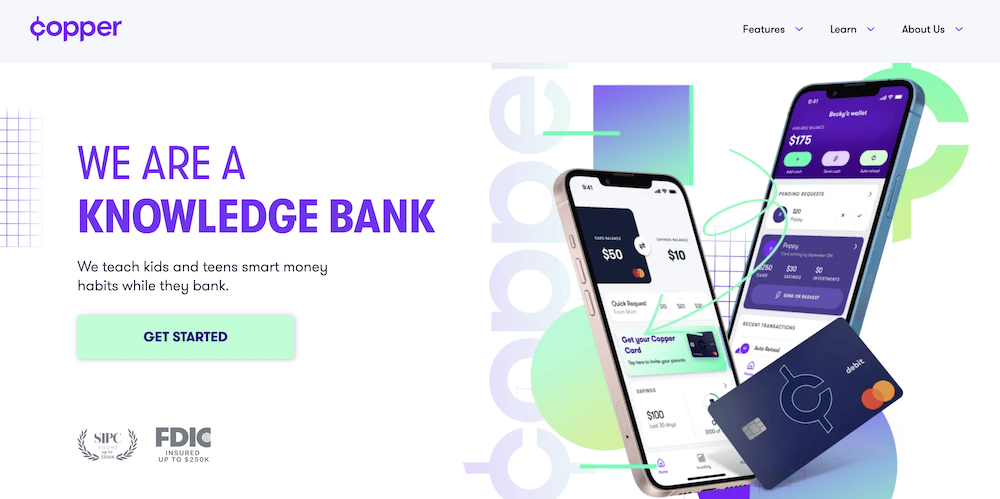
The Copper app and debit card teaches your child how to make smart financial decisions by creating a platform where parents and their kids can connect. With the Copper app, you get easy snapshots of your accounts. And with the Copper Debit Card, it’s easy to shop in-store or online, including with Apple Pay or Google Pay.
Plus, users get exclusive access to engaging advice curated by a team of financial literacy experts who provide tips on how to take control of their financial future.
Copper Banking Features:
- Send/Request: Kids and parents can easily send and receive money all at the touch of a button.
- Spend: Spend using Apple or Google Pay, or using the Copper Debit Card.
- Withdraw: Access your money from more than 55,000 fee-free ATMs.
- Monitor: Get a snapshot of all your child’s spending in an easy-to-read dashboard.
- Save: Gain quick snapshots of your kid’s savings and helpful tips on how to save even more. Set up savings buckets and save for the things that you want.
- Learn: With the help of Copper’s team of financial literacy experts, gain bite-sized tips on how you can maximize your money and prepare yourself for your financial future.
The basic Copper account includes the above banking features. With Copper + Invest, your child also gets access to automatically curated smart portfolios built with their preferences in mind. Your child is given a questionnaire that helps Copper determine a portfolio based on their age, income, net worth, investment objective(s) and investment horizon. Copper then recommends one of three ETF portfolios—Moderately Aggressive, Aggressive, and Extra Aggressive—made up of thousands of stocks. Parents can review the portfolio to ensure it matches with not just your child’s preferences, but your family’s. (Portfolios can be changed later on by accessing the Support chat.)
Your child can begin investing for as little as $1, then add more contributions down the road. Copper will automatically rebalance the portfolio as needed to make sure it always keeps up with your child’s investment preferences.
Copper is available to kids 6 years and older.
Read more in our Copper Banking review.
- Copper is the digital bank and debit card for teens built with the mission of creating a financially successful generation.
- Send/Request: Teens and parents can easily send and receive money all at the touch of a button.
- Spend: Pay with a digital wallet via Apple Pay or Google Pay or use the physical Copper Debit Card.
- Monitor: Get a snapshot of all your spending in an easy-to-read dashboard.
- Save: Gain quick snapshots of your savings and helpful tips on how you can save even more. Set up savings bucks and save for the things that you want.
- Learn: With the help of Copper's team of financial literacy experts, learn more about how to maximize your money and prepare yourself for your financial future.
- Allowance administration
- Financial education resources
- Network of 55,000-plus fee-free ATMs
- No chores tracking or assignment
- No parental controls beyond notifications

Related: Best Teen Credit Cards for Building Credit
4. FamZoo (Best for Financial Education)
- Available: Sign up here
- Price: Free trial. Then $5.99/mo., $25.99/6 mos., $39.99/12 mos. or $59.99/24 mos. (all per family)
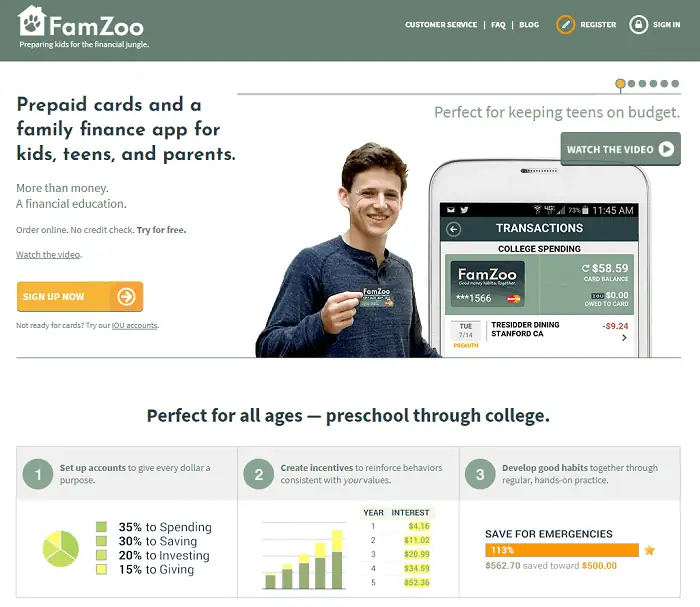
FamZoo is another service for parents interested in opening prepaid debit cards to manage their children’s spending.
Parents can fund a FamZoo account through numerous routes, including bank transfers, Direct Deposit, even cash. Typically, parents will load their primary funding card, then they will transfer those funds onto their kids’ cards. But you do have the option of directly funding kids’ cards.
There are plenty of safety features, too. And there’s no risk of having your bank account information stolen from FamZoo—because FamZoo never asks for it. Adults can monitor transactions, you can temporarily lock and unlock cards, and you can set up real-time alerts for card activity and remaining balances.
After a free trial, this app costs $5.99 per month, but the price goes down if prepaid in advance.
However, FamZoo rates as our top education choice because of its robust financial education library. Many of the functions have financial literacy in mind, too. For instance, payment checklists teach kids the value of a dollar by tying chores and odd jobs to rewards and penalties.
Spend, Save, and Give accounts separate funds into different purposes. And with “Parent-Paid Interest,” you can teach your kids the power of compound interest over time.
FamZoo has no minimum age requirements but recommends starting earlier rather than later.
- FamZoo is the prepaid debit card used by families to teach children good financial habits from an early age.
- FamZoo lets you fund your account in a variety of ways, including bank account, debit card, payment app, digital wallet, and cash.
- Many of the app's functions also have financial literacy in mind, including Parent-Paid Interest, parental loans, and reimbursements.
- Robust, customizable allowance and chores functions.
- Prepaid card without overdraft fees
- Highly customizable allowance and chores functions
- Strong financial education resource library
- High fee at monthly rate
- No paired investment account
- Weak parental controls

Related: Greenlight vs. Famzoo
5. Revolut (Capable App for Many Money Needs)
- Available: Sign up here
- Price: Standard: No monthly fees. Premium: $9.99/mo. Metal: $16.99/mo.
- Platforms: Mobile app (Apple iOS, Android)
Revolut is a financial technology company that helps customers save money in several ways, offering payment tools, a prepaid debit card, currency exchange, investing… and, of course, savings.
Like many other financial apps, Revolut lets you make one-time deposits or set up recurring transfers to your Savings Vault, where you keep your savings. You can add money to a Revolut account in numerous ways, including bank transfer, debit card, Apple Pay or Google Pay, direct deposit, even transfers from other Revolut customers. You can also round-up purchases and have the spare change dropped into your Savings Vault.
You can withdraw money any time, quickly and at no cost from 55,000 in-network ATMs. Just note that Revolut limits out-of-network ATM withdrawals at up to $1,200 per month, and third party fees may apply.
Revolut offers other useful money-related features as well, such as the ability to get paid up to two days early*, Group Bills (to split costs), discounts, cash-back rewards on certain brands, discounted airport lounge access (Premium and Metal plans only), and more.
- Revolut <18 is a prepaid debit card for kids designed to assist parents teach kids ages 6-17 about money. Families can handle chores and allowance, create budgets, set parental controls and more.
- Revolut <18 comes with unique, customizable cards that parents can use to set up tasks and goals to work on together as a family.
- Prepaid debit card for teens
- Parental controls
- Round-ups
- Chore and allowance management
- Customizable designs (fees apply)
- Children can't load funds, only parents can
- Parents need to have a personal Revolut account

6. BusyKid (Best Prepaid Visa Debit Card for Kids)

- Available: Sign up here
- Price: $4/mo. billed annually. (Up to 5 cards)
If you’re looking for prepaid debit cards for kids that also teaches your children about money, lets you pay them allowance, and allows them to spend, consider the award-winning BusyKid app and the connected BusyKid Visa Spend Card.
BusyKid started as an easy-to-use, interactive chore app for kids, but has since added a prepaid debit card that allows your children to spend their money in stores and online. Your children can earn real money by completing chores and other tasks around the house, then use the app to learn valuable financial skills, such as budgeting, saving, and even giving back.
Parents can pay allowance on an ad hoc basis, or they can set up Auto-Allowance. When parents add to their children’s accounts, that money can be split between Save, Share, and Spend:
- Save: Parents can automatically allocate money toward a savings basket; however, parents can also match any money their children elect to save.
- Donate: Children can choose which charities they would like to give money to, and parents must approve before the cash is transferred.
- Spend: When they’re ready for independence, BusyKid has a Visa Spend Card so kids are never without cash in hand.
Also, with BusyKid, the parent isn’t the only person who can add money to child accounts. With a share of the QR code, grandparents, aunts, uncles, other family members, and even friends can add money—from birthday presents to paying for chores–for a $1 fee (plus any credit card or bank transaction costs).
Finally, BusyKid also allows children to invest their earnings through the app. Doing so requires setting up a separate Apex Clearing account. Children can choose to invest in hundreds of stocks and ETFs with as little as $10.
In addition to the $4 monthly subscription, BusyKid charges other fees, including 50 cents per declined transaction, $5 for a card reissue, and a $5 monthly fee for paper statements.
- BusyKid is an award-winning, parent-approved app that educates kids about money.
- Parents can pay allowance on an ad hoc basis, or they can set up Auto-Allowance.
- Parents can split allowance money across Save (and even match money in the Save category), Spend (which kids can access with their Visa Spend Card), and Donate (children can choose charities to donate to; parents must approve).
- Parents can set up a separate Apex Clearing brokerage account to allow their children to invest earnings through BusyKid, with as little as $10.
- Feature-heavy allowance function
- Offers investment functionality
- Combines several kid-focused financial needs in one app
- Charges a fee
- Lower customer user ratings than competitors

Related: Best Bar Mitzvah Gift Ideas [Financial Gift Ideas That Last]
7. Till Financial (Best for Spending Lessons)
- Available: Sign up here
- Price: Free (no monthly fees)
Earning, saving, and investing money are important cornerstones for every child to learn before setting out into the world. But just as important is the fourth pillar: how to spend money wisely.
That’s where Till Financial wants to help.
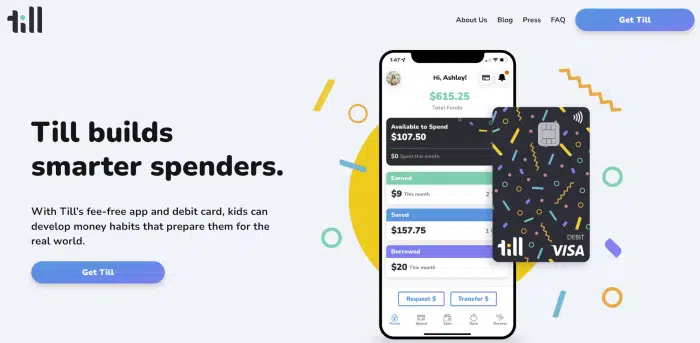
The free debit card and banking platform for kids describes itself as a collaborative family financial tool that empowers children to become smarter spenders. They do this by designing their banking product to encourage “open and honest” discussions between parents and kids.
Further, they allow kids to establish savings targets based on goals. For example, if a teen wants to save up to buy a new laptop or iPad, they can set up an account to save toward this goal themselves, but also solicit help from family members to contribute the same (or more) funds. They can also track their progress along the way, which helps to encourage them to continue saving because the path to their goal feels more real.
Till Financial also wants to further their money education effort by helping kids to “learn by doing,” gaining confidence in their spending decisions along the way. They do this by giving them responsibility over their financial actions through the service, such as learning about the costs of recurring subscriptions like Netflix or Spotify.
Another thing that stands out about Till Financial are all the various ways children can receive money. These include:
- Quick gives: One-time instant transfers from parent wallets to kids’ wallets.
- Allowance: An automated recurring transfer from parents’ wallets to kids’ wallets.
- Tasks: You create a chore, a frequency and an associated payment for your child to complete. If your child marks the task as completed, you’ll be notified—if you confirm the task actually was completed, the funds will be transferred.
- Direct deposit: Does your child have a job with direct deposit? They can have their checks sent directly to their Till account.
- Contributions: You can send recurring contributions toward your child’s savings goal. This can be set as a percent match to each of your child’s contributions, an interest payment (percent match to total amount) or weekly contributions.
- Transfers: A child or adult can transfer money between their Save and Spend balances. (If the child initiates the transfer, it must be approved by an adult.)
- Other contributions: Grandparents, aunts, uncles, and other close friends can contribute to a child Till user’s goal.
If you’d like to sign up for a free account with Till Financial, you’ll be equipped with a bank account, digital and physical debit card, and goal-based savings features. The debit card can be used online or in person, and parents enjoy safety features like one-tap card freezes should their child lose their physical card.
- Till Financial is a free app and debit card for kids aimed at creating "Smart Spenders" by fostering discussions between parents and children.
- The app aims to teach kids the importance of spending wisely, setting goals, and understanding the value of money.
- Till Financial's app features a host of ways to transfer money, including allowance, Tasks (chores), direct deposit, "quick gives," recurring contributions, and more.
- Free debit card for kids
- Numerous ways to contribute to a child's account
- Strong financial education core
- Savings goals with progress tracking
- Can only link one funding source at a time
- No cash deposits
- Limited educational tools

Related: Best Banking Apps for Kids & Teens [Teen Banking]
Do you want to get serious about saving and planning for retirement? Sign up for Retire With Riley, Young and the Invested’s free retirement planning newsletter.
7. Current (Great No-Monthly-Fee Teen Card)
- Available: Sign up here
- Price: Free (no monthly fees)
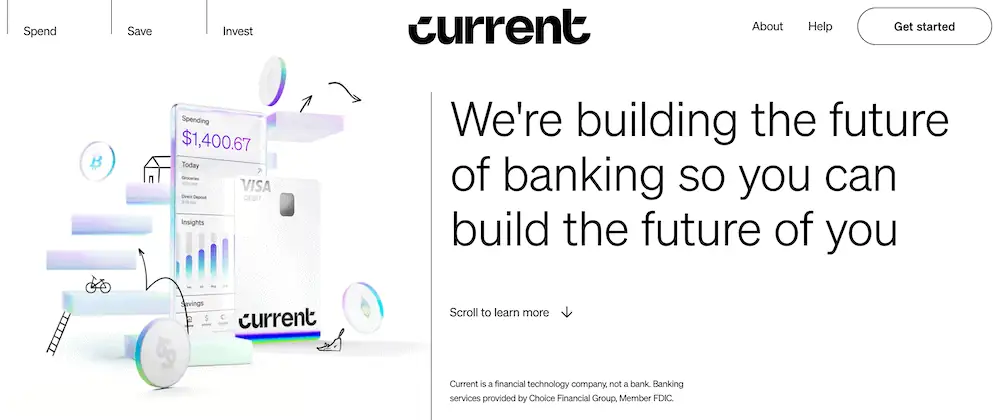
Current is a banking app designed for families; it offers both parent and teen accounts, with the latter acting like prepaid debit cards that parents load for their children. The Current app allows you to track your teen’s spending in real-time, set limits on how much your children can spend, and even block specific merchants on its Visa-enabled debit cards. You also get the peace of mind that comes with knowing your children’s money is safe because it’s not cash—no temptations, just a tool parents can use to help teach teens financial responsibility.
Among Current’s features:
- No minimum required balances, no fees on transfers to other Current accounts, and no hidden fees.
- Create Savings Pods, or Giving Pods, that allow you to save up for various goals.
- Round-Ups allow you to round up purchases to the nearest dollar amount and store the difference in Savings or Giving Pods.
- Buy and sell 27 different cryptocurrencies with zero trading fees.
Teens will love easy allowance deposits, a card they can use in stores or online, instant gas hold removals when buying gas, and access to more than 40,000 fee-free Allpoint ATMs nationwide. They’ll also have the opportunity to learn about financial responsibility and financial independence through Current’s Budgets feature, which allows them to track their spending and even receive alerts when they get too close to (or exceed) a predetermined limit.
The product has no specifically stated minimum age requirement, but the marketing suggests teens are the target audience. However, you might be able to open an account for a younger child.
Read more in our Current review.
- Current is a financial technology platform that lets teens enjoy not just traditional banking basics, but numerous features meant to simplify spending, streamline saving, and set them on the path toward more organized finances.
- Teens can spend with the Current Visa debit card, which allows them to purchase in-store and online, as well as withdraw money fee-free from more than 40,000 in-network Allpoint ATMs.
- Current Teen Accounts also come with Savings Pods, which earn 0.25% APY and allow you to round up purchases (overages are funneled into your savings).
- Parents can monitor their kids' spending, adjust maximum ATM withdrawal and spending limits, and even toggle spending categories (and the Current debit card itself) on and off.
- Parents can also automate allowance payments, pay for chores, instantly transfer money to their teens, and more.
- Free account (no monthly maintenance fees)
- Good parental controls
- Fee-free ATMs
- Cash reloads
- Gas hold deposits
- 24/7 email and live-chat support
- No direct deposit
- No paired investment account
- No card customization

Related: Best Online Jobs for Teens to Make Money While at Home
Featured Financial Products
Are There Alternatives to Prepaid Debit Cards?
You might decide that a prepaid card just isn’t for you, and instead want a more traditional bank account. Here are a few of our favorite solutions—more traditional banking products that are designed with kids and teens in mind.
| App | Apple App Store Rating + Best For | Fees |
|---|---|---|
 Capital One MONEY Capital One MONEY | ☆ 4.8 / 5 Free, feature-filled checking + debit card from a major bank | Free (no monthly fees) |
 Axos First Checking Axos First Checking | ☆ 4.7 / 5 Teens ready to learn about money management | Free (no monthly fees) |
 Chase First Banking Chase First Banking | ☆ 4.8 / 5 High customer satisfaction from a major bank without fees | Free |
| *Apple App Store Rating as of July 28, 2025. | ||
9. Capital One MONEY (Best Free Teen Checking Account)
- Available: Read our review and sign up
- Price: Free (no monthly fees)
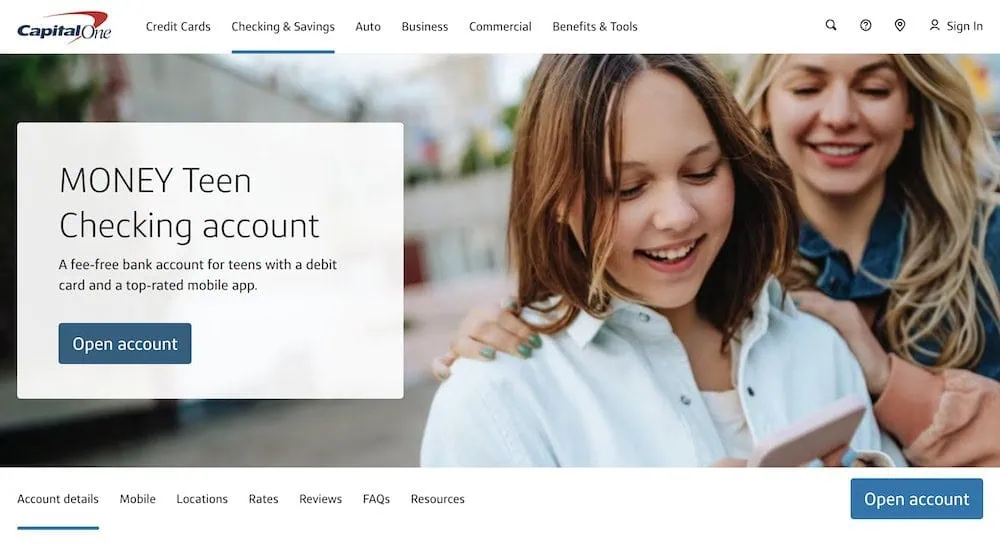
Capital One MONEY Teen Checking is one of Young and the Invested’s top choices for parents who want to financially empower their kids at an early age. Yes, this free checking account is predominantly aimed at teenagers, but it’s actually available to kids as young as 8 years old.
This joint checking account offers flexibility for kids and a touch of tranquility for parents. Kids get a Mastercard debit card that they can use at millions of merchants across the U.S., as well as in roughly 210 countries and territories worldwide. Your teen also enjoys access to one of the largest fee-free ATM networks among kids debit cards—more than 70,000+ Capital One, MoneyPass, and AllPoint machines. They can also send and receive money via Zelle, receive direct deposits from employers, and even cash paper checks by snapping a couple photos within the highly rated Capital One app.
Parents, meanwhile, can also pay their kids a regular allowance, or make one-time payments as gifts or rewards. They also can monitor their teens’ transactions, lock and unlock their child’s card, and control their kid’s access to (and transfer limits within) Zelle.
To learn more about the account, read our Capital One MONEY Teen Checking review. Or you can sign up today by clicking “Get Started” above.
- Capital One MONEY is a full-fledged money management account that comes with both a debit card and a highly rated mobile app.
- Boasts one of the largest nationwide fee-free ATM networks, which currently stands at more than 70,000 machines nationwide.
- Security features include monitoring tools and easy card lock/unlock.
- Age requirement: 8+ with a parent-sponsored account
- APY: 0.10%
- Minimum deposit: None
- Minimum balance required: None
- Free account and card
- Access to 70,000+ fee-free ATMs
- Access to Zelle
- Mobile check deposit
- Cash deposits
- Allowance
- Ability to migrate account to 360 Checking when minor becomes 18
- Sparse educational tools
- Few rewards or perks

Related: Best Debit Cards for Kids
Make Young and the Invested your preferred news source on Google
Simply go to your preferences page and select the ✓ box for Young and the Invested. Once you’ve made this update, you’ll see Young and the Invested show up more often in Google’s “Top Stories” feed, as well as in a dedicated “From Your Sources” section on Google’s search results page.
10. Axos Bank First Checking (Best Free Debit Card for Teens at an Online-Only Bank)
- Available: Sign up here
- Price: Free (no monthly fees)
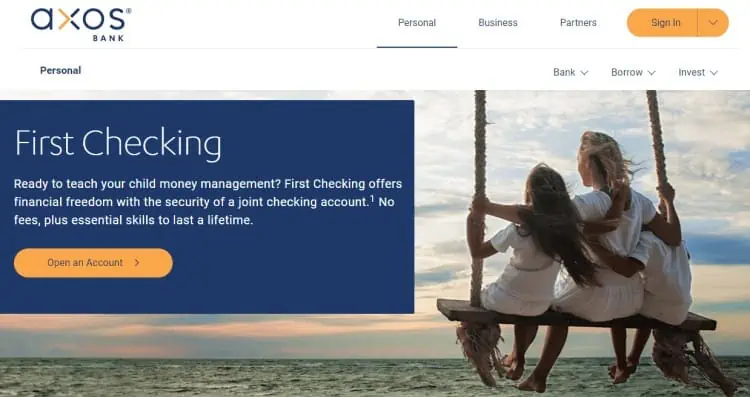
First Checking by Axos Bank is the ultimate starter checking account for teens, and it comes with a debit card.
The world of banking can be a little scary, but not with the simplicity and power of Axos’ First Checking Account. It works as a joint checking account between a parent or guardian and their teen, allowing for easy-to-set, customizable parental controls with a debit card dashboard.
Parents and teens can manage almost every part of the banking experience through a convenient mobile app or through the online desktop portal. Perfect for modern families who always find themselves on the go.
The First Checking account from Axos Bank gives teens their first taste of financial independence by giving them their own checking account (which pays interest!) and free debit card for teens. But it also provides safeguards against teens getting carried away with the money held in their account, such as daily limits on cash transactions ($100) and debit transactions ($500).
Further, you can receive up to $12 in domestic ATM fee reimbursements per month, and you avoid any monthly maintenance, overdraft, and non-sufficient funds fees—essentially making the account free! Meanwhile, users can also earn a modest 0.10% APY on any balance—lower than the national average rate, but fair for a simple teen checking account and debit card product.
The account carries the highest level of security through biometric authentication techniques like fingerprint readers, voiceprints and facial recognition (pending smartphone feature availability).
The product has a minimum age requirement of 13 and is recommended for ages 13 to 17. It will convert to an Axos Checking Account after the minor reaches the age of majority.
Read more in our Axos First Checking Account review.
- Axos Bank First Checking is a joint checking account targeted for teenagers ages 13-17 and their parents.
- Account holders get a Visa or Mastercard debit card that can be used to spend online or in person, or to withdraw cash at any ATM. (Axos provides up to $12 in monthly domestic ATM fee reimbursements.)
- No monthly maintenance, overdraft, or non-sufficient fund fees.
- The debit card's security features include account alerts, card locking, and daily transaction alerts of $100 (cash) and $500 (debit).
- Currently, you can earn up to 0.10% APY on any balance.
- Free (no monthly maintenance fees)
- ATM fee reimbursements (up to $12 per month)
- Converts to adult checking account after minor reaches age of majority
- No paired investment account
- No robust financial literacy resources

Related: 8 Best Free Debit Cards for Kids & Teens [Save, Spend & Earn]
Do you want to get serious about saving and planning for retirement? Sign up for Retire With Riley, Young and the Invested’s free retirement planning newsletter.
What Is a Debit Card for Teens?

Children generally can’t open their own bank account until they reach the age of majority in their state—often 18 years old. Thus, parents often look for other paths, such as opening a sub-account from their own bank account so they can provide their children with a card to use.
In that event, your child likely will need to be at least 13 years old before receiving a card.
Unfortunately, these accounts might not come with the custom spending controls, parental oversight, or feature-filled mobile apps provided by many new debit cards for kids. These new apps provide numerous controls over your children’s spending, including spending notifications, limiting where your child can use the card, and even allowing you to quickly lock and unlock the card. And in many cases, you simply fund your child’s debit card, so it effectively functions as a prepaid debit card.
Traditional banks or prepaid debit cards might not allow you to do this beyond keeping the account balance at a certain level.
Can I Get a Debit Card for Teens Under 18?
Though rules vary by financial institution, some banks don’t allow minors to have debit cards under their own name before the age of 16. Others choose to offer them to kids who are 13 or younger.
But even if you can get one from your current bank, you might not want to just hand your child any ol’ debit card. You might want more insight and control over their spending so you can introduce and reinforce good spending habits.
One such option includes having a joint prepaid debit card with your child, allowing you both to manage the money and agree on what the card can be used for. These cards give children some of the control they seek over their own cash but still allow parents to monitor spending and offer useful guidance when necessary. (Traditional banks don’t often have these controls available to you, making this a difficult task without the tools necessary to oversee account management.)
Most of the cards listed above, however, act like individual prepaid debit cards for your children. You load the cards with money, and they can only spend what is available on the card.
Teens’ Debit Cards vs Teens’ Prepaid Cards
The primary difference between a standard debit card and a prepaid debit card is that the former is connected to money in an account at a bank or a credit union, whereas the latter requires you to reload money on the card to be able to use it.
A standard debit card is attached to a bank account, typically a checking account. The account is typically funded through means like
Automated Clearing House (ACH), direct deposit, or otherwise depositing earnings into your account. You can also deposit cash into your bank account without incurring a fee.
When you go to spend with the card, charges are made against the balance in your account. If you spend more than the balance, you’ll “overdraft” your account, and many banks charge overdraft fees in response.
A prepaid debit card is a “stored value” card funded by loading money onto the card. And typically, if you want to load a card using cash, you’ll incur cash reload fees.
The upside of a prepaid debit card is that you can’t be charged overdraft fees. If you’re at risk of overspending your account, the card transaction will simply be declined.
Can Teens Have Prepaid Cards?
In short, teens absolutely can have prepaid cards. The question is whether they’re the top solution.
Prepaid debit cards can serve as a great way for young children to enter into the financial world. Kids can only spend the balance held on the card, and parents can tie those funds to things like allowance earned through performing chores or just a set payment schedule.
That said, modern prepaid debit cards are even great for older children and teens because help teach people how to manage their money digitally as opposed to just physically. With cash or a physical debit card, your kids will still gain some understanding of how money works. But a prepaid debit card with a mobile app interface will give them a better-rounded, more interactive experience.
A digital-based prepaid debit card is also useful because teens increasingly want to buy items online—and in some cases, it’s the default method for buying goods and services such as video-game add-ons.
Disclosures
Revolut <18
Disclaimer
* Early salary subject to employer deposit timing and not guaranteed.
Revolut is not a bank, banking services are provided by Lead Bank, Member FDIC. Fees may apply. The Revolut USA Prepaid Visa and Prepaid Mastercard are issued by Lead Bank pursuant to licensing by Visa® U.S.A. Inc. and Mastercard International for Mastercard cards. Funds in your Revolut Prepaid Card Account are held at or transferred to Lead Bank, Member FDIC, and are insured by the FDIC up to $250,000 applicable limits by the FDIC in the event Lead Bank fails if specific deposit insurance requirements are met. See FDIC-Prepaid Cards and Deposit Insurance Coverage
Securities products and services provided by Revolut Securities Inc., member FINRA/SIPC. Securities products are not insured by the FDIC or any federal government agency, are not bank deposits, are not obligations of or guaranteed by any bank and are subject to investment risks, including possible loss of the principal amount invested.Automated investing is provided by Revolut Wealth Inc., an SEC registered investment advisor. Information about operations, services, and fees is set forth in Revolut Wealth’s current Form ADV Part 2 (Brochure), a copy of which is available upon request and at IAPD – Investment Adviser Public Disclosure – Homepage.
Bonus Terms & Conditions: https://www.revolut.com/en-US/legal/partner-sign-up-bonus/