



What do the market’s best dividend stocks look like?
Annoying an answer as this is, it depends on what you’re looking for. Maybe you want prolific dividend growth, for instance. Or maybe you’re looking for high current yield.
But today, I want to focus on so-called “total package” dividend stocks: top-quality companies that pay well-covered dividends that amount to above-average yields. In some cases, these companies have been growing their distributions, and a few deliver truly high yields. However, the main point across the board here is these companies’ overall quality.
Read on as I highlight Wall Street’s best dividend stocks, as rated by research firms that routinely cover these companies. I’ll also take some time to explain the importance of dividend income and sustainable payouts.
Editor’s Note: Tabular data presented in this article is up-to-date as of Sept. 14, 2026.
Featured Financial Products
Disclaimer: This article does not constitute individualized investment advice. Individual securities, funds, and/or other investments appear for your consideration and not as personalized investment recommendations. Act at your own discretion.
Table of Contents
Why Dividend Stocks?
Dividend stocks can do wonders for the long-term performance of your portfolio. These companies pay a regular flow of their profits directly back to shareholders, meaning you receive some sort of return—even when share prices aren’t cooperating.
Stocks that can both grow and pay dividends are the ultimate long-term stocks given just how much in additional returns they can generate over the long term.
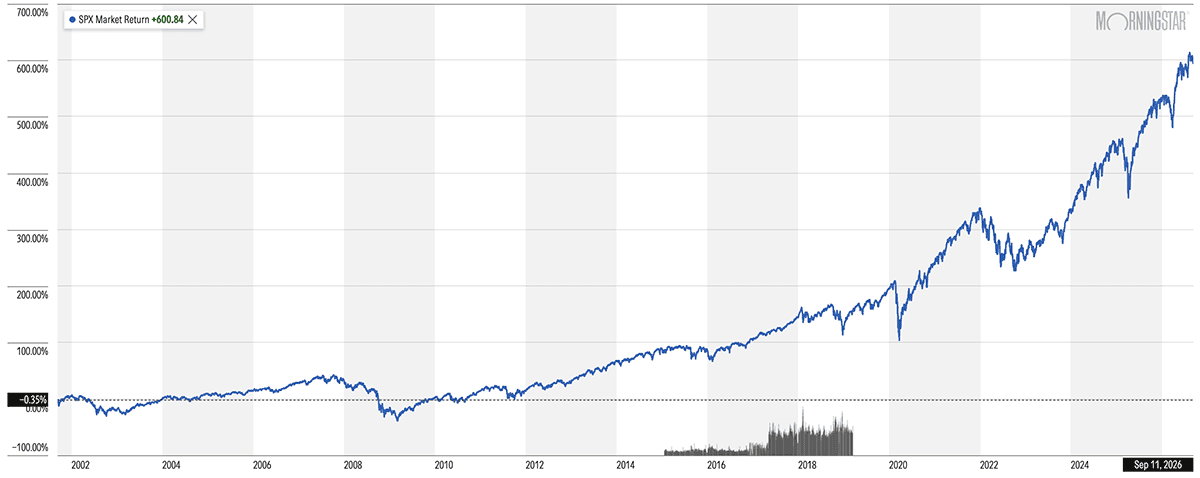
Here’s a look at the return someone could expect if they received just the price returns from the S&P 500 over the past 25 years:
Now look at how much better the return is when you factor in dividends had you had reinvested those dividends back into the S&P 500 (returns illustrated by an S&P 500-tracking ETF; note that expenses are included in performance):
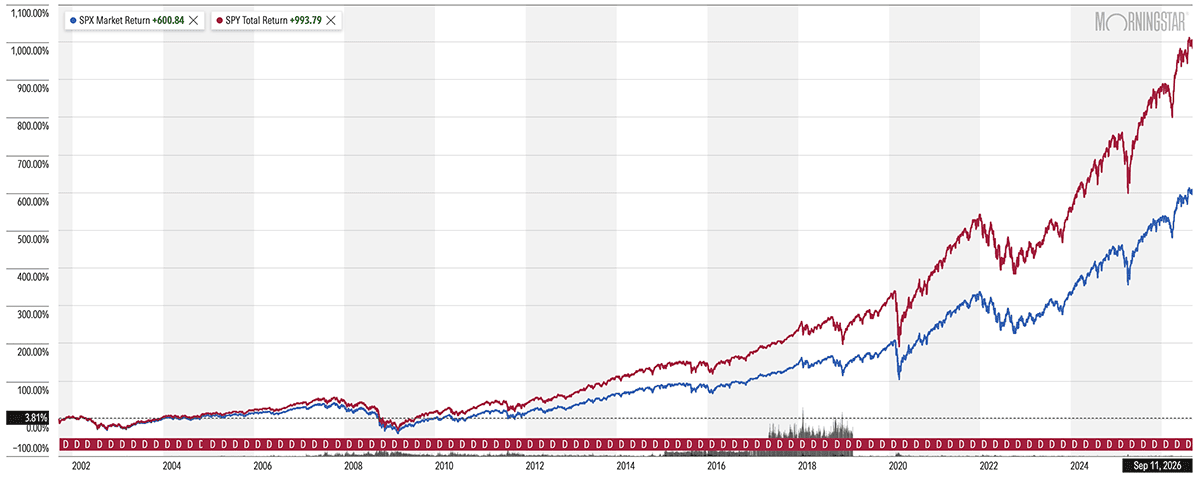
The price return is right around 600%. The total return (price plus dividends) is almost 995%!
Just like price return on stocks can be improved upon with dividends, though, a stock that pays dividends but doesn’t go anywhere isn’t exactly ideal, either. Thus, the best dividend stocks will provide both a steady baseline of income and provide you with the potential for meaningful price upside.
Dividend Yields (And Dividend Safety)
Dividend yield is a simple calculation—annual dividend / price x 100—that can mean a world of difference for investors, especially those reliant on income.
But dividend yield isn’t everything. Sometimes, stocks with high yields can look more attractive, but they’re actually flashing a warning signal that the dividend isn’t sustainable. You see, a company can get a very high annual dividend yield in two very different ways: the dividend growing very rapidly, or the share price falling very quickly.
For example, Alpha Corp., which trades for $100 per share, pays a 75¢-per-share quarterly dividend, or $3 across the whole year. It yields 3.0%. In a month, however, it yields 6.0%. Here are two ways that could have happened:
- Alpha Corp. doubled its dividend to $1.50 per share quarterly, good for a $6-per-share annual dividend. The share price stays the same. ($6 / $100 x 100 = 6.0%)
- Alpha Corp. kept its dividend at 75¢ quarterly ($3 annually), but its share price plunged in half to $50 per share. ($3 / $50 x 100 = 6.0%)
In one of those scenarios, Alpha Corp. has a very safe dividend. In the other one, Alpha’s dividend could be ready to implode.
So, if you’re sniffing out the best dividend stocks to buy for 2026, make sure you’re not just looking at yield, but also gauging a dividend’s safety. Among other things, you’ll want to look at payout ratio, which determines what percentage of a company’s profits, distributable cash flow, and other financial metrics (depending on the type of stock) are being used to finance the dividend. Generally speaking, the lower the payout ratio, the more sustainable the payout.
Do you want to get serious about saving and planning for retirement? Sign up for Retire With Riley, our free retirement planning newsletter.
Earn a Dividend Match With Plynk**
- Plynk® is a dividend-friendly app that offers commission-free trades* on 5,000 stocks and more than 3,400 ETFs, and also supports mutual funds and cryptocurrencies.
- Plynk offers a cash match of 25% on dividend income that allows you to earn up to $250 extra each year.**
- Track your dividends and interest with Income Hub.
- Earn a 3.48% APY on uninvested cash.
- Plynk charges no account opening fees, and you can start investing for as little as $1.
- No account fees
- Smart design and smooth user experience
- Fractional shares
- Designed for beginning investors
- Virtual portfolios and simulated trading
- 25% dividend match
- Earn interest on uninvested cash
- One of the best automated investing programs we've seen (Steady Start)
- Elite educational resources and tools
- Lacks features such as options trading and advanced charting that more experienced traders prefer

How I Chose the Best Dividend Stocks to Buy
Before I started this article, I was video calling a colleague and joked, in a pseudo-philosophical voice, “What is a good dividend stock, anyways?”
But I was only partly kidding. What’s ideal to one investor might not fit the bill for another. Ultimately, though, I coalesced around safe dividends, with some capacity to grow, sporting above-average yields, paid by larger (and thus likelier to be more stable) companies. Specifically, they have to …
- Be in the S&P 500.
- Have a yield greater than 1.5%, to ensure they’re better than the overall market. Most of the stocks on this list yield more than 2%. (If that’s too low a baseline yield for you, I suggest you instead read our list of high-yield dividend stocks, where 5%-plus yields are the norm.)
- Have an earnings payout ratio below 70%. This is a generally safe level where there’s still at least some room for dividend growth, and the lower the payout ratio, typically the more growth potential there is. (Note: Free cash flow payout ratio is an even better metric, but screening data for this tends to be unreliable.)
- Have at least a consensus Buy rating according to analysts tracked by S&P Global Market Intelligence. S&P boils down consensus ratings down to a numerical system where anything less than 1.5 is a Strong Buy, 1.5 to 2.5 is a Buy, between 2.5 and 3.5 is a Hold, 3.5 to 4.5 is a Sell, and anything greater than 4.5 is a Strong Sell. In this case, I only included stocks with a 2.0 rating or less—so at least a pretty firm consensus Buy rating, if not an outright Strong Buy.
I also limited the energy sector to just two stocks. Energy companies were extremely overrepresented in the screen; most problematic is that several sport variable dividends that rise and fall based on available cash flow, which is largely tethered to the motion of energy prices. So a 3% yield today could be 1% in a year, 2% the year after, and so on. The rest of the list is populated with stocks that have more traditional dividend programs—regular payouts that typically only change when the company announces a hike.
The equities here are listed in reverse order of their consensus analyst rating, starting with the worst-rated stock and ending with the best-rated stock.
Related: 15 Dividend Kings for Royally Resilient Income
10. Citizens Financial Group

- Sector: Financials
- Market cap: $29.7 billion
- Dividend yield: 2.6%
- Consensus analyst rating: 1.61 (Buy)
Citizens Financial Group (CFG) is the holding company behind Citizens Bank, a large regional bank with roughly 1,000 branches serving 14 East Coast and Midwest states as well as Washington, D.C. It provides a wide variety of consumer and commercial banking services, including deposits, mortgages, credit cards, business loans, wealth management, foreign exchange, corporate finance, and more.
One noteworthy area of growth for CFG is Citizens Private Bank, which offers personal banking, wealth management, and other services to people with at least $10 million in net worth and at least $5 million in liquid assets. Since launching near the end of 2023, Private Bank has accumulated $17.8 billion in deposits, $9.7 billion in loans, and $11.2 billion in client assets.
Related: 10 Best Alternative Investments [Options to Consider]
“Positive policies around deregulation, looser capital requirements, and more stress test transparency stand to benefit CFG,” says Argus Research analyst Kevin Heal, who rates Citizens’ shares at Buy. “Management has remained confident that Private Bank will deliver 20% to 25% return on equity for FY26. Additionally, the bank continues to show strong performance in the New York metro region.”
“A third consecutive quarter of positive [earnings per share] revisions underscores our confidence in the time-based and methodical [return on tangible common equity] improvement narrative that underpins our constructive thesis,” Keefe, Bruyette & Woods analysts, who rate the stock at Outperform, said after the company’s most recent earnings report. “CFG remains among our top ideas among Super Regional banks, with a time-based and methodical ROTCE improvement story that is built on strengthening growth, business model diversification (Private Bank), and positive operating leverage.”
All told, CFG has a broad bull camp of 15 Buys versus three Holds and no Sells, putting it among the S&P 500’s best dividend stocks right now.
Citizens Financial has paid a dividend every year since its initial public offering (IPO) in 2014. Its dividend-growth history is less consistent; nonetheless, the quarterly payout has improved by 360% since its initial 10¢ payout. Most recently, in October 2025, it announced a 9.5% improvement to the dividend, to 46¢ per share. It’s a very well-covered payout that represents about 35% of Citizens’ anticipated profits for 2026.
Featured Financial Products
Related: The 7 Best REITs to Buy for the Rest of 2026
9. UnitedHealth Group
- Sector: Healthcare
- Market cap: $344.3 billion
- Dividend yield: 2.5%
- Consensus analyst rating: 1.58 (Buy)
UnitedHealth Group (UNH) is America’s largest health insurer, though its massive healthcare operations go far beyond typical coverage. In addition to its UnitedHealthcare insurance division, UNH also is the parent of Optum, which provides medical-care coordination, pharmaceutical services, and health data and analytics.
Indeed, while UnitedHealth is the better-known brand, Optum’s businesses actually contribute more to the bottom line.
UNH shares trudged through a lousy first few months of the year as the company was dogged by a number of issues, including the possibility of funding cuts for Medicaid, rising medical costs, and a Wall Street Journal article claiming that the U.S. Department of Justice was investigating UnitedHealth’s Medicare billing practices. But it has since staged an energetic bounce-back that has it outperforming both the S&P 500 and healthcare sectors for the year to date.
Related: 7 Best High-Yield Dividend ETFs for Income-Hungry Investors
It’s also coming off strong second-quarter results that easily beat Street estimates, thanks in large part to Medicare Advantage.
“We believe UNH is well positioned by virtue of its diversification, strong track record, elite management team, and exposure to certain higher growth businesses,” say Oppenheimer analysts (Outperform), who upgraded their earnings estimates for 2026-28 following the report. “The company’s Optum business is a nice complement to its core managed care operations and continues to account for a large share of earnings. Furthermore, UNH’s vertical integration strategy strengthens the company’s competitive positioning across many areas of the healthcare landscape.”
UnitedHealth has a robust bull camp of 22 Buys, against four Holds and no Sells, to put it among the best-rated dividend stocks on Wall Street.
As for the dividend, UNH raised its payout by 5% in June, to $2.32 per share, which comes out to about half of this year’s projected profits. That’s a higher ratio than in recent years, but it still gives UnitedHealth some room to modestly improve the dividend going forward.
Make Young and the Invested your preferred news source on Google
Simply go to your preferences page and select the ✓ box for Young and the Invested. Once you’ve made this update, you’ll see Young and the Invested show up more often in Google’s “Top Stories” feed, as well as in a dedicated “From Your Sources” section on Google’s search results page.
8. Bunge Global

- Sector: Consumer staples
- Market cap: $23.3 billion
- Dividend yield: 2.4%
- Consensus analyst rating: 1.56 (Buy)
Bunge Global (BG) is a leading agribusiness and food company, operating across the entire agricultural supply chain through its many subsidiaries. All told, its operations span roughly 23,000 employees across more than 300 facilities in over 40 countries.
The U.S.-headquartered but Switzerland-incorporated firm is a leading global oilseed processor and producer of vegetable oils and protein meals. It sources, processes, and distributes grains such as soybeans, wheat, and corn. It produces agricultural products such as fertilizers and sugars. And that’s just some of what this ag giant does.
Related: 11 Best Vanguard Funds for the Everyday Investor
Bunge has been a “patience stock” for years thanks to lower margins on crush (the process that produces soybean oil and protein meal), as well as delays to its proposed mega-acquisition of Canadian grain handling business Viterra. However, investors who have had patience are finally seeing the payoff, with the stock up more than 40% over the past year amid optimism over renewable volume obligation (RVO) and the closing of its Viterra deal.
“BG raised 2026 EPS guidance to $9.25-$9.75 (from $9.00-$9.50) as higher crush/refining expectations are mitigated by softer merchandising/milling outlook,” BMO Capital Markets Analyst Andrew Strelzik, who rates the stock at Outperform, wrote after the company’s second-quarter earnings report in late July. “Guidance implies second-half EPS mid-point in-line with consensus and annualized run-rate of ~$11, and we see further upside potential to outlook. We reiterate Outperform and view today’s pullback as an attractive buying opportunity ahead of second-half EPS acceleration and favorable 2027 outlook.”
Related: 7 Best Vanguard Dividend Funds [Low-Cost Income]
Strelzik is one of eight analysts with a Buy-equivalent rating on Bunge. That compares well against just one Hold and no Sells.
BG, meanwhile, can pay investors at least a modest sum for their patience. The 2%-plus yield, on a quarterly dividend of 72¢ per share, is more than a percentage point better than what you’ll get from the S&P 500. That dividend has also grown by a decent 37% over the past five years, and it’s as safe as you could want it, with Bunge maintaining a conservative payout ratio of 30% of 2026 profit estimates.
Make sure you sign up for The Weekend Tea, our free weekly newsletter that over 10k monthly readers use to level up their money know-how.
7. Avery Dennison
- Sector: Consumer discretionary
- Market cap: $13.0 billion
- Dividend yield: 2.4%
- Consensus analyst rating: 1.55 (Buy)
Avery Dennison (AVY) is a materials science and digital identification solutions provider—an odd bird, but one with a ton of practical applications.
For instance, it offers pressure-sensitive label materials, performance tapes, and other adhesive-based materials. It provides graphics and reflective products for commercial sign companies, digital printers, and architectural firms. It makes reflective films that are used in traffic and safety, pressure-sensitive vinyl and specialty materials for digital imaging. But it’s also a leader in radio-frequency identification (RFID), which companies like Walmart (WMT) can use in inventory management and supply chain visibility.
Related: The 10 Best Vanguard Index Funds You Can Buy
Avery Dennison technically belongs to the consumer discretionary sector, but it has elements of materials and industrials. All of that still makes it a cyclical business whose top and bottom lines can ebb and flow from one year to the next. Regardless, it has built up a 16-year streak of consecutive dividend increases, making it not just one of the best dividend stocks to buy now, but one of the best dividend-growth stocks, too.
The most recent improvement, announced in late April 2026, was a 6% hike to an even $1 per share. The distribution represents only 40% of its expected earnings for 2026, which provides some flexibility.
The announcement came just a couple days after it reported a strong Q1, which it then followed up with a surprisingly robust Q2 report in late July.
“Despite significant concerns around raws and the weakening consumer, AVY delivered not only a solid 2Q beat but also had confidence to post a FY26 outlook solidly better than expected/feared,” says John P. McNulty, U.S. Chemicals Analyst at BMO Capital Markets, who rates the stock at Outperform (equivalent of Buy). “With a notable jump in Sols margins tied to vol growth, that should accelerate with RFID in [the second half of 2026 going into 2027], price and efficiency likely to help Mats profitability, robust [free cash flow] being put to work in buybacks, and a valuation near the lowest levels since 2017, we see AVY poised to outperform.”
BMO is just one of nine Buys on the stock. The other two analysts covering AVY call it a Hold.
Related: 12 Best Vanguard ETFs You Can Buy [Build a Low-Cost Portfolio]
6. Bank of America
- Sector: Financials
- Market cap: $415.9 billion
- Dividend yield: 2.0%
- Consensus analyst rating: 1.54 (Buy)
Bank of America (BAC) is one of the world’s largest banks, serving roughly 70 million Americans through 3,800 branches and 15,000 ATMs across 39 states. However, BofA is much, much more than its consumer business—it also provides financial products and services for small and midsized businesses, large corporations, institutional investors, and even governments. Its offerings range from checking and savings accounts to commercial loans, trade finance, treasury management, and securities clearing.
Related: The 10 Best Dividend ETFs for the Rest of 2026
BAC shares had spent most of the year in the red, but they rebounded during the summer to flip to single-digit gains. Relatively volatile markets have helped push trading revenues higher, loans are growing, and the company’s net interest margin (NIM) picture is improving.
“Management continues to focus on what it terms ‘responsible growth.’ We believe this may be seen in the company’s ability to expand its loan portfolio without taking on excessive credit risk, and to balance growth across segments so that more volatile businesses, such as trading and investment banking, do not account for an outsized portion of profits,” says Argus Research analyst Stephen Biggar (Buy). “We believe that the current BAC share price undervalues the franchise given ongoing improvement in return metrics and continued positive operating leverage.”
Related: 10 Best Dividend Mutual Funds You Can Buy Now
More recently, BAC is coming off a solid second-quarter earnings release in which the company reported stronger fee income and muted expenses. “The second-quarter print reaffirms our prior view that BAC’s NIM remains among the more defensible in the group, supported by fixed-rate asset repricing tailwinds and strong deposit franchise, evidenced by a 1-basis-point decline in total deposit costs,” says Citi analyst Benjamin Gerlinger (Buy).
Analysts are plenty bullish on this Big Four bank, offering up 20 Buy ratings against just four Holds and no Sells. Bank of America has raised its cash distribution by 55% between 2020 and today. Most recently, it announced a stellar 14% hike, to 32¢ per share, effective as of the September 2026 payout. That dividend is very well-covered at less than 30% of 2026’s expected earnings.
Related: The 7 Best Mutual Funds for Beginners
Need Help Picking Stocks? Consider These Top-Rated Services
|
Best Introductory Stock Picking Service

|
Data-Driven Stock Picking Service

|
Best Proprietary Ranking System

|
|
Primary Rating:
4.7
|
Primary Rating:
4.3
|
Primary Rating:
4.2
|
|
$99/yr. ($100 first-year savings)
|
$449/yr. ($50 discount)*
|
30-day free trial, then $249/yr.
|
5. BlackRock
- Sector: Financials
- Market cap: $165.0 billion
- Dividend yield: 2.1%
- Consensus analyst rating: 1.53 (Buy)
BlackRock (BLK) is one of the world’s largest asset management firms, boasting more than $15 trillion in assets across its many lines of business. Individual investors know it well for both its BlackRock mutual funds and closed-end funds (CEFs), as well as its iShares exchange-traded funds (ETFs). But it also manages money for institutional clients, including pension plans, foundations, charities, and insurance companies, among others.
Related: 11 Best Investment Opportunities for Accredited Investors
BlackRock has been in a broader consistent uptrend since the depths of the Great Recession, and that has come alongside similar progression in both the company’s top and bottom lines. There have been a few hiccups along the way, of course, such as COVID and early 2026’s market downturn—but analysts frequently call out these dips as reasons to buy BLK shares.
In fact, it’s difficult to find any Wall Street pros with something negative to say about BlackRock right now despite the fact that BLK remains in the red so far in 2026. Shares currently enjoy 15 Buy calls versus two Holds and no Sells.
Related: 8 Best Stock Picking Services, Subscriptions, Advisors & Sites
“We believe that BLK remains well positioned to deliver above-peer organic growth given its unmatched product breadth and distribution footprint (helped by its iShares franchise),” say Keefe, Bruyette & Woods analysts Aidan Hall and Kyle Voigt, who rate BlackRock’s stock at Outperform (equivalent of Buy). “Also, its scale and demonstrated ability to generate operating leverage bodes well for future earnings growth and operating leverage. The firm’s increasing alternatives presence and growing technology revenue stream add further breadth to what is already a diverse product/solutions offering.”
BlackRock has been a fount of dividend growth since the Great Recession, too. In the past decade alone, BLK has managed to average 10% annual dividend growth. Its most recent hike, announced in early February 2026, was a stout 10% bump to $5.73 per share. Still, a payout ratio just below 45% of 2026 profit estimates should keep investors plenty confident in the dividend’s health and its ability to keep growing.
Do you want to get serious about saving and planning for retirement? Sign up for Retire With Riley, our free retirement planning newsletter.
4. Hasbro

- Sector: Consumer discretionary
- Market cap: $12.8 billion
- Dividend yield: 3.1%
- Consensus analyst rating: 1.47 (Strong Buy)
Toys are a part of everyday life that has endured for eons. The toys might change—wooden dolls have given way to kids’ tablet computers and chemistry sets—but the desire to make a business out of entertaining children isn’t going anywhere.
Hasbro (HAS) is one of the world’s largest toy and gamemakers, offering action figures, dolls, trading cards, plush products, preschool toys, play sets, and other consumer products across dozens of both its own brands as well as third parties it has contracted with. Indeed, just a partial rundown of Hasbro’s biggest brands include the likes of Star Wars, Magic: The Gathering (MTG), Play-Doh, Transformers, Peppa Pig, Final Fantasy, The Lord of the Rings, The Avengers, Nerf, and Monopoly.
Related: 5 Best Stock Recommendation Services [Stock Tips + Picks]
Hasbro appears to be clawing its way out of a prolonged earnings slump, posting 10 consecutive quarters of profit growth. That hasn’t come without bumps—shares slumped in May after the company beat Q1 earnings estimates but provided conservative guidance amid high oil prices and an uncertain tariff situation. But the shares started coming back around in July thanks to strength in the firm’s Wizards of the Coast (responsible for MTG) and Digital Gaming arms.
“The stock has been under pressure since the last print given worries over demand of Magic trading cards and the entry into video games in 2027. 2Q26 results show that Magic continues to be strong” writes Xian Siew, BNP Paribas Equity Research Senior Analyst, who rates the stock at Outperform (equivalent of Buy). “Magic strength was supported by Secrets of Strixhaven and Marvel Super Heroes. We are glad to see Marvel do well, which is in contrast to worries into the print that the set could disappoint.”
Related: 8 Best T. Rowe Price Funds to Buy for the Rest of 2026
Siew represents one of 13 Buy-equivalent calls on HAS stock, versus just two Holds and no Sells, putting it among the best dividend stocks to buy right now.
Speaking of dividends: Hasbro’s cash distribution has either remained steady or grown every year for a quarter-century. Its current 70¢ quarterly dole comes out to a well-above-average yield of 3.5%, and represents less than half of this year’s projected earnings—a plenty comfortable cushion that should at least allow Hasbro to maintain the dividend at current levels, if not modestly raise in the future.
Featured Financial Products
3. Targa Resources
- Sector: Energy
- Market cap: $61.6 billion
- Dividend yield: 1.7%
- Consensus analyst rating: 1.45 (Strong Buy)
Targa Resources (TRGP) deals in the midstream energy market segment—alongside its subsidiary, Targa Resource Partners LP, it owns a wide array of gathering, processing, logistics, and transportation assets across numerous natural resource plays, including the Permian Basin, Bakken Shale, Anadarko Basin, and the Gulf of Mexico, among others. The Permian Basin is arguably Targa’s biggest growth driver; roughly 3 in 5 lower-48 U.S. shale rigs are located there, and about 80% of Targa’s natural gas inlet volumes are sourced from there.
Targa went public in 2010, peaked in 2014, cratered, then largely hovered for a few years after that. But after bottoming out during COVID, the stock has roared back to life and nearly doubled in 2024 to hit all-time highs. After flatlining in 2025, shares have exploded upward by more than 50% in 2026, and the analyst community remains wildly bullish: Twenty Buys dwarf just two Hold calls and no Sells, making TRGP one of the market’s best dividend stocks to buy right now.
Much of this can be attributed to Targa’s positioning in the Permian.
Related: 8 Best Schwab Index Funds for Thrifty Investors
“Targa maintains peer-leading earnings growth as one of the central infrastructure companies in the Permian and is simultaneously buoyed by an accelerating capital return profile, which we believe is likely to help sustain share momentum,” say Stifel analysts (Buy), who resumed coverage of the stock in September. “Targa is fully integrated across the [natural gas liquids] supply chain and is increasing natural gas exposure with a dominant Permian G&P position that in aggregate supports ~11% adjusted EBITDA [earnings before interest, taxes, depreciation, and amortization] growth through 2030, underpinned by over 90% fee-based earnings.”
Energy infrastructure stocks are a different breed. Many of them are master limited partnerships (MLPs), which are required to return a majority of their income to unitholders (shares in MLPs) in the form of distributions (dividend-like payments to shareholders that have different tax consequences). Targa is technically a corporation, though, so it pays dividends like a traditional stock.
In April, the company announced a 25% increase to its dividend, to $1.25 per share. That comes out to 45% of 2026 earnings projections.
Related: 11 Best Vanguard Retirement Funds [Save More in 2026]
2. Devon Energy
- Sector: Energy
- Market cap: $54.7 billion
- Dividend yield: 2.6%
- Consensus analyst rating: 1.31 (Strong Buy)
Energy businesses are typically referred to by their “stream.” Upstream companies search for and extract oil, gas, and other raw energy resources; midstream companies transport, store, and sometimes process those resources; and downstream companies refine these resources into final products such as gasoline, diesel, and natural gas liquids (NGLs).
Devon Energy (DVN) is an upstream firm—an independent oil and natural gas exploration and production (E&P) firm that operates in some of America’s most potent locations, including the Delaware Basin, Anadarko Basin and Eagle Ford.
Related: 10 Best Schwab Mutual Funds You Can Buy [Low Fees, $1 Minimums]
DVN has also become much bigger thanks to the company’s recent merger with Coterra Energy. Devon says that on a pro forma basis, the combined company’s 2025 daily production was about 548,000 barrels of oil, 348,000 barrels of natural gas liquids, and about 4.3 billion cubic feet of natural gas.
E&P companies are more beholden to commodity prices than the other “streams,” so as oil and nat gas prices go, so go their shares. Their differences boil down to operational efficiency, and Devon Energy is among the best, according to Wall Street analysts, who as a group have 26 Buys on the stock against three Holds and no Sells. For now, that puts Devon among the very best-rated dividend stocks to buy within our selection universe.
“DVN has multiple catalysts for absolute and relative outperformance post-[Coterra] close, but attracting long-only capital requires clearer focus on durable core assets,” say Jefferies analysts, who recently upgraded the stock to Buy from Hold. “Divesting non-core, particularly the Marcellus (likely commanding a premium to current valuation), could eliminate debt and boost returns.”
Devon Energy celebrated the acquisition by announcing an $8 billion share buyback authorization and hiking its dividend by 33%, to 32¢ per share quarterly. That comes out to just 25% of this year’s expected earnings—a conservative payout ratio that offers plenty of dividend stability and room for expansion.
Related: 10 Best Schwab ETFs to Buy [Build Your Core for Cheap]
1. CRH plc
- Sector: Materials
- Market cap: $59.2 billion
- Dividend yield: 1.8%
- Consensus analyst rating: 1.30 (Strong Buy)
Dublin-based CRH plc (CRH) is a leading global provider of building materials and construction solutions. It manufactures aggregates (crushed stone, sand, and gravel), cement, asphalt, ready-mixed concrete, and more. These materials are used for transportation networks, critical utilities, and commercial and residential building projects.
The company is getting bigger, too, with CRH in June announcing that it will acquire Dallas-based aggregates player Arcosa (ACA) for $8.5 billion in cash, which represented a 25% premium to Arcosa’s share price. The deal is expected to produce about $60 million in run-rate cost synergies in the first year following the deal close, $130 million in the second year, and $175 million in the third year.
Related: The 10 Best Dividend Stocks for Beginners in 2026
“The diversity of business will clearly help CRH in what is going to be a turbulent year of inflation particularly in Europe, solid demand in North America materials, and rising prices in many products,” says Truist Managing Director Keith Hughes (Buy). “The company’s recent M&A also helps cushion the inflation impact. The recent deals do show somewhat of a shift more towards water infrastructure (buying Axius) and away from outdoor living (sale of decking/mulch) in a trend that we believe will continue.”
At 19 Buys, two Holds, and zero Sells, you can’t find a better-rated dividend stock than CRH right now.
The track record is a bit odd, however. While CRH has paid dividends for more than 50 years, the lion’s share of that time has been spent paying European-style interim-and-final dividends. But in 2024, the company switched to the quarterly system we’re used to in the U.S., and it has raised that payout twice since then, including a 5% improvement starting with the April 2026 distribution.
Related: 8 Best Vanguard Retirement Funds for a 401(k)
Want to talk more about your financial goals or concerns? Our services include comprehensive financial planning, investment management, estate planning, taxes, and more! Schedule a call with Riley to discuss what you need, and what we can do for you.

Related: 15 Best Long-Term Stocks to Buy and Hold Forever
As even novice investors probably know, funds—whether they’re mutual funds or exchange-traded funds (ETFs)—are the simplest and easiest ways to invest in the stock market. But the best long-term stocks also offer many investors a way to stay “invested” intellectually—by following companies they believe in. They also provide investors with the potential for outperformance.
So if you’re looking for a starting point for your own portfolio, look no further. Check out our list of the best long-term stocks for buy-and-hold investors.
Related: 10 Best Monthly Dividend Stocks for Frequent, Regular Income
The vast majority of American dividend stocks pay regular, reliable payouts—and they do so at a more frequent clip (quarterly) than dividend stocks in most other countries (typically every six months or year).
Still, if you’ve ever thought to yourself, “it’d sure be nice to collect these dividends more often,” you don’t have to look far. While they’re not terribly common, American exchanges boast dozens of monthly dividend stocks.
Please Heart ❤️, Follow and Subscribe
Did you find this article helpful?
1. Click the Heart Button.
2. Follow WealthUpdate —-> https://flipboard.com/@WealthUpdate
3. Subscribe to Retire With Riley, our free weekly retirement planning newsletter.
Read More on WealthUpdate
- CRUTs vs. CRAT: Which Charitable Remainder Trust Is Best?
- Greenlight vs. Current [Which Kids’ Debit Card is Better?]
- The 11 Best Fidelity Funds to Buy Now
Disclosures
Plynk
All Plynk disclosures can be viewed here.