


Consumer prices rose only modestly in July, leaving Wall Street a little more convinced that the Federal Reserve will keep interest rates level at its September meeting.
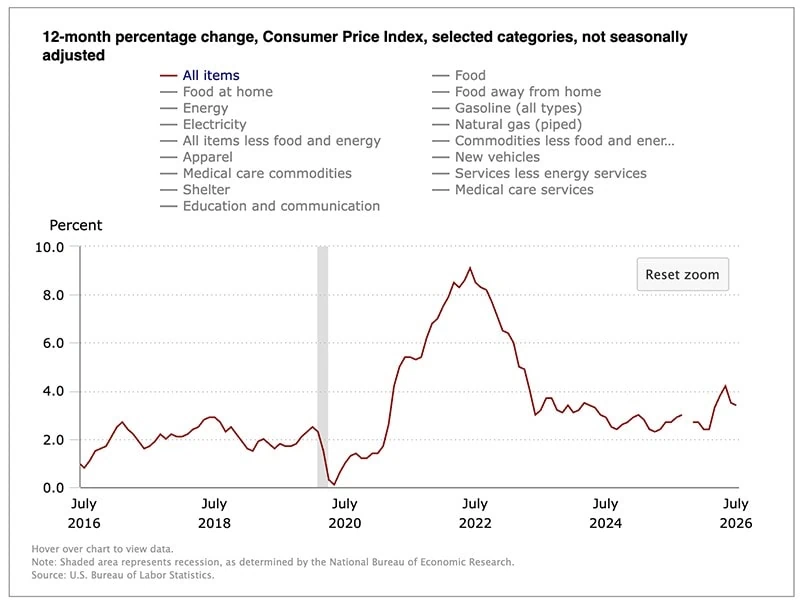
The U.S. Bureau of Labor Statistics said Wednesday that July’s consumer price index (CPI), which measures the change in prices on a variety of consumer goods and services, rose by a seasonally adjusted 3.4% year-over-year—in line with estimates and a notch below June’s 3.5% headline figure. On a month-over-month basis, prices did reverse last month’s 0.4% decline, but they only ticked up by 0.1%, which also matched estimates.
“Core” CPI—a measure of inflation that excludes food and energy costs (factors that are more volatile than the other prices tracked by the Labor Department)—was also plenty softer than expected. Core inflation came in up 0.2% MoM and 2.5% YoY, coming in exactly where economists predicted.
Related: Empower Personal Strategy Review: Wealth Management More People Can Afford
Equities bounced Tuesday morning, with Wall Street believing the report will stay the Fed’s hand at its next rate-setting meeting.
“One down, one to go,” says Lindsay Rosner, head of multi-sector fixed income investing at Goldman Sachs Asset Management. “With another round of inflation data due before the September FOMC meeting, it remains all to play for, but today’s in-line report was a good start. Contained core inflation adds to the encouraging signs in last month’s release of a moderation in underlying inflation, helping strengthen the case for a September hold.”
Here’s a quick look at July’s key CPI figures:
- MoM CPI: +0.1% (estimate: +0.1%)
- YoY CPI: +3.4% (estimate: +3.4%)
- MoM Core CPI: +0.2% (estimate: +0.2%)
- YoY Core CPI: +2.5% (estimate: +2.5%)
Consumers continued to enjoy relief at the pump from America’s temporary pause in its war on Iran, with gasoline prices falling 2.9% month-over-month after dropping by nearly 10% the month before. Fuel oil costs were also 1.7% lower following a 9%-plus reduction the month before.
The U.S. saw two other price declines: a 0.6% drop in medical care commodities (prescription drugs, over-the-counter drugs, and other medical equipment and supplies), and a 0.1% dip in food costs at home.
Shelter prices, meanwhile, continued to moderate, growing by only 0.1% MoM for the second consecutive month.
Related: The 11 Best Fidelity Funds to Buy Now
“One of the most scrutinized parts of CPI, OER (owner’s equivalent rent), remained tame at 0.26%, giving a YoY number of 3.22%,” says John Kerschner, Global Head of Securitized Products and Portfolio Manager at Janus Henderson. “Housing remains one of the brightest lights in the Fed’s fight against overall inflation, and we expect this to continue in the months ahead given mortgage rates stubbornly high around 6.7%.”
Most other price increases were modest. Utility gas service increased 0.7% MoM, medical care services climbed 0.6%, used cars and trucks were 0.4% more expensive, and consumers paid 0.3% more for food away from home. Both shelter and new-vehicle prices inched 0.1% higher.
“Structural disinflationary forces continue in shelter and autos,” says David Russell, Global Head of Market Strategy at TradeStation, an online brokerage firm. “This could be a very bullish inflation report in the absence of Hormuz, but gasoline and especially diesel remain big risks going forward. Energy is the 800-pound gorilla in the living room.”
Need Help Picking Stocks? Consider These Top-Rated Services
|
Best Introductory Stock Picking Service

|
Data-Driven Stock Picking Service

|
Best Proprietary Ranking System

|
|
Primary Rating:
4.7
|
Primary Rating:
4.3
|
Primary Rating:
4.2
|
|
$99/yr. ($100 first-year savings)
|
$449/yr. ($50 discount)*
|
30-day free trial, then $249/yr.
|
Market Still Mixed on Whether Fed Holds in September
Wall Street has for months been convinced that the Federal Reserve will raise its target range for the federal funds rate at some point in 2026. But it has been split about the when.
The CME FedWatch Tool, which uses trading in federal-funds futures to determine Wall Street’s expectations for future Federal Reserve actions, shows a 62% chance that the central bank will maintain its current 3.50%-to-3.75% range at the conclusion of its next Federal Open Market Committee (FOMC) meeting, scheduled for Sept. 15-16, 2026, with the remaining odds on a quarter-point hike. That probability of a stay is up from 52% yesterday and 45% a week ago.
“Inflation remains stuck above the Fed’s 2% target and outside of economic shocks, like the ongoing Iran conflict, the progress toward 2% is painfully slow,” says Steve Wyett, Chief Investment Strategist at BOK Financial. “This release pushes a potential first move a bit later in the year, but there is another round of labor and inflation reports before the next FOMC meeting.”
The implied odds of a hold throughout 2026 increased, from 22% to 29%. But the majority still see at least one rate hike by year’s end, and nearly 30% believe the Fed could hike more than once before 2027 begins.
What the Experts Think About July’s CPI Report
Here, we outline more thoughts from the experts on what last month’s CPI numbers mean for consumers, markets, the Federal Reserve’s future actions, and more:
Josh Jamner, Senior Investment Strategy Analyst, ClearBridge Investments
“An in-line July CPI print leaves a September rate hike on the table, with the decision likely to be more influenced by the combination of August’s jobs and inflation data. Supercore CPI [CPI ex-food, energy and housing] came in at 0.19% [MoM], and the read-through from today’s CPI data for the Fed’s preferred core PCE [personal consumption expenditures] measure points to a reading in the low 0.2% [MoM] range, both of which suggest underlying inflationary pressures are holding steady slightly above the Fed’s 2% target.”
Jason Pride, Chief of Investment Strategy & Research, Glenmede
“The clearest evidence that higher energy costs are reaching other parts of the consumption basket shows up in transportation, and the list largely ends there. Airfares rose 2.2% in July, which is consistent with its role as the most direct transmission of fuel costs into consumer services prices. Transportation services turned positive at 0.3% after three consecutive monthly declines. Beyond that channel, price trends in the rest of the consumption basket remained benign in aggregate and suggest there has been no broad-based pass-through from higher energy prices.”
Related: 5 Dandy Dividend-Growth ETFs to Buy Now
Sonu Varghese, Chief Macro Strategist, Carson Group
“July CPI was a relief on the headline side, but a 2.6% annualized core pace shows we’re not out of the inflation woods. The problem goes beyond energy and tariffs, with the Fed’s preferred core PCE measure likely to come in around 3% [YoY]. The softer headline only sets up maximum uncertainty heading into the September Fed meeting.”
Brad Conger, Chief Investment Officer, Hirtle & Co.
“All the price data was in line with expectations. This should encourage a relief rally in U.S. Treasury yields and some compression of the term premium. We have been adding to duration over 5% on the 20-year Treasury based on our conviction that many forces are militating against broad inflation—most notably, real wages, which are flat.”
Get Elite Stock Analysis From Seeking Alpha
Among our favorite platforms for both data and picks is Seeking Alpha Premium, which gives you unlimited access to thousands of active authors who deliver stock analysis.
Seeking Alpha also provides you with stock research tools, real-time news updates, crowdsourced debates, and market data. Users can create their own portfolio of favorite stocks, see how they perform, and receive email alerts or push notifications about their investments.
Try out Seeking Alpha Premium free for seven days and get a discount on your first year’s subscription.
- Seeking Alpha Premium and Pro help you find profitable investing ideas, improve your portfolio, research stocks better and faster, track the news to find investing opportunities, and connects you to the world's largest investing community.
- A Premium subscription provides access to Seeking Alpha's stock and ETF ratings, including Seeking Alpha Quant Strong Buy recommendations, which have greatly outperformed the stock market over time.
- Premium also gives you access to Seeking Alpha's portfolio health check, which will analyze your portfolio's quality, risk level, and performance.
- Advanced and professional investors can sign up for Pro, where they'll get everything from Premium, as well as instant access to ideas from SA's top 15 analysts, the PRO Quant Portfolio (for active traders), short-selling ideas, and more.
- Special offer on Premium: New subscribers through our link receive a $30 discount off the price of Seeking Alpha Premium in their first year.*
- Special offer on Pro: New subscribers through our link receive one month of Pro for $89, then get $250 off their first full year's subscription.**
- Active community of engaged investors and analysts
- Stock screeners, quantitative tools for stock analysis
- Strong track record of market outperformance on stock ratings
- Minimal mutual fund coverage