



America’s employment situation was worse than anticipated for a second straight month, with a surprise decline in July payrolls muting experts’ expectations for a September interest-rate hike.
The Labor Department reported Friday that nonfarm payrolls (NFP) declined by 23,000 in July, versus Dow Jones-polled economists’ expectations for growth of 95,000—what would’ve been a faster pace than June’s initial reading of 57,000 jobs added. June’s payrolls total was corrected lower, too, to 20,000 added, while May was revised down to 63,000 from 129,000 previously. Combined, June and May’s totals came in more than 100,000 jobs shy of their prior readings.
“History doesn’t repeat, but sometimes it rhymes,” says Lindsay Rosner, head of multi sector fixed income investing at Goldman Sachs Asset Management. “For the third time in as many years, July jobs data saw a mid-summer loss of momentum. While incoming inflation data will be the ultimate arbiter, slowing jobs growth helps support a September hold.”
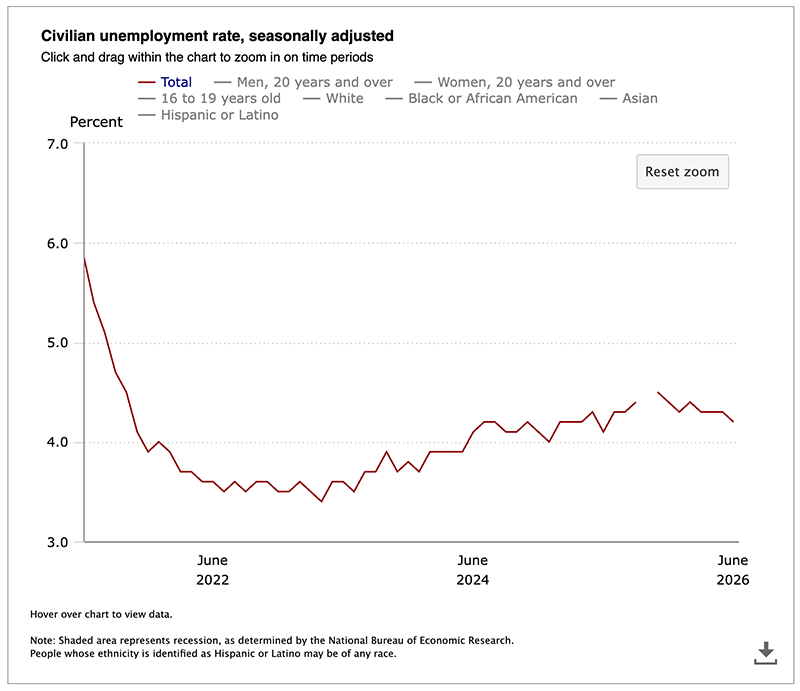
The unemployment rate slipped to 4.1% against expectations for 4.2%, though that was likely in part also due to a slip in the labor force participation rate, from 61.5% in June to a new five-year low of 61.4% in July.
Related: Empower Personal Strategy Review: Wealth Management More People Can Afford
Average hourly earnings were marginally lower, at $37.62. On a year-over-year basis, that’s 3.2% higher, which was below estimates of 3.5%.
Here’s a brief look at the July jobs report’s most pertinent details:
| Reported | Estimated | Previously | |
|---|---|---|---|
| July payrolls | -23,000 | +95,000 | +20,000 (June) |
| July unemployment | 4.1% | 4.2% | 4.2% (June) |
| July hourly earnings (YoY) | +3.2% | +3.5% | +3.5% (June) |
| June payrolls (revised) | +20,000 | N/A | +57,000 |
| May payrolls (revised) | +63,000 | N/A | +129,000 |
| Source: U.S. Bureau of Labor Statistics. | |||
“The weakness was concentrated in local government [-49,600 jobs], largely due to school-calendar seasonal effects, and leisure and hospitality [-40,000] as the World Cup boost rolled off,” says Carson Group Chief Macro Strategist Sonu Varghese. Other significant declines came from retailers (-19,000 jobs) and financial activities (-14,000).
Healthcare remained a source of strength, but even that was relative slack, with payroll growth of 22,000 coming in far below the prior-12-month average of 36,000. Other job gains came from the professional and business services (+18,000), information (+11,000), and transportation and warehousing (+9,700) industries.
July’s weak nonfarm payrolls data came a day after the release of a disappointing ADP private payrolls report showing 44,000 jobs created last month, which was slower than June’s 98,000 and missing expectations for 75,000.
Jason Pride, Chief of Investment Strategy & Research at Glenmede, says this data continues the “low hire, low fire” narrative.
“Softer hiring has not been accompanied by any notable pickup in layoffs, and that distinction is what separates a downshift in the labor market from an outright downturn,” he says. “Initial jobless claims have run below 200k for several weeks—a historically low level and the clearest confirmation that firms are holding onto workers even as they slow new hiring. The number of people unemployed for fewer than five weeks fell 222,000 to 2 million and is down 344,000 over the year.”
And these reports merely add to what is a tall and growing stack of mixed economic signals.
“July inflation reports show signs of moderation, yet persistent energy costs from ongoing Middle East tensions continue to put upward pressure on prices for households and businesses,” says Jerry Tempelman, Former Senior Analyst at the NY Fed and VP of Economic and Fixed Income Research at Mutual of America Capital Management. “Despite moderate gains in consumer confidence last week, spending patterns continue to diverge along income lines, as higher-income households continue to benefit from strong financial market gains, while lower-income households in particular face budget concerns from elevated energy prices and tariff-driven cost increases that have constrained discretionary spending.”
Do you want to get serious about saving and planning for retirement? Sign up for Retire With Riley, our free retirement planning newsletter.
Need Help Picking Stocks? Consider These Top-Rated Services
|
Best Introductory Stock Picking Service

|
Data-Driven Stock Picking Service

|
Best Proprietary Ranking System

|
|
Primary Rating:
4.7
|
Primary Rating:
4.3
|
Primary Rating:
4.2
|
|
$99/yr. ($100 first-year savings)
|
$449/yr. ($50 discount)*
|
30-day free trial, then $249/yr.
|
Fed Rate-Hike Expectations Cool Down
For months, markets were increasingly confident that the Federal Reserve would not only raise interest rates at some point in 2026, but that it might do so during the summer or early fall. However, the central bank failed to green-light a hike in July, and this report throws further doubt on the potential for the Fed to pull the trigger in September.
“With the recent focus on the Fed and its credibility around inflation fighting, this print brings back into light some questions arounds the labor market and takes some pressure off [Federal Reserve Chair Kevin] Warsh to deliver hikes,” says Bradford Smith, Portfolio Manager at Janus Henderson Investors.
The CME FedWatch Tool, which uses Fed funds futures prices to track the probability of a change to the federal funds rate, shows a 56% chance that the Federal Reserve will hold its benchmark steady at 3.50%-3.75% after the next Federal Open Market Committee (FOMC) meeting, scheduled for Sept. 15-16. That’s up from 45% yesterday and 33% a week ago.
That said, the markets are still largely pricing in at least one rate hike by the end of 2026, with a 45% chance of rates climbing a quarter-point, to 3.75%-4.00%—and a roughly 30% chance of an even steeper ascent—by December’s meeting.
“In aggregate, the numbers show parts of the economy continuing to perform while others struggle,” says Steve Wyett, Chief Investment Strategist at BOK Financial. “When combined with this week’s JOLTS and weekly jobless claims numbers, the pressure on the Fed to raise rates is not coming from the labor market. We will get a look at the inflation side of the picture next week but so far, a stable Fed appears to be the correct stance.”
Related: What Is VOO? A Quick Guide to the Vanguard’s S&P 500 ETF
More Expert Reactions to July’s Jobs Report
Here’s what other strategists, financial managers, and experts had to say about last month’s employment situation:
Jeff Schulze, Head of Economic and Market Strategy, ClearBridge Investments
“The July payroll release disappointed across the board, reversing the trend of this year’s positive labor market momentum. … However, today’s headline jobs number is not as worrying as it might first appear, with a -50,000 drag from the local government education sector. This is a typical seasonal development with the end of the school year that is usually reversed come fall suggesting that underlying job creation remained modestly positive. Job creation for the private sector was +30,000.
“The unemployment rate—considered a first among equals data point given the uncertainty around labor supply stemming from reduced immigration flows—declined which is a positive sign for the economy.”
Related: The 10 Best Fidelity ETFs You Can Buy [Invest Tactically]
Peter Graf, Chief Investment Officer, Amova Asset Management Americas
“July’s broadly disappointing employment report suggests that it may be more important for central bankers to be lucky than good, with Chair Warsh’s light touch on monetary policy looking vindicated by what appears to be an increasingly dreary jobs market. In addition to the unexpected drop in payrolls, we also saw large downward revisions to prior payroll numbers and a continued trend lower in the overall population-to-employment ratio. The contrast between these negative numbers and still-strong jobless claims points to reverse immigration and a declining population as a major factor, but the report is also likely to bring back questions about the job-killing dark side of AI.
Although the stock market is likely to welcome the dovish implications of the report, investors should be wary of the future growth potential of an economy where fewer people are working.”
Steve Rick, Chief Economist, TruStage
“The July jobs report [signals that] the labor market is losing steam as employers remain cautious amid elevated interest rates, persistent inflation pressures, and ongoing uncertainty around trade and global events.”