



Monthly dividend stocks have hit a rough patch in recent months.
You’d think the nature of these income-generating machines would keep them pretty level. After all, not only do monthly dividend stocks pay us thrice as frequently as typical U.S. stocks (which usually pay quarterly), but on the whole, they tend to pay much more generous sums of income compared to the average equity.
Unfortunately, these companies also happen to be clustered in several industries that are highly sensitive to interest-rate movements. When the Federal Reserve raised its fed funds rate in September (and nodded to the possibility of future hikes), many monthly dividend stocks were sent reeling.
On the upside, stock-price declines have sent these monthly dividends’ yields soaring. But buyer beware: If a higher-rate environment persists for too long (and if other underlying pressures don’t ease), some monthly dividend stocks might evaluate reductions in their regular doles.
With all that in mind, let’s take a look at the world of companies that distribute their cash monthly. I’ll start off by discussing the virtue of more frequent distributions, then introduce you to some of the best monthly dividend stocks to buy right now. And again, while there’s no rule mandating that monthly payers yield more than the average stock, they often do—indeed, the average yield across these 10 stocks is a full 9%.
Editor’s Note: Tabular data presented in this article is up-to-date as of Oct. 8, 2026.
Featured Financial Products
Disclaimer: This article does not constitute individualized investment advice. Individual securities, funds, and/or other investments appear for your consideration and not as personalized investment recommendations. Act at your own discretion.
Table of Contents
Why Monthly Dividends?

Monthly dividends, from a pure payout-schedule perspective, have a very clear appeal to retirees. But as I’ll show you, they benefit every kind of investor in some way.
We’re actually pretty lucky. In many parts of the world, it’s common to receive dividends only semiannually or even annually. U.S. companies typically distribute cash quarterly, which puts them ahead of virtually everyone else.
Still, they’re not paying during the same quarters. Different stocks have different schedules, with some paying in Jan/Apr/Jul/Oct, some in Feb/May/Aug/Nov, and some in Mar/Jun/Sep/Dec. And depending on how much you have invested in stocks with different schedules, you could be receiving your checks in uneven clumps, which makes them difficult to budget around.
But with monthly dividend stocks, you’re typically getting the same exact payout every month (and sometimes an occasional payout hike, too). That’s outstanding news to retirees. After all, they’re not working anymore—but they still have bills to pay, and bills still come monthly.
There’s also a tangible (albeit slight) benefit to investors of any age: quicker compounding.
When a company pays a dividend, you can choose to have it go straight to your account for use as you’d like … or you can immediately reinvest those dividends, which many people do when they’re not already retired.
Let’s say you buy $10,000 worth of shares in a stock with a 5% yield and hold it for 30 years. It never gains a dime, the yield holds at 5% the entire time, and you reinvest every dividend.
- If that stock paid you quarterly, you’d end up with a balance of $44,402.13.
- If that stock paid you monthly, you’d end up with a balance of $44,677.44.
Sure, $275 isn’t world-changing, but more is still more. If nothing else, it’s a case for including a few of these income investments as part of a diversified portfolio.
Empower Advisory Group offers a comprehensive wealth management service known as Personal Strategy Investment Services.
This managed account solution provides clients with discretionary investment management, personalized portfolio construction, and access to financial planning support.

The Importance of Dividends
A dividend is a cash payment that a company makes to its shareholders. It’s an excellent additional source of investment return that complements price gains—and it means different things for different investors.
Dividend stocks (which commonly are value stocks, but can be growth stocks) are great ways to drive long-term performance of your portfolio. These companies pay a regular flow of their profits directly back to shareholders, meaning you receive some sort of return regardless of the ebb and flow of share prices.
Stocks that can both grow and pay dividends are the ultimate long-term stocks given just how much in additional returns they can generate over the long term.
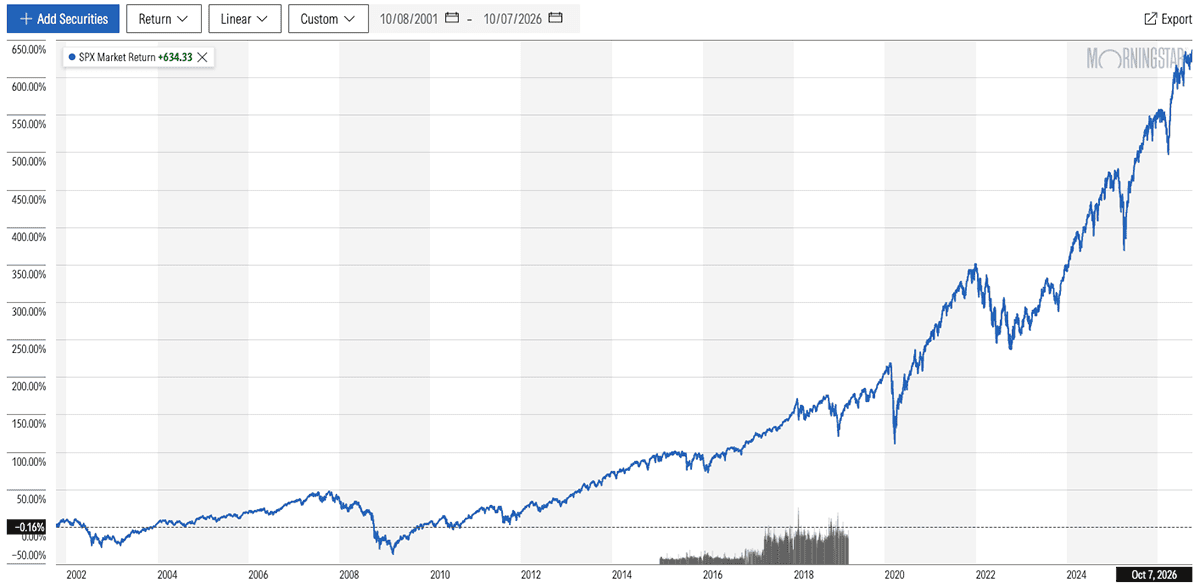
The above image is a look at the return someone could expect if they received just the price returns from the S&P 500 over the past 25 years.
But What If I Reinvested My Dividends?
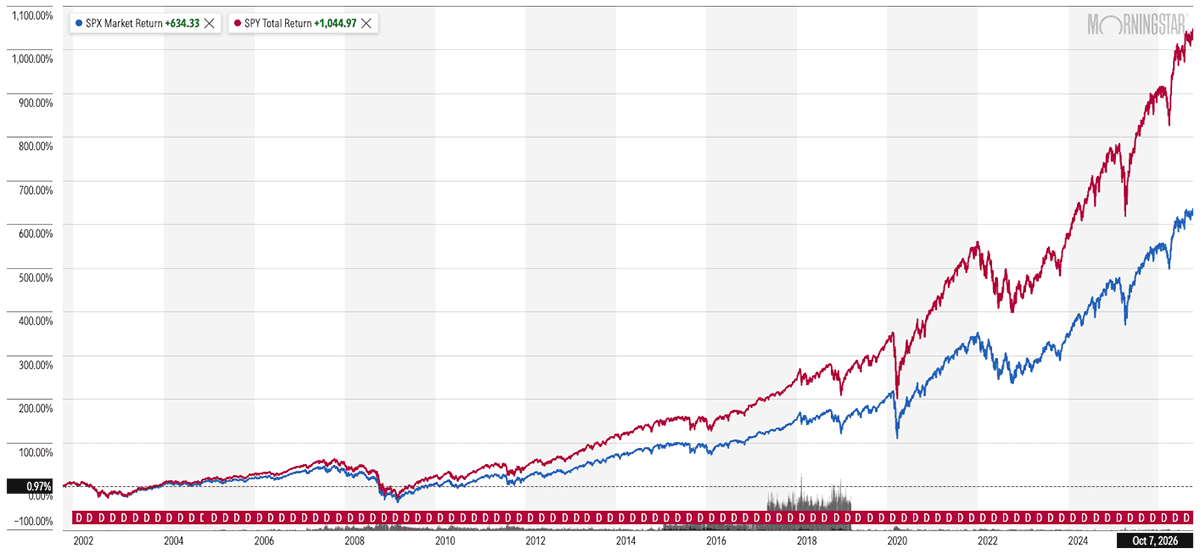
Now look at the above chart to see how much better the return is when you factor in dividends, assuming you reinvested those dividends back into the S&P 500 (returns illustrated by an S&P 500-tracking ETF; note that expenses are included in performance).
The price return is around 635%. The total return (price plus dividends) is almost 1,045%!
But dividends can mean something else entirely when you’ve reached retirement. Specifically, they can become a source of passive income.
When you retire, you no longer receive a regular paycheck from an employer. Instead, you have to rely on Social Security checks and whatever you’ve saved up for retirement. Investors typically withdraw money from their nest egg to pay the bills in retirement, but a steady stream of stock-dividend and bond-interest income can reduce how much of your investment accounts you have to draw down—keeping your nest egg better intact for longer.
Earn a Dividend Match With Plynk**
- Plynk® is a dividend-friendly app that offers commission-free trades* on 5,000 stocks and more than 3,400 ETFs, and also supports mutual funds and cryptocurrencies.
- Plynk offers a cash match of 25% on dividend income that allows you to earn up to $250 extra each year.**
- Track your dividends and interest with Income Hub.
- Earn a 3.48% APY on uninvested cash.
- Plynk charges no account opening fees, and you can start investing for as little as $1.
- No account fees
- Smart design and smooth user experience
- Fractional shares
- Designed for beginning investors
- Virtual portfolios and simulated trading
- 25% dividend match
- Earn interest on uninvested cash
- One of the best automated investing programs we've seen (Steady Start)
- Elite educational resources and tools
- Lacks features such as options trading and advanced charting that more experienced traders prefer

Which Stocks Pay Monthly?
One last thing to know before I introduce my list of monthly dividend payers: They’re largely not what you’d consider “normal” stocks.
A “normal” stock is, say, an Apple (AAPL) or a General Electric (GE)—virtually always a plain-vanilla C corporation with no unusual rules or designations.
But for whatever reason, most monthly dividend stocks tend to involve companies with specialized structures, such as real estate investment trusts (REITs), business development companies (BDCs), and royalty trusts. These businesses all have one thing in common: They’re mandated to pay out large percentages of their taxable income or cash flow back to shareholders in the form of dividends.
In general, these special classes tend to deliver much higher yields than your average stock. That’s great for income hunters, but remember: Higher yields can often involve higher risk, or at least a bigger emphasis on income at the cost of lower price returns.
So today, I’m going to point you in the direction of monthly dividend-paying stocks that largely garner positive opinions from the Wall Street analyst set. Take a look and see which ones you’ll want to target for a closer look of your own.
Stocks are listed in order of dividend yield, from smallest to largest.
Related: The 13 Best Mutual Funds for the Rest of 2026
10. Janus Living

- Industry: Senior housing
- Market capitalization: $6.6 billion
- Dividend yield: 2.1%
Janus Living (JAN) is a REIT that exclusively invests in senior housing communities, setting it apart from other senior-housing REITs that also invest in skilled nursing, assisted living, medical, and other properties. Its portfolio is currently made up of 11,420 units across 41 senior housing communities in 13 states. It operates entirely under the RIDEA (REIT Investment Diversification and Empowerment Act) structure, which allows senior housing and healthcare REITs to go beyond acting as passive landlords, and instead participate directly in their properties’ operating income.
Related: REITs vs Private Placements: An Investment Guide
Janus is also one of the newest publicly traded REITs around, spun off in March 2026 by fellow monthly payer Healthpeak Properties (DOC). Healthpeak retains a 73.6% majority stake in the company, and it externally manages Janus through one of its subsidiaries.
“We have a constructive growth outlook for the company,” say JPMorgan analysts. “We see the stock as being well positioned to deliver outsized internal and external growth compared to what we expect for our overall REIT coverage universe. We expect near-term internal growth to be in the low-double digits, roughly 3-4x what we are forecasting for the overall REIT group, as the senior housing (operating) segment continues to enjoy significant tailwinds.”
They also point out that the company is sitting on no debt and “significant amounts of cash” following both its IPO and a June secondary offering.
JAN kicked off its dividend in June with a prorated quarterly payout, but it switched to a 4.75¢-per-share monthly starting with its July distribution. The yield isn’t anything to scream about—it’s certainly modest compared to other monthly dividend stocks. But the dividend represents only about 60% of Wall Street’s estimates for Janus’s 2026 funds from operations (FFO, a profitability metric for REITs), so there’s plenty of room for this REIT to raise.
Do you want to get serious about saving and planning for retirement? Sign up for Retire With Riley, our free retirement planning newsletter.
Need Help Picking Stocks? Consider These Top-Rated Services
|
Best Introductory Stock Picking Service

|
Data-Driven Stock Picking Service

|
Best Proprietary Ranking System

|
|
Primary Rating:
4.7
|
Primary Rating:
4.3
|
Primary Rating:
4.2
|
|
$99/yr. ($100 first-year savings)
|
$449/yr. ($50 discount)*
|
30-day free trial, then $249/yr.
|
9. Agree Realty
- Industry: Commercial real estate
- Market capitalization: $8.2 billion
- Dividend yield: 4.9%
Let’s start with Agree Realty (ADC)—a commercial real estate operator that deals in a wide array of retail tenants. How wide? Grocery stores are the largest part of the annualized base rent mix … at just 10%. Assets are spread out across numerous categories, including home improvement stores, convenience stores, tire and auto centers, pharmacies, even farm and rural supply stores.
Agree currently boasts 2,825 properties, representing more than 60 million square feet, across all 50 states. And it leases those properties out on a “net lease” basis. This means ADC’s leases are “net” of insurance, maintenance, and taxes. So whereas “normal” REITs would be responsible for all three items, in a net-lease situation, tenants such as Walmart (WMT), Tractor Supply (TSCO), Dollar General (DG), and Best Buy (BBY) take care of those costs separately. Agree Realty simply collects a rent check.
This system results in much more stable, more predictable income for REITs—exactly what you want when you’re relying on a stock for income.
Related: The 10 Best Dividend ETFs for the Rest of 2026
Sure, real estate broadly has been a minefield over the past decade, given the pain that e-commerce has caused traditional brick-and-mortar retailers. But not all retailers are built equally—many discretionary retailers operating malls might have been pelted, but many of the staples-goods retailers on Agree’s tenant list are doing just fine and paying steadily climbing rents. And those are the types of tenants Agree has built its business around.
“We believe the company is in a good position in terms of its cost of capital, liquidity, balance sheet, high-quality portfolio, and acquisition pipeline,” Stifel analysts said after the company’s second-quarter earnings report in July, which included better-than-expected FFO. “ADC is entrepreneurial and has created value and continues to create value across its three platforms and through its relationships. The company balances its growth objectives with careful management of credit risk and focuses on e-commerce and recession-resistant retail categories.”
Agree Realty’s dividend program isn’t new, but it is a relative newbie among monthly dividend stocks—ADC started making more frequent payouts in 2021. Also, Agree has been improving the dividend on a semiannual basis since 2016.
Make Young and the Invested your preferred news source on Google
Simply click here and select the ✓ box for Young and the Invested. Once you’ve made this update, you’ll see Young and the Invested show up more often in Google’s “Top Stories” feed, as well as in a dedicated “From Your Sources” section on Google’s search results page.
Featured Financial Products
8. SmartStop Self Storage REIT

- Industry: Self-storage real estate
- Market capitalization: $1.9 billion
- Dividend yield: 4.9%
SmartStop Self Storage REIT (SMA) is a self-storage REIT that owns and/or manages 460 properties representing 35 million square feet across the U.S. and Canada.
What’s attractive about self-storage? Well, it’s a business that can thrive in both up and down economies. When people have money to spend, they often spend it—sometimes to the point where they accumulate so much stuff, it no longer fits where they live, so they decide to stash it elsewhere. However, when times are tighter, people who are forced to downsize their living situation will often store many of their possessions in hopes that they’ll eventually be able to return to a larger place in time.
Related: The Best Dividend Stocks: 10 Pro-Grade Income Picks to Buy
That doesn’t mean self-storage can’t go through its own hiccups—it can and is, in fact. But SmartStop currently looks like one of the most resilient players in the space, from both a share-price and operational perspective. The company is coming off a second-quarter report that saw same-store net operating income (SSNOI) growth accelerate and margins expand.
“Guidance moved higher,” says Truist Managing Director Michael Lewis, who rates SMA at Buy. “Management raised the low end of normalized FFO guidance to $1.98-$2.04 per share and increased SSNOI, reflecting confidence in operating trends and expense controls.”
SmartStop is one of the growthiest such businesses in North America, recently entering the top 10 largest operators in the U.S. But it’s also one of the newest REIT listings—it pulled off an initial public offering (IPO) to list on the New York Stock Exchange in April 2025.
SMA does pay a monthly dividend … albeit in the oddest of fashions. SmartStop’s past 12 dividends have come out to 13.59¢, 13.15¢, or 12.27¢, in no particular order. Regardless, they add up to a healthy annualized yield of almost 5%.
Related: 8 Low- and Minimum-Volatility ETFs for Peace of Mind
7. Realty Income
- Industry: Commercial real estate
- Market capitalization: $58.1 billion
- Dividend yield: 5.2%
Any roundup of the best monthly dividend stocks should include Realty Income (O), which literally bills itself as the “Monthly Dividend Company.”
No, really. They even registered the nickname.
Realty Income is a real estate investment trust focused on single-tenant commercial properties. It owns more than 15,500 properties in the U.S., U.K., and eight other countries that are under long-term net-lease agreements. It currently boasts more than 1,800 different tenants—including 7-Eleven, Dollar General (DG), Walgreens (WBA), Wynn Resorts (WYNN), and Life Time Fitness (LTH)—across 92 widely varying industries.
Related: 8 Best High-Yield Dividend ETFs for Income-Hungry Investors
It’s a behemoth in the space, and it keeps getting bigger, both naturally and by acquisition. For instance, in 2021, it bought fellow net-lease REIT VEREIT. Then in 2024, it bought out another net-lease play, Spirit Realty Capital.
“O has been very active, acquiring both investment and non-investment grade assets,” say Stifel analysts, who call the stock a Buy. “The company has one of the sector’s strongest balance sheets, in our view, the lowest costs of capital, and pays a consistent and growing monthly dividend.”
A reflection of that balance sheet comes from Fitch Ratings, which recently assigned the company a long-term issuer default rating of “A” with a “Stable” outlook. “The team highlighted this development puts the company among a group of only four U.S. REITs receiving the same or equivalent rating from 1 of the 3 major rating agencies,” Stifel adds.
And again, the monthly dividend isn’t just generous—it has been outright bulletproof. Realty Income has paid 675 consecutive monthly dividends and increased the payout for 116 consecutive quarters.
Related: Dividend Kings: The Full List of American Dividend Royalty
6. EPR Properties

- Industry: Experiential real estate
- Market capitalization: $4.2 billion
- Dividend yield: 6.9%
EPR Properties (EPR) might be responsible for one of your favorite places, and you just don’t know it yet.
Once known as Entertainment Properties Trust, EPR Properties is an “experiential” real estate firm whose locations are dedicated to helping you learn, stretch out, and play. This is a 346-property portfolio, leased out to 62 tenants in 43 states and Canada, that includes movie theaters, water parks, ski resorts, Andretti Karting & Games go-karting, TopGolf gamified driving ranges, golf courses, fitness studios, private schools, early childhood education centers, and more.
Related: The 10 Best-Rated Dividend Aristocrats Right Now
EPR is also growing its amusement-park roster, completing the purchase of six attraction properties back in April (and it added seven overall). Stifel analysts (Buy) wrote at the time: “Spending during the quarter was primarily allocated towards the acquisition of the previously announced Six Flags portfolio acquisition. EPR noted that it spent $304.4 million on the seven-property portfolio and expects to spend $11.0 million on improvements across the portfolio over the next two years.”
Stifel analysts have since called EPR one of its top picks in the “triple-net lease” space. That refers to landlords like EPR whose leases are predominantly “net” of taxes, maintenance, and insurance. Tenants tackle all of those costs; EPR just collects the rent.
JPMorgan analysts, who rate the stock at Overweight (equivalent of Buy) lay out the strength of its most recent earnings: “Overall, we think EPR had a good quarter, and the bottom line is that it is back to making investments and can do so with capital costs that have been coming down. That’s a strong setup, in our view, with its growth trending better than most net lease REITs.”
EPR has been paying and raising its monthly dividend for years. Most recently, in February, it announced a 5% bump higher to 31¢ per share, putting this monthly dividend stock at a yield of almost 7%.
Related: 7 Best Closed-End Funds (CEFs) Paying Us Up to 17.2%
5. Gladstone Investment Corp.
- Industry: BDC
- Market capitalization: $612.9 million
- Dividend yield: 9.8%
Business development companies (BDCs) are specialized firms that provide capital for small- and midsized businesses. It’s a small niche in the public markets—only a few dozen trade on U.S. exchanges—but it’s also one of the highest-yield corners of Wall Street. That’s because, like REITs, they must distribute at least 90% of their income in the form of dividends in exchange for exemption from corporate income tax.
Gladstone Investment Corp. (GAIN) is a BDC that specializes in acquiring mature, lower-middle-market companies. It’s a bit narrow for a BDC, at just 30 companies, though those companies are spread across 20 states and Canada, and they represent 16 different industries. Its target companies generate between $4 million and $15 million in annual EBITDA (earnings before interest, taxes, depreciation, and amortization), and boast strong management teams as well as attractive financial and operational fundamentals.
Related: 8 Best Vanguard Retirement Funds for a 401(k)
“GAIN’s equity participation in most of its portfolio companies allows it to participate in the upside if a company performs above expectations,” say Oppenheimer analysts Mitchel Penn and Andrew Denkler, who rate shares at Outperform. “This has contributed to GAIN’s relatively high [return on equity].”
However, owning both debt and equity is a higher-risk strategy than other BDCs pursue. Penn and Denkler add that the equity would also expose Gladstone to the first loss in a downturn.
Gladstone boasts an impressive dividend history, paying out 249 consecutive monthly distributions to its shareholders. Dividend growth isn’t grand, but it’s decent enough—the payout has doubled between 2011 and 2026.
However, investors should know that the yield isn’t quite what it seems. Gladstone pays a regular monthly dividend of 8¢ per year, then typically shells out a supplemental dividend once each year from the realized capital gains generated by equity stakes in successful exits. When that dividend gets paid, and how much it is, varies from year to year. In 2025, GAIN paid out 54¢ in June. The year before it was 54¢ in October. Based on the regular dividend and last year’s supplemental (if one is hopeful that Gladstone will pay another supplemental this year), GAIN yields 9.8%. But the yield on only the regular distribution is still a generous 6%-plus.
Related: The 12 Best Vanguard ETFs to Buy [Build a Low-Cost Portfolio]
But investors should know that the yield isn’t quite what it seems. Gladstone pays a regular monthly dividend of 8¢ per year, then typically shells out a supplemental dividend once each year from the realized capital gains generated by equity stakes in successful exits. When that dividend gets paid, and how much it is, varies from year to year. In 2025, GAIN paid out 54¢ in June. The year before it was 54¢ in October.
Based on the regular dividend and last year’s supplemental, GAIN yields 9.2%. But the regular by itself yields just under 6%.
Do you want to get serious about saving and planning for retirement? Sign up for Retire With Riley, our free retirement planning newsletter.
4. Capital Southwest Corp.

- Industry: BDC
- Market capitalization: $1.5 billion
- Dividend yield: 10.8%
Capital Southwest Corp. (CSWC) is another BDC, this one focusing on lower-middle-market companies with $3 million to $25 million of EBITDA. It primarily deals in first lien debt, which makes up 90% of the portfolio at fair value. Equity makes up 9%, and the remaining sliver is split between second-lien and subordinated debt.
This is a much wider portfolio than Gladstone Investment, at around 130 companies. It spreads its $2.1 billion in assets across a couple dozen industries, though most prominent at the moment are healthcare services, consumer services, media & marketing, and consumer products, all of which enjoy low double-digit weights.
Related: 7 Best Real Estate Crowdfunding Sites + Platforms
In August, Capital Southwest reported decent results for the first quarter of its fiscal 2027. Net investment income (NII) was in line with Wall Street estimates. Non-accruals (loans in which the borrower has stopped making payments, and the lender has stopped recording interest income) held at 1.1% after a decline from 1.5% between Q3 and Q4 of fiscal 2026. And almost 90% of its debt investments enjoyed the top “1” or “2” rating (out of 5) on Capital Southwest’s internal rating scale.
“We continue to expect [net asset value, or NAV] outperformance versus the group in future quarters due to CSWC’s internally managed model, moderate leverage, and top-quartile return on equity,” says B. Riley Securities analyst Sean-Paul Adams (Buy).
Capital Southwest also uses a regular-and-supplemental dividend strategy, though it’s far more stable than GAIN’s. The company has been paying a 19.34¢ monthly dividend since it converted away from its quarterly schedule in 2025. But it also paid out 6¢ per share in supplemental distributions in each of the past six quarters. On its own, the regular dividend equates to a 9.8% yield. Add in the supplemental, and that percentage nears 11%.
Related: 9 Best Vanguard Retirement Funds [Save More in 2026]
Empower Advisory Group offers a comprehensive wealth management service known as Personal Strategy Investment Services.
This managed account solution provides clients with discretionary investment management, personalized portfolio construction, and access to financial planning support.
3. Trinity Capital

- Industry: BDC
- Market capitalization: $1.6 billion
- Dividend yield: 11.9%
Trinity Capital (TRIN) is another BDC, this one focused on high-growth companies. It provides senior secured term loans to institutionally backed tech companies and commercial-stage life science companies; secured term loans to PE-backed software companies; equipment finance; and asset-based lending to special purpose vehicles (SPVs).
Its roughly 200 portfolio companies include the likes of launch service and spacecraft component provider Rocket Lab (RKLB), non-alcoholic craft brewer Athletic Brewing, and arthroplasty-focused medical device firm Shoulder Innovations.
Related: The 10 Best Fidelity ETFs You Can Buy [Invest Tactically]
B. Riley’s Adams has a Buy rating on shares, citing the company’s investment-grade rating from Moody’s, SBIC fund approval, record origination levels and increased equipment finance vertical demand.
“TRIN’s strong yield, originations momentum, and platform expansion provide meaningful near-term upside potential,” he says. “Record fundings of $619 million and platform [assets under management] of $3.2 billion (up 36% Y/Y) keep origination momentum and the fee platform as the primary earnings drivers.”
Trinity is one of the most recent additions to our monthly dividend stocks. It has long demonstrated the necessary quality, but it only recently became a monthly dividend payer. In December 2025, the company announced the shift, which took effect in January with a 17¢-per-share monthly distribution.
Related: 8 Best-in-Class Bond Funds to Buy
Need Help Picking Stocks? Consider These Top-Rated Services
|
Best Introductory Stock Picking Service
|
Data-Driven Stock Picking Service
|
Best Proprietary Ranking System
|
|
Primary Rating:
4.7
|
Primary Rating:
4.3
|
Primary Rating:
4.2
|
|
$99/yr. ($100 first-year savings)
|
$449/yr. ($50 discount)*
|
30-day free trial, then $249/yr.
|
2. Ellington Financial
- Industry: Mortgage real estate
- Market capitalization: $1.5 billion
- Dividend yield: 13.4%
Ellington Financial (EFC) is a mortgage real estate investment trust (mortgage REIT or mREIT, for short). It invests in residential and commercial mortgage loans, residential and commercial mortgage-backed securities (MBSes), consumer loans, asset-backed securities backed by consumer loans, and a number of other mortgage- and loan-related investments.
Related: 7 Best Fidelity Dividend Funds [Passive Income Picks]
Whereas your typical equity REIT owns and possibly operates physical real estate, an mREIT deals in “paper” real estate like the instruments I just mentioned. An mREIT will take out debt to purchase mortgages and related products, and their profit is the spread between what they’re paying on debt and what they’re earning in interest income from their mortgages—known as net interest margin.
It’s a difficult business—one that can be rocked by any number of things, including high and/or rising interest rates. September’s hike did a number on EFC, which is off by 6% year-to-date even when accounting for its massive dividend. However, Wall Street remains more hopeful about Ellington than most of its industrymates.
Related: HSA Contribution Limits for 2026 + 2027
“While [the third quarter] was likely challenging for most companies in the sector, we would expect the best book value performance from EFC and [Rithm Capital],” write Keefe, Bruyette & Woods analysts Bose George and Frankie Labetti (Outperform). “EFC provides monthly book values, and its August book value of $13.62 was relatively flat from Q2 book value of $13.61. While book value is likely down in September (we estimate down 2.8%), this still suggests the shares are trading below 90% of book.”
In 2024, Ellington Financial reduced its monthly dividend from 15¢ per share to 13¢ as it absorbed the recent acquisition of another mREIT, Arlington Asset Investment Corp., and as Longbridge, a 2022 acquisition, worked on returning to profitability. Good news on the latter front: Longbridge has indeed returned to the black and actually looks attractive as some Baby Boomers choose to remain in their existing homes during retirement.
The dividend has stabilized, and EFC still boasts one of the largest yields among the best monthly dividend stocks covered here today. George and Labetti add that they believe the dividend remains “well covered.”
Related: The 7 Best Gold ETFs You Can Buy
1. Dynex Capital
- Industry: Mortgage real estate
- Market capitalization: $2.7 billion
- Dividend yield: 19.1%
Dynex Capital (DX) is the longest-tenured mREIT, founded in 1987. And it’s explicitly an “agency” mREIT, which means it deals in mortgages and MBSes from government agencies such as Freddie Mac and Fannie Mae. In fact, its portfolio is 97% agency residential MBSes (RMBSes), and most of the remainder is agency commercial MBSes (CMBSes).
Few analysts cover Dynex, which is typical for the mREIT industry. Still, among these few pros, the bulls are the majority.
Keefe, Bruyette and Woods, whose analysts rate Dynex at Outperform, was broadly bullish on agency MBS sectors heading into 2026. Agency MBS spreads tightened in the back half of 2025, but KBW believed spreads would benefit from a steeper yield curve as the Federal Reserve cut rates.
Related: 10 Best Alternative Investments [Options to Consider]
The year hasn’t played out that way so far, but KBW still remains upbeat about DX.
“We expect valuation to trend up as the market cap increases, which should continue as the company issues equity accretively and returns remain strong,” KBW’s George and Labetti wrote in July. “Management noted equity issuance this quarter was at a premium to book value as the shares traded above book value for a large part of the quarter. We believe more scale makes sense both in terms of improving operating efficiency and also in terms of valuation since the market appears to be willing to pay a meaningful premium for larger market cap names.”
More recently, in the wake of the Fed rate hike, they said they remain most constructive on DX.
Dynex pays the most generous monthly dividend on this list, at a wild 19%-plus as I write this. But Dynex has hacked away its payout in the past—indeed, the dividend shrunk by 85% between 2012 and 2020, to 13¢ per share monthly. It remained there until mid-2024, when Dynex announced its first dividend raise in more than a decade—to 15¢ per share. It followed that up with another hike in 2025, to 17¢, as of its April payout.
That history is an important reminder that double-digit yields are hardly risk-free.
Related: 10 Best Schwab ETFs to Buy [Build Your Core for Cheap]
Featured Financial Products
What Is Dividend Yield?
Dividend yield is a simple financial ratio that tells you the percentage of a company’s share price that is paid out across a year’s worth of dividend distributions. Expressed as a mathematical equation, it’s simply:
Dividend yield = annual dividend / price x 100
Yield helps dividend investors normalize dividend payments regardless of stock price, different quarterly payments, even different payment frequencies (like monthly or annually). For instance, each of the following fictional stocks all have a dividend yield of 2.5%:
- Alpha Corp. currently trades for $40 a share. It pays a 25¢ quarterly dividend, for $1.00 per year in full. ($1 / $40 x 100 = 2.5%)
- Beta Inc. pays $1 in the first quarter, $2 in Q2, $3 in Q3 and $4 in Q4. That’s $10 in dividends for the full year. It trades for $400 a share. ($10 / $400 x 100 = 2.5%)
- Gamma Ltd. pays $2.50 just once per year. It trades for $100 a share. ($2.50 / $100 x 100 = 2.5%)
- The idea is to focus on the percent of your initial investment you get back, and help you compare apples to apples.
Taking this math a step further, you learn that a company can suddenly feature a very high dividend yield through one of two very different ways: the share price falling very quickly, or the dividend growing very rapidly.
Alpha Corp., which trades for $40 per share, pays a 25¢ quarterly dividend that yields 2.5%. In a month, it yields 5.0%. Here are two ways that could have happened.
- Alpha Corp. doubled its dividend to 50¢ per share, for a full $2 per share across the year. The share price stays the same. ($2 / $40 x 100 = 5.0%)
- Alpha Corp. kept its dividend the same, but its share price plunged in half to $20 per share. ($1 / $20 x 100 = 5.0%)
Clearly, that 5% yield appears to be much safer and reliable in one scenario than the other.
What If I Need Help Picking Stocks?
Motley Fool Stock Advisor is a stock picking service that espouses my favorite, plain-vanilla trading style: buy-and-hold. Fool analysts provide recommendations for both “Steady Eddies” and potential high-flying stocks with sound fundamentals—exactly the combination of holdings you want to generate strong performance without risking extremely high volatility.
Importantly, Stock Advisor doesn’t just give you a list of tickers and call it a day—it also provides investment rationales and research for each pick to help educate you before you buy.
Stock Advisor stock picks have performed exceptionally well over the service’s 22-year existence. The service has made 190 stock recommendations that have historically delivered 100%+ returns.
The service charges a discounted rate for the first year and has a 30-day membership-fee-back period. Sign up for Stock Advisor today.
- Motley Fool Stock Advisor is a stock service that provides recommendations for both "steady Eddie" and high-flying stocks, as well as a few ETFs for investors who want diversified holdings, too.
- Just getting started? Stock Advisor provides 10 "Foundational Stocks" you can use to anchor your portfolio.
- You're not alone! Stock Advisor membership also gives you access to a community of investors who also want to outperform the market and love talking shop.
- Enjoy access to GamePlan: Motley Fool's financial planning hub, which includes advice on personal finances, taxes, retirement, and more, as well as calculators and other financial tools.
- Limited-Time Offer: Get your first year with Stock Advisor for $99 (vs. $199 usual value)—a 50% discount for new members!—by clicking our link.*
- Discounted introductory price
- Strong outperformance compared to the S&P 500
- High overall average return for stock picks
- High renewal price
- Not every stock is a winner
What Is a Payout Ratio?

As with dividend yield, it’s important to normalize the dividend payout ratio for a stock. This is simply the percentage of a company’s earnings per share that is being distributed via dividends. It’s calculated as:
Payout ratio = dividends per share / earnings per share x 100
As an example, a stock that makes $100 million in profits and has 10 million shares of public stock has $10 in earnings per share. And if that company pays $5 annually in dividends, it has a payout ratio of 50% ($5 / $10 x 100 = 50%).
There’s a lot of “gray” when it comes to payout ratios. In general, though, the lower the payout ratio, the more sustainable the dividend, and the more room for future hikes.
Note: Payout ratio is calculated using different metrics depending on the type of business you’re looking at. For typical companies, you look at earnings. But, for example, when working with REITs, you typically calculate payout ratio using funds from operations (FFO), which is an important measure of REIT profitability.
What Is ‘Yield on Cost’?
When you look up a stock’s information, the dividend yield listed is based on the most recent dividend and the current stock price.
That yield is often actually different than the one current shareholders enjoy. That yield is called “yield on cost,” which is the payout based on what you paid, at the moment you invested.
Let’s say you buy a stock at $100, and it pays $1 per share. It yields 1.0% when you buy it ($1 / $100 x 100 = 1.0%).
In a year, that stock has doubled to $200 per share, and it also doubled its dividend to $2 per share. If you look up its information, its dividend is still 1.0% ($2 / $200 x 100 = 1.0%).
That’s not your yield on cost, however. You’re still receiving that higher dividend of $2 per share. But your cost basis is still the original $100 you bought the share at. So now, your yield on cost has doubled, to 2.0% ($2 / $100 * 100 = 2.0%)!
Related: 11 Best Investment Opportunities for Accredited Investors
Want to talk more about your financial goals or concerns? Our services include comprehensive financial planning, investment management, estate planning, taxes, and more! Schedule a call with Riley to discuss what you need, and what we can do for you.

Featured Financial Products
Related: 15 Best Long-Term Stocks to Buy and Hold Forever
As even novice investors probably know, funds—whether they’re mutual funds or exchange-traded funds (ETFs)—are the simplest and easiest ways to invest in the stock market. But the best long-term stocks also offer many investors a way to stay “invested” intellectually—by following companies they believe in. They also provide investors with the potential for outperformance.
So if you’re looking for a starting point for your own portfolio, look no further. Check out our list of the best long-term stocks for buy-and-hold investors.
Related: Vanguard’s 7 Best Dividend Funds for Low-Cost Income
What’s better than a smart, sound dividend income strategy? How about a smart, sound dividend income strategy with very little money coming out of your pocket?
If that sounds good to you, you need look no farther than low-cost pioneer Vanguard, which offers up a number of payout-oriented products. Find out what you need to know in our list of seven top-notch Vanguard dividend funds.
Please Heart ❤️, Follow and Subscribe
Did you find this article helpful?
1. Click the Heart Button.
2. Follow WealthUpdate —-> https://flipboard.com/@WealthUpdate
3. Subscribe to Retire With Riley, our free weekly retirement planning newsletter.