


The Federal Reserve on Wednesday went in the direction Wall Street largely expected, green-lighting the first hike to its benchmark interest rate in three years and signaling that another might be on the way.
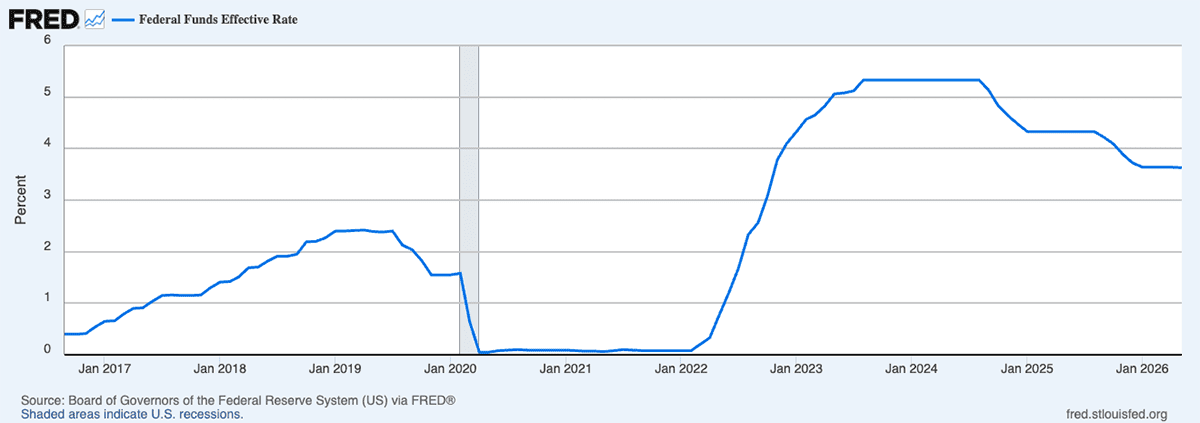
The central bank’s Federal Open Market Committee (FOMC) voted unanimously to increase the federal funds rate by a quarter of a percentage point, to 3.75%-4.00% from 3.50%-3.75% previously. The decision, which came after several high consumer price index (CPI) and personal consumption expenditures (PCE) readings over the past few months, as well as relatively hawkish commentary from Federal Reserve Chair Kevin Warsh in August.
“After Fed Chief Kevin Warsh’s speech at Jackson Hole last month … he would have been hard-pressed to explain the Fed’s monetary policy stance if it had not raised short-term interest rates at this week’s FOMC meeting,” says Jerry Tempelman, Former Senior Analyst at the NY Fed and VP of Economic and Fixed Income Research at Mutual of America Capital Management.
The CME FedWatch Tool, which uses trading in federal-funds futures to determine Wall Street’s expectations for future Federal Reserve actions, indicated a greater-than-90% chance of a September hike prior to Wednesday’s meeting.
Is This It for the Fed, Or Are More Rate Hikes Coming?
Steve Rick, Chief Economist at TruStage, says the big question now is whether this rate increase is a one-and-done event or the start of a new tightening cycle.
“Higher oil prices stemming from continued conflict in the Middle East could keep inflation elevated, but monetary policy works with long and variable lags, and additional increases would put more pressure on consumers and businesses already facing elevated borrowing costs,” he says.
The FOMC’s updated Summary of Economic Projections points to another quarter-point hike this year, and a higher long-run policy rate of 3.2% (versus 3.1% previously).
Related: How to Invest in Your 20s [Best Ways to Start Investing Money]
“The Fed has signaled it does not at this stage envisage an aggressive tightening cycle,” says Kay Haigh, global head and CIO of Fixed Income and Liquidity Solutions at Goldman Sachs Asset Management. “Most FOMC members see a total of two hikes this year per the SEP, and it will likely skip October’s meeting given its proximity to the midterm elections. One more hike this year in December is our base case, although this remains contingent on upcoming CPI reports and the path of energy prices.”
The market also seems to believe at least one more rate hike is nigh. According to CME FedWatch, futures are now pricing in a 53% possibility of another quarter-point hike, to 4.00%-4.25%, by the December meeting, and a nearly 30% chance of a half-point hike, to 4.25%-4.50%.
“At the same time, growth projections were revised modestly higher, unemployment forecasts were revised lower to 4.1%, and core PCE inflation was revised higher to 3.4% in 2026,” says Daniel Siluk, Head of Global Short Duration & Liquidity and Portfolio Manager at Janus Henderson Investors. “Taken together, the Fed is effectively telling markets that the economy is stronger, labor markets are tighter, inflation is proving more persistent, and policy needs to remain tighter for longer to restore price stability.”
The stock market’s initial response was relatively muted given the highly telegraphed nature of the move, but the major indexes declined into the close as investors absorbed the potential for additional rate hikes going forward.
Consumers, meanwhile, can expect to pay more for debt but earn more in savings.
“The immediate impact will hit variable-rate banking products: consumers can expect to earn more on high-yield savings accounts, but will also pay more to carry revolving debt like credit cards,” says Iñigo San Martin, CFA and Executive Director at fintech platform Raisin US. “Fixed-rate products with a set end date like CDs and mortgages have largely already adjusted upward following the yield curve.”
Other Expert Insights on September’s FOMC Meeting
Here, we outline more thoughts from investment managers, strategists, and other experts about the Federal Open Market Committee’s September meeting.
Jason Pride, Chief of Investment Strategy & Research, Glenmede
“The message of the dot plot is that most of the committee believes there is work left to do; how much work is up for debate. The consensus on the committee has coalesced around one more hike this year (likely in December). Twelve of eighteen participants landed on one further increase and four on two, and not a single participant projects a policy rate below today’s setting by year-end. The 2027 dots are where the uncertainty shows through, as the spread in dots reflects a range of projections more than twice as wide as for 2026. That combination reads as a committee largely united on the need to tighten now but not quite sold on the pace and duration of the tightening cycle from here.”
Jeff Schulze, Head Investment Strategist, Franklin Templeton Institute
“Warsh’s press conference closely echoed the hawkish tone of his Jackson Hole remarks, framing the hike as evidence that the Committee is backing its words with action on returning inflation to target. Warsh emphasized that the labor market is at full employment, noting that price stability—the other side of the dual mandate—now has the Fed’s undivided attention and stands as the Committee’s key priority. Warsh reiterated that he is ‘not in the forward guidance business,’ declining to commit to a specific path for monetary policy going forward.”
Brad Conger, Chief Investment Officer, Hirtle & Co.
“Today’s FOMC could mark the moment when the FOMC regained a measure of spine. There were many arguments for standing still. But for once, the committee sided with main street. Inflation is a pervasive concern, and its uncertainty is impeding decision making among all businesses. One swallow doesn’t make a spring, but we might have just caught a glimpse of Volckerian decisiveness as opposed to the eternal sycophancy of the Powell era.”