



America’s employment situation was much more robust than expected last month, as the Labor Department delivered an “unambiguously strong jobs report” that included payroll and wage growth that exceeded estimates, as well as receding unemployment.
The U.S. Bureau of Labor Statistics reported Friday that nonfarm payrolls (NFP) increased by 165,000 in October, shattering Dow Jones-polled economists’ expectations for expansion of 59,000. Jobs totals for the prior two months were sharply revised upward by a total of 84,000 jobs. September’s payrolls were adjusted to 60,000 from 29,000, while August’s sum moved to 186,000 from 133,000 before.
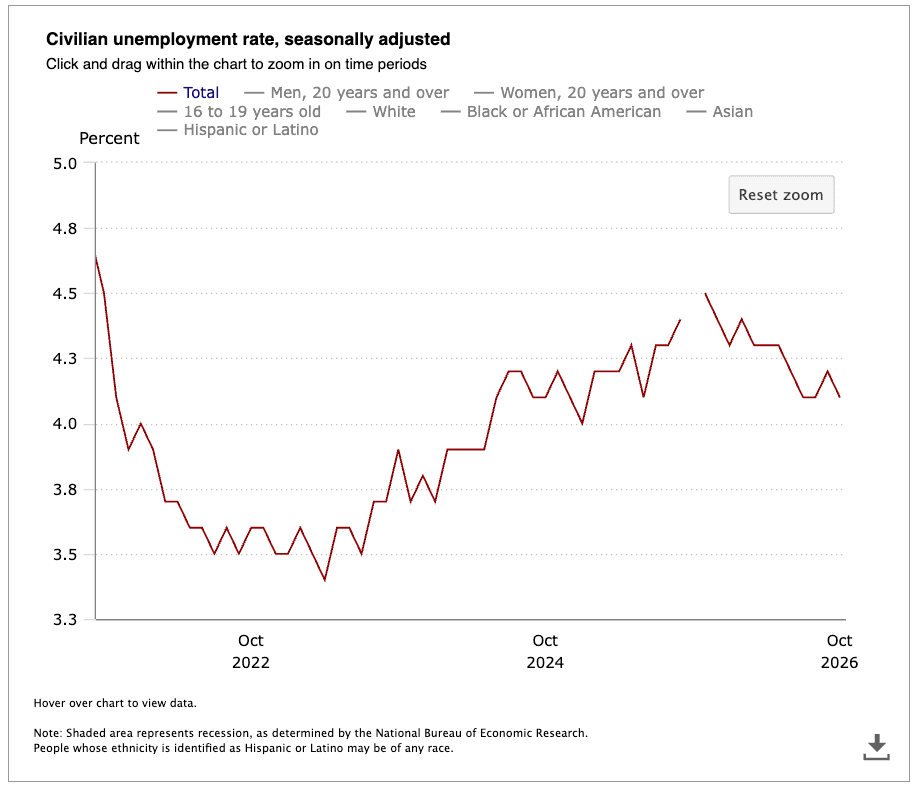
The unemployment rate slipped back to 4.1%, while economists were looking for it to stay flat at 4.2%.
Jerry Tempelman, Former Senior Analyst at the NY Fed and VP of Economic and Fixed Income Research at Mutual of America Capital Management, says the report signals that last month’s weakness may have just been a temporary dip rather than evidence of worsening market deterioration.
“Today’s data supports the idea that businesses remain willing to hire despite the Federal Reserve’s measured rate tightening cycle amid elevated inflation,” he says. “Solid job creation, particularly in private sector employment, may indicate that demand for labor persists even as companies contend with higher borrowing costs and persistent geopolitical headwinds affecting energy prices and supply chains.”
Average hourly earnings were stronger than economists were projecting, growing by 0.4% month-over-month, to $38.00. On a year-over-year basis, that’s 3.1% higher, which was better than estimates for 2.9%; that marked a significant bounce off the prior-month’s YoY rate, which was the slowest wage growth in more than five years.
Related: 7 Best Fidelity Dividend Funds [Passive Income Picks]
“The bounce in average hourly earnings is a reset rather than a revival with annual wage growth at 3.1%—a level consistent with inflation below the Fed’s 2% target given the continued solid productivity gains which were released yesterday,” says Jeff Schulze, Head Investment Strategist at the Franklin Templeton Institute.
Here’s a brief look at the October jobs report’s most pertinent details:
| Reported | Estimated | Previously | |
|---|---|---|---|
| October payrolls | +165,000 | +59,000 | +29,000 (September) |
| October unemployment | 4.1% | 4.2% | 4.2% (September) |
| October hourly earnings (YoY) | +3.1% | +2.9% | +3.0% (September) |
| September payrolls (revised) | +60,000 | N/A | +29,000 |
| August payrolls (revised) | +186,000 | N/A | +133,000 |
| Source: U.S. Bureau of Labor Statistics. | |||
Strengths and Weaknesses in October’s Jobs Report
The gains were led by professional and business services jobs, which grew by 70,000 last month. That’s several times better than its average monthly gain of 15,000 over the past year, and brings the industry’s total growth to 269,000 jobs over the past year.
Healthcare jobs—which have been a pillar of strength this year but fell well below their pace in September—bounced back with 42,000 additions in October. That tops the industry’s 31,000 monthly average.
Transportation and warehousing added 25,000 jobs, manufacturing grew by 19,000, and general merchandise retailing improved by 18,000.
Related: A Quick Guide to Open Enrollment [Don’t Fumble Your Benefits]
“Perhaps just as important as the strong headline payrolls figure is the breadth of that gain. The share of private industries with employment increasing rose from 54.2% to 57.6%,” says Jason Pride, Chief of Investment Strategy & Research at Glenmede. “The most forward-looking detail was temporary help services, which added 19,000 after declining in September, since staffing demand tends to turn before permanent hiring does. Holiday-season hiring in couriers and messengers, up 17,000, accounts for part of the gain and bears watching for reversal in the months ahead.”
A few industries took a step backward last month. Leisure and hospitality lost 13,000 jobs, wholesale trade peeled back 9,100 roles, and construction positions declined by about 3,000.

Stocks largely didn’t respond to the jobs report, with futures mostly unchanged from where they were before the report; the tech-heavy Nasdaq was set to open strongly, while the S&P 500 was pacing for a breakeven open.
“The seems to be some stability working back into the equity market after the rout on Thursday,” says Scott Helfstein, Head of Investment Strategy at Global X. “October was a rough month for markets and continued selling pressure following the election warrant some caution. [But] we continue to believe the that the underlying economic and corporate fundamentals are strong and that is likely to prevail even if some election and AI concerns drive near-term volatility.”
The employment situation follows a laundry list of other positive jobs data, including a strong private-sector report from ADP (+86,000 jobs in October), low unemployment claims, and a multiyear October low in Challenger layoff announcements.
“This is an unambiguously strong jobs report and follows a string of healthy labor market data points recently,” says Addison Maier, Portfolio Manager at Janus Henderson Investors. “The Fed has not been worried about the state of the labor market but has instead been focused on inflation. This should only reinforce that stance as we remain a ways from overheating in the jobs market.”
Related: What Is SPLV? A Quick Guide to the Invesco S&P 500 Low Volatility ETF
Fed Largely Expected to Hike Rates One More Time in 2026
While the Federal Reserve held rates steady at its October Federal Open Market Committee (FOMC) meeting, Wall Street had largely been looking at October’s jobs data as the potential trigger for a second 2026 hike on the central bank’s benchmark interest rate.
The CME FedWatch Tool, which uses Fed funds futures prices to track the probability of a change to the federal funds rate, now shows a 73% chance that the Federal Reserve will raise its benchmark rate from a range of 3.75%-4.00% to a range of 4.00%-4.25% when the FOMC meets Dec. 8-9. That’s up from 67% yesterday.
“This payroll number removed the traffic light at the December intersection for the Fed,” says Lindsay Rosner, head of multi-sector fixed income investing at Goldman Sachs Asset Management. “Fed focus was already firmly on moderating inflation, and continued signs of tightening in the labor market give it a license to raise rates without hindering its employment mandate. Additional tightening is possible in the first quarter if inflation continues to print strong.”
More Expert Reactions to October’s Jobs Report
Here’s what other strategists, financial managers, and experts had to say about last month’s employment situation:
Steve Wyett, Chief Investment Strategist, BOK Financial
“The strength of the economy is being called into question, particularly within the artificial intelligence ecosystem, after the mid-term election results, but this morning’s release on the employment market in October show an economy with significant forward momentum. Job growth accelerated well past expectations, the unemployment rate fell, and there were upward revisions to past month’s reports. This will not answer the question of what will happen to the AI cap-ex cycle from here, but it does show our economy may very well be resilient enough to take a slow-down in some cap-ex spending and avoid a recession. The overall mosaic of the job market supports an outlook for growth.”
Brad Conger, Chief Investment Officer, Hirtle & Co.
“Under normal circumstances, an unexpectedly strong jobs report would crush Treasuries and lift rate-hike expectations. Given the rout in the artificial intelligence [capital expenditures] sectors over the past couple weeks, however, all data points will be considered extremely ‘backward looking.’ All eyes are, rightly, on the PHLX Semiconductor Sector and Anthropic initial public offering.”
Steve Rick, Chief Economist, TruStage
“October’s jobs report exceeded expectations, offering an encouraging sign that the labor market remains resilient despite the recent slowdown in hiring. That said, one good month doesn’t undo a slowdown, just as one weak month doesn’t necessarily signal trouble ahead. The broader trend will tell us more about whether hiring is beginning to regain momentum or simply experiencing a stronger month.”
Sonu Varghese, Chief Macro Strategist, Carson Group
“Tech stocks are selling off, but October payroll data confirms that the labor market is still on solid footing. That keeps the Fed on track to raise rates, adding another hurdle for markets and making the AI buildout more expensive to finance.”