



The Federal Reserve had no spooky surprises for interest-rate watchers as it closed out its October meeting.
America’s central bank on Wednesday announced it would keep its benchmark interest rate steady at a target range of 3.75% to 4.00%, which the market largely expected from the conclusion of its two-day Federal Open Market Committee (FOMC) session. But Wall Street still anticipates a second rate hike before 2026 comes to a close.
“We expect the Fed to resume rate hikes in December,” says Kay Haigh, global head and CIO of Fixed Income and Liquidity Solutions at Goldman Sachs Asset Management. “September’s strong consumer price index (CPI) print is a reminder that upside inflation risks remain, and the Fed is likely to look to take out further insurance.”
A reminder: September CPI rose by a seasonally adjusted 3.7% year-over-year, which was both ahead of expectations and faster than August’s 3.4% headline figure.
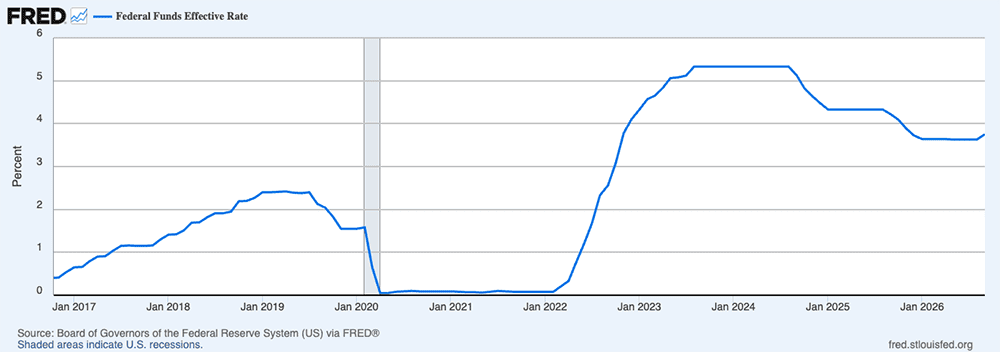
The CME FedWatch Tool, which uses trading in federal-funds futures to determine Wall Street’s expectations for future Federal Reserve actions, indicated an 86% chance that the central bank will follow up on September’s quarter-point hike with another, to a range of 4.00% to 4.25%, at the conclusion of its final 2026 meeting, scheduled for Dec. 8-9.
“While the September ‘dot plot’ suggests just one more hike, another increase in energy prices or further strong data prints could bring additional tightening into play next year,” Haigh adds.
The FOMC vote was 10-2 in favor of a pause, with Governor Lisa Cook and Cleveland Fed President Beth Hammack dissenting in favor of a quarter-point increase.
Empower Advisory Group offers a comprehensive wealth management service known as Personal Strategy Investment Services.
This managed account solution provides clients with discretionary investment management, personalized portfolio construction, and access to financial planning support.

Related: Why You Shouldn’t Change Your Portfolio Before Elections
“The Committee is continuing its policy of maintaining ample reserves in the banking system,” the Federal Reserve said in a statement. “Economic activity is expanding at a strong pace. While uncertainty remains elevated owing, in part, to geopolitical developments, domestic spending has been resilient. Productivity growth is strong, and capital investment is robust. Job gains have kept pace with the workforce, and the unemployment rate has changed little.”
The Fed also noted that inflation remained elevated, adding that “the accumulation of more information will help the Committee determine the policy stance appropriate to ensure a timely return of inflation to the Committee’s 2 percent goal.”
Daniel Siluk, Head of Global Short Duration & Liquidity and Portfolio Manager at Janus Henderson Investors, says that while the line could be interpreted as mildly dovish, it’s better viewed as an expression of patience.
“The door remains open to further tightening, but the Committee appears willing to wait for incoming data to validate the need for additional action, particularly given the stronger assessment of current economic activity,” he says. “Attention now turns to Kevin Warsh’s press conference and, in particular, how he justifies the need to accumulate ‘more information’ despite the upgrade in activity from ‘solid’ to ‘strong.’ His explanation of what evidence the Committee needs to see before tightening again should be the key signal for the near-term policy path.”

Additional Expert Insights on October’s FOMC Meeting
Here, we outline more thoughts from investment managers, strategists, and other experts about the Federal Open Market Committee’s October meeting.
Jerry Tempelman, Former Senior Analyst, NY Fed; VP of Economic and Fixed Income Research, Mutual of America Capital Management
“The policy decision is a good illustration of why Federal Reserve chair Kevin Warsh opposes providing guidance with respect to future monetary policy. Economic growth continues to be robust and the labor market remains solid. Still, inflation has increased for three consecutive months—both total “headline” inflation and with volatile food and energy components stripped out. All in all, economic data suggest that there was no good reason for the Fed to delay tightening monetary policy. But by having signaled through the September Summary of Economic Projections and through statements by senior Fed officials earlier this month that it intends to wait until its December meeting, the Fed more or less boxed itself in, in that financial markets would have been surprised if it had tightened policy at this meeting.
Jason Pride, Chief of Investment Strategy & Research, Glenmede
“The Fed’s adjustments to its inflation commentary appear to suggest that the incoming data may need to dissuade the committee from another hike in December. The statement’s new sentence frames the accumulation of more information as the input that may help determine the stance appropriate to ensure a timely return of inflation to 2%, and it sits alongside the retained declaration that the committee will deliver price stability. That does not read as a committee looking for reasons to move. Building a credible case for another pause would take a couple of consecutive inflation prints showing meaningful improvement in core and core services inflation. That is not the base case today, but it is a scenario worth watching.”
Steve Rick, Chief Economist, TruStage
“Today’s decision to hold rates steady makes sense coming off last month’s increase as policymakers continue to balance elevated inflation against a labor market that is showing signs of slowing. Monetary policy works with long and variable lags, so the Fed will want to see how the higher rates already in the system are affecting consumer spending, business investment and hiring before determining whether additional tightening is necessary. There’s no need to rush.”
Jeff Schulze, Head Investment Strategist, Franklin Templeton Institute
“The Fed held against the backdrop of stronger growth and inflation, indicating it warranted a somewhat restrictive policy stance. This is an interesting contrast to the September meeting when the Fed tightened policy following three months of relatively tame inflation data. This evolution could help shift investor perception that the Fed is more focused on the underlying trend in inflation and less (perhaps overly) sensitive to each data release; importantly, Warsh indicated that anchored inflation expectations are allowing the Fed to stay patient.”