



Consumer prices continued to swell in September, and they did so at a slightly brisker pace than expected, keeping pressure on the Federal Reserve to continue its rate-hiking cycle at some point over the coming months.
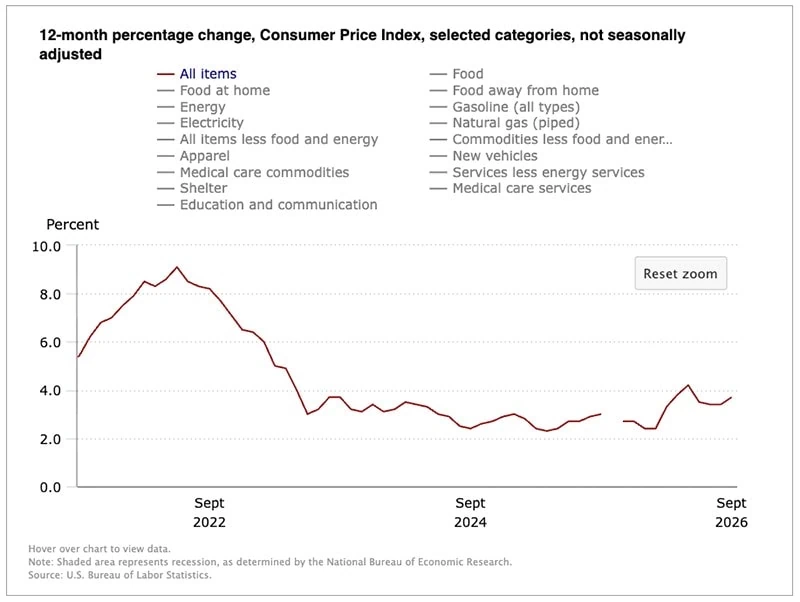
The U.S. Bureau of Labor Statistics reported Wednesday that September’s consumer price index (CPI), which measures the change in prices on a variety of consumer goods and services, rose by a seasonally adjusted 3.7% year-over-year—ahead of Dow Jones-polled economists’ estimates for 3.6% and faster than August’s 3.4% headline figure. On a month-over-month basis, prices advanced by 0.6%, which was also quicker than the prior-month’s pace but on par with expectations.
“Core” CPI—a measure of inflation that excludes food and energy costs (factors that are more volatile than the other prices tracked by the Labor Department)—was also quicker than economists predicted. September’s core inflation was up 0.3% MoM and 2.6% YoY, ahead of consensus targets of 0.2% and 2.5%, respectively.
The genie is out of the bottle,” says David Russell, Global Head of Market Strategy at TradeStation, an online brokerage firm. “Inflationary pressures have been building across the economy, and now they seem to be breaking through because businesses can no longer hold off raising prices.”
Related: Dividend Kings: The Full List of American Dividend Royalty
Stock-market futures, which were headed to gains prior to the report, sagged in response as the data further raised Wall Street’s expectations of another bump in the Fed’s benchmark interest rate before 2026 ends.
“[Fed Chair Kevin] Warsh advised market participants to focus on the trend and not the incremental data; September CPI leaves intact the upward trend in core prices over the last six months,” says Brad Conger, Chief Investment Officer at investment management firm Hirtle & Co. “At the margin, it bolsters the case for a hike at the October [Federal Open Market Committee meeting]. … I believe Warsh understands that the recent massacre of the long end owes something to lack of inflation fighting credibility, so his calculus is that a hike can settle the long end.”
Here’s a quick look at September’s key CPI figures:
- MoM CPI: +0.6% (estimate: +0.6%)
- YoY CPI: +3.7% (estimate: +3.6%)
- MoM Core CPI: +0.3% (estimate: +0.2%)
- YoY Core CPI: +2.6% (estimate: +2.5%)
Energy-price inflation came roaring back in September, with gasoline jumping 9.1% month-over-month; prices at the pump are 35% higher than they were a year ago. Fuel oil rocketed ahead by 15.3%, with prices ahead by more than 74% since last September.
Consumers are feeling an energy pinch at home, too; electric and gas utilities were only up 0.1% and 0.2% MoM, but on a year-over-year basis, those prices have advanced by 4.6% and 4.4%, respectively—quicker than the overall inflation rate.
Related: Empower Personal Strategy Review: Wealth Management More People Can Afford
Other costs growing in September? Used cars were 0.7% more expensive MoM, though those prices have still fallen by 1.5% over the past year; new-vehicle sales were up 0.2% MoM. Consumers also paid more 0.4% more for shelter, 0.6% more for transportation, and 0.3% for medical care. Food prices as a whole were flat.
“It seems that a preponderance of businesses have realized that the oil spike is no longer temporary, especially since the oil volume flowing through Hormuz is nearly as high as it was pre conflict,” says John Kerschner, Global Head of Securitized Products and Portfolio Manager at Janus Henderson. “The market is pricing in an oil hazard tax and businesses are increasingly passing this through to consumers instead of reluctantly eating it.”
Also watched closely Wednesday was the Consumer Price Index for Urban Wage Earners and Clerical Workers (CPI-W). The annual Social Security cost-of-living adjustment (COLA) is determined by the increase in CPI-W from the third quarter of the most recent year a cost-of-living adjustment was made to the current year’s Q3 CPI-W.
Last month’s CPI-W came out to 3.9%, for a 3.6% average across July, August, and September, resulting in a 3.6% Social Security COLA for 2027.
“That’s roughly $75 more per month for the average retiree,” says Sonu Varghese, Chief Macro Strategist at Carson Group, a registered investment advisor. “That’s hardly a windfall, and is simply compensation for higher prices, and rising Medicare premiums could eat into the increase.”
Fed Still Expected to Raise Rates Again in 2026
Investors largely see at least one more interest-rate hike down the pike this year.
The CME FedWatch Tool, which uses trading in federal-funds futures to determine Wall Street’s expectations for future Federal Reserve actions, still shows just a 20% chance the central bank will raise its benchmark interest rate from its current 3.75%-4.00% during the next Federal Open Market Committee (FOMC) meeting, scheduled for Oct. 27-28, 2026.
However, that probability jumps to 55% when looking at the December meeting … and futures are pricing in a 40% chance of a half-point hike, to 4.25%-4.50%.
“In our view, today’s print puts the Fed’s tactical breather priced into the market for October in question,” says Tim Urbanowicz, Chief Investment Strategist, Innovator ETFs from Goldman Sachs Asset Management. “With $100-plus crude adding friction to already sticky core prices, the latest data increasingly complicates the disinflation narrative and may limit the Fed’s flexibility.”
Other Expert Thoughts on September’s CPI Report
Here’s a look at a few more reactions from economists, strategists and more to last month’s CPI numbers, including what they mean for consumers, markets, the Federal Reserve’s future actions, and the economy:
Jeff Schulze, Head Investment Strategist, Franklin Templeton Institute
“Today’s warmer core CPI release bolsters the case for additional rate hikes, but recent dovish Fed-speak from New York President Williams and Governor Jefferson suggests that the bar is high for an immediate hike. In our view, September’s print was likely not sufficient for the Fed to execute back-to-back increases at the October FOMC meeting. The steady rise in long yields has increased corporate/consumer borrowing costs and tightened financial conditions alongside the Fed’s move, meaning the bond market has been doing some of the heavy lifting for the Fed.”
Jason Pride, Chief of Investment Strategy & Research, Glenmede
“Core goods prices, which had been relatively tame for much of the year despite expectations that tariffs and higher energy prices would bleed through, now appear to be accelerating. Prices for goods less food and energy rose 0.3%, which is the firmest monthly reading since January. Recreational commodities were the standout, with toys up 4.2% and the broader category of other recreational goods up 3.5%, both the largest monthly increase on record for those series. While some may point to this as a sign of outliers driving the result, these large jumps have continued to pop up in different portions of the consumption basket, suggesting they may instead be signs of broader price pressures emerging in fits and starts.”
Peter Graf, Chief Investment Officer, Amova Asset Management Americas
“Given the recent re-acceleration in a variety of inflation indicators, today’s higher-than-expected US CPI reading would have been the least surprising surprise had the market not been lulled into complacency by the dovish pronouncements from FOMC members.
It’s understandable that the rate setters would like to avoid hiking two more times this year after the employment report hinted at a deterioration in labor conditions, but they cannot avoid acknowledging that technological advances have re-invigorated the AI investment engine that is powering the economy and driving up prices. Energy prices also provide little leeway for inflation optimism with conflicts seeming to flare up in both the Middle East and Ukraine.
Rate hikes are unlikely to be the perfect medicine for either of these inflation drivers, but with prices moving in the wrong direction, this month’s FOMC meeting should very much be put back in-play.”
Scott Helfstein, Head of Investment Strategy, Global X
“The September inflation data likely keeps one more Fed rate hike in play before year-end, likely in December after the midterm elections. The problem is that higher rates do not help alleviate supply shortages in areas like energy and shelter.
Earnings are likely to overshadow inflation and macro data for the next couple of weeks, so markets may well take the inflation report with a grain of salt even if they dip in the short run. Expectations for earnings and margin growth are near record highs. That should be more important than any one-off economic data point.”