



America’s employment situation slowed much more sharply than expected last month, with the Labor Department delivering a September jobs report that “further takes an October hike off the table” and calmed worries that the Federal Reserve might have two more rate hikes in store this year.
The Labor Department reported Friday that nonfarm payrolls (NFP) increased by just 29,000 in September, coming in well below Dow Jones-polled economists’ expectations for growth of 84,000. Jobs totals for the prior two months were downwardly revised by a total of 60,000 jobs. August’s initial read of +162,000 was changed to +133,000, while July’s payroll growth of 21,000 was revised back down to a loss (-10,000).
The unemployment rate climbed a notch, to 4.2%, while economists were looking for it to stay flat at 4.1%. Average hourly earnings barely changed, growing 0.1% month-over-month, to $37.81. On a year-over-year basis, that’s 3.0% higher, which was below estimates for 3.1% and the slowest such rate in more than five years.
“Fed Chair [Kevin] Warsh can breathe a sigh of relief after today’s tepid jobs report because the committee now has a perfect excuse to leave rates steady at this month’s FOMC meeting,” says Peter Graf, Chief Investment Officer at Amova Asset Management Americas.
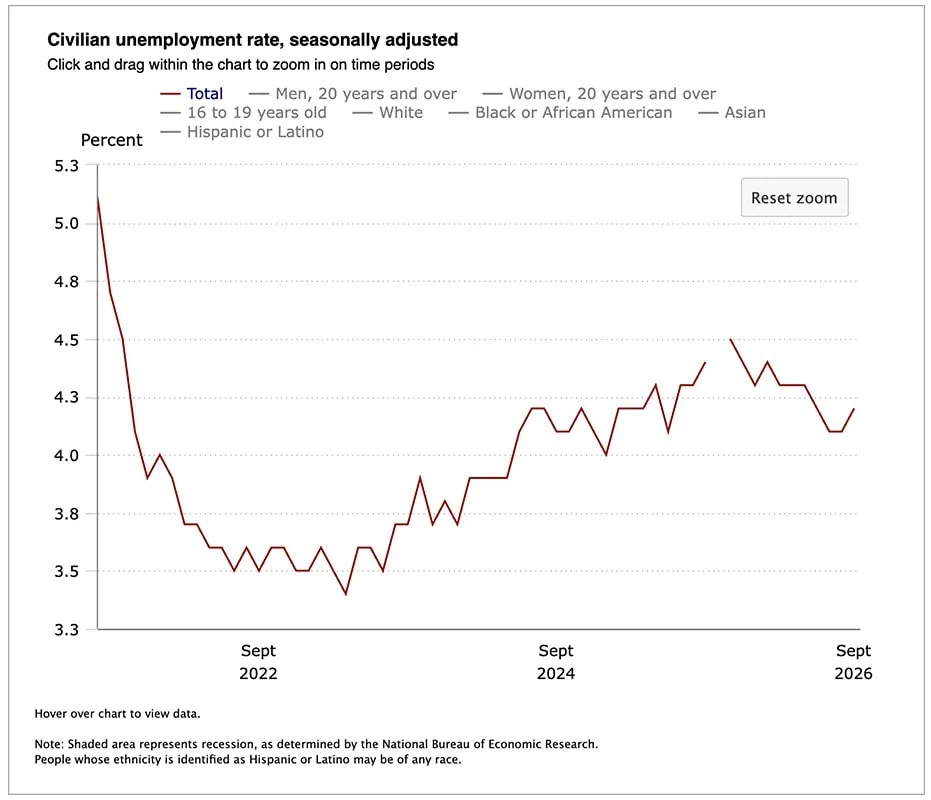
Here’s a brief look at the September jobs report’s most pertinent details:
| Reported | Estimated | Previously | |
|---|---|---|---|
| September payrolls | +29,000 | +84,000 | +162,000 (August) |
| September unemployment | 4.2% | 4.1% | 4.1% (August) |
| September hourly earnings (YoY) | +3.0 | +3.1% | +3.1% (August) |
| August payrolls (revised) | +133,000 | N/A | +162,000 |
| July payrolls (revised) | -10,000 | N/A | +21,000 |
| Source: U.S. Bureau of Labor Statistics. | |||
“September payroll growth has tended to underperform its recent trend when Labor Day is later in the month—like it was this year,” say Goldman Sachs economists Ronnie Walker and Jessica Rindels, who added that August’s sharp increase in nonfarm payrolls was boosted by outsized increases in leisure and hospitality and local educational services payrolls that were unlikely to repeat. Indeed, leisure and hospitality grew by just 10,000 jobs compared to 37,000 in August; last September, when Labor Day fell on the first, the segment grew by 37,000. Local government education jobs, meanwhile, declined by 1,800 last month.
Related: 7 Best Fidelity Dividend Funds [Passive Income Picks]
Other points of weakness: Governmental payrolls were off by 17,000 in September, temporary help services were off by -10,900), and information lost 10,000 jobs. Financial activities (-7,000), and mining and logging (-2,000), were also lower.
Healthcare employment continued to be a strong point for the economy, growing by 17,000 jobs last month. Even then, that was a slower pace than the 33,000 monthly jobs added over the past year. Construction employment improved by 11,000, slightly higher than its 10,000 12-month average, and manufacturing added 9,000 jobs.
The government report was also a bit of a contrast from ADP’s earlier-week report showing 90,000 private-payroll jobs were created in September, which was the strongest such data in three months.
Fed Rate-Hike Expectations Cool Down
A weaker-than-expected personal consumption expenditures (PCE) price index reading for August earlier this week helped tamp down expectations that the Federal Reserve might raise the federal funds rate at its upcoming Federal Open Market Committee (FOMC) meeting. September’s jobs data put even more cold water on that notion.
The CME FedWatch Tool, which uses Fed funds futures prices to track the probability of a change to the federal funds rate, now shows an 81% chance that the Federal Reserve will keep its benchmark rate level, at 3.75%-4.00%, when the FOMC meets Oct. 27-28. That’s up from just 36% a week ago.
“Today’s soft payroll report demonstrates that the labor market is simmering, not boiling, which should bolster the case for the Fed to remain on hold at the October meeting,” says Jeff Schulze, Head Investment Strategist, Franklin Templeton Institute.
Wall Street also seems to believe the Fed will be a little less aggressive throughout the rest of the year. Futures are pricing in a 75% chance of at least one rate hike by year’s end, up from more than 90% a week ago. And whereas there was almost a coin flip’s chance of a half-point raise, that has now withered to just 13%.
“Inflation has begun to show signs of moderation from its summer peaks. However, the combination of softer employment growth and the Federal Reserve’s September interest rate hike may pose risks to consumer spending, particularly for households already squeezed by elevated energy prices and tariff-driven cost increases,” says Jerry Tempelman, Former Senior Analyst at the NY Fed and VP of Economic and Fixed Income Research at Mutual of America Capital Management.” If upcoming jobs reports continue to reveal weak data, the Fed could reconsider its tightening stance—particularly if there are signs that the labor market is slowing down faster than policymakers anticipated.”
Related: How Is Your Retirement Income Taxed?
More Expert Reactions to September’s Jobs Report
Here’s what other strategists, financial managers, and experts had to say about last month’s employment situation:
Bradford Smith, Portfolio Manager, Janus Henderson Investors
“A dovish report that further takes an October hike off the table. … The print is a mirror image of the strong August print giving back some of that strength. The weaker print only marginally softens the pressure on the Fed to hike in its renewed effort to fight inflation and restore credibility on inflation.
It does, for now, take off the tail risk that the labor market has tightened to a level that accelerating economic activity results in wage-based inflation, which would further complicate the Fed’s conundrum. The likelihood of an October pause was already high with this print nudging up those chances. Still, employment remains at full employment levels leaving the Fed myopically focused on its inflation fight.”
Lindsay Rosner, Head of Multi-Sector Fixed Income Investing, Goldman Sachs Asset Management
“Fall temps hit jobs and October seems unlikely. Today’s soft print argues against the idea that the labor market is retightening. One follow-up hike in December remains our base case; however, continued pressure by markets and moves higher in energy prices could force the Fed’s hand this month as well.”
Related: The Best Healthcare ETFs: 5 Wholesome Picks
Jason Pride, Chief of Investment Strategy & Research, Glenmede
“Not every increase in the unemployment rate is a warning; this one in particular reads as a sign of confidence rather than distress. The entire rise in unemployment came from people entering the labor market rather than losing jobs: reentrants rose 152,000 and new entrants rose 118,000, while the ranks of job losers shrank. The labor force expanded 485,000 and participation climbed to 61.8%, the highest reading since January.
After spending most of this year at the low end of the range consistent with full employment, a tick higher in the unemployment rate matters far less than the reason behind it, and workers choosing to come off the sidelines is an encouraging signal about how they view their prospects.”
Scott Helfstein, Head of Investment Strategy, Global X
“The strong August job growth was slightly misleading, largely driven by back-to-school employment patterns in the hospitality and leisure industries. A slowdown this month should not come as a big surprise. Approximately 70,000 jobs last month were attributed to leisure and hospitality, well above trend.
There is some good news in the relatively weak report. Manufacturing jobs have been growing for the past three months while construction has been adding headcount since March. The reshoring efforts and the AI data center buildout are positive developments even if the total job creation is modest.”
Related: CRUTs vs. CRATs: Which Charitable Remainder Trust Is Best?
Steve Rick, Chief Economist, TruStage
“One month doesn’t make a trend, and monthly payroll numbers can bounce around quite a bit. What matters more is whether the three-month trend continues to show a labor market that is gradually cooling rather than falling off a cliff.
Even with a softer report, this still looks like a labor market that is moderating rather than deteriorating. Employers are not hiring aggressively, but they are not laying off workers aggressively either. We may be settling into a low-hire, low-fire environment, where businesses are being more selective about adding workers but still want to hold on to the employees they have.”
Sonu Varghese, Chief Macro Strategist, Carson Group
“The headline payroll numbers muddy the labor market picture, thanks to low labor supply. However, a historically low unemployment rate of 4.2% and a prime-age (25-54) employment-population ratio that has rebounded to 80.7% (higher than anything we saw in the 2000s and 2010s expansion cycles) tells you that the labor market is in a solid place.”