




“Net worth” feels like a term that’s only relevant to the most affluent people, largely because the media frequently reports on the net worth of the world’s richest individuals.
But in reality, net worth is a metric that’s useful for all households to know. Your net worth, in concert with the average net worth of your peers, can act as a gauge of your financial progress over time. That knowledge in turn can better educate the money steps you take going forward.
Read on as I provide Americans’ average and median net worths by age group. I’ll also show you how to calculate your own net worth, then offer up a few ways to increase it.
What Is Net Worth?

Your net worth is a measurement of wealth. It’s simply the value of your assets minus your liabilities.
Examples of assets include cash, liquid accounts (like checking, savings, and certificates of deposit), investments, retirement accounts, and personal property like cars and jewelry. Examples of liabilities include unpaid credit card debt, medical debt, student loans, and auto loans.
When you buy a home with a mortgage, you’re getting both an asset (your home/land) and a liability (your mortgage debt). Generally speaking, when you first buy a home, your net worth remains level unless you made a very small down payment, in which you might sustain a hit to your net worth. Over time, as the worth of your home widens against what you owe, your net worth will increase.
Knowing your net worth can give you insights into your financial health and help you determine whether your wealth is increasing or depleting over time. while, knowing the net worth of your peers lets you see whether you’re meeting, exceeding, or falling short of common targets, and it can motivate your financial goals.
A Quick Note About the Numbers
At some point during your educational career, you were likely taught the mathematical terms “mean” and “median”:
- Mean is just another term for “average.” You find it by adding all data points and dividing by the number of data points.
- To find the median in a data set, you order all of the data points, then find the middle number.
To make things easy on all of us, I’ll just say “average” instead of “mean.”
While I’ll provide both the average and median net worth numbers by age group, you’ll likely want to focus on the median. A small number of extremely wealthy households tend to drive up America’s mean net worth—indeed, the 0.1% wealthiest individuals in the U.S. own about a quarter of the country’s wealth, per Federal Reserve data. Thus, the median is considered a more accurate gauge.
Make sure you sign up for The Weekend Tea, our free weekly newsletter that over 10k monthly readers use to level up their money know-how.
Median and Average Net Worth by Age Group
The following information about Americans’ net worth comes from the Federal Reserve’s Survey of Consumer Finances. I’m using the most current data available, which was collected in 2022.
The average net worth of U.S. households was $1.06 million at the time, while the median net worth was $192,700.
Of course, more useful to you is how those numbers vary by age group. So let’s dive in. Here are the average and median net worths by age of the head of family.
Related: Is Your Retirement on Track? Here Are the Average 401(k) Balances By Age
Under 35

- Average net worth: $183,380
- Median net worth: $39,040
No surprise: People in this age group generally have lower net worths than any other generation of adults.
Many of the people in this cohort are just beginning their careers, so their salaries aren’t as high as they will be later in life.
They haven’t had much time to accumulate savings, nor much purchasing power to accumulate assets.
Understandably, this age group often has a lot of debt, too. Many individuals still have high student loan balances. Consumer debt looms large here, too. People may have fresh mortgages, and some of those might have involved only a modest down payment.
If you’re under age 35 and your net worth looks slim even compared to the low numbers above, you don’t necessarily need to worry, especially if your career required many years of post-secondary education or you recently acquired a mortgage. You have lots of time to flip this around.
Related: 10 Money-Smart Wedding Planning Tips [Luxe Look, Low Price]
35-44
- Average net worth: $548,070
- Median net worth: $135,300
The net-worth curve is proceeding exactly like you’d expect. People in their mid-30s to mid-40s have had more time to reduce their debt and grow their assets.
The average age of a homebuyer in the U.S. has risen over time, so it now sits in the 35-to-40 range. That means many people in this cohort will be homebuyers, but some of those will still be relatively new homebuyers and thus might still have a weight hanging on their net worth.
Assuming a lack of high-interest debt, this is an important time to prioritize investing and saving for the future. It’s far too easy for an increase in income to turn into more spending money rather than more money set aside for retirement.
Related: 9 Best Micro-Investing Apps [Small Investment Apps]
45-54

- Average net worth: $971,270
- Median net worth: $246,700
Average net worth is rising. Median net worth is rising. Everything is proceeding as it should.
That doesn’t mean this age range isn’t tricky, financially speaking.
On a positive note, people in their mid-40s to mid-50s are typically near or in their highest-paying years. They’ve had more time to pay down and outright eliminate debt. They’ve had a couple decades to not only save for retirement, but see those investments compound.
But new financial responsibilities are starting to emerge. You might be saving toward a child’s college tuition. Or you might need to start acting as a financial caregiver for an elderly relative. The very broad advice for people in these situations: It’s essential to find a balance between helping others while protecting your own financial future.
Related: Should You Let Your Kids Move Back Home After College?
55-64
- Average net worth: $1,564,070
- Median net worth: $364,270
People in the 55-to-64 cohort usually have many of their biggest expenses (vehicles, tuition) in the rearview. The mortgage might or might not be paid off. They’re either gearing up for retirement or, happily, retired early.
That said, this is where the pressure can really be felt if you’re behind on your retirement savings, as you have less time to contribute and let compounding do its thing.
Among the levers you have is taking advantage of (super) catch-up contributions for any applicable retirement account. For instance, the 2026 contribution limit for 401(k)s and similar workplace plans is $24,500. However, people ages 50-59 or 64 and over can make an additional $8,000 in catch-up contributions, while people ages 60-63 can make up to $11,250 in “super” catch-up contributions.
If you’re still financing your home, this is when you’ll want to start considering the pros and cons of paying off a mortgage before retirement.
Related: 9 Financial Mistakes That Can Quickly Drain Your Retirement Savings
65-74

- Average net worth: $1,780,720
- Median net worth: $410,000
It’s no wonder why people in their mid-60s to mid-70s have the highest average and median net worths. They’re either still working (and thus still saving) or have only really begun to draw from their retirement accounts, while virtually all of their significant debts are behind them.
A big question for people who at this point are still uncertain about their nest egg is Social Security timing. Putting off retirement for just a couple of years can give you a couple more years to continue accumulating wealth and putting money in your accounts, and putting off Social Security can help increase the amount of your monthly benefit.
Among the greatest priorities at this stage is cementing your retirement withdrawal strategy, which you’ll need in place to ensure you don’t outlive your savings. (Many people follow the 4% rule for retirement withdrawals, but some experts believe the 4% rule is outdated.)
And near the high end of this age range, required minimum distributions (RMDs) are going to become a consideration, too.
Related: How Much Is My RMD If I’ve Saved $1 Million for Retirement?
Empower Advisory Group offers a comprehensive wealth management service known as Personal Strategy Investment Services.
This managed account solution provides clients with discretionary investment management, personalized portfolio construction, and access to financial planning support.

75+
- Average net worth: $1,620,100
- Median net worth: $334,700
By the time you’ve reached 75, you’ve very likely stopped accumulating wealth and begun to draw from your various assets, and thus your net worth will begin to decline.
At this point, your net worth predominantly matters in terms of having enough to last through retirement, as well as determining how much you’ll pass on in retirement (and to whom).
For some people, this will involve merely writing a will and assigning beneficiaries to financial accounts. But higher-net-worth individuals might need to consider more complex but beneficial vehicles such as revocable or irrevocable trusts, dynasty trusts, and charitable remainder trusts (CRTs).
Related: How Is Your Retirement Income Taxed?
How Can I Calculate My Net Worth?

The net worth formula itself is pretty simple:
Assets – Liabilities = Net Worth
Again, your assets are everything you own that has monetary value. Bank account balances, retirement accounts, real estate, investments, life insurance policies, even the cash in your wallet all count as assets.
Liabilities are debts or other financial obligations. Student loans, mortgages, credit card debt, and payday loans are all examples of liabilities.
To calculate your net worth, add up all of your assets. Then add up all of your liabilities and subtract that number from your assets.
Let’s look at a very simple example. Pretend your assets include just a checking account, savings account, and 401(k) with the following balances:
- Checking account: $5,000
- Savings account: $10,000
- 401(k): $20,000
Your total assets would amount to $35,000 ($5,000 + $10,000 + $20,000 = $35,000)
Now, pretend your liabilities are just the following:
- Credit card debt: $1,500
- Student loans: $20,000
Your total liabilities would amount to $21,500 ($1,500 + $20,000 = $21,500).
In this scenario, your net worth would be $13,500 ($35,000 – $21,500 = $13,500).
While you can have a negative net worth if your liabilities outweigh your assets, this isn’t necessarily a cause for alarm. It commonly happens right after a person takes out a mortgage or other large loan with a small down payment. But in many cases, that kind of debt is an investment that will grow in value.
The net worth formula is easy to understand, and the example above is extremely simplified. But often, people have far more assets and liabilities. Making matters more complicated, the numbers change frequently. A credit card balance may change multiple times per day. To monitor real-time net worth without constantly checking balances and doing calculations, some people opt to use net worth trackers.
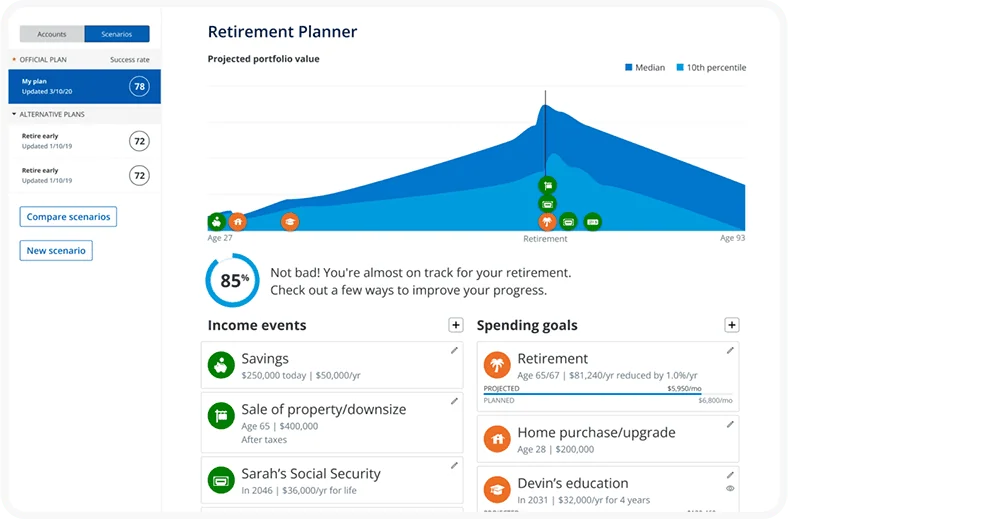
Track Your Net Worth With Empower
- Available: Sign up here
- Price: Tools: Free. Wealth Management: Starts at 0.89% of assets annually.*
Empower is one of our top-rated financial services firms for people of any income level thanks to the quality and breadth of its offerings:
- Free financial tools: Empower’s free Personal Dashboard includes a host of useful tools, including a savings planner, retirement planner, financial calculators, and even a cost planner for your children’s education. But the tool that sets Empower apart is its Investment Checkup tool, which assesses portfolio risk, analyzes past performance, provides a target allocation for your portfolio, and lets you compare your portfolio to the S&P 500 and Empower’s “Smart Weighting” Recommendation.
- Fee-based wealth management services: Empower also offers several suites of advisory services depending on your investible assets. People with as little as $100,000 can get unlimited financial advice and retirement planning and a professionally managed portfolio. Clients with higher assets can access more services, including dedicated financial advisors, specialists in areas such as real estate and stock options, and even access to private equity.
Use our exclusive link to sign up for the Empower Personal Dashboard, whether that’s for the free tools or the advisory services. If you have $100,000 or more in investible assets, you’ll also be able to schedule a free initial 30-minute financial consultation with an Empower professional.
- Empower offers both a free set of portfolio, net worth, and cash flow tracking tools, as well as paid asset management service.
- Link Empower to your bank and investing accounts, credit cards, and more to see a single view of useful information and data, including your net worth.
- Empower Advisory Group offers a comprehensive wealth management service known as Personal Strategy. This managed account solution provides clients with discretionary investment management, personalized portfolio construction, and access to financial planning support. Accounts investing $100k to $250k receive unlimited advice and retirement planning help from financial advisors, as well as a professionally managed ETF portfolio with reviews upon request. Higher asset tiers offer access to dedicated advisors, estate planning, and tax specialists, plus additional investment options like access to private equity.**
- Special offer: If you have $100k+ in investible assets, sign up with our link to schedule a free initial 30-minute financial consultation with an Empower professional.
- Free portfolio tracker (Dashboard)
- Free net worth, cash flow, and investment reporting tools (Dashboard)
- Tax-loss harvesting (Personal Strategy)
- Dividend reinvestment (Personal Strategy)
- Automatic rebalancing (Personal Strategy)
- Low investment expense ratios (Personal Strategy)
- High number of investment accounts supported (Personal Strategy)
- Low $100k minimum for investment management (Personal Strategy) compared to traditional advisors.
- Moderately high investment management fee (0.89% AUM) compared to other online advisors (Personal Strategy)
- No dedicated advisor unless you have $250k+ in assets
Related: What Are the Average Retirement Savings By Age?
How Can I Increase My Net Worth?
Whether you’re worried about your net worth or just seeking a more comfortable retirement, you might want to increase your net worth at a faster pace. Here are a few tips on doing just that.
1. Aggressively Pay Off High-Interest Debt

The moment you pay off your debt, you don’t actually change your net worth. While you reduce your debt (a liability), you do so by reducing your cash on hand by the same amount (an asset).
The payoff to your net worth comes over time, in the form of savings on the interest you otherwise would have paid. You could then take those savings and, say, invest them in stocks or other assets that could further increase over time.
But this isn’t a one-size-fits-all rule.
The best way to think about it is “Where can I get the best return on my money?” Consider this: The S&P 500, on average, returns about 10% a year. So if your mortgage or car loan charges just 5% in interest, your excess savings would ultimately deliver a greater return investing in stocks rather than quickly paying down your debt. But if you owe a significant sum on a credit card charging 20%, your money will be most effective paying down that high-interest debt first.
Related: Budgeting in Retirement: Our Step-by-Step Guide
2. Increase Your Income
We know it sounds easier than it is, but if you want to increase your net worth, earning more would certainly help.
At the very least, you should target a job that grants cost-of-living raises every year. Inflation might not be consistent from one year to the next, but it’s persistent, so higher consumer prices mean a flat salary will purchase less and less each year.
Past that, if you’re a strong performer or have taken on additional responsibilities, you should request a raise to better align your compensation with the value you provide the company.
Of course, many companies make the mistake of prioritizing new-talent hiring over retention, so for some people, a higher income might only come from getting a new job elsewhere. Indeed, switching companies within certain industries can sometimes result in substantial pay bumps. Just remember when negotiating that salary isn’t everything: It’s important to look at an employer’s full compensation package and consider other benefits, such as insurance, retirement accounts and contribution matches, and transportation stipends.
If you enjoy your current job and have no desire to move to another role or company, another option is to start a side hustle to earn more income. Even something that takes up only a couple of hours a week, such as leading a fitness class, could make a notable difference in your net worth over time.
Related: Should You Max Out Your 401(k) Each Year? [Yes … and No]
3. Make Your Money Work for You

Even with a high salary, you’re unlikely to meet your net worth goals if all of your earnings sit in a checking or traditional savings account earning next to nothing.
You need to grow your money, not let it rot.
Money earmarked for short- and medium-term savings goals is often best held in a high-yield savings account,
For short-term and medium-term savings goals, you may have money in a high-yield savings account, certificate of deposit (CD), money market account (MMA), or another liquid account that offers decent yield. Money meant for retirement and other long-term goals should be invested in riskier assets such as stocks and alternative investments.
Every dollar you earn doesn’t need to be in exchange for time worked. Let compounding lift some of those bricks.
Related: 20 Alarming Gen X Retirement Statistics
4. Talk to a Financial Advisor
Everyone’s financial situation is unique. For a custom plan on how to increase your net worth, it’s best to talk to a financial advisor. These professionals can help you build a diversified portfolio that matches your risk tolerance and, if you so choose, manage your investments for you.
Advisors can also help with retirement planning, implement strategies to minimize your tax burden, help with estate planning, and more. Any time you’re going through a major life event, such as marriage, the birth of a child, or a major financial windfall, is a good time to check in with a professional.
Related: How to Choose a Financial Advisor
Want to talk more about your financial goals or concerns? Our services include comprehensive financial planning, investment management, estate planning, taxes, and more! Schedule a call with Riley to discuss what you need, and what we can do for you.