



Wall Street’s expectations for an October interest-rate hike were dialed back Wednesday after the Federal Reserve’s favored inflation gauge showed that consumer prices grew less than expected last month.
The Commerce Department reported this morning that the personal consumption expenditures (PCE) price index increased at a seasonally adjusted rate of 0.3% month-over-month in August, which was on par with estimates from Dow Jones-surveyed economists. On a year-over-year basis, PCE of 3.4% was slower than projections for 3.7%.
“Core” PCE inflation, meanwhile, came in just 0.2% MoM and 3% YoY, both of which were lower than expectations for 0.3% and 3.3%, respectively.
“This is good news for investors worried about the recent surge in bond yields, and it bolsters the case for not hiking in October,” says David Russell, Global Head of Market Strategy at TradeStation. However, he adds that “it’s also relatively old data at this point that doesn’t reflect this month’s surge in diesel prices. Investors will remain wary of energy prices as we enter a key period of fuel consumption.”
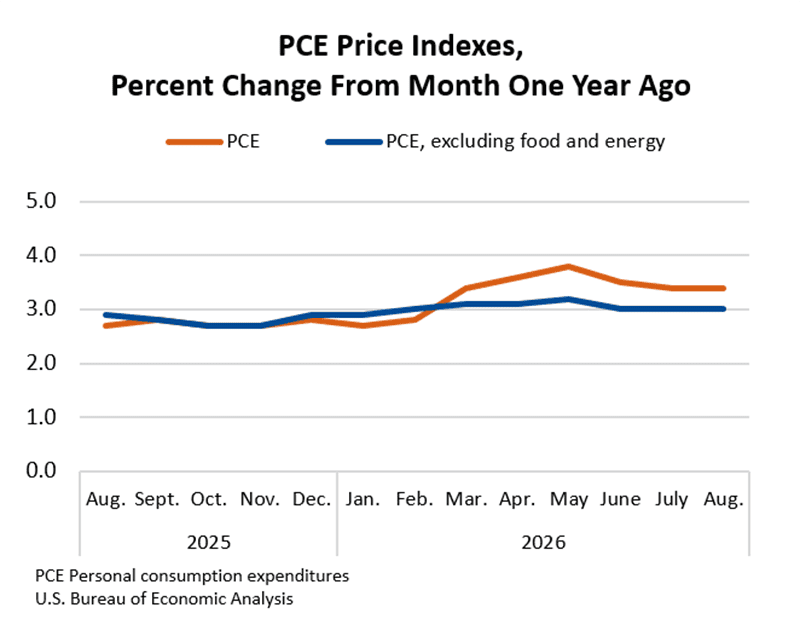
The PCE data follows a firm August consumer price index (CPI) report and a September Federal Open Market Committee (FOMC) meeting that saw the central bank raise its benchmark interest rate for the first time in three years.
“The underlying economy proves resilient once again,” says Adam Hetts, Global Head of Multi-Asset and Portfolio Manager at Janus Henderson Investors, who noted that the second-quarter gross domestic product (GDP) reading for Q2 was also revised higher today, to 2.2% “alongside a particularly strong Q3 GDP ‘nowcast.'”
Here’s a quick look at August’s key PCE figures:
- MoM PCE: +0.3% (estimate: +0.3%)
- YoY PCE: +3.4% (estimate: +3.7%)
- MoM Core PCE: +0.2% (estimate: +0.3%)
- YoY Core PCE: +3.0% (estimate: +3.3%)
Worth noting: The softer-than-expected figures come amid a few BEA changes to the index’s methodology, which economists believed would tamp down the numbers to some extent.
Gasoline costs were an unsurprisingly significant driver of August’s rise in prices, surging 4.4% month-over-month, while energy goods and services as a whole climbed 2.3%. Transportation services prices grew by 1.4%; food services and accommodations (0.5%) and other services (0.9%) also pulled the index higher.
Related: What Is the Average Net Worth By Age?
However, costs for motor vehicles and parts, furnishings and other durable household equipment, and recreation services remained level last month, as did food and beverages purchased for off-premises consumption.
Core PCE for July was also revised lower, from about 3.3% year-over-year to 3%. Among the components that brought that number lower were computer software and accessories, as well as portfolio management services.
“Long-awaited revisions to core PCE inflation ultimately ended up being a bit larger than we were expecting, with July year-on-year revised 36 basis points relative to our forecast for a 30-basis-point downward revision,” Citi Research economist Veronica Clark says. “While core PCE at 3% is still clearly higher than the 2% target, core PCE is now tracking notably softer than the median Fed forecast of 3.4% in the September [Summary of Economic Projections] and even softer than [Fed Chair Kevin] Warsh’s estimate of 3.2%YoY in August.”
The BEA’s report also showed a 0.2% month-over-month increase in personal income, which was below expectations for 0.4%. Growth in spending of 0.9% was a touch hotter than estimates for 0.8%
Do you want to get serious about saving and planning for retirement? Sign up for Retire With Riley, our free retirement planning newsletter.
October Rate-Hike Looks Less Likely, But …
The major stock-market indexes rose in relief Wednesday following the PCE report, as Wall Street signaled less confidence that an October rate hike is nigh.
“The bond market’s moves over the last few trading days have been extreme,” says Steve Wyett, Chief Investment Strategist at BOK Financial. “So, the PCE report today was under a microscope as participants try to get a handle on how aggressive the Fed needs to be with future rate increases.”
The CME FedWatch Tool, which uses trading in federal-funds futures to determine Wall Street’s expectations for future Federal Reserve actions, now shows a 63% chance that the target range for the federal funds rate will stay at its current 3.75%-to-4.00% range at the conclusion of the next Federal Open Market Committee (FOMC) meeting, scheduled for Oct. 27-28. A week ago, futures were pricing in a 70% chance of a quarter-point hike.
That said, futures are still indicating a strong likelihood of at least a quarter-point raise by the end of the year, with a 58% chance that the Fed’s range will step up to 4.00%-4.25%, and a 30% chance of a half-point rise to 4.25%-4.50%.
“While today’s inflation data is somewhat better than expected,” Hetts says, “strong labor and GDP data suggest the print is unlikely to derail consensus expectations for another rate hike before the end of the year.”
“Even after major methodological revisions, PCE inflation is still running hot however you cut it,” adds Sonu Varghese, VP Global Macro Strategist at Carson Group. “At the same time, Q2 GDP growth was revised up to 2.2% from 1.5%, and nominal growth to 8.5% from 8%. The economy is running hot, policy remains easy, and the Fed’s challenge is figuring out how much restraint is needed. That’s a tailwind for stocks as we move into Q4.”
Related: The Best Healthcare ETFs: 5 Wholesome Picks
What If I Need Help Picking Stocks?
Motley Fool Stock Advisor is a stock picking service that espouses my favorite, plain-vanilla trading style: buy-and-hold. Fool analysts provide recommendations for both “Steady Eddies” and potential high-flying stocks with sound fundamentals—exactly the combination of holdings you want to generate strong performance without risking extremely high volatility.
Importantly, Stock Advisor doesn’t just give you a list of tickers and call it a day. It also provides investment rationales and research for each pick to help educate you before you buy.
Stock Advisor has returned 934% since its founding in February 2002, more than tripling the S&P 500 over that time (as of 9/30/26). You can join this service at a discounted rate for the first year, and get a 30-day membership-fee-back period, if you sign up for Stock Advisor today.
- Motley Fool Stock Advisor is a stock service that provides recommendations for both "steady Eddie" and high-flying stocks, as well as a few ETFs for investors who want diversified holdings, too.
- Just getting started? Stock Advisor provides 10 "Foundational Stocks" you can use to anchor your portfolio.
- You're not alone! Stock Advisor membership also gives you access to a community of investors who also want to outperform the market and love talking shop.
- Enjoy access to GamePlan: Motley Fool's financial planning hub, which includes advice on personal finances, taxes, retirement, and more, as well as calculators and other financial tools.
- Limited-Time Offer: Get your first year with Stock Advisor for $99 (vs. $199 usual value)—a 50% discount for new members!—by clicking our link.*
- Discounted introductory price
- Strong outperformance compared to the S&P 500
- High overall average return for stock picks
- High renewal price
- Not every stock is a winner