


It doesn’t take much to learn how to invest in stocks. All you need is a little patience, discipline, and consistency.
The publicly traded markets provide several universally accessible investment vehicles to grow your assets over time. That’s not just stocks, but bonds, commodities, and investment funds like mutual funds and exchange-traded funds (ETFs) that hold these and other assets.
Your first step to begin investing in the stock market is as simple as opening an online brokerage account, using robo-advisors to automate your investing and letting your contributions compound. Though if you want to get your hands dirty, you can also participate in stock picking and attempt to outperform the market.
You don’t need any credentials or investing experience to build substantial wealth for yourself, no matter your investing style. Nor does getting started in stock investing have to be an arduous affair.You can set up automatic contributions to a retirement plan each time you get paid, like through an employer-sponsored plan, individual retirement account (IRA), or even a taxable brokerage account.
Further, what you contribute doesn’t need to be sizable if you start early enough. Micro-investing apps and robo-advisor apps cater to people who want to start investing with small amounts of money, and they can show you how to build a diversified portfolio that can weather market volatility.
This is my guide on how to invest in stocks as a beginner. We’ll talk about better understanding what you can invest in, what it takes to succeed at investing, and how to make your balance grow over time.
Featured Financial Products
Table of Contents
How to Invest in Stocks

Investing in stocks doesn’t require expert-level knowledge that only Wall Street veterans possess. Nor is it only for wealthy or high earners.
Like I said: Anyone can learn how to invest in stocks.
But if you’re just starting out, and/or if you don’t have much money to invest, you’ll need a little help in the form of education and tools. Today, I’ll help provide the former and point you toward the latter.
How Do You Want to Invest in the Stock Market?
When you start to think about the stock market and how you’d like to invest, before you open an account, ask yourself a couple of questions:
- What are your goals? (What would you like your money to eventually accomplish?)
- How much risk are you willing to take? (Can you afford to lose what you’re investing? Can you emotionally deal with short-term losses when the goal is long-term gains?)
Several brokers start first by asking you to complete a questionnaire to identify your reasons for why you would like to invest. These answers can help the broker to identify the many ways to get you on the path to accomplishing what you want through a brokerage account. The best brokerages provide advice to those who need it and the tools to invest how they wish.
Related: Do I Need a Financial Advisor? 7 Questions to Ask Yourself
Best Brokerages for Investing in Stocks

When considering your preferred manner of stock investing, you need to consider the different types of brokers available. In the past, brokers split into two main types:
- Full-service brokers: Brokers which provide a full range of services from assisting with an investment account, planning for retirement, helping with personal finance decisions and even executing your wishes to buy or sell a stock order.
- Discount brokers: For many years, investing in the stock market required going through full-service brokers or your bank. Discount brokers didn’t rule the roost as they do now. These brokers allow you to get started by placing your own trades. This meant you held responsibility for knowing your risk tolerance, whether individual stocks represented the best choice for how you want to invest, and whether you wanted to buy and hold for the long-term or instead choose to trade for short-term gains.
Today, smartphones have revolutionized how we interact with money, including ways to invest and make money in the stock market. Some investors want to take an active approach, while others prefer a passive way to invest in individual stocks, ETFs or mutual funds.
Our primer on the best stock trading apps and platforms can help get you started, but here’s a shortlist for now:
| App | Apple App Store Rating / "Best For" | Fees | Promotions |
|---|---|---|---|
 Plynk | ☆ 4.6 / 5 Beginning and intermediate investors | Free to access, no commissions* on stocks and ETFs. | Earn up to $250 annually with a 25% cash match on your dividends. |
 Acorns | ☆ 4.7 / 5 Automated investing | Bronze: $4/mo. Silver: $8/mo. Gold: $12/mo. | $20 bonus when you set up recurring investments and make your first successful recurring investment |
 Robinhood | ☆ 4.3 / 5 Basic stock and ETF investing; options | No-commission stock, ETF, and options trades. Robinhood Gold: Free 30-day trial, then $5/mo. or $50/yr. | Earn $5-$200 in cash to put toward stock when you sign up and fund your account with at least $10. |
 Webull | ☆ 4.7 / 5 Self-directed investors and intermediate traders | No-commission stock, ETF, and options trades. Webull Premium: $3.99/mo. or $40/yr. | Frequently changes but typically involves free stock or deposit bonuses. See Webull box below for latest bonus. |
 moomoo | ☆ 4.6 / 5 Advanced traders | Commission-free equities trading | New users get up to $1,000 in free NVDA stock when they sign up using our link and make a qualifying deposit. |
 SoFi Invest: iOS, Android and Desktop | ☆ 4.8 / 5 Fee-free active trading and automated investing | No-commission stock and ETF trades. SoFi Robo-Investing: 0.25%/yr. AUM advisory fee. SoFi Plus: $10/mo. | Fund a new account with at least $50 within 30 days of opening an account, and get up to $1,000 in stock.* |
 J.P. Morgan Self-Directed Investing | ☆ 4.8 / 5 Self-directed investors and Chase customers | Commission-free trades | Free account bonus commensurate with contributed funds |
 Public.com | ☆ 4.7 / 5 Social theme-based investing interests | Basic: Commission-free trading. Premium: $8/mo.*, fee waived for account balances over $50,000. | $3 - $300 worth of free stocks for signing up |
 M1 Finance | ☆ 4.7 / 5 Passive investors Fee-free active trading and automated investing | $3/mo. for account balances <$10,000.* | None |
 Stash | ☆ 4.7 / 5 Young investors looking for a complete personal finance platform | $12/mo. | $5 stock bonus for making a deposit of $5 or more |
 Vanguard | ☆ 4.7 / 5 Basic ETF investing | Commission-free trades | None |
 Betterment | ☆ 4.7 / 5 Building a globally-diversified portfolio | $4/mo or set up recurring monthly deposits totaling $250, or reach a balance of at least $20,000 across all Betterment accounts, to change to a 0.25% AUM fee | None |
| Note: Apple App Store Rating is as of Sept. 30, 2026. | |||
What Are Robo-Advisors?

A lot has changed in the stock investment space over the past quarter-century.
In that time, we’ve seen exchange-traded funds eclipse the assets of mutual funds, commission-free stock trading becoming the norm rather than the exception, and the rise of a new breed of investment advisor: the robo-advisor.
Robo-advisors look to provide a diversified, low-cost portfolio as a substitute to traditional financial advisors.
A robo-advisor allows you to start investing in stocks without knowing anything beyond your investment goals, risk tolerance and time horizon. This simplification creates a way to invest in stocks for beginners who have little money or knowledge of markets. The robo-advisor acts without emotion and can include fantastic features like tax-loss harvesting, automated rebalancing, and age-appropriate changes to your asset allocation over time.
This new type of investment app creates portfolios based on scientific research to optimize portfolio performance, often with little money needed to start and reasonable fees.
With the success of index investing, when targeting long-term growth for building wealth, a robo-advisor might help you more than other stock trading platforms.
Related: 9 Best Robo-Advisors for Investing Money Automatically
What Is Micro-Investing?
Micro-investing apps have empowered a new generation of investors by lowering the barriers to how much money you need to start investing and at what cost.
Popularized by Acorns, other apps like Public.com and Robinhood have also enabled fractional shares investing or the ability to purchase less than a whole share of a company that might have a high per-share stock price.
These apps can act as a fun, gentle way to start investing. Many of these financial apps also round up the cost of your purchases automatically to the nearest dollar, and the rounded-up amount then gets automatically invested. For example, if you buy a drink for $4.25, the app would set aside 75 cents and invest it according to your selections.
Even though each contribution amounts to less than a dollar, if you make regular purchases with your linked debit card or credit card, over the long-term, this amount can add up and become a passive way to invest without actively remembering to designate deposits.
You can think of these apps as advanced piggy banks or banking apps for kids, teens and young adults. However, where they outperform a piggy bank is investing the money in assets that appreciate in value instead of the funds sitting there (and losing value over time).
Some apps will allow you to set specific rules. For instance, you might place a rule that every time you get fast food from your favorite restaurant, your app contributes an extra dollar to your investments. Most apps will also let you set regular or one-time contributions.
One of the top benefits of micro-saving apps is that it automates your savings. When you use a “set it and forget it” strategy, the funds keep adding up, and you rarely if ever need to make adjustments to your portfolio.
How to Invest in an IRA
An individual retirement account (IRA) is an account that helps you save for retirement. There are many types of IRAs, but they all allow individuals to accumulate funds in a tax-smart manner to spend later in life during retirement. These accounts offer tax breaks on your income taxes and let you invest your money with a financial institution such as a bank or an investment firm.
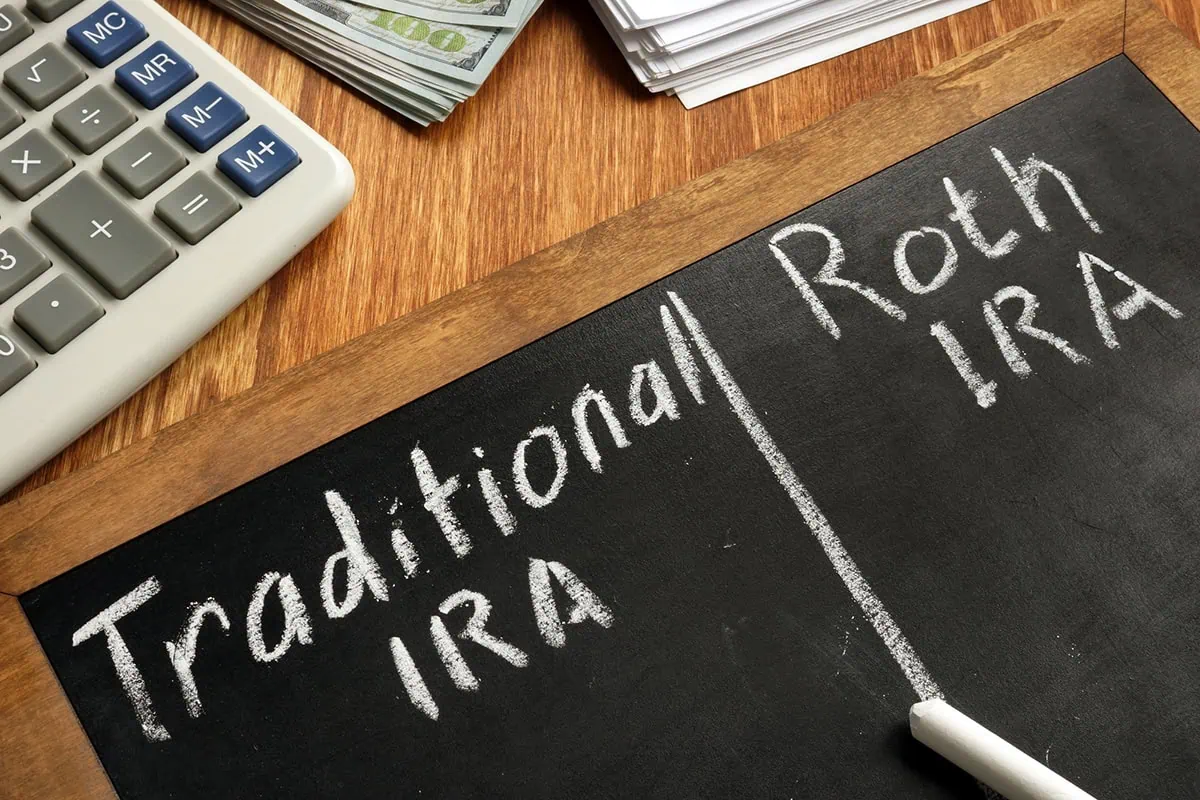
IRAs come in two primary types: traditional and Roth IRAs.
A traditional IRA is what most people think of when they hear “IRA.” This type allows you to deduct your contributions from your taxable income in the year of contribution, but any growth or interest earned within will be taxed when you make withdrawals in retirement.
A Roth IRA allows you to pay taxes upfront and see your funds grow tax-free, and you will not pay taxes on your withdrawals in retirement.
Each year, you can contribute up to the lesser of the annual limit or your earned income. Here are the various IRA contribution limits you need to know about:
| Single, Head of Household | Married Filing Jointly | Married Filing Separately | |
|---|---|---|---|
| Contribution Limit (Age 49 and below) | $7,500 | $7,500 | $7,500 |
| Contribution Limit (Age 50 and above) | $8,600 | $8,600 | $8,600 |
| Roth IRA contribution limit reduced if MAGI is ... | At least $153,000 but less than $168,000 | At least $242,000 but less than $252,000 | Between $0 and $10,000 |
| Cannot contribute to Roth IRA if MAGI is ... | $168,000 or more | $252,000 or more | $10,000 or more |
| Limits apply to the 2026 tax year. | |||
You can open an IRA through brokers such as Webull. This stock trading app offers traditional and Roth IRAs with commission-free trading, fractional-stock investing, and valuable stock research and analysis tools to understand the investments available.
Sign up with our exclusive link to receive the promotion below.
- Webull is a low-cost trading and investing app that allows you to invest in stocks, ETFs, options, futures, commodities, and crypto, and even participate in initial public offerings (IPOs).
- No-commission stock, ETF, and option trades (and many options have $0 contract fees).
- Trading features such as charting tools, technical indicators, customizable screeners, real-time stock alerts, and group orders.
- Let Webull manage your money for you with Webull Smart Advisor, which combines Webull's in-house investment expertise and artificial intelligence to build, manage, and rebalance an ETF portfolio for you.
- Sign up for Webull Cash Management to earn up to a 3.6% APY on uninvested cash.*
- New users get one free month of Nasdaq TotalView's Level 2 Quotes service. (That subscription costs $2.99/mo. thereafter.)
- Subscribe to Webull Premium and receive a premium APY on uninvested cash in individual and joint cash accounts, premium margin rates, a 3% match when you transfer or roll over your IRA, and an extra 3.5% match on qualifying IRA contributions.
- Special offer: Open an account and get one free month of Premium, make an initial deposit of at least 1¢ to unlock a one-month 1.4% APY boost*, and deposit $100 to receive 10 free fractional shares worth between $3 and $300.**
- Good selection of available investments
- Fractional shares
- Powerful technical analysis tools
- Offers robo-advisory services
- Accessible to beginning and intermediate users
- Voice commands
- Offers highly competitive APY through Webull Cash Management
- Does not support mutual funds

Related: 10 Common IRA Money Mistakes to Avoid
How to Invest through Your Employer
Many people save for retirement through their employers’ 401(k), 403(b) or 457 plans. These allow you to set aside a percentage of each paycheck into a retirement plan offering investment options like mutual funds or even the company’s stock.
Often, employers offer to match up to a percentage of your contributions as an added incentive to get you invested in the plan. This free money carries a 100% return, making contributions to your employer’s retirement plan a no-brainer.
If you can, consider increasing your contribution percentage as time passes. Learning to live on your current pay and contributing each annual raise can make significant strides over the long term without harming your finances in the short term.
Related: Should You Max Out Your 401(k) Each Year? [Yes … and No]
What Is a Mutual Fund?

A mutual fund is an investment vehicle that pools money from many investors to buy stocks, bonds, or other securities.
Individual investors in a mutual fund enjoy the benefits of professional management and certain economies of scale. A pool of potentially millions or even billions of dollars is large enough to diversify across a wide range of investments that would be impractical for an individual investor to own by themselves.
For example: An investor wanting to invest in the S&P 500 Index (an index made up of 500 large, U.S.-listed companies that is frequently used as a proxy for the whole stock market) would generally have a hard time buying and managing a portfolio of 500 individual stocks, especially in the exact and ever-changing proportions of the S&P 500 Index. Owning an equity mutual fund would solve this problem.
Or an investor wanting a diversified bond portfolio might have a hard time building one when individual bond issues can have minimum purchase sizes of thousands (or tens of thousands!) of dollars. Owning a bond fund would be much more practical.
To invest in a mutual fund, you’ll need to open an account with the fund sponsor or open a brokerage account with a broker that has a selling agreement in place with the fund sponsor. As a general rule, most large, popular mutual funds will be available at most brokers, so if you open a traditional investment account (like an IRA or brokerage), you’ll have access to most of the mutual funds you’d ever want to invest in.
Related: The 7 Best Mutual Funds for Beginners
What Is an Exchange-Traded Fund (ETF)?
An exchange-traded fund (ETF) works similarly to a mutual fund in that it allows you to invest in a pool of investments.
However, it has several differences. The core one is that it trades on an exchange throughout the trading day, just like a stock. (All trading of a mutual fund, on the other hand, settles once per day, after the market closes.) And while it does charge annual expenses, an ETF has no other fees.
ETFs also typically publish the investments they hold much more frequently than mutual funds, and they enjoy a couple tax advantages that can provide a very small boost to returns.
What Are Actively Managed and Index Funds?
There are two main types of mutual fund or ETF: actively managed funds, and index funds.
- An actively managed fund is run by one or more portfolio managers who buy and sell the stocks, bonds, or other assets. They might have to follow certain guidelines (say, they can only by stocks of large companies), but they ultimately make the decisions based on their own research and intuition.
- An index fund simply tries to replicate the performance of a specific market index, like the S&P 500 or Nasdaq Composite. It’s based largely on rules and computer algorithms. An S&P 500 index fund, for instance, will simply buy the stocks that make up the S&P 500 index, in the same ratios as the index. (The larger the stock, the greater its representation in the S&P 500.)
As a general rule, most mutual funds are actively managed, but there are index mutual funds. And most ETFs are index funds, but there are actively managed ETFs.
All funds provide some level of diversification, which means you’re reducing risk by spreading your money around. (For example, a fund might invest in several stocks within a certain industry; another fund might invest in bonds from 50 different countries.)
However, index funds are popular among long-term investors for two main reasons. 1.) They’re typically cheaper, because you’re not paying the salaries of numerous portfolio managers. 2.) Human managers often struggle to outperform these benchmarks … so if you can’t beat ’em, join ’em!
Just like any other investment, an index fund carries some risk; an S&P 500 index fund will drop if the broader stock market drops. And the investments in an index fund can change over time depending on the index’s rules—financial companies (like banks) made up 19% of the S&P 500 in 2000; in 2020, they only made up 10%!
Related: What Is SPLV? A Quick Guide to the Invesco S&P 500 Low Volatility ETF
What Is Diversification?

Diversification is, to make it really simple, not putting all of your eggs in one basket. And there are all sorts of ways to diversify.
Let’s say you had $100,000 all invested in Apple (AAPL). Historically, that has been a winning play. But it’s possible that one day, Apple’s products will fall out of favor, its revenues and profits will fall, and its stock will sink. So if Apple loses, say, 50% of its value, your portfolio would lose half of its value, too.
Not great. So, how would you diversify to reduce that risk?
Well, let’s say you split that $100,000 across Apple and Microsoft (MSFT), so $50,000 apiece. If Apple lost 50% of its value and your other stock remained level, your portfolio would only lose 25% of its value. Not great, but it’s a lot better than 50%.
Can we do better? Absolutely. You could also invest in Broadcom (AVGO), Micron (MU) and Advanced Micro Devices (AMD), so now, each stock only represents 205 of your assets.
But have you noticed all your money is still invested in technology stocks? What if the sector falls out of favor? Easy: You invest in other sectors. Instead of buying five tech stocks, what if you owned Apple, Coca-Cola (KO, consumer staples), Bank of America (BAC, financials), Eli Lilly (LLY, healthcare), and Google parent Alphabet (GOOGL, communication services). That’s five different industries.
You could spread out your money even further, to 20, 50, even 100 stocks, but at a certain point, managing all those different positions would get really complicated. That’s where mutual funds and ETFs come in handy. Because if you bought an S&P 500 index fund, like the Vanguard S&P 500 ETF (VOO), you’d suddenly own a slice of 500 different companies … all contained within a single ticker.
Of course, the S&P 500 is made up of almost entirely U.S. companies. But what if American stock markets struggled in the future? Easy: You could diversify geographically by owning stocks or stock funds of firms located in other countries or regions.
But what if stocks are a little too aggressive for you? There’s yet another solution: diversify into other assets. You could own something more conservative, like bonds. And depending on your risk profile, you could consider other assets, such as preferred stocks, physical metals, real estate, cryptocurrency, and more.
And that’s diversification.
Related: The 11 Best Fidelity Funds to Buy Now
The Risk of Stock Picking
Some investors find wildly successful stocks and become investing all stars, but few and far between sustain this success across multiple stock picks. As you can reason, consistently picking the best stocks isn’t an easy task.
If it were, everyone would do it. Plus, no one would crown Warren Buffett as the “Oracle of Omaha.”
It’s easy to think that an investor’s primary focus is to do is to home in on the best stocks possible by in surfacing the best stocks by following stock news websites or analyzing and researching stocks, but this notion presents problems.
The better view involves seeing investing outcomes as a span of probabilities.
What do I mean by that? Well, instead of thinking each stock needs to serve as a home run for your portfolio, instead, you want to research stocks based on the likelihood they will provide returns in a serious of outcome categories.
For example, how do you see the likelihood of Amazon (AMZN) doubling its revenues in the next five years?
- Can it happen? Why or why not?
- What private insight leads you to think this outcome is more or less probable?
- Then, how does your insight compare to that of other investors in the market?
In truth, what you really want to ask yourself is whether you know more about Amazon’s business than the millions of other investors active in the market.
What a Portfolio Needs to Succeed
A well-performing portfolio requires a healthy balance of risk and reward as well as exposure to many different securities. I keep the following items in mind for my portfolio:
- Sidestep any and all avoidable risks. Don’t take on unnecessary risks with your portfolio when you don’t have a high probability of a better outcome.
- Be cautious and highly skeptical of your conclusions and whether you feel you possess some edge. It is much more likely you don’t have one when compared to the deep pockets spending endless time and money seeking the next edge.
- Keep minimal contact with your portfolio. By making trades in and out of stocks in the hope of better returns without clear cut reasons behind these transactions frequently leads to negative consequences for your returns. Letting a robo-advisor handle the account trades removes you from the decision-making on when to buy and sell your index funds, ETFs or stocks.
- Don’t make big mistakes. While certainly a guiding force most investors should aim to achieve and likely goes without saying, you often see larger gains when doing nothing than thinking you have some edge (when you don’t) and acting upon it.
Are You Ready to Start Investing in Stocks?

Investing is a way to take today’s earnings and turn them into tomorrow’s wealth. When done consistently and with discipline, anyone can learn how to invest in stocks and build a financially secure life.
It’s hard to fight the math behind investing in small amounts consistently over time. If you can start investing as little as $100 per week (or 10% of your paycheck) by your early 30s and grow these contributions over time, you’re very likely to hit the millionaire mark by retirement.
Yet, not enough people do.
Over 100 million adults in the United States don’t have an investment account, leading them toward an uncertain financial future. Many choose to deposit money into a savings account instead, hoping it earns them passive income and is there when they need it. The interest earned in these accounts will not make a significant dent in your retirement preparation like investing can. Investing is more potent than leaving cash in a savings account.
Fortunately, you don’t have to be in that number. With a simple approach involving stocks for beginners, you can quickly get started by following these investing principles:
- Keep it simple
- Keep investing
- Keep portfolios diversified
- Commit to your financial health
Reward your efforts taken now with money that multiplies over the long term.