



Yet another higher-than-expected reading in consumer prices has left experts believing a December interest-rate increase is “all but signed, sealed, and delivered” to battle persistent inflation.
The U.S. Bureau of Labor Statistics reported Tuesday that October’s consumer price index (CPI), which measures the change in prices on a variety of consumer goods and services, rose by a seasonally adjusted 0.4% month-over-month—slower than September’s 0.6% print, but ahead of Dow Jones-polled economists’ estimates for 0.3%. “Core” CPI—a measure of inflation that excludes food and energy costs (factors that are more volatile than the other prices tracked by the Labor Department)—was also quicker than economists predicted. September’s core inflation was up 0.3% MoM against a consensus target of 0.2%.
There were no year-over-year measures for overall inflation in October 2026 because the government did not collect enough data during the government shutdown in October 2025. (However, in some cases, it was able to collect individual-item data.)
Stock-market futures slumped in response, as the inflation data, which follows a red-hot October jobs report, now heavily suggests that the Federal Reserve will raise its benchmark interest rate during its final meeting of 2026.
“Today’s hot October core CPI print leaves a December rate hike all but signed, sealed, and delivered after Governor Waller’s notably hawkish remarks,” says Jeff Schulze, Head Investment Strategist, Franklin Templeton Institute. “A steady labor market gives the Fed ample flexibility to fight core inflation that has now run above its 2% target for more than five straight years.”
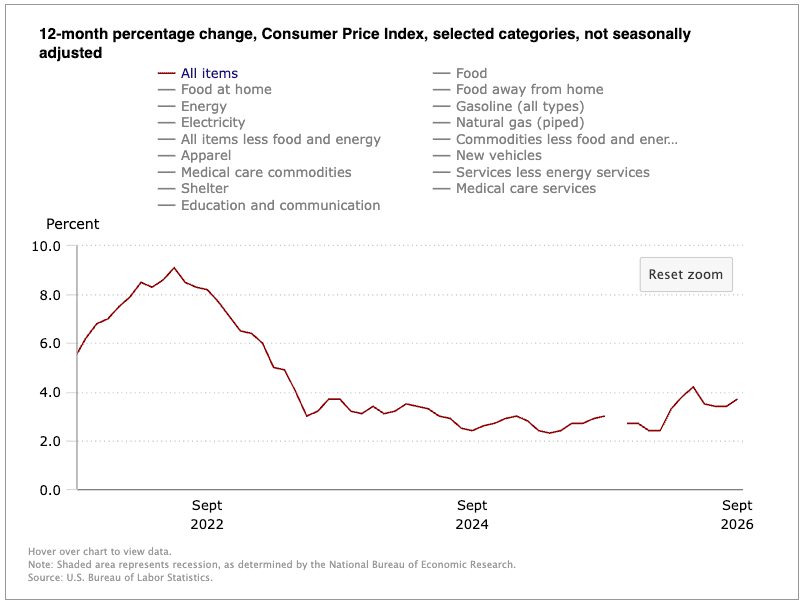
Here’s a quick look at October’s key CPI figures:
- MoM CPI: +0.4% (estimate: +0.3%)
- YoY CPI: N/A (estimate: N/A)
- MoM Core CPI: +0.3% (estimate: +0.2%)
- YoY Core CPI: N/A (estimate: N/A)
Energy continued to be a pain point for consumers, with fuel oil prices rising 2% month-over-month and gasoline climbing 1%. Electricity utility services also climbed, by 0.9%, though utility gas service costs actually declined by 0.8%.
Food prices were up 0.5% MoM, which was also ahead of the overall rate. Leading the rise in food prices were beef (+0.9%); dairy and related products (+0.6%); fruits and vegetables (+0.6%); and meats, poultry, fish, and eggs (0.5%).
Transportation services cost 0.8% more than they did in the prior month, medical care commodities were up 0.5%, and shelter prices (+0.3%) remained sticky, though they grew slightly below the average inflation rate.
Related: Empower Personal Strategy Review: Wealth Management More People Can Afford
“Cost pressures are spreading as companies play catchup on needed price increases,” says David Russell, Global Head of Market Strategy at online brokerage firm TradeStation. “Transportation and energy price pressures seem to be spreading into areas like food and medical services, and auto insurance is pressuring squeezing core services. Today’s report shows the inflation problem is far from solved and parts of the economy are at risk of overheating.”
Jason Pride, Chief of Investment Strategy & Research at Glenmede, adds that two specific data points speak loudest about whether inflation can return to target, and those two data points moved the wrong way in October.
“Services less rent of shelter rose 0.5%, the firmest reading since May, extending the sticky services dynamic that has been the central obstacle to getting price trends back to 2% all year. That measure needs to average out near 0.2% before there is a credible case that broad inflation is converging on target, and it’s moving away from that level rather than toward it,” he says. “On the goods side, prices for commodities less food, energy, and used cars rose 0.4%, the firmest since January. That cut strips out most of the volatile components within goods; this month, that includes the outright deflation seen in used vehicle prices. One month is not a trend, but a 0.4% print on that measure is difficult to reconcile with price stability.”
Fed All But a Lock to Raise Rates Once More in 2026
The market’s response was an equity swoon projecting investors’ belief that the Federal Reserve has one more interest-rate hike in the chamber.
The CME FedWatch Tool, which uses trading in federal-funds futures to determine Wall Street’s expectations for future Federal Reserve actions, shows an 85% chance that America’s central bank will raise its benchmark interest rate from its current 3.75%-4.00% range to 4.00%-4.25% during the next Federal Open Market Committee (FOMC) meeting, scheduled for Dec. 8-9, 2026.
The remaining 15% probability is for a half-point hike to 4.25%-4.50%.
“For the Federal Reserve, we think this cements the case for a December rate hike, particularly following Governor [Christopher] Waller’s comments earlier this morning around the risks from persistent inflation,” says Daniel Siluk, Global Head of Short Duration & Liquidity and Portfolio Manager at Janus Henderson. “While today’s 0.3% core reading meets the threshold Waller suggested could warrant consideration of a larger move, we still think a 50bp increase in December would be a high bar.”
That said, Tuesday’s report could put more pressure on the Fed’s policy-rate projections for next year.
“The Fed could push for a more-aggressive tightening cycle with CPI continuing to print strong,” says Lindsay Rosner, head of multi-sector fixed income investing at Goldman Sachs Asset Management. “A December hike is our firm base case despite wider artificial intelligence jitters, and stubborn inflation means we cannot rule out further hikes in 2027.”
Related: IRS Raises Standard Deduction for 2027 [Find Your Deduction]
Other Expert Thoughts on October’s CPI Report
Here’s a look at a few more reactions from economists, strategists and more to last month’s CPI numbers, including what they mean for consumers, markets, the Federal Reserve’s future actions, and the economy:
Scott Helfstein, Head of Investment Strategy, Global X
“To offer a contrarian view, the CPI data suggests a return towards broad-based price stability outside energy and shelter. The Fed will likely raise rates in December, but they should be cautious. There is a risk of triggering a recession in an attempt to fight a phantom inflation problem. … Core inflation excluding shelter was spot on the Fed’s two percent target in August and September. That trend is likely to continue when we get year-over-year data next month. While the last jobs report was pretty strong, there is evidence that financial conditions are tightening given the move higher in long rates. The Fed should let that process play out for a little while before getting too aggressive.
Inflation and the impact of higher rates are uneven across the economy. Rate sensitive sectors are feeling the impact and prices are stabilizing. Rates do not matter much for sectors subject to supply constraints or blessed with abundant capital. The Fed mandate does not include building houses or exploring for energy. Inflation is largely limited to supply-side constraints, and higher rates discourage investment needed to add capacity.”
Related: What Is the Gift Tax Exclusion for 2027?
Peter Graf, Chief Investment Officer, Amova Asset Management Americas
“Traders hoping that recent stock market volatility could justify a short and sweet Fed tightening cycle could be disappointed by today’s October CPI report that shows little deceleration in prices. Although the drop in gasoline did bring down the monthly increase in headline prices, core goods and services prices both barely budged from their September rates and continue to run well above the Fed’s inflation target. The sticky trend may partially reflect the lag for energy relief to pass through to other prices, but it also reminds investors that the AI-investment fueled economic growth has also been a big contributor to the inflationary environment.
With less political pressure to toe the line on low rates after the midterm election, don’t be surprised to see FOMC members expressing regret about last month’s hold in rates and reminding the market that two more hikes may not be enough to complete the cycle.”
Sonu Varghese, VP Global Macro Strategist at Carson Group
“The CPI data shows that inflation remains hot and it’s not just energy, or tariffs, or even AI-related bottlenecks. It’s a much broader problem. That means we’re just at the start of a rate hiking cycle and the Fed’s going to have to play catch-up in a hurry.”
Get Elite Stock Analysis From Seeking Alpha
Among our favorite platforms for both data and picks is Seeking Alpha Premium, which gives you unlimited access to thousands of active authors who deliver stock analysis.
Seeking Alpha also provides you with stock research tools, real-time news updates, crowdsourced debates, and market data. Users can create their own portfolio of favorite stocks, see how they perform, and receive email alerts or push notifications about their investments.
Try out Seeking Alpha Premium free for seven days and get a discount on your first year’s subscription.
- Seeking Alpha Premium and Pro help you find profitable investing ideas, improve your portfolio, research stocks better and faster, track the news to find investing opportunities, and connects you to the world's largest investing community.
- A Premium subscription provides access to Seeking Alpha's stock and ETF ratings, including Seeking Alpha Quant Strong Buy recommendations, which have greatly outperformed the stock market over time.
- Premium also gives you access to Seeking Alpha's portfolio health check, which will analyze your portfolio's quality, risk level, and performance.
- Advanced and professional investors can sign up for Pro, where they'll get everything from Premium, as well as instant access to ideas from SA's top 15 analysts, the PRO Quant Portfolio (for active traders), short-selling ideas, and more.
- Special offer on Premium: New subscribers through our link receive a $30 discount off the price of Seeking Alpha Premium in their first year.*
- Special offer on Pro: New subscribers through our link receive one month of Pro for $89, then get $250 off their first full year's subscription.**
- Active community of engaged investors and analysts
- Stock screeners, quantitative tools for stock analysis
- Strong track record of market outperformance on stock ratings
- Minimal mutual fund coverage