




Every year, when we get ready to write our annual “sell in May and go away” look-ahead, we reflect on past years’ opinions just to remind ourselves what the markets looked like.
And all we can say is “History doesn’t repeat itself but it often rhymes” rings mighty true right now.
Let’s take a quick trip back to 2025!
This edition of our annual screed on “sell in May and go away” comes at an … well, we’ll just say an interesting moment for the markets. One in which investors already got a healthy helping of selling out of their systems, only to start buying with both hands again right before a period of seasonal weakness.
If that’s not 2026 in a nutshell, we don’t know what is. Consider this quick lay of the land from Sam Stovall, Chief Investment Strategist at independent research firm CFRA:
“After enduring a near-10% decline in the S&P 500 over a two-month period, triggered by the global economic implications of a shutdown in the transportation of 20% of the world’s oil supplies, the market then recovered all that was lost in only 16 calendar days.”
So, let’s get to the question. In 2026, should you sell in May and go away?

And if you do decide to sell anyway, at least don’t do it just because “May” rhymes with “away.”
Make sure you sign up for The Weekend Tea, Young and the Invested’s free weekly newsletter that over 10k monthly readers use to level up their money know-how.
“Sell in May and Go Away”
We’ve long bemoaned Wall Street’s perpetual love affair with goofy stock-market indicators and oversimplified wisdom. The profession is dominated by data analytics, but if you spend a few minutes listening to longtime pros, you’d think you were listening to a college football coach in a postgame presser.
- “Markets are climbing the ‘wall of worry.'”
- “Pigs get fat, hogs get slaughtered.”
- “Stocks take the stairs up and the elevator down.”
- “If you don’t know who you are, this is an expensive place to find out.”
No wonder “sell in May and go away” took off. You’ve got six-word wisdom and a rhyme. That’s Wall Street catnip right there.
Young and the Invested Tip: Forget market superstitions and folklore—make smart investments by learning through these research and analysis apps.
“Sell in May and go away” refers to a historical phenomenon in which the stock market tends to take its foot off the gas between May and October, then gets going again between November and April.
Of course, “sell in May and go away” only really tells you when to sell, then it just trails off, distracted by a butterfly flitting away, leaving you to believe the only way to succeed in the investing world is to quit during the springtime and take up walking.
But you can chalk that up to modern-day laziness.
When the Brits coined the term a couple hundred years ago, they had the decency to fill in the blanks. You see, “sell in May and go away” is a shortened version of “sell in May and go away, do not return until St. Leger’s Day.” That’s how British stock brokers started referring to the summer vacation stretch between May and the end of the horseracing season—marked by a race on St. Leger’s Day in mid-September.
Kinda funny, that. “Sell in May” didn’t even start out so much as a market warning, but just a reminder to start packing parasols and full-body bathing suits.
Let’s Put the Historical Numbers on Display
The phrase has not only packed on some pounds since then, gobbling up the rest of September and October, but it has also evolved to take on its more negative current-day connotation.
It’s pretty easy to see how. Some of the stock market’s worst drops have occurred during this period. Black Monday (October 1987). The post-Lehman crash (September 2008). The Kennedy Slide (May 1962). The crash of 1929 (October). And while we got most of the losses back in minutes, the 2010 flash crash was in early May.
But even in years without the fireworks, the “sell in May” period is simply weaker.
“Since 1945, the S&P 500 gained nearly 7% in the six-month period from Oct. 31 through April 30, rising in price 75% of the time,” Stovall says. “Conversely, the market advanced only an average of 2% from April 30 through Oct. 31, and gained in price 66% of the time.”
Young and the Invested Tip: See how the best ETFs for 2026 have fared so far this year. (And check out our picks for long-term and defensive buys, too.)
Midterm years (and 2026 is one!) are even worse, with the S&P 500 falling an average of 1.2% and only rising in price half the time. Stovall adds that this data is consistent since 1990—the index has averaged 1.6% declines and fell 56% of the time during the period—which is when S&P Global started gathering sector-level data. Some of the lowlights there:
- Average losses for all sizes and styles.
- Average losses for 7 of 11 sectors and more than 60% of the 73 subindustries in existence since 1999.
- The best performances came from the defensive healthcare (6.3%) and consumer staples (3.2%) sectors. The worst sectors were real estate (-8.5%) and materials (-6.4%).
- The best industries were tobacco (8.1%), pharmaceuticals (7.3%), and brewers (4.7%), while the worst industries were home furnishings (-22.0%), construction materials (-21.7%), and casinos & gaming (-15.2%).
The Take: So, in a nutshell: May-October? Bad. May-October in midterm years (which this is)? Really bad. Got it, Lee?
Do you want to get serious about saving and planning for retirement? Sign up for Retire With Riley, Young and the Invested’s free retirement planning newsletter.
Why Sell in May When It Still Pays to Stay?
Look at that quote again (this time, with emphasis added):
“Since 1945, the S&P 500 gained nearly 7% in the six-month period from Oct. 31 through April 30, rising in price 75% of the time. Conversely, the market advanced only an average of 2% from April 30 through Oct. 31, and gained in price 66% of the time.”
Listen, 66% isn’t a guarantee, but that’s still pretty good historical odds. And sure, 2% on average isn’t much, but it isn’t nothing either.
Would you rather earn 2% in the bank or keep your cash under the mattress?
OK, But You Said Midterm Elections Lead Us Astray
They do! But then, midterm election years tend to be awful in general.
Ameriprise Financial, in its own data analysis going back to 1946, shows that weakness isn’t exclusive to the May-October period, and that there are historical pockets of strength during “sell in May” season. Take a look at which months tend to do better or worse during midterm years than in non-election years:
“Sell in May” Months
- Higher median return in midterm years: August, September, October
- Lower median return in midterm years: May, June, July
Non-“Sell in May” Months
- Higher median return in midterm years: March, November
- Lower median return in midterm years: January, February, April, December
And as you’re about to find out, that May-July period has really turned things around.
As Time Passes, “Sell in May” Is Losing Its Way
Remember what we said about history rhyming?
“This time a year ago, many were expecting the big rally in April to roll right back over and a big summer bear market would rule,” Ryan Detrick, Chief Market Strategist at Carson Group, writes in his annual blog post on the topic. “Well, instead, we saw the strongest ‘Sell in May’ six-month rally in history. In fact, make that nine of the past 10 years [that] stocks gained during this historically bearish period. We were one of the few places a year ago that expected to see a big rally.”
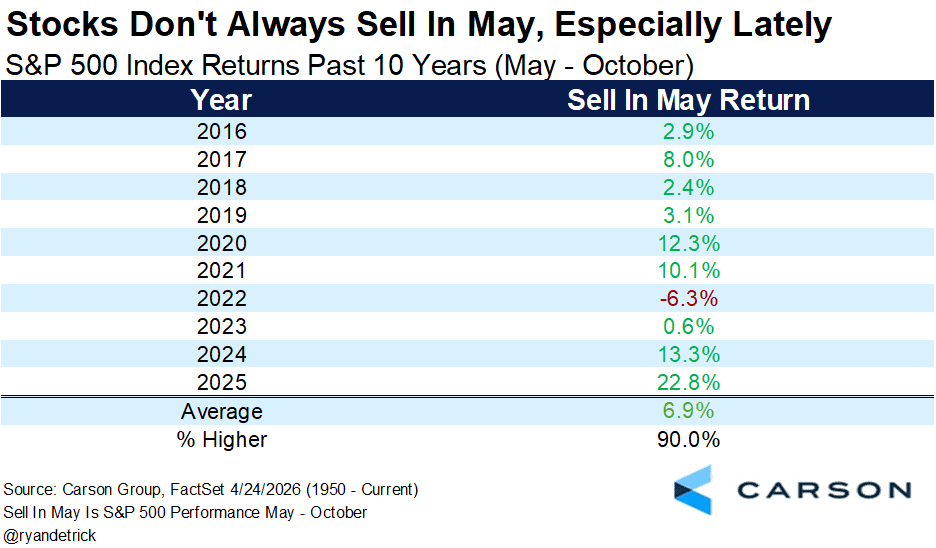
And if you were to sell in May, you could realize your mistake pretty quickly. Detrick points out that despite the aforementioned long-term historical weakness of the May-July period, the S&P 500 has been reliably positive during those three months in more recent years:
- May: Up in 12 of the past 13 years
- June: Up in 9 of the past 10 years
- July: Up 11 years in a row
Positive Starts Tend to Hold Sway
A coach would preach the importance of momentum going into the second half, and sure enough, a head of steam has historically mattered, as far as “sell in May” is concerned.
“If the S&P 500 is up more than 4% for the year (like this year likely will be), the next six months go from an average return of 2.1% to 4.4%,” Detrick says. “The flipside is some of the worst ‘Sell in May’ periods in history took place after a bad start to the year.”
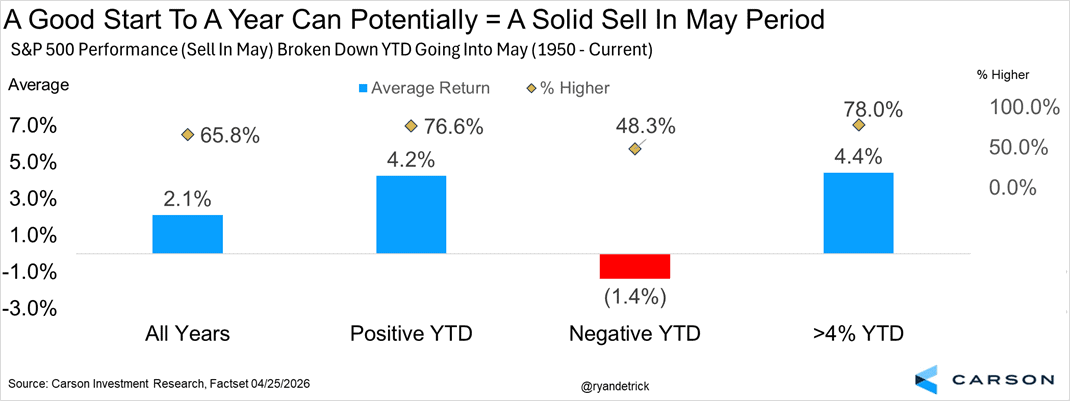
That’s good news for us in 2026, as the S&P 500 closed out January-April up more than 5%!
Don’t Waylay Your Eventual Investment Payday
We hammer the folly of “sell in May” every year because it speaks to one of the most important lessons in all of investing: You can’t time the market.
Forget six months of the year—Morgan Stanley points out why even missing a few days of the year can be disastrous to your long-term returns:
“Missing out on just some days in a market cycle can drag down returns considerably. The S&P 500 generated an annualized return of 10.7% between 1990 to 2024 for investors who remained invested during that entire period. Investors who missed just the 15 best days during that period only saw returns of 7.6%, investors who missed the best 45 days had returns of 3.6% and investors who missed the best 90 days actually suffered an annualized loss of 0.9%.”
That doesn’t exactly bode well for investors who choose to sit out half the year. So the smart move for anyone looking to build wealth over time is to sit back, relax, and let that time do its thing.
Young and the Invested Tip: Buy-and-hold really is the way to go. For instance, these 15 stocks are the kinds of investments some people hold forever.
Will we at some point see a day in which we don’t need to remind people not to sell in May? We pray.
But that day is not today.
Want to talk more about your financial goals or concerns? Our services include comprehensive financial planning, investment management, estate planning, taxes, and more! Schedule a call with Riley to discuss what you need, and what we can do for you.

—
Nothing puts a spring in our step like getting to spend a day rhyming like idiots. Thank you for indulging us, and we’ll talk to you again next week!
Riley & Kyle
Like what you’re reading but not yet a subscriber? Get our weekly financial insights and updates delivered to your inbox every Saturday morning by signing up for The Weekend Tea today! You can also follow us on Flipboard for more great advice and insights.